How U.S. homeowners can score tax breaks and other Biden climate cash

Add Axios as your preferred source to
see more of our stories on Google.
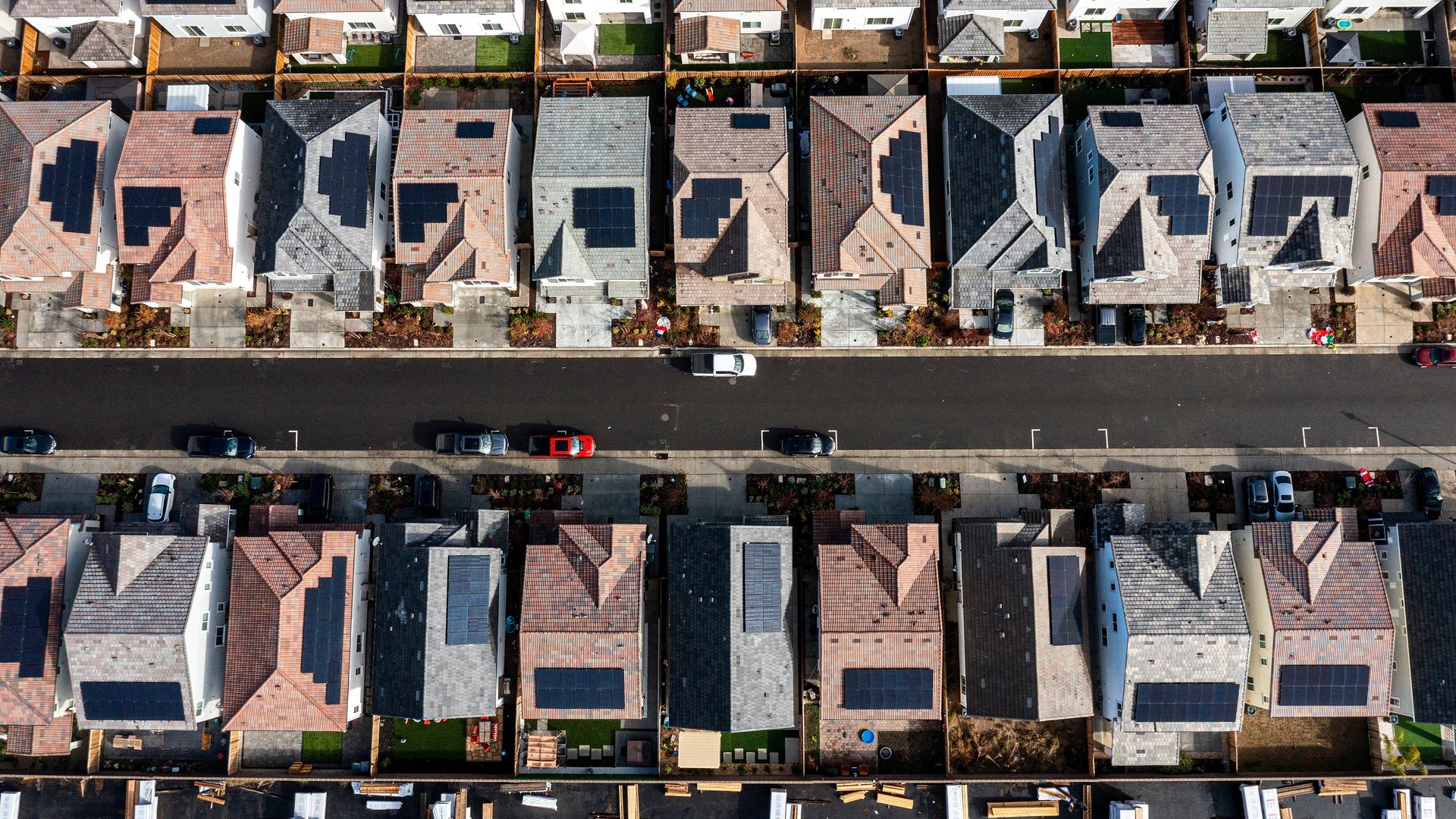
Homes in Rocklin, California, in December 2022. Photo: David Paul Morris/Bloomberg via Getty Images
U.S. homeowners and renters can now use tax credits included in the $740 billion Inflation Reduction Act to help pay for energy-efficient home improvements to lower their carbon footprint and save money.
Why it matters: The benefits are meant to help climate-proof not just individual homes but whole neighborhoods and communities while promoting clean energy investments and jobs.
Available credits for home improvements
One former tax credit revived by the IRA was the "nonbusiness energy property credit," now under the new name of "energy efficient home improvement credit."
- The previous credit, which expired in 2017 but was repeatedly extended, allowed a 10% break for select energy-efficient improvements, like insulation, windows, doors, roofing up to a max of $500 per person.
- The revised credit, extended to 2032, bumped the credit amount to 30% of qualified expenditures and replaced the $500 lifetime limit with a $1,200 annual limit.
- It also expanded the credit to other upgrades, like biomass stoves and boilers, and added a $2,000 credit for certain equipment, like heat pumps, according to an IRS fact sheet outlining eligible improvements.
Zoom out: In total, homeowners or renters may be able to write off a maximum of $3,200 for updates, so long as purchases qualify and the manufacturer creates identification numbers for the items for tax purposes.
The IRA also revamped the previous "residential energy efficient property credit" — which was set to expire — as the "residential clean energy property credit."
- Now extended to 2034, the credit bumped the amount owners or renters can claim on clean energy expenditures like solar panels to 30% and expanded the credit to battery storage technologies.
- The credit doesn't just apply to solar energy installations. It can be claimed for solar water heaters, wind turbines, geothermal heat pumps and battery storage.
- There's no annual or lifetime dollar limit to this credit like there is with the energy efficient home improvement credit, but the former is only available the year an installation is made.
Zoom in: It's only hard limit is $500 for each half kilowatt of capacity for fuel cell equipment, which can increase to a maximum of $1,667 per half kilowatt of capacity if more than one person lives in the home.
- The credit is set to fall to 26% of expenditures in 2033 and 22% in 2034.
Who and what qualifies
Both credits are available for new and existing main homes, or generally where you live most of the time, in the U.S., and it doesn't matter if you own or rent the property.
- Landlords or other property owners cannot claim the credits, nor can those who use a home solely for business purposes.
- Qualified purchases and installations have to meet efficiency standards and be completely new systems or comprised of new materials.
Soon-to-be available energy-efficient rebates
The IRA also set aside $8.8 billion for point-of-sale rebates for energy-efficient electric appliances purchases and energy-saving retrofits, which will be administered through state energy offices or tribal entities through 2031.
- The rebates are specifically for families — either owners or renters — making less than 150% of their area median.
- They could cover 100% of costs incurred by low-income households (as defined by the DOE) and moderate-income families can qualify for up to 50% of their costs covered.
- The rebates would apply to a large swath of appliances and upgrades, from dryers and cooktops to electrical panels and wiring.
- The DOE estimated that the home energy rebates programs could eventually help households save up to $1 billion annually on energy bills and support over 50,000 jobs.
Caveat: They are currently not widely available across the U.S. Since they are administered through state or trial governments, those entities must first apply to the U.S. Department of Energy (DOE) for funding.
- Among states, they are currently only available in New York, while only applications from California, Hawai'i, Maine and Washington have been approved.
- The remaining states have either submitted their application or are in the process of doing so, according to a DOE map.
- The department expects many states and territories to have launched their programs by the end of the year.
The future of the IRA
How long these credits and rebates remain available may depend on the results of the upcoming election.
- If Republican election wins give conservatives the opportunity to alter the IRA, it's unclear how much or little of it they would preserve.
- If Democrats retain the White House and Senate, new incentives under the law could be created, or it could be altered in a bipartisan package, Axios' Jael Holzman and Nick Sobczyk report.
Go deeper: Yellen touts new affordable housing efforts
