
Axios Generate

June 01, 2023
☕ Good morning! Today's newsletter has a Smart Brevity count of 1,310 words, 5 minutes.
🚨 Situational awareness: The Senate begins work today on the debt ceiling bill that expedites the Mountain Valley Pipeline and speeds environmental reviews for energy projects.
🎶 This week in 1976, Steely Dan released the album "The Royal Scam," and they crossed the diamond with the pearl on today's intro tune...
1 big thing: New tech may shake up hurricane forecasting
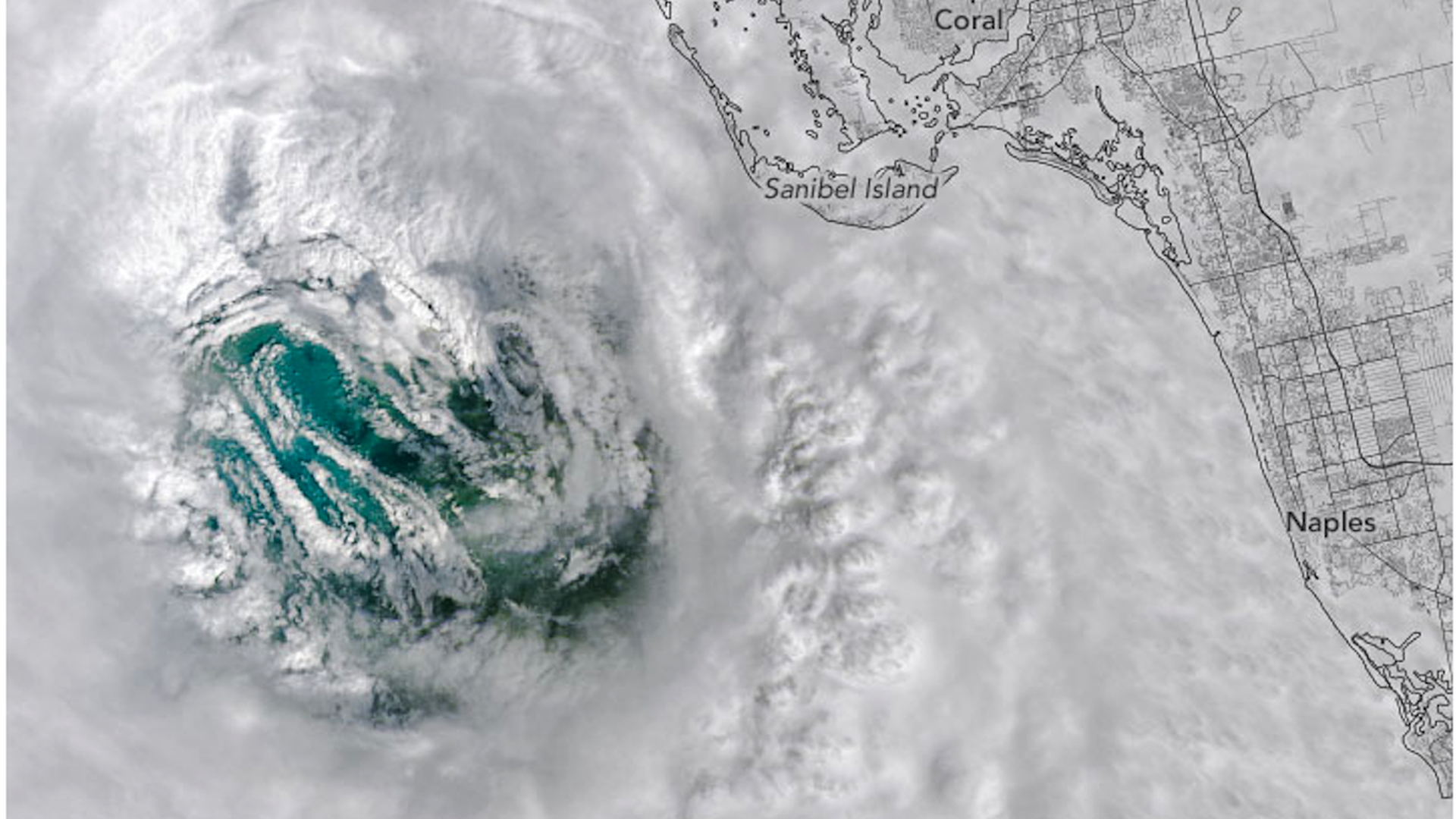
Closeup of Hurricane Ian's eye seen from space as the storm struck Sanibel Island, Fla., on Sept. 18, 2022. Image: NASA
Next-generation radar technology capable of taking 3D slices of hurricanes and other storms is poised to move ahead after years of fits and starts, Andrew writes.
Driving the news: The National Science Foundation announced $91.8 million in funding this morning — the first day of the Atlantic hurricane season — for the National Center for Atmospheric Research to design, build and test an airborne phased array radar.
- The technology consists of thousands of transmitters and receivers on horizontal plates mounted at different points on a plane.
- Together, they would scan storms in unprecedented detail, from the storms' overall organization to the type, shape and direction of movement of droplets within the clouds.
Why it matters: Currently, NOAA’s aging hurricane research aircraft fly tail-mounted Doppler radars into the heart of hurricanes. But the new APAR could yield significant insights into weather predictions and climate projections.
- For example, it could provide a far more detailed picture of the inner structure of a hurricane. That data can then be fed into computer models, which can warn of sudden intensity or track changes.
Context: Human-caused climate change is leading hurricanes to dump more rainfall than they used to. The storms also are more likely to rapidly intensify, with several landfalling systems in recent years leaping multiple categories on the Saffir Simpson Scale in just 24 to 36 hours.
- Climate change is also driving an increase in the frequency and severity of nontropical extreme precipitation events, of which this technology may be able to improve understanding.
- The NSF press release cites climate change’s “unprecedented threats” as a reason for the new funding.
Zoom in: The funding will be used to outfit a C-130 research aircraft, operated jointly by NSF and NCAR, with the new radar.
- The NSF investment does not cover NOAA’s new equipment, though the oceans and atmosphere agency would benefit from NCAR’s research insights.
- NCAR director Everette Joseph said the radar should be ready for use in 2028.
Between the lines: In selecting NCAR for the funding and research, NSF is following a long-established model with the Boulder, Colorado-based organization.
- The partnership has helped advance weather and climate forecasting for decades.
What they're saying: APAR has been a priority for storm researchers and forecasters for years.
- Scott Rayder, who leads Leidos’ climate, energy and environment portfolio, said such technological leaps should not take so long, since lives are at stake.
- "When I first heard about the technology in 2012, I knew APAR would be a game changer,” Rayder told Axios. “The fact that it took 10 years to get to this decision is a concern — we need to find ways to more rapidly develop technologies like APAR and move them into operations.”
2. Breaking: Exxon strikes carbon deal with steel giant Nucor

Illustration: Aïda Amer/Axios
Exxon just announced a deal with steel giant Nucor to trap, transport and store carbon dioxide emissions from a Louisiana plant, Ben writes.
Why it matters: Metals production spews lots of CO2, and it's a very tough-to-decarbonize industry due to high heat requirements.
Driving the news: Exxon said that, beginning in 2026, it will capture up to 800,000 metric tons of CO2 annually from a Convent, Louisiana, plant that produces a steel input called "direct reduced iron."
- The financial terms and duration were not disclosed.
State of play: It's the third CO2 capture deal Exxon has reached over the past seven months, following tie-ups with industrial gas giant Linde and fertilizer maker CF Industries.
- The deals together commit the company to transporting and storing 5 million metric tons annually, Exxon said.
- That's akin to replacing 2 million gasoline-powered cars with electric models, it added.
What they're saying: "Momentum is building as customers recognize our ability to solve emission challenges at scale," Dan Ammann, head of Exxon's low-carbon business, said in a statement.
The big picture: Oil sector investments in climate-friendly tech and projects have been growing.
- Exxon plans to spend roughly $7 billion through 2027 on projects with industrial partners, and $10 billion to cut emissions from its own operations.
Yes, but: The International Energy Agency last week called out the oil and gas industry for not investing more in low-carbon projects, given its massive profits and global emissions-cutting needs.
Flashback: Ammann recently told Axios the "limiting factor" in scaling low-carbon ventures is not capital, but finding viable projects and customers.
3. The U.N. plastics negotiations are an oil story
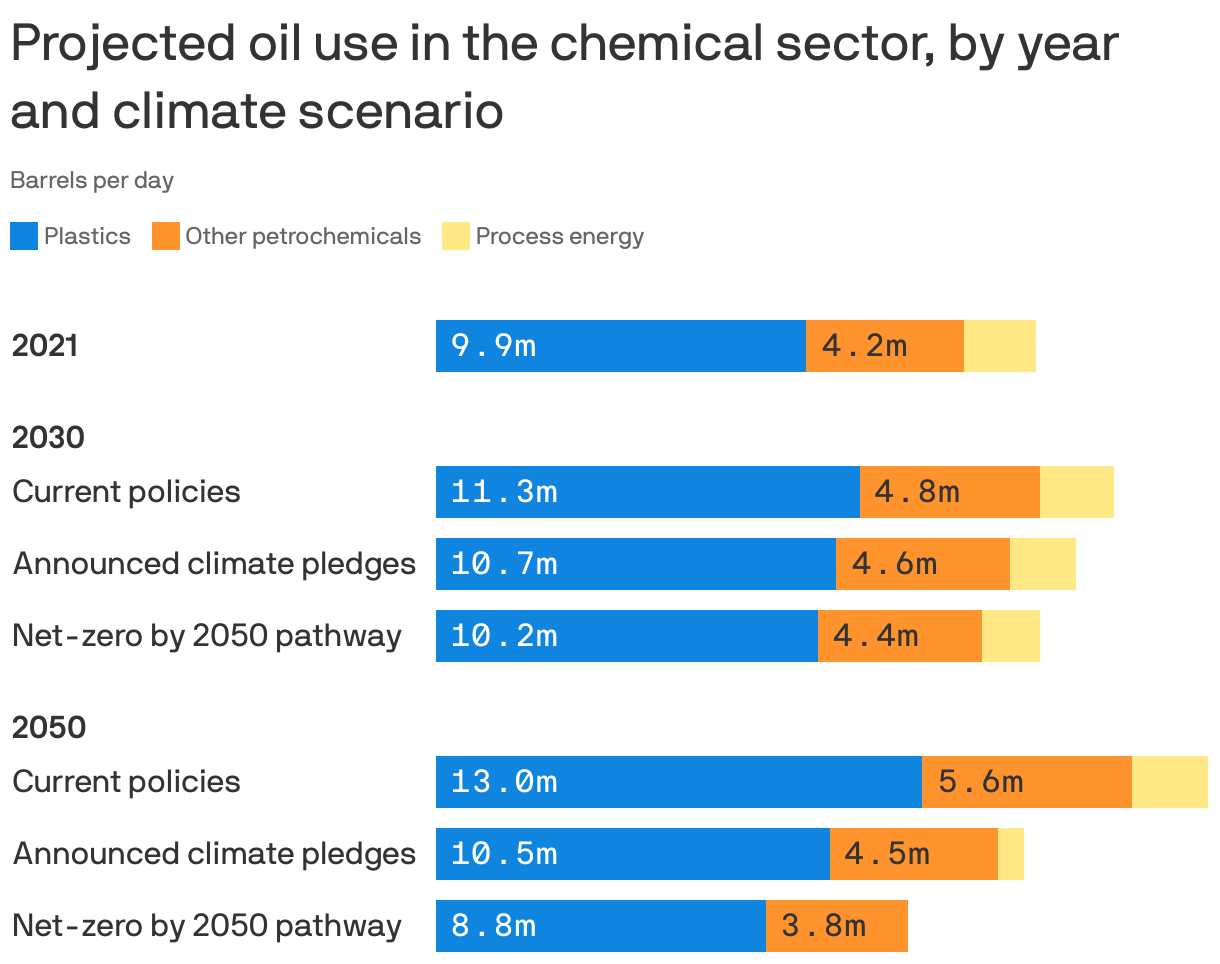
United Nations talks in Paris this week on crafting a global treaty to cut plastic waste have high stakes for the oil industry, Ben writes.
Why it matters: Petrochemicals used in plastics (among many other products) are a large and growing source of oil demand.
- The treaty U.N. officials hope to complete by the end of 2024, depending on how it's written and enforced, will likely affect that trajectory.
Zoom in: The chart above shows 2022 IEA estimates of oil demand for plastics under existing policies, nations' climate pledges and a hypothetical path to net-zero emissions.
- Under any circumstance, you can see it's a lot of oil in what's a roughly 100 million barrel per day market.
What we're watching: The specifics of the talks. Let's outsource things to the AP's table-setter on this week's meeting:
- They report that some nations, led by Norway and Rwanda, want a "legally binding" deal to end plastic pollution by 2040.
- "Alternatively, the treaty could have a more limited scope to address plastic waste and scale up recycling, as some of the plastic-producing and oil and gas exporters want," AP reports, and notes U.S. support for this approach.
4. The renewable power surge and its discontents

Illustration: Shoshana Gordon/Axios
A rebound in onshore wind projects alongside the ongoing solar surge are pushing renewable power growth to fresh records this year, Ben writes.
Yes, but: The IEA's market analysis out today warns of headwinds to getting on track with Paris Agreement climate goals.
- Among them: Wind equipment manufacturing "may struggle to keep up with demand growth through 2030."
- A rosier note: Solar manufacturing growth is consistent with the agency's midcentury net-zero emissions pathway.
The big picture: Renewable generating capacity additions are slated to rise by over 440 gigawatts this year, a 107 GW bump over 2022.
- Solar is the largest chunk of new additions. Onshore wind additions are on course to surge 70% this year to 107 GW after two years of decelerating growth.
- The wind expansion is "mainly due" to projects in China delayed by COVID, but also US and European projects hit by supply chain challenges last year.
One wild stat: Fossil fuels remain the biggest power source, but IEA offers a snapshot of renewables' fast rise.
- The 440-plus GW of capacity arriving this year is "equivalent of more than the entire installed power capacity of Germany and Spain combined."
5. 🤷🏽♀️OPEC's mysterious press snub
OPEC didn't invite reporters from Reuters, Bloomberg and the Wall Street Journal to a key meeting in Vienna on Sunday, per reports in the Financial Times and elsewhere, Ben writes.
What we don't know: The reason for the apparent snub. OPEC hadn't responded to a request for comment as of this morning.
- But the FT, citing anonymous sources, said it was instigated by the Saudi energy minister, who has "come under growing pressure to raise the price of crude."
Why it matters: Per Reuters, citing an OPEC source, these reporters can't enter the official OPEC Secretariat where ministers meet or attend the post-meeting press conference.
- The cartel, Russia and allied producers — collectively called OPEC+ — will meet at OPEC's Vienna headquarters to discuss joint output policy.
Yes, but: The exclusion won't prevent these outlets — which cover the group carefully, including airing internal disputes — from tracking the events by other means.
- Bloomberg "will send a team to Vienna as usual," the outlet notes.
What we're watching: Whether OPEC+ will deepen joint output curbs, announced in April, to counter the recent erosion of prices.
- Goldman Sachs analysts, in a note, expect the major producers to keep output unchanged but see a "35% subjective probability" of fresh reductions from big players.
Editor's note: Item 6 in Tuesday's newsletter was corrected with the name of GFANZ, the Glasgow Financial Alliance for Net Zero.
🙏 Thanks to Gail Hughes and Javier David for edits to today's edition, along with the talented Axios Visuals team.
Sign up for Axios Generate

Untangle the energy industry’s biggest news stories


