Axios Generate
August 25, 2023

🚀 Let's do this! Today's newsletter has a Smart Brevity count of 1,276 words, 5 minutes.
🌹 Ben loved the rain-soaked Guns N' Roses show in Boston earlier this week, so their new single is today's intro tune...
1 big thing: The case against imminent peak oil demand

Illustration: Shoshana Gordon/Axios
A few stats from prominent analyst Arjun Murti offer a sobering case for why a global peak in oil demand may be very far away, Ben writes.
The big picture: In a compelling analysis, he notes the 1 billion who live in the U.S., Canada, western Europe, Japan, Australia and New Zealand averaged 13 barrels per capita annually last year.
- The rest of the globe's roughly 7 billion people? A mere three barrels, Murti's writes in the latest of several recent posts on the topic.
- "Even as attempts are made to reduce rich-country oil demand, the upside potential in the developing world we believe is magnitudes greater," writes Murti, a Goldman Sachs veteran who's now a partner at Veriten LLC.
- In a video, he argues demand increases are inevitable for at least the next decade, "and frankly I think it is going to be much longer than that." Murti likes renewables and electric vehicles but describes himself as a realist. "I am not advocating for fossil fuels. What I am doing is applying analysis."
State of play: Murti notes electric vehicles, renewables and other non-fossil sources will meet some of this growing demand; so per-capita oil use everywhere certainly won't grow enough to match today's rich consuming nations.
Why it matters: The timing of when oil demand peaks — and, crucially, the slope of the decline — has big repercussions for global carbon dioxide emissions, and beyond.
Threat level: Murti, whose other affiliations include Columbia University's energy think tank and ConocoPhillips' board of directors, has been writing on this a lot lately.
- He argues the discussion of hypothetical demand horizons has real stakes because unrealistic forecasts can distort policy and investment.
- "There actually isn't an end in sight...and we need to recognize that and we need to incorporate that into how we view the world."
The other side: There's no consensus, but some analysts call the late 2020s or early 2030s very possible.
- For instance, the International Energy Agency recently projected demand growth will slow "markedly" in the next few years, with a peak "in sight before the end of this decade."
Quick take: Who knows what the next five years hold, let alone the next 25.
The bottom line: "...The idea that crude oil will not play a role [in growth] and would globally decline is pure fantasy. Looking at the numbers, it's not a close call," Murti writes.
2. First Look: Weather satellite's first images are a storm MRI
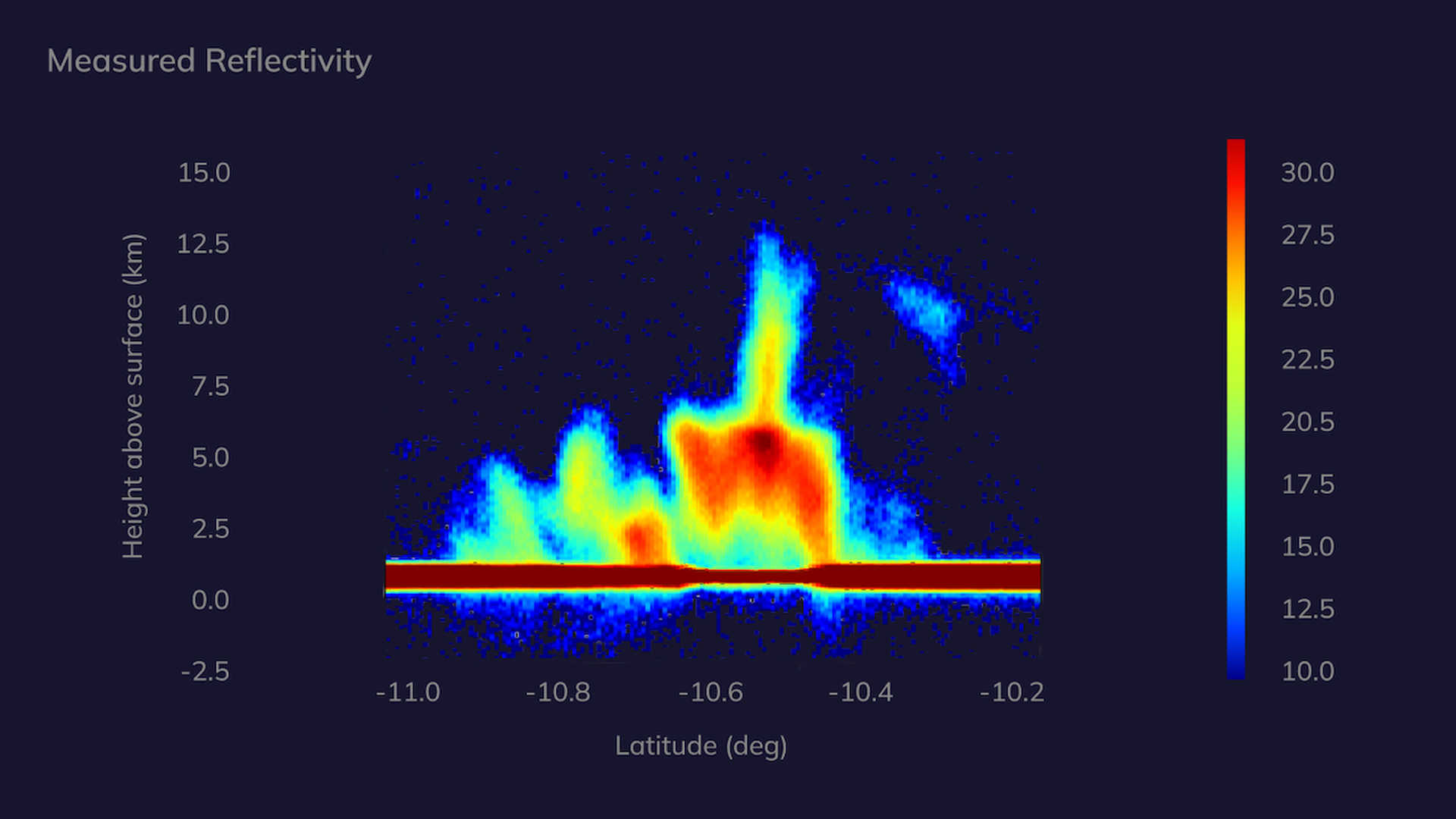
Radar reflectivity image from a Tomorrow.io weather radar satellite scanning over the Southwest Pacific Ocean. Image: Tomorrow.io
A new weather satellite constellation has sent back its first images, Andrew writes.
Why it matters: Climate intelligence company Tomorrow.io is aiming to drastically expand the data available over the world's data-sparse regions, including the oceans and many developing countries.
- Tomorrow.io plans to use the satellite constellation, which now numbers two but may total more than 30, to improve its weather models and help other countries improve their warning systems.
What they're saying: "In an ever-changing climate, having the right information is not just an advantage today, it's a necessity," Itai Zlotnik, a co-founder and chief customer officer at Tomorrow.io, told Axios in an interview.
The big picture: The company is betting that satellites that can peer within the clouds to detect precipitation rates, cloud structure and other parameters have the potential to drastically improve weather forecasts.
3. Quick take: the GOP debate's energy moments

Illustration: Eniola Odetunde/Axios
A Donald Trump-less GOP debate showed fissures and agreement among candidates hoping the ex-president's massive lead isn't bulletproof, Ben writes.
⚔️ There was a divide on climate. Entrepreneur Vivek Ramaswamy said "the climate change agenda is a hoax," adding, "the anti-carbon agenda is the wet blanket on our economy."
- You could argue the term "agenda" before "hoax" is a policy view, not a comment on the existence of climate change. But he repeatedly praised fossil fuels.
- Former South Carolina governor Nikki Haley offered a contrast with, "Is climate change real? Yes, it is," while arguing that what really matters is telling China and India to cut emissions.
🇨🇳 Multiple candidates argued President Biden's climate law helps China.
- "If we're going to stop buying oil from the Middle East and start buying batteries from China, we're just trading OPEC for Sinopec," North Dakota Gov. Doug Burgum said.
- Haley said: "These green subsidies that Biden has put in, all he's done is helped China," citing EV batteries produced there.
- Yes, but: Lots of climate law incentives are aimed at onshoring green energy equipment manufacturing, which is prompting major new investment in the U.S.
🛑 Florida Gov. Ron DeSantis blocked the chance to see the whole field's willingness (or not) to back the scientific consensus on human-caused climate change.
- Fox moderator Martha MacCallum asked for a show of hands, but DeSantis broke in, "Look, we're not schoolchildren, let's have the debate."
- He avoided the question and instead bashed President Biden's response to Hawai'i's wildfires.
⛽ Gas prices surfaced a few times, in a sign that while they're far below 2022 peaks, they're still high enough to create political headaches for Biden.
Editor's note: This story has been revised to reflect the correct wording in Vivek Ramaswamy's quote, in which he cites the "anti-carbon agenda" rather than "anti-climate."
4. EU's change to negotiating team ahead of COP28
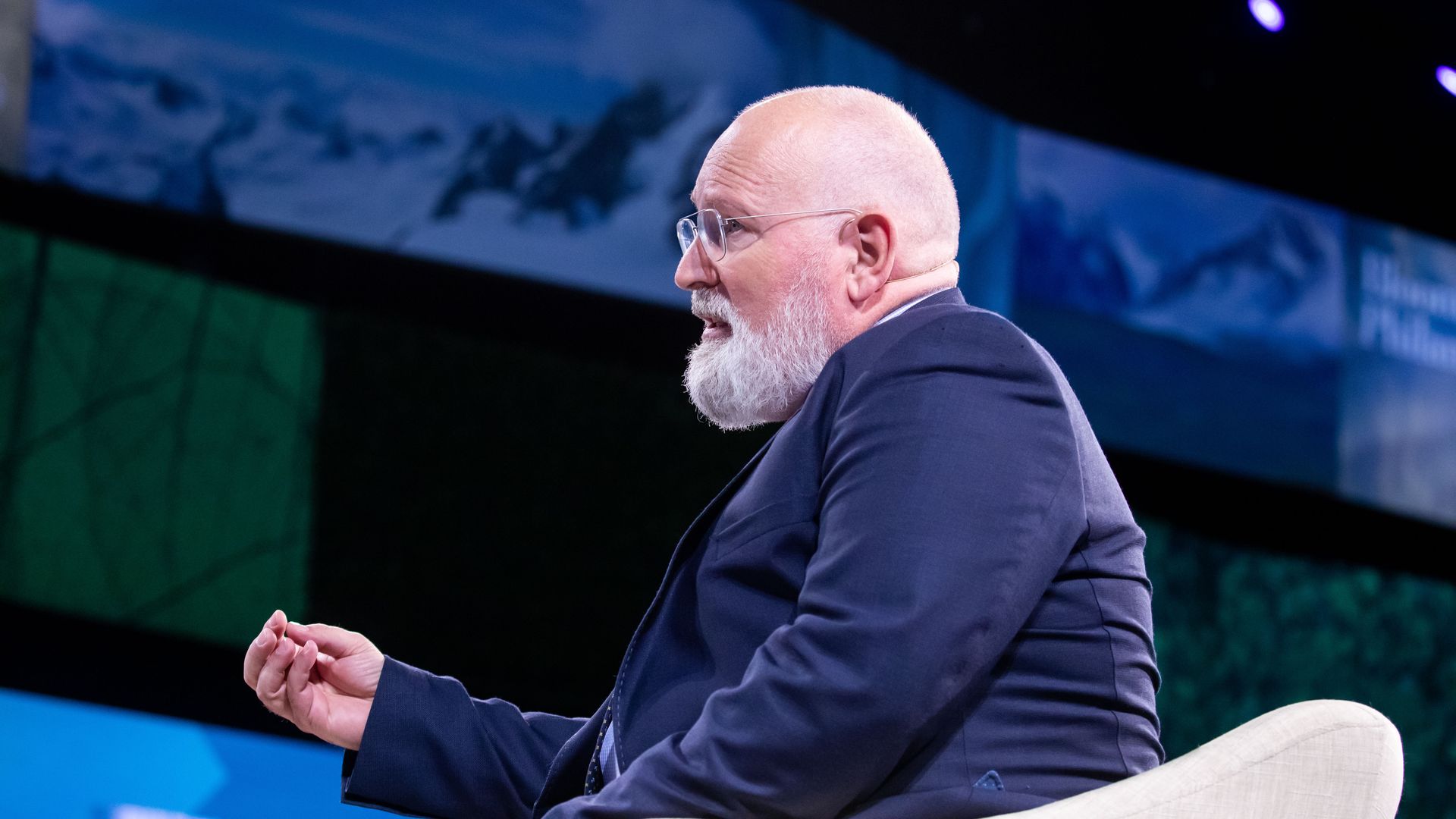
Frans Timmermans, vice president of the European Commission, speaks in New York in 2022. Photo: Michael Nagle/Bloomberg via Getty Images
Europe's point person on climate change, Frans Timmermans, has stepped down to run for prime minister in his native Netherlands, Andrew writes.
Why it matters: Timmermans was a powerful player at two U.N. climate summits, having helped to broker the creation of a "loss and damage" fund for developing nations.
- If fully operationalized, it would help compensate developing countries for climate change-related harms industrialized emissions cause.
State of play: Ursula von der Leyen, president of the European Commission, appointed Commission vice president Maroš Šefčovič to assume Timmermans' portfolio until the Dutch government appoints a replacement.
Between the lines: Šefčovič, who worked to help secure the European Union's alternative sources of natural gas in the wake of Russia's invasion of Ukraine, will represent Europe at the upcoming U.N. climate summit in Dubai later this year.
- At the summit, the E.U. is expected to push for commitments from other nations for more significant and rapid emissions cuts. Timmermans' absence is likely to be felt, particularly in contentious loss and damage fund negotiations.
5. 🏃🏽♀️ Catch up fast on tech: Google, VC, lithium

Illustration: Aïda Amer/Axios
🤝🏼 Google Cloud and Hitachi Energy this morning unveiled a strategic agreement to collaborate on "multiple cloud software products and services designed to support the global energy transition," Ben writes.
- Driving the news: The first fruit of the agreement is that Hitachi's new Velocity Suite Power Prices service is now available on Google Cloud Marketplace.
- What they're saying: This enables renewables and storage operators, among other parties, to make "better, faster decisions" on projects and investments, they said.
👀 Interesting tidbit about EV fast-charging startup Electric Era's $11.5 million Series A round: the venture arm of lithium heavyweight SQM is among the investors with a $3 million stake.
- The intrigue: There's been a lot of attention paid to auto companies ramping up investments in battery material players, but investment is also flowing from miners to EV-related companies.
🧳 Longtime climate investor Matt Eggers joined Prelude Ventures this week, departing Breakthrough Energy Ventures, where he was partner, Axios Pro: Climate Deals' Alan Neuhauser scooped yesterday.
- Why it matters: Eggers is a prominent figure in climate investing and is moving between two of the most well-known venture firms in the sector. Subscribe for the full story and vital news and analysis every week.
6. One wild chart: Permian dominance
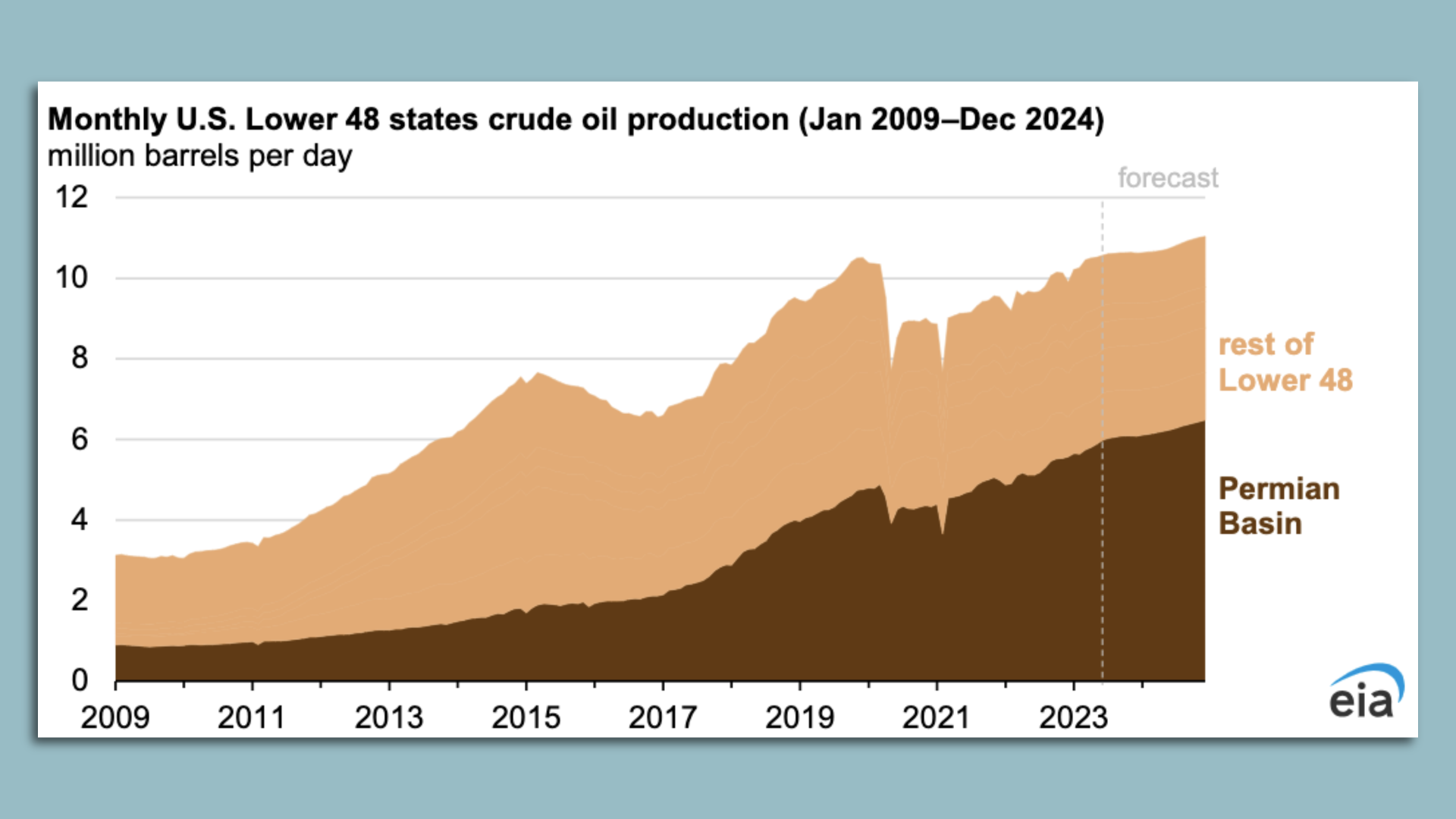
Image courtesy of the Energy Information Administration
This Energy Information Administration graphic is a striking reminder of how the Permian Basin, if it was a country, would be among the world's biggest petro-states, Ben writes.
The big picture: The chart shows onshore production in the lower 48 states, and you can see how the shale boom propelled growth in the Permian that spans parts of Texas and New Mexico.
What we don't know: The growth rate ahead is unclear as producers focus on investor payouts, and the best acreage may be getting scarce.
📬 Did a friend send you this newsletter? Welcome, please sign up.
🙏 Thanks to Chris Speckhard and Javier E. David for edits to today's edition, along with the talented Axios Visuals team.