
Axios Generate

March 04, 2022
☕ Welcome back. Today's Smart Brevity count is 1,328 words, 5 minutes.
🗓️ Join Axios virtually at our first What’s Next Summit on April 5. Register for sessions on trends that will revolutionize our future.
🚨 Follow Axios' live updates on the war in Ukraine.
1 big thing: Groundswell of support for oil imports ban
Illustration: Annelise Capossela/Axios
There is growing momentum in Congress to cut off U.S. imports of oil and petroleum products from Russia in response to the invasion of Ukraine, Andrew writes.
- This issue is pitting lawmakers from both parties against the White House, which is wary of a ban's potential to jack up gas prices.
Driving the news: Yesterday, a bipartisan, bicameral coalition of lawmakers introduced a bill that would ban U.S. oil and petroleum product imports from Russia.
- The lawmakers include Senate Energy Committee Chairman Joe Manchin (D-W.Va.) along with Sen. Lisa Murkowski (R-Alaska).
- House Speaker Nancy Pelosi backed the idea. "I'm all for that. Ban it. Ban the oil coming from Russia," Pelosi said at a news conference.
The big picture: Total U.S. oil and refined product imports have declined greatly since the mid-2000s, but the country remains a significant importer.
- The U.S. imports from Russia have bounced around, from more than 800,000 barrels per day in mid-2021 to about 400,000 per day in December.
Yes, but: Banning Russian imports into the U.S. could further increase gas prices, which are already running at their highest levels since 2014.
- For this reason, the White House has opposed an oil imports ban.
- "Our objective and the president's objective has been to maximize impact on President Putin and Russia while minimizing impact to us and our allies and partners," White House press secretary Jen Psaki said yesterday.
- "We don't have a strategic interest in reducing the global supply of energy," she said. "It’s as simple as: Less supply raises prices."
A short time later on Capitol Hill, Manchin contested the administration's arguments, saying an imports ban would not necessarily reduce oil supplies and cause prices to rise because the U.S. can boost its domestic production in the meantime.
- "We can basically produce whatever needs to be produced," he said.
Zoom in: The bill, which has 18 bipartisan co-sponsors, would prohibit more than the importation of Russian crude oil. It would also ban imports of petroleum products, liquefied natural gas and coal.
The intrigue: The White House needs Manchin's support to pass any pared-down version of the Build Back Better legislation, including climate provisions.
If the administration blocks Manchin's push for an imports ban, it could complicate already tough efforts to revive pieces of that legislative package.
Ben contributed reporting.
2. The latest on Russia's nuclear plant attack

Ukraine's Zaporizhzhia nuclear power plant during a fire following clashes around the site. Photo: Getty Images
Ukrainian officials said today they've extinguished a fire near the Zaporizhzhia nuclear power station in southeastern Ukraine that ignited during shelling by Russian forces, but confirmed that Russia's military had "seized" the plant, Axios' Rebecca Falconer and Ben report.
Where it stands: Energoatom, Ukraine’s nuclear power operator, said in a Telegram statement that the "administrative building and the checkpoint" at Europe's largest nuclear power station "are under occupiers' control."
The latest: The International Atomic Energy Agency (IAEA), citing Ukrainian plant operators, said safety systems at the plant's six reactors were not affected and "there has been no release of radioactive material."
- "Radiation monitoring systems at the site are fully functional," said IAEA, the United Nation's nuclear watchdog.
- U.S. Energy Secretary Jennifer Granholm, after speaking with her Ukrainian counterpart, tweeted last night: "The plant's reactors are protected by robust containment structures and reactors are being safely shut down."
- She also said DOE has activated its Nuclear Incident Response Team and "we have seen no elevated radiation readings near the facility."
Yes, but: "[T]he operator has reported that the situation remains very challenging and therefore it has not yet been possible to access the whole site to assess that all safety systems are fully functional," IAEA said.
Threat level: The plant fire and seizure show the extraordinary risks involved with Russia's assault on Ukraine.
- Ukrainian President Volodymyr Zelensky accused Russian forces of "nuclear terror," per a translation by the Ukrainian Embassy in D.C.
- He called on European leaders to "wake up" and stop Russia's military before there is "a nuclear catastrophe."
Zoom in: Per IAEA, one of the plant's units is down for maintenance, two others have undergone "controlled shut down," another is at 60% and the remaining two are in reserve "low power" mode.
What they're saying: Jon B. Wolfsthal, a former adviser to Biden when he was VP, tells the Washington Post that the plant's reactors are safer and better protected than the technology at the Chernobyl site.
“It’s not as dangerous as Chernobyl, but tank fire and nuclear reactors are never a good combination,” he said.
3. COVID recovery spending has not been green


New analysis shows how badly most nations' economic responses to COVID-19 have failed to heed calls for green-tinted recovery, Ben writes.
Driving the news: The study in Nature, conducted by Johns Hopkins University analysts, explores $14 trillion-plus in G20 stimulus and recovery packages.
- Under $1 trillion went to programs that cut emissions directly (renewables, EV support or grants for efficient heating, etc.) or even indirectly, with most in the latter camp.
- The vast majority, 91%, did not seek to shift emissions, the researchers found.
Threat level: "[A]lmost 3% of stimulus funding has targeted activities that are likely to increase global emissions, such as subsidizing the coal industry."
The bottom line: "There is still time for improvement."
4. Arctic Council boycott goes into effect over Ukraine

Secretary of State Antony Blinken (L) and Russia's Minister of Foreign Affairs Sergei Lavrov (R) in Iceland in May. Photo: Russian Foreign Ministry/TASS via Getty Images
The diplomatic chill over Russia's unprovoked invasion of Ukraine has frozen the cooperative governing body for the Arctic, Andrew and Axios' Ivana Saric write.
Driving the news: Yesterday, seven out of the eight members of the Arctic Council announced they would temporarily suspend their participation in the organization due to Russia's actions in Ukraine.
- The council is comprised of the U.S., Canada, Denmark, Finland, Iceland, Norway, Sweden and Russia. Representatives of Indigenous populations also participate.
- The Arctic has long been an area of cooperation and collaboration despite the potential for competition and conflict. The steps are unprecedented in the council's history.
Why it matters: The Arctic Council is akin to a mini-U.N. for the Arctic. It is a forum for discussing the feasibility and potential impacts of increased oil and gas drilling in the region and sponsors scientific research.
The big picture: Russia currently holds the council's rotating chair, and in a joint statement yesterday, the other seven members condemned the invasion and noted the "grave impediments to international cooperation, including in the Arctic, that Russia's actions have caused."
5. Chart of the day: Big Oil's Russian assets
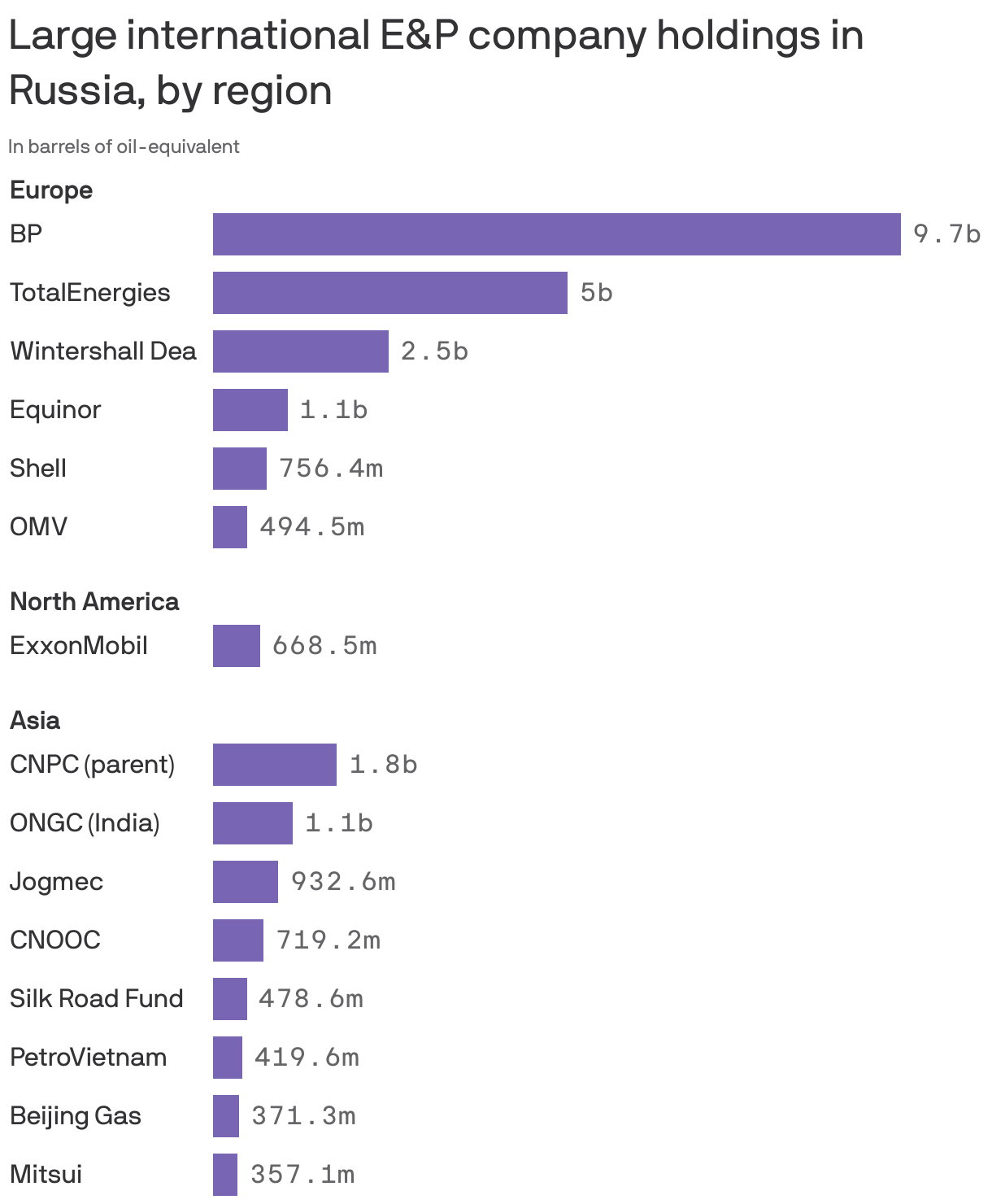
Rystad Energy is out with a wide-ranging report on energy-related dimensions of Russia's invasion of Ukraine, Ben writes.
Why it matters: There's lots of helpful stuff for anyone trying to get their arms around the topic.
That includes a look at large oil companies' Russian holdings (see above) at a time when industries are under pressure to cut ties there.
Catch up fast: Several companies — including Shell, BP and ExxonMobil — have all said they're pulling out of Russian ventures.
TotalEnergies did not follow but did swear off new investments there.
Go deeper: Bloomberg has a good look at where various energy companies stand.
6. Electric competition for gas-guzzling powerboats

Arc One electric speed boat. Photo courtesy of Arc
A team of former Space-X engineers and boating enthusiasts aims to transform recreational boating with a speedboat that zips across the water on electricity instead of gas or diesel fuel, Joann Muller reports.
Why it matters: Like automobiles, motorcycles and small airplanes, boats are beginning to go electric, which could make lakes and rivers more serene — and less polluted.
The big picture: Electric boats have pluses and minuses.
While quiet and efficient, they require tremendous energy. That means they need a gigantic, heavy battery and can't go very far or very fast — a killjoy for boating enthusiasts.
Yes, but: Gas-powered boats bring their own problems.
"They're really expensive to operate, you have to winterize the engine, they're noisy and unreliable, the fumes are noxious and they're annoying to maintain," says Mitch Lee, CEO of Los Angeles-based Arc Boats.
What's new: Arc yesterday introduced the all-electric Arc One, a 24-foot cruiser developed to address challenges posed by battery-operated boats.
It combines a lightweight aluminum hull with a gigantic 220 kWh battery integrated into the floor.
Where it stands: Other marine companies are shifting to electric propulsion, too.
Sign up for Axios Generate

Untangle the energy industry’s biggest news stories


