Axios Generate

April 11, 2024
🕺 Good morning! Today we've got a wide-ranging edition that's still just 1,246 words, 4.5 minutes.
👀 Situational awareness: Global coal-fired power capacity grew by another 2% last year, driven by Chinese additions and slowing shutdowns in the U.S. and other regions, per new analyses led by Global Energy Monitor.
🎵 Massive Attack released their debut album this week in 1991 and it provides today's intro tune...
1 big thing: MBA students lean in on climate

Illustration: Annelise Capossela/Axios
Students at leading U.S. and European MBA programs are pushing the next generation of business leaders to integrate sustainability into the core of their careers, Andrew writes.
Driving the news: The "Climate Legacy Commitment" was launched last month by two University of Cambridge MBA candidates and has since been signed onto by students at each of the top programs in the "Magic Seven" elite business schools in the U.S.
- MBA students in programs comprising the Business Schools for Climate Leadership Network in Europe have also co-signed the effort.
Why it matters: The campus push arrives as corporate leaders worldwide are on the defensive over incorporating climate and sustainability goals into their business models.
- At the same time, policymakers widely view corporations as essential to raising funds needed to enable the energy transition, as concerns grow over the intensifying fallout from a warming climate.
Zoom in: The Cambridge Judge Business School is a foundational sponsor of the initiative.
- U.S. schools participating include Columbia Business School, Harvard, MIT, Stanford, and Northwestern University, among others.
- More than 45% of the Cambridge MBA cohort has now signed the pledge, according to creators Collin G. Janich and Peter Golding.
How it works: Signers of the commitment recognize the scientific evidence of climate change and the conclusions of the U.N. climate summit in Dubai late last year.
Between the lines: The pledge marks the start of a movement to more deeply integrate sustainability, and specifically the curbing of greenhouse gas emissions, into the corporate boardrooms of tomorrow.
- It also offers signs of a pushback within elite business schools against the anti-ESG movement, which has focused on the arguments that businesses should pursue what's best for the bottom line and maximizing shareholder value, while paying less attention to environmental goals.
2. IEA defends energy outlooks in letter to Capitol Hill
Illustration: Gabriella Turrisi/Axios
The International Energy Agency is clapping back at Republicans who say it has lost its way, Ben writes.
Why it matters: An April 5 letter from IEA boss Fatih Birol — first obtained by Axios — provides the agency's most detailed response yet to criticisms and inquiries from Capitol Hill Republicans.
A few toplines from Birol's response to John Barrasso, the top Republican on the Senate's energy committee, and House Energy and Commerce Chair Cathy McMorris Rodgers:
- IEA showed its energy security bona fides when it coordinated releases from members' emergency oil stockpiles after Russia attacked Ukraine.
- He defended IEA's projection that, under nations' stated policies, fossil fuel demand will peak this decade, claiming it's within the mainstream analyst hive-mind.
- Birol also parried critics of this "stated policies" scenario, which is now IEA's most cautious long-term case, replacing the "current policies" outlook abandoned a few years back.
The other side: "Officials at the IEA have been around long enough to know that pie-in-the-sky promises of politicians are no substitute for the actual laws that legislatures enact," Barrasso said in a statement to Axios.
3. Top UN climate official elevates the stakes
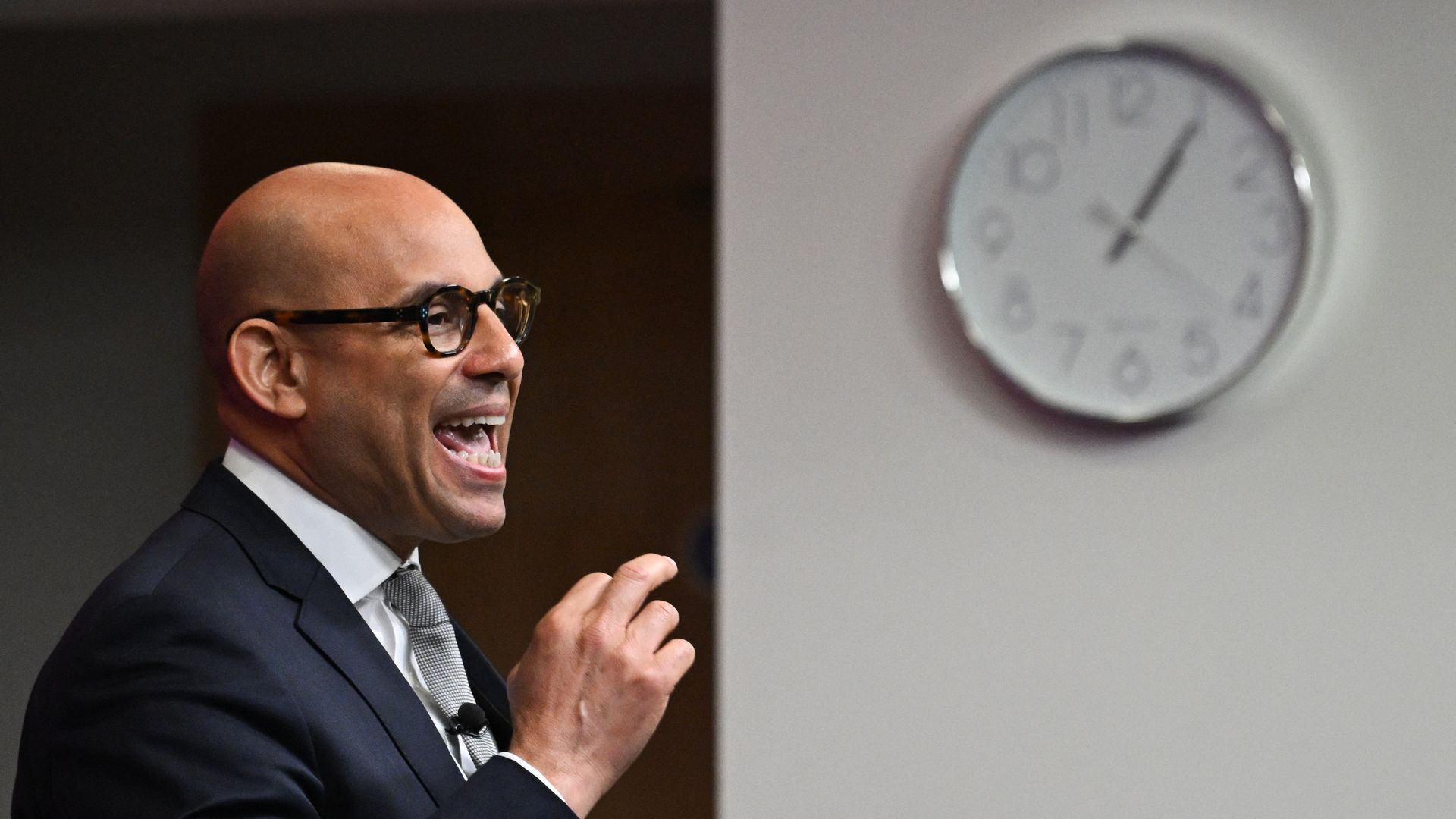
UN climate chief Simon Stiell speaks at Chatham House in London yesterday. Photo: Justin Tallis/AFP via Getty Images
The top UN climate official used jarring, controversial framing in a stark speech in London yesterday, claiming we only have "two years left to save the world," Andrew writes.
Why it matters: Simon Stiell's speech laid out the stakes for meeting the Paris targets before multiple international gatherings, elections and deadlines, starting with World Bank-IMF spring meetings next week.
Yes, but: The headline of his talk at the Chatham House think tank is garnering the most attention.
- His presentation risks straying into the land of climate doomers, but it is about the timeline of the Paris Agreement, not evidence showing the globe has a two-year window to avert climate catastrophe.
- The accord calls for countries to submit their next national climate targets by 2025, covering the period out to 2035.
- Stiell made the case for stronger pre-2030 targets to be made ASAP, noting current plans "in aggregate would barely cut emissions at all by 2030."
Zoom in: Significantly, Stiell also called for a "new deal" on climate finance to be negotiated at COP 29 in Baku.
- It would provide vastly more abundant and flexible funding to help countries withstand climate impacts and transition away from fossil fuels, he said.
- In a message with relevance to the U.S., he said demand-side measures, such as carbon pricing, are needed to "speed up the decline of fossil fuels."
- He also warned against governments, and voters, deemphasizing climate ahead of pivotal elections.
The bottom line: Stiell sees a time crunch approaching that could have long-lasting repercussions.
4. Catch up quick on policy
Illustration: Annelise Capossela/Axios
🇯🇵 The U.S. and Japan agreed to boost cooperation on offshore wind and nuclear fusion during PM Fumio Kishida's visit, Ben writes.
- Why it matters: Their joint statement papers over Japanese concerns about the White House pause on new LNG export approvals.
- The big picture: The U.S. is "unwavering" in its support for Japan's energy security, "including its ability to predictably supply LNG while accelerating the global transition to zero-emissions energy," it states.
🛢️ Via E&E News, "The Biden administration has given a final green light for a massive oil export terminal to be built off the Texas coast and send U.S. crude to Asia and Europe."
- The big picture: The project comes amid the years-long rise in U.S. crude exports.
⚛️ Senate and House negotiators are near a deal on legislation to speed the federal licensing process for advanced reactors, Axios Pro's Nick Sobczyk and Jael Holzman report.
- Why it matters: After a failed attempt to get it into the second "minibus" spending package, the bill's sponsors hope to have legislation in hand they can attach to the next moving vehicle.
- Go deeper: Unlock the whole story — and a steady diet of scoops and smart analysis — by talking to our sales team about Axios Pro: Energy Policy.
5. Energy is charging up inflation

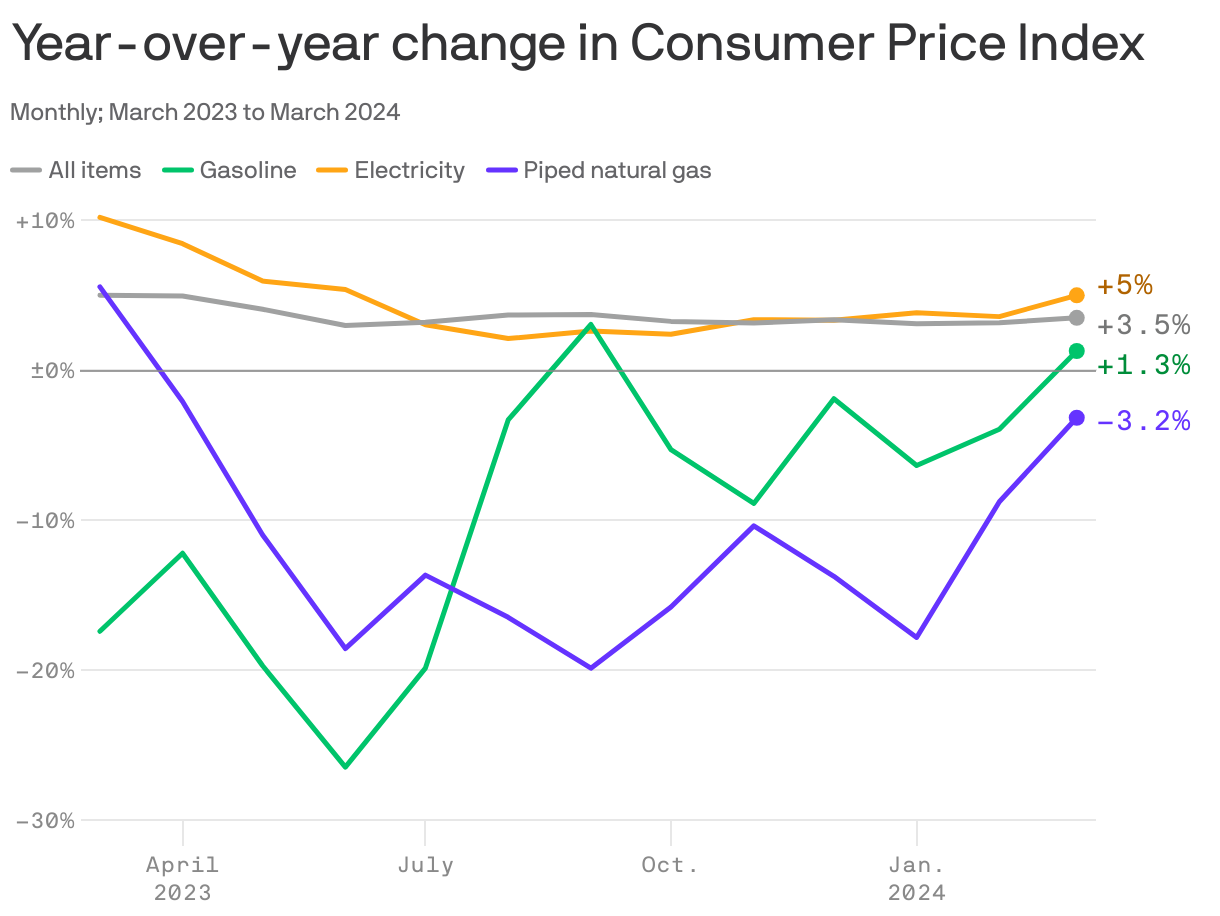
Rising energy prices helped push up overall consumer inflation last month, Ben writes.
Why it matters: The recent uptick in prices at the pump may create new political perils for President Biden ahead of summer driving season, and November's election.
The big picture: The chart above, a yearlong snapshot, shows gas and electricity leading energy costs higher.
- March's data was the third consecutive month of hotter-than-expected price data, casting doubt on imminent interest rate cuts, Axios Macro's Courtenay Brown and Neil Irwin report.
Zoom in: Inflation for all energy categories combined ticked up 1.1% last month, while it rose 1.7% for gasoline and 0.9% for electricity.
The bottom line: Middle East crises will help dictate oil prices — and hence gasoline costs.
6. Catch up quick on tech finance

Illustration: Aïda Amer/Axios
☀️ Nexamp, a community solar provider, raised $520 million led by Manulife Investment Management, Ben writes.
- Why it matters: Community solar helps provide renewables to people who can't install panels because they live in multi-unit buildings, aren't homeowners, or lack the resources. It's also a corporate option.
- Go deeper: Axios Pro: Climate Deals' Katie Fehrenbacher had the scoop on the capital raise yesterday, and you should really subscribe because Axios Pro is awesome.
🌊 Carbon removal startup Captura landed a fresh $10 million for its Series A round, bringing its total raise to $45.3 million, and added National Grid Partners and Japan Airlines as new investors.
- Why it matters: Nobody knows if various air capture technologies from Captura and others will ever truly scale, but deep pockets are interested in finding out.
- Go deeper: It's among several new investments from National Grid's VC arm. Axios' Kia Kokalitcheva has more.
🚗 Via Bloomberg, "HysetCo SAS, a startup that rents hydrogen-powered electric vehicles to hundreds of taxi drivers around Paris, raised nearly €200 million ($218 million) to expand its operations beyond the French capital."
📬 Did a friend send you this newsletter? Welcome, please sign up.
🙏 Thanks to Chris Speckhard and Javier E. David for edits to today's edition, along with the brilliant Axios Visuals team.
Sign up for Axios Generate

Untangle the energy industry’s biggest news stories