
Axios Generate

October 03, 2023
🐣 Good morning! Today's newsletter has a Smart Brevity count of 1,175 words, 4.5 minutes.
🎸 Happy birthday to the great guitarist and songwriter Lindsey Buckingham. Copy editor extraordinaire Chris Speckhard chose today's intro tune...
1 big thing: Private sector needs to pony up on climate
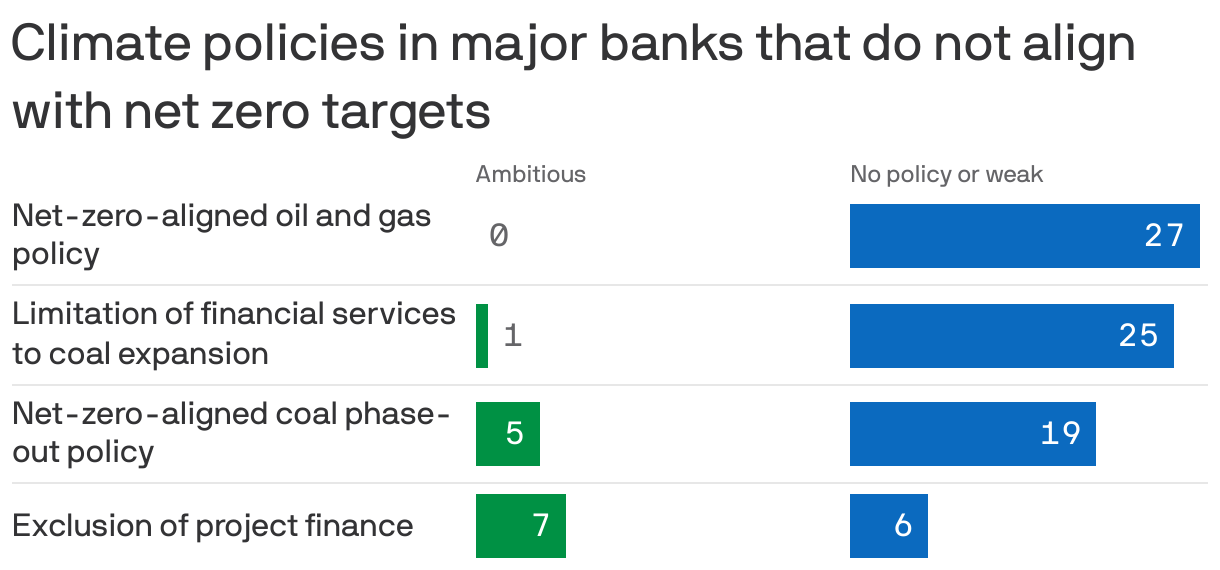
The International Monetary Fund is warning that countries cannot rely exclusively on public funds to cut greenhouse gas emissions, Andrew writes.
Why it matters: In two new reports, the IMF points to how far off track the Group of 20 largest industrialized countries are from their own 2030 emissions targets and emphasizes the need for far more private sector money.
The reports will inform high-level meetings in Washington and Morocco during the next two weeks.
The big picture: The IMF laid out its conclusions as parts of larger analyses. Taken together, the fund warns that nations are likely to face significant limits on public sector spending for the climate fight.
- In particular, the IMF cites growing debt burdens from weaker economic growth, rising interest rates, and other economic headwinds during the 2023 to 2028 period.
- This is expected to complicate tapping national coffers to pay for the transition to a low-carbon economy, the IMF wrote.
- A major theme was the need to draw in far more private capital to pay for steep increases in cleaner energy spending in emerging markets and developing countries.
Of note: The IMF concludes that the private sector will need to supply about 80% of the needed investments for the developing world's energy transition through 2030, but this share rises to 90% when you exclude China.
- The findings cited International Energy Agency figures indicating emerging market and developing economies will need about $2 trillion per year by 2030 to reach net-zero emissions by 2050; that is five times the current level.
Zoom in: The IMF describes leaders as facing decisions that are only getting harder. Climate change is being addressed mainly through spending measures, which runs the risk of raising debt levels to unsustainable heights; The alternative involves pursuing more modest, less costly climate actions, which would not fulfill the Paris targets.
The bottom line: While an exercise in fiscal analysis, the IMF's findings will be a major focus of the upcoming UN Climate Summit in Dubai, which begins late next month.
2. Catch up fast on EVs: Tesla and Rivian

Illustration: Annelise Capossela/Axios
📉 Tesla reported a roughly 7% drop in third-quarter deliveries relative to the prior three months and also lower production, Ben writes.
- The big picture: Tesla delivered slightly over 435,000 vehicles and made 430,488, citing "planned downtimes for factory upgrades." The results, while reflecting previously announced factory conditions, nonetheless missed analysts' estimates. But investors were nonplussed — Tesla's share price didn't move much.
- Yes, but: Bloomberg columnist Liam Denning says the real story isn't about volume. "The central issue with Tesla this year has been the collapse in its profit margins as it slashed prices to entice customers and maintain growth, the central pillar on which its outsized valuation stands," he writes.
📈 Rivian, a startup much earlier in its life cycle, beat Wall Street estimates by reporting 15,564 deliveries and producing 16,304 in Q3. The company reiterated its target of building 52,000 vehicles this year.
- Zoom in: The Wall Street Journal has a deeply reported feature on the buzzy startup's struggles on the dangerous road to becoming a commercial electric vehicle maker at scale.
- Key stat: Rivian has made progress in cutting costs, but its vehicles are still expensive enough to manufacture that "in the second quarter the company lost $33,000 on every one it sold," the paper reports.
3. Bonus: Breaking down the carbon case for EVs
Illustration: Brendan Lynch/Axios
Analysis from consultancy Rystad Energy is the latest to find EVs do way less climate damage than petro-powered models — even when charging on fossil-heavy grids, Ben writes.
The big picture: The firm's breakdown weighed emissions from vehicle and battery manufacturing, fuel emissions and more.
- Despite higher emissions in manufacturing, Rystad finds that on a life-cycle basis, it's not even close.
- In nations with grids "dominated" by fossil fuels, EVs emit about half the CO2-equivalent of internal combustion models.
- "As renewable sources replace coal and gas-fired generation, emissions related to the operation of BEVs could drop by 86%."
4. Oilfield services giants deepen carbon biz work

Illustration: Gabriella Turrisi/Axios
Two things crossed my screen that help show how oilfield services giants are deepening their carbon capture and storage work, Ben writes.
Driving the news: SLB, formerly Schlumberger, just launched a "carbon storage screening and ranking solution" that helps clients assess the quality of sequestration sites.
- It helps avoid "suboptimal storage sites with risk factors that can waste valuable time and resources" and lower the chances that projects are greenlit, SLB said.
- Meanwhile, Reuters reports: "UK oil services firm Petrofac said on Tuesday it got a more than $600 million contract from ADNOC Gas for the Habshan carbon capture and storage (CCS) project, as the Abu Dhabi-based company steps up its decarbonisation plan."
The big picture: It's part of the industry's wider diversification efforts that have accelerated in recent years.
Yes, but: Visions of large-scale carbon capture and storage development have long outpaced real-world scale-up.
The International Energy Agency's updated scenario for net-zero emissions notes the project pipeline has surged, but only about 5% have reached final investment decisions.
Carbon capture and storage now plays a smaller role in their hypothetical net-zero pathway than the first version in 2021.
5. The electric air taxi age is drawing closer

A Beta Technologies' eVTOL aircraft hovers above an airport. Photo: Courtesy of Beta Technologies
Future-of-aviation startup Beta Technologies has opened the doors of a net-zero production facility, Axios' Alex Fitzpatrick reports.
Why it matters: The company will make both conventional and vertical takeoff and landing (VTOL) electric aircraft.
- The new, nearly 200,000-square-foot facility is a big vote of self-confidence from Beta. Along with rivals like Joby Aviation and Archer Aviation, Beta is still working on approval for commercial passenger operations.
State of play: Beta's new plant, located at Vermont's Burlington International Airport, is designed to eventually churn out up to 300 of the company's ALIA aircraft each year.
- The net-zero facility is powered by a combination of geothermal wells and rooftop solar.
- There's enough space to double the facility's size if needed later, Beta says.
The big picture: eVTOLs are inching closer to flying paid passengers, but that's still years away, as the Federal Aviation Administration certification process continues.
- In the meantime, Beta is working with the military and cargo operators to open revenue streams that don't require regulators to greenlight commercial passenger service.
- Joby and Archer are likewise leaning into Defense Department contracts while they undergo civilian certification.
What they're saying: Opening the new facility "preemptively" will improve efficiency, says Beta Technologies CEO Kyle Clark, who adds that it's wise to certify both the aircraft itself and the underlying production methods simultaneously.
6. ⚖️ Number of the day: $553 million
That's how much U.S. investment firm Gramercy Funds Management is loaning U.K.-based law firm Pogust Goodhead for work on environmental lawsuits against mining and auto companies, Ben writes.
State of play: It will help finance current litigation against BHP and Vale on behalf of victims of the massive 2015 collapse of a tailings dam in Brazil, and separate action against automakers over 2015's infamous "dieselgate" scandal.
- Beyond those cases, law firm CEO Tom Goodhead said in a statement that "we are putting global corporate giants on notice that we have the financial muscle to take them on for their wrongdoing."
The bottom line: It's "one of the largest ever litigation funding deals," the Financial Times reports.
Did someone forward you this newsletter? Welcome, and please sign up.
🙏 Thanks to Chris Speckhard and Javier David for edits to today's edition, along with the talented Axios Visuals team.
Sign up for Axios Generate

Untangle the energy industry’s biggest news stories