Axios Future of Mobility

September 23, 2026

👋 I hope you're having a terrific Wednesday!
🇨🇳 What we're watching: GM CEO Mary Barra is expected to attend President Trump's state dinner at the White House tomorrow for Chinese President Xi Jinping, Reuters scooped.
- The dinner comes as automakers plead with the Trump administration to banish Chinese vehicles from the American market. Recall, Trump has signaled an openness to Chinese cars if they're built in the U.S. (Axios)
🚖 Yes, but: Today's edition is a special Deep Dive into Uber's autonomous vehicle strategy.
- Let's get into it!
1,958 words, a 7½-minute read.
1 big thing: Uber rewrites its playbook for robotaxis
Uber, the taxi industry's original disrupter, is rewriting its own success formula as it confronts the next revolution in transportation: robotaxis.
Why it matters: The ride-hailing giant expects to pour more than $10 billion into AV companies, vehicles and physical infrastructure over the next few years — a dramatic reversal by one of Silicon Valley's quintessential "asset-light" companies.
- It's a price CEO Dara Khosrowshahi is willing to pay to try to ensure Uber remains the go-to marketplace for rides — even when nobody is behind the wheel.
- "Uber has never been about protecting the status quo. Autonomous vehicles can accelerate safer, more affordable and reliable transportation for all, and we're driving it forward," he says.
The big picture: Uber's original formula was matching riders with cars it didn't own, and with drivers it didn't employ.
- It repeated that success with food delivery and freight; Uber provided the digital marketplace and routing software while others managed the expensive hardware.
- But now companies like Waymo and Tesla are building their own driverless taxi networks, threatening to cut Uber out of the transaction altogether.
Uber's response is to bet broadly on AV investments rather than pick a winner.
- "We want to partner with every single AV provider, technology provider out there," Sarfraz Maredia, Uber's head of autonomous mobility and delivery, tells me in an interview.
- Uber gives AV companies what they need to scale: riders, infrastructure and a ready-made marketplace.
- And it's supporting dozens of companies with equity investments, vehicle purchases or robotaxi partnerships, both to promote competition and to ensure Waymo and Tesla don't get too far ahead.
Between the lines: These investments, Uber has said, are designed to jumpstart the AV industry.
- The risk on the mind of investors is that the company is changing its business model and committing enormous resources before the underlying economics of robotaxis have been proven.
Zoom in: "The strongest thesis behind investing in AVs is the safety and reliability that it can bring," Maredia says.
- "The piece that we hope is true over a longer period of time is that that technology, which is safer, will be cheaper."
- Whether anyone can deploy robotaxis safely, profitably, and at scale, however, is still unproven, he acknowledged.
- "Nobody has checked all three of those boxes. Not even Waymo," he said, referring to the robotaxi leader.
Flashback: Uber tried to develop its own AVs a decade ago, but then stopped after one of its test vehicles killed a pedestrian in Arizona in 2018.
- Uber sold the division to Aurora in 2020 after years of heavy spending.
- Now it's pivoting from building AV technology to partnering with those who do.
Follow the money: Uber believes that, this time around, its AV spending spree will be temporary.
- "There are certain things that we're choosing to do at this stage because we think it helps catalyze growth for the ecosystem," Maredia says.
- Eventually, Uber expects third-party investors will take over financing robotaxi fleets and depots so it won't need to carry those assets on its own balance sheet forever.
By the numbers: Uber has more than 30 AV partners — spanning robotaxis, delivery robots, drones and trucking — who have pledged to deploy 120,000 robotaxis on Uber's platform.
- Uber has invested directly in some of them — albeit with milestone-based strings attached — including up to $1.25 billion in Rivian, $500 million in Lucid, $500 million in Nuro and $250 million in Waabi.
- It also has undisclosed investments in Avride, Wayve and China's WeRide.
- Uber also plans to spend $100 million for robotaxi depots in three cities, with more infrastructure spending in the works, including in cities that have not yet been publicly announced.
The bottom line: Uber's strategy ultimately depends on two unproven bets: that robotaxis can become a profitable business — and that, when they do, someone else will be willing to own the expensive parts.
2. Human drivers make robotaxis work
Uber is betting billions on a driverless future, but the secret to making the economics work could be — surprise! — its vast army of human drivers.
Why it matters: The company believes a hybrid network of robots and people can keep its expensive autonomous vehicles busier, and therefore more profitable, than fleets made up entirely of robotaxis.
The big picture: Think of a high-tech robotaxi like an airplane: It costs money whether it's carrying passengers or sitting on the ground.
- The more trips each vehicle makes, the more revenue Uber and its robotaxi partners can squeeze from that expensive asset, offsetting the fixed costs of the technology, vehicle financing, insurance, depot space and other infrastructure.
Between the lines: Ride-hailing is a supply-driven business, and robotaxis aren't a substitute for drivers, Uber says — they're an additional form of supply.
- With greater supply comes lower prices and shorter wait times, which means increased reliability.
- That stimulates more demand, and ultimately makes the ride-hailing pie bigger.
- That's Uber's theory.
Robotaxi economics remain unproven, Maredia says.
- It's still early, and no company is making money yet operating them, nor is anyone yet operating them at massive scale.
- Whether AVs and all that's needed to support a fleet — including charging infrastructure and maintenance — will ultimately be cheaper than today's ride-hailing model "very much has yet to be proven," Maredia says. "The unit economics today have a long way to go."
Uber's bet is that its mix of human drivers and AVs will produce better returns.
How it works: In a hybrid network, AVs would handle the steady "base load" of everyday demand.
- Human drivers, meanwhile, would provide extra capacity during rush hour, bad weather, concerts and other demand spikes.
So far, Uber says, robotaxis are taking shorter city-center trips, while drivers get longer, more lucrative ones.
- "You could argue that the AVs are getting the scraps," Khosrowshahi told Fast Company earlier this year.
That flexibility is an advantage, the company says.
- A robotaxi operator needs enough cars to handle its busiest periods — leaving expensive AVs sitting idle when demand falls.
- Uber, by contrast, can size its robotaxi fleet for normal demand and summon more human drivers when needed.
- Drivers only get paid when they're working, whereas robotaxis cost money even when they're idle.
Reality check: Drivers will be displaced eventually, and Uber doesn't argue that point — but a hybrid network will help ease that transition, it says.
By the numbers: Uber says trips are up in Austin and Atlanta, where Waymo AVs are sharing the Uber app with drivers, and driver earnings have stayed consistent.
Yes, but: Independent research from Gridwise, an app that lets gig drivers track earnings, expenses and mileage, had different findings.
- In Austin, where Waymos are exclusively available on Uber, base pay and gross pay per hour rose less than rideshare drivers in other parts of the country, Gridwise found, suggesting AV growth could already be putting pressure on driver earnings.
The bottom line: Humans may make Uber's robotaxi math work. Whether the math works as well for the humans is less certain.
3. Data to spare
Uber's robotaxi ambitions depend on something it can't control: how quickly its autonomous-vehicle partners can perfect their technology.
Why it matters: Uber needs its AV partners to close Waymo's roughly two-year technology lead — and it's betting data from millions of human-driven trips can help accelerate their progress.
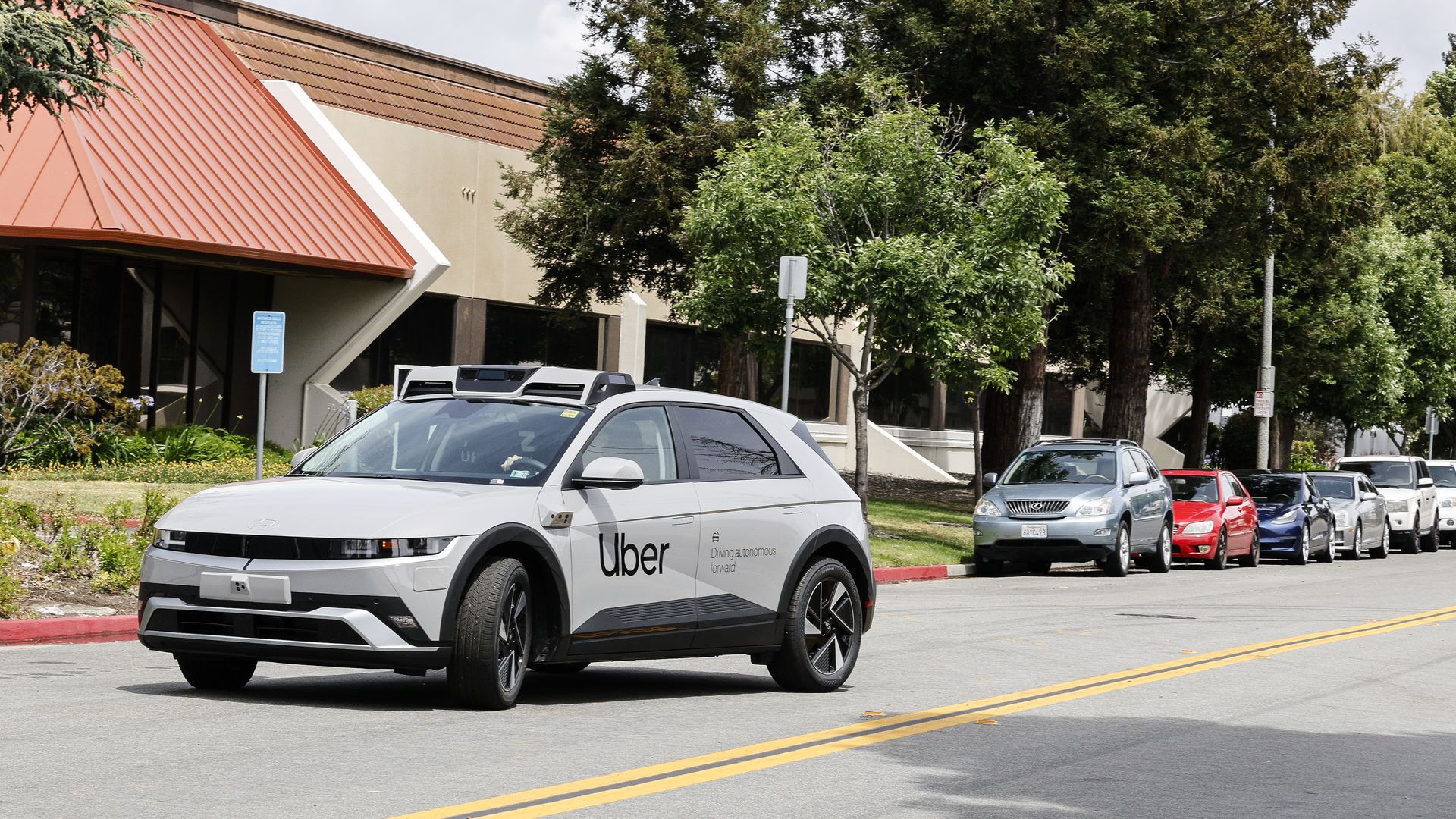
Driving the news: Starting this month, Uber will deploy up to 500 specially equipped Hyundai Ioniq 5s to gather data about the weird stuff that Uber drivers encounter every day.
- The human-driven vehicles, outfitted with 14 cameras, eight lidars, nine radars and onboard computers, are designed to capture the kind of real-world situational data that's so crucial for AV developers to train their AI driving systems.
The big picture: The AV race is increasingly a scramble for data.
- Engineers are no longer writing rules for how a car should handle specific situations. Instead, they're developing generalized AI systems that learn how to drive from examples.
- "To fine-tune the software, really, what you need is [more] data," explains Uber's vice president of engineering and science, Danny Guo, who heads its newly created AV Labs unit.
Zoom in: The more varied driving situations an AI model sees, the better it can learn how to respond.
- The hardest part is collecting enough unusual "edge cases" — everything from a police officer directing traffic to debris blowing across the road — that rarely show up in routine driving.
State of play: Tesla has a huge advantage because millions of customer-owned vehicles are collecting data from public roads every day.
- And Waymo has already logged far more than 200 million fully autonomous miles with its fleet of more than 4,000 vehicles.
- Uber thinks its global ride-hailing network can provide a similar advantage for the dozens of AV companies it hopes will eventually operate on its platform.
What we're watching: 500 vehicles is no match for Tesla's global fleet of almost 10 million vehicles.
- But Uber says it can deploy its much smaller fleet in the specific cities and driving conditions its partners need, such as navigating crowded entertainment districts or tricky pickup and drop-off points.
Uber AV Labs already has deals to provide data to Nvidia and Wayve to help their robotaxi development, and it's in discussions with other AV partners, too, Guo says.
Inside the room: I got a backstage pass to see Uber's Hyundai fleet being upfitted at Roush Industries, the contract manufacturing firm in suburban Detroit that is the go-to manufacturer for tech companies developing AV test fleets.
- Floor-to-ceiling curtains separate each of the secretive projects within the sprawling manufacturing campus.
- I watched as technicians tore down the Ioniq 5s — removing the headliner, seats and other internal panels to run wiring that would carry information from the sensors to an onboard computer installed in the trunk.
- They drilled holes in the bumpers and fenders and then installed cameras, lidar and radar sensors.
The bottom line: Uber doesn't have to catch Waymo itself. Its human-driven fleet can help train the robotaxis that eventually join its platform.
4. Drive-thru
It's not all about Uber ...
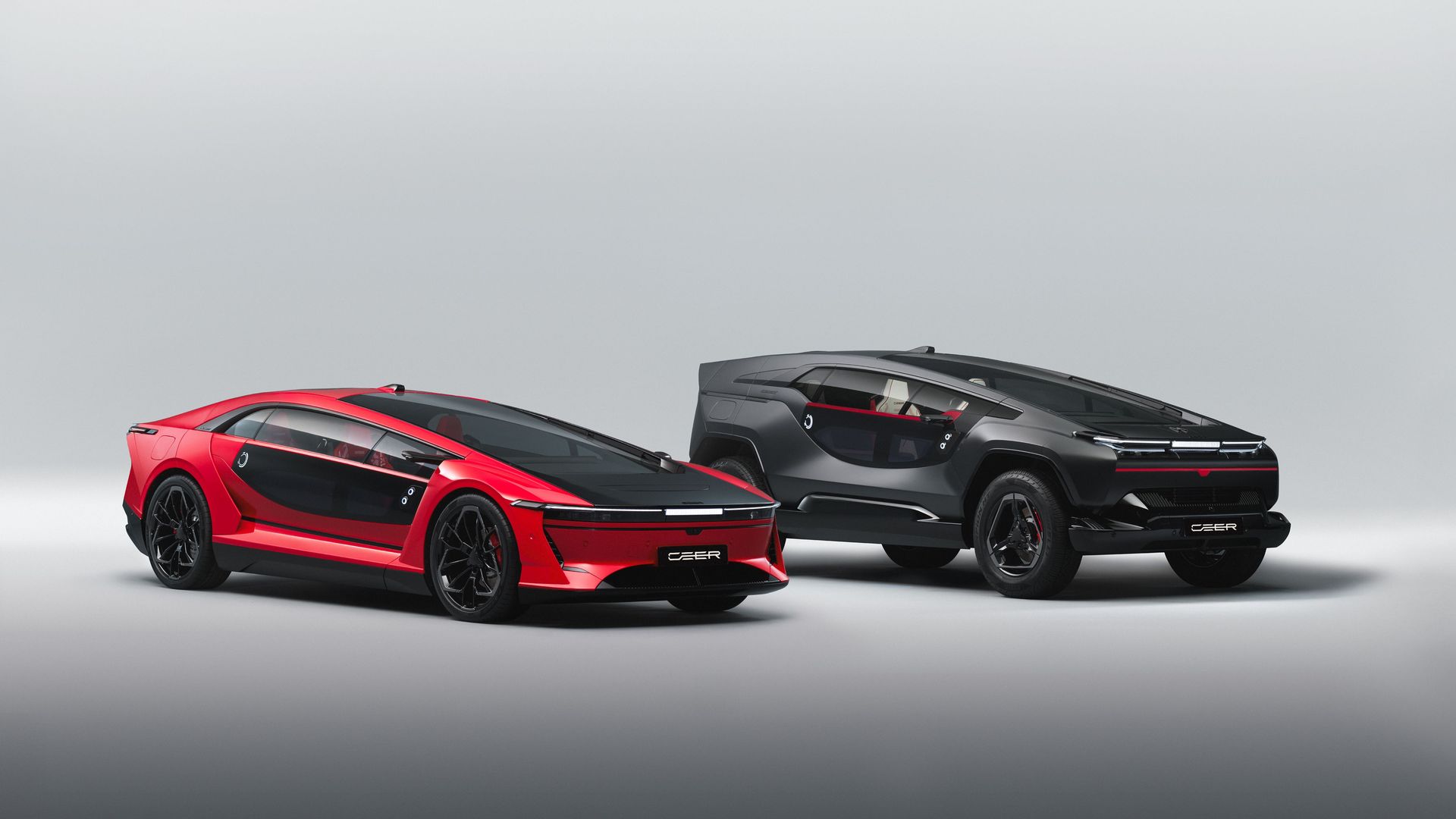
🇸🇦 A new Saudi startup called Ceer introduced two of the wildest-looking electric vehicles I've seen (and that includes Tesla's Cybertruck). The Exobot sedan and SUV (above) are expected to go on sale in Saudi Arabia starting in 2027. (The Verge)
🚗 Future Mercedes-Benz vehicles will use driver-assistance technology powered by Wayve, a UK-based autonomous-driving startup. It means Mercedes cars will be capable of point-to-point driving assistance in cities, similar to Tesla's FSD (Supervised) system.
🚛 📈 Aurora outlined an ambitious vision for 2030, targeting more than 30,000 driverless trucks on the road, and telling analysts to expect a "multi-billion dollar revenue stream and SaaS-like gross margins." (Aurora release)
- That's a steep growth curve; Aurora is on track to have 200 trucks in operation by the end of this year.
📌 If you're in Washington, D.C., on Thursday, Oct. 1, join me at 7:30 am for a conversation on the policies, investments and technologies shaping the future of transportation.
- The event will feature Northern Virginia Transportation Authority CEO Monica Backmon, Advocates for Highway and Auto Safety president Cathy Chase, and Nuro co-founder and co-CEO Dave Ferguson. RSVP here.
Thanks to editors Pete Gannon and Bill Kole. If you're a fan of this newsletter, please ask your friends to sign up, too.
Sign up for Axios Future of Mobility