Uber rewrites its playbook for the robotaxi era

Add Axios as your preferred source to
see more of our stories on Google.
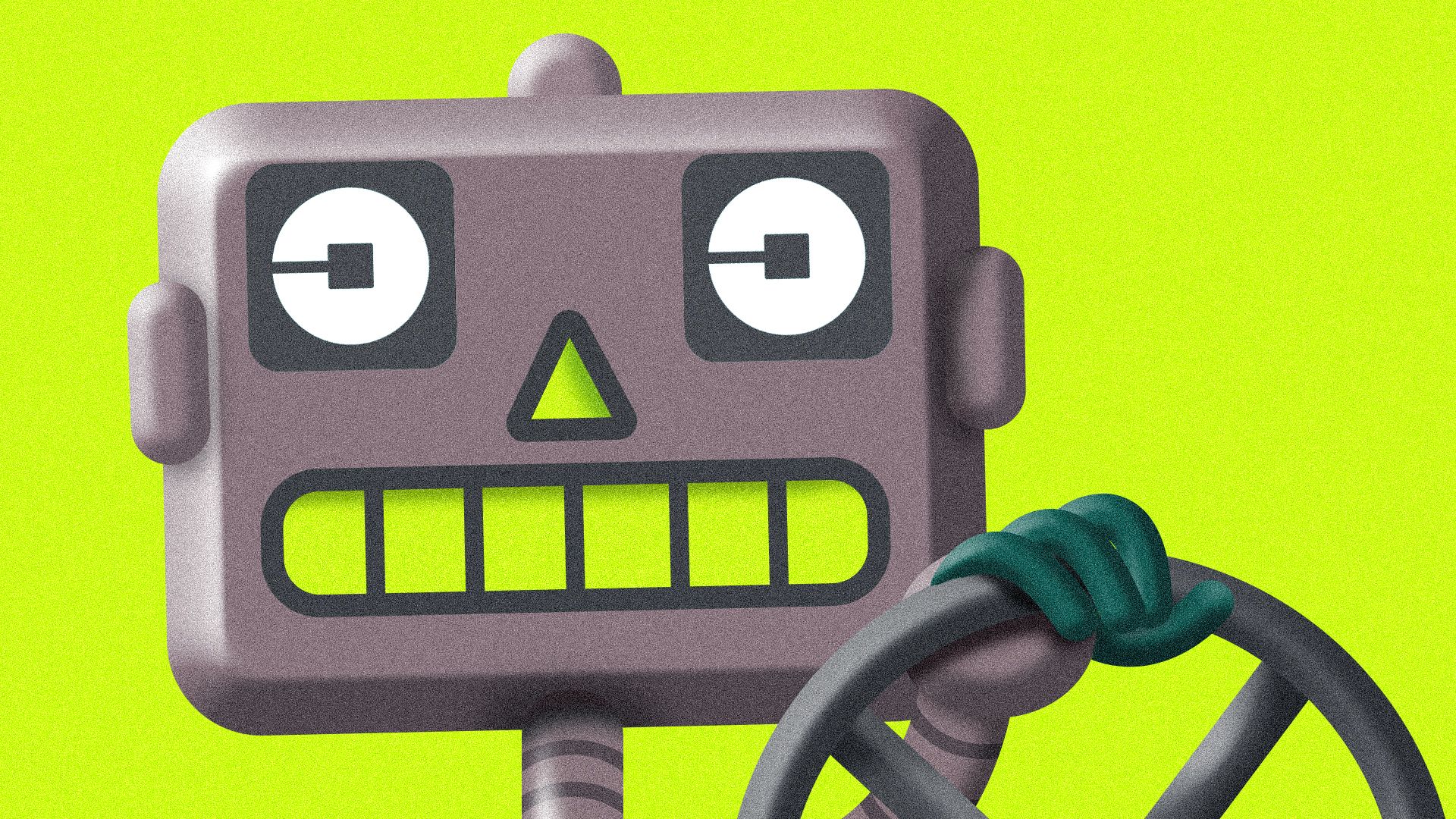
Illustration: Sarah Grillo/Axios
Uber, the taxi industry's original disrupter, is rewriting its own success formula as it confronts the next revolution in transportation: robotaxis.
Why it matters: The ride-hailing giant expects to pour more than $10 billion into AV companies, vehicles and physical infrastructure over the next few years — a dramatic reversal by one of Silicon Valley's quintessential "asset-light" companies.
- It's a price CEO Dara Khosrowshahi is willing to pay to try to ensure Uber remains the go-to marketplace for rides — even when nobody is behind the wheel.
- "Uber has never been about protecting the status quo. Autonomous vehicles can accelerate safer, more affordable and reliable transportation for all, and we're driving it forward," he tells Axios.
The big picture: Uber's original formula was matching riders with cars it didn't own, and with drivers it didn't employ.
- It repeated that success with food delivery and freight; Uber provided the digital marketplace and routing software while others managed the expensive hardware.
- But now companies like Waymo and Tesla are building their own driverless taxi networks, threatening to cut Uber out of the transaction altogether.
Uber's response is to bet broadly on AV investments rather than pick a winner.
- "We want to partner with every single AV provider, technology provider out there," Sarfraz Maredia, Uber's head of autonomous mobility and delivery, tells Axios in an interview.
- Uber gives AV companies what they need to scale: riders, infrastructure and a ready-made marketplace.
- And it's supporting dozens of companies with equity investments, vehicle purchases or robotaxi partnerships, both to promote competition and to ensure Waymo and Tesla don't get too far ahead.
Between the lines: These investments, Uber has said, are designed to jumpstart the AV industry.
- The risk on the mind of investors is that the company is changing its business model and committing enormous resources before the underlying economics of robotaxis have been proven.
Zoom in: "The strongest thesis behind investing in AVs is the safety and reliability that it can bring," Maredia tells Axios.
- "The piece that we hope is true over a longer period of time, is that that technology, which is safer, will be cheaper."
- Whether anyone can deploy robotaxis safely, profitably, and at scale, however, is still unproven, he acknowledged.
- "Nobody has checked all three of those boxes. Not even Waymo," he said, referring to the robotaxi leader.
Flashback: Uber tried to develop its own AVs a decade ago, but then stopped after one of its test vehicles killed a pedestrian in Arizona in 2018.
- Uber sold the division to Aurora in 2020 after years of heavy spending.
- Now it's pivoting from building AV technology to partnering with those who do.
Follow the money: Uber believes that, this time around, its AV spending spree will be temporary.
- "There are certain things that we're choosing to do at this stage because we think it helps catalyze growth for the ecosystem," Maredia says.
- Eventually, Uber expects third-party investors will take over financing robotaxi fleets and depots so it won't need to carry those assets on its own balance sheet forever.
By the numbers: Uber has more than 30 AV partners — spanning robotaxis, delivery robots, drones and trucking — who have pledged to deploy 120,000 robotaxis on Uber's platform.
- Uber has invested directly in some of them — albeit with milestone-based strings attached — including up to $1.25 billion in Rivian, $500 million in Lucid, $500 million in Nuro and $250 million in Waabi.
- It also has undisclosed investments in Avride, Wayve and China's WeRide.
- Uber also plans to spend $100 million for robotaxi depots in three cities, with more infrastructure spending in the works, including in cities that have not yet been publicly announced.
The bottom line: Uber's strategy ultimately depends on two unproven bets: that robotaxis can become a profitable business — and that, when they do, someone else will be willing to own the expensive parts.
