Uber uses its ride-hailing fleet to train AI

Add Axios as your preferred source to
see more of our stories on Google.
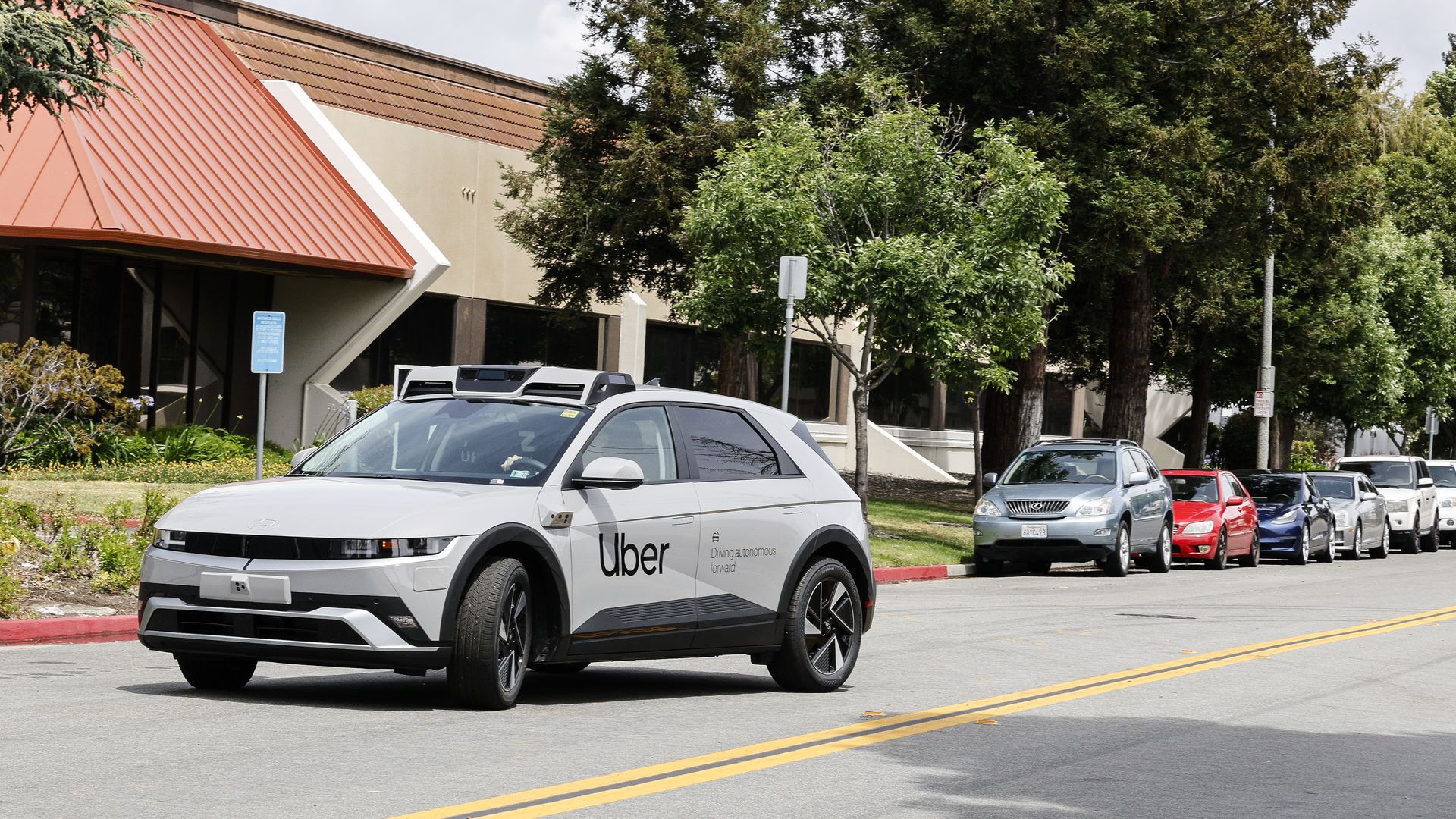
Uber AV Labs' data collection vehicle. Image: Courtesy of Uber
Uber's robotaxi ambitions depend on something it can't control: how quickly its autonomous-vehicle partners can perfect their technology.
Why it matters: Uber needs its AV partners to close Waymo's roughly two-year technology lead — and it's betting data from millions of human-driven trips can help accelerate their progress.
Driving the news: Starting this month, Uber will deploy up to 500 specially equipped Hyundai Ioniq 5s to gather data about the weird stuff that Uber drivers encounter every day.
- The human-driven vehicles, outfitted with 14 cameras, eight lidars, nine radars and onboard computers, are designed to capture the kind of real-world situational data that's so crucial for AV developers to train their AI driving systems.
The big picture: The AV race is increasingly a scramble for data.
- Engineers are no longer writing rules for how a car should handle specific situations. Instead, they're developing generalized AI systems that learn how to drive from examples.
- "To fine-tune the software, really, what you need is [more] data," explains Uber's vice president of engineering and science, Danny Guo, who heads its newly created AV Labs unit.
Zoom in: The more varied driving situations an AI model sees, the better it can learn how to respond.
- The hardest part is collecting enough unusual "edge cases" — everything from a police officer directing traffic to debris blowing across the road — that rarely show up in routine driving.
State of play: Tesla has a huge advantage because millions of customer-owned vehicles are collecting data from public roads every day.
- And Waymo has already logged far more than 200 million fully autonomous miles with its fleet of more than 4,000 vehicles.
- Uber thinks its global ride-hailing network can provide a similar advantage for the dozens of AV companies it hopes will eventually operate on its platform.
Between the lines: 500 vehicles is no match for Tesla's global fleet of almost 10 million vehicles.
- But Uber says it can deploy its much smaller fleet in the specific cities and driving conditions its partners need, such as navigating crowded entertainment districts or tricky pickup and drop-off points.
- Guo estimates that 500 cars operating for six months to a year could produce enough diverse, searchable data to be useful to an AV developer preparing for deployment.
Uber AV Labs already has deals to provide data to Nvidia and Wayve to help their robotaxi development, and it's in discussions with other AV partners, too, he said.
Inside the room: I got a backstage pass to see Uber's Hyundai fleet being upfitted at Roush Industries, the contract manufacturing firm in suburban Detroit that is the go-to manufacturer for tech companies developing AV test fleets.
- Floor-to-ceiling curtains separate each of the secretive projects within the sprawling manufacturing campus.
- I watched as technicians tore down the Ioniq 5s — removing the headliner, seats and other internal panels to run wiring that would carry information from the sensors to an onboard computer installed in the trunk.
- They drilled holes in the bumpers and fenders and then installed cameras, lidar and radar sensors.
The bottom line: Uber doesn't have to catch Waymo itself. Its human-driven fleet can help train the robotaxis that eventually join its platform.
