Axios Future of Defense
October 29, 2025

Hello, again, and happy early Halloween.
- I carved a pumpkin for the first time in, like, 20 years over the weekend. It was messier than I remember.
🇮🇱 Situational awareness: Israeli Prime Minister Benjamin Netanyahu yesterday ordered "powerful strikes in the Gaza Strip" after accusing Hamas of violating ceasefire conditions.
Enjoy: Hanwha huddles with HavocAI, AUVSI links with Altana, and True Anomaly CEO Even Rogers lands in the hot seat.
Today's newsletter is 2,097 words, an 8-minute read.
1 big thing: Trump-Xi Taiwan talk
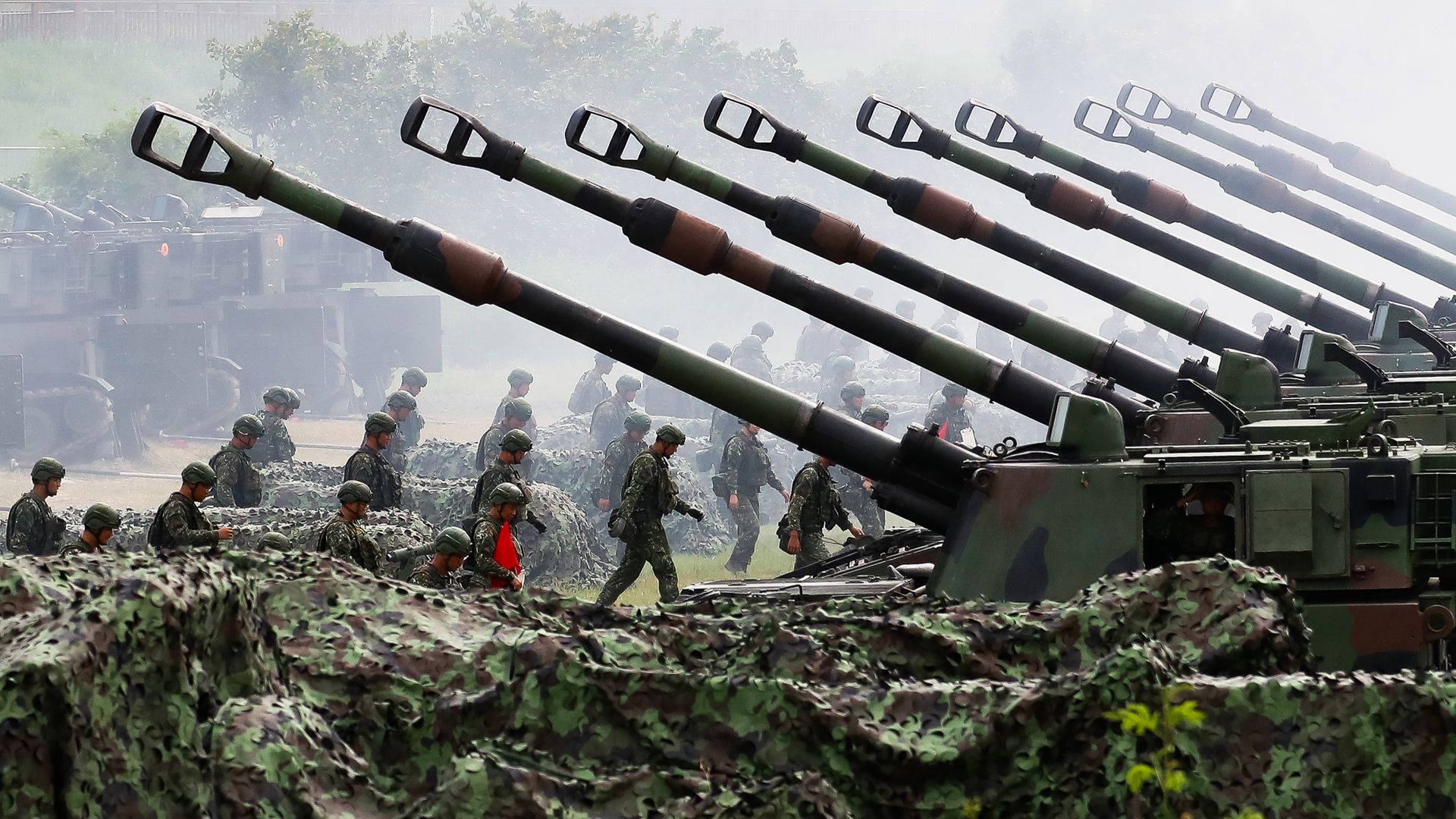
Eyes and ears are fixed to the Indo-Pacific this week, as President Trump leapfrogs across Malaysia, Japan and South Korea and prepares for a high-profile rendezvous with Chinese President Xi Jinping.
Why it matters: Trade is at the top of Trump's agenda, with the markets bracing for news on tariffs and export controls. But the two are also expected to discuss Taiwan, which remains a focal point of fears over potential great-power conflict.
- After all, the Davidson window — or the idea that Beijing could make a move by 2027 — is drawing near.
- Trump has sporadically cast doubt on America's willingness to defend the self-governing island, including by claiming Taiwan "stole our chip business." But he's also claimed Xi won't actually invade, at least while he's president.
- Any remarks Trump makes in South Korea will be parsed in Taipei.
Breaking it down: At the Future of Defense Summit last week, I discussed the state of play with Ambassador Alexander Yui, Taiwan's representative to the U.S. Here are some of the standout moments:
🥊 On invasions: "We are doing what we can to prop up our self-defense capabilities," Yui said.
- If Xi "calculates he can't do it quickly, I don't think he'll do it. I don't think the Chinese people have the stomach for a protracted war," he added.
- Russia's failure to achieve a speedy victory in Ukraine — coupled with a staggering number of recorded casualties — could factor into Xi's thinking.
🗺️ On navigating Trump 2.0: The new administration is "obviously" different from its predecessors, but "we respect that because every country has its own way of managing things," Yui said. "Every day is still a surprise. It's been, what, nine, 10 months? There's been a lot going on."
- Taiwan is hardly alone in contending with Trump's surprises, including on security issues. Consider the experiences of NATO boss Mark Rutte or Ukrainian President Volodymyr Zelensky.
- But for Taiwan, where even a stray word in a presidential statement can spark concern at home or stoke tensions with Beijing, it's a particular challenge.
- "The communications — the relations — between Taiwan and the United States, it's very fluid, very close and very open," Yui stressed. "You are our most important partner."
📦 On arms deliveries: "The F-16Vs that we purchased during President Trump's first term, the first plane rolled out in March. And the 66 we bought are supposed to be delivered all by next year," Yui said.
- "It's going to be a little challenging. But they're doing what they can to try to speed up. Same with other weapon systems."
- A delivery ceremony was held earlier this year in Greenville, South Carolina, where Lockheed Martin has a factory. But there remains a $21.5 billion backlog in U.S. arms deliveries as of September, according to the Taiwan Security Monitor.
🪖 On China's military: "The Chinese in the last decade or so have expanded their military prowess considerably. Look at the Sept. 3 parade — quite an impressive display of armaments. But their forces are not tested, and they have a pretty interesting situation with their military command," Yui said.
- Nine top generals were expelled this month, officially for financial crimes.
- Previous ousters included former Defense Minister Li Shangfu.
Zoom out: The Pentagon last year assessed that Taiwan continues "to improve defensive resilience through a whole-of-society approach."
- That includes "building its war reserve stocks, growing its defense-industrial base, improving joint operations and crisis response and strengthening its officer and noncommissioned officer corps," according to the latest China Military Power Report.
What we're watching: Trump's social media feeds as the talks wind down.
Go deeper: Crash in South China Sea underscores "incredibly tense" situation
2. Exclusive: Navier's new vessels

Maritime-technology startup Navier today unveiled three hybrid-electric hydrofoiling vessels: the 30-foot Quanta, the 80-foot Valkyrie and the 120-foot Morpheus.
- Each is customizable. And each promises thousands of nautical miles of range as it glides above choppy waters.
The big picture: The Trump administration is obsessing over the shipbuilding gap with China. Sampriti Bhattacharyya, a roboticist and Navier's chief executive, told me the U.S. doesn't just need to catch up in terms of quantity. It also needs to "out-innovate" competitors.
- "Out-innovate means not just producing cheaper vessels," she said in an interview. "The vessels have to be a step-function superior."
- "When it comes to maritime, which is of huge national security, geopolitical, trade and economic risk, we are behind," she said.
- "I want to build a company with the understanding 'How do you make America win?'"
Zoom in: Quanta, launching in 2026, builds on the company's existing N30 Pioneer, which has logged thousands of foiling hours.
- Quanta is being pitched as compact — optimized for patrols and surveillance. Renderings I reviewed show several configurations, including unmanned surface vessel and cargo-carrying.
Zoom out: Navier, just a few years old, is a dual-use company. Defense, Bhattacharyya said, is "a key part of restoring our leadership."
- Navier is already working with the U.S. Navy, and its customers include big-name defense players such as Leidos.
- While the company builds sensors, it doesn't build weapons.
The bottom line: "I believe the technology we have built, and the vessels we are building, will play a key part in fundamentally changing America's positioning on the seas," Bhattacharyya said.
- "We can have a presence that will be unmatched."
3. Mark your calendars
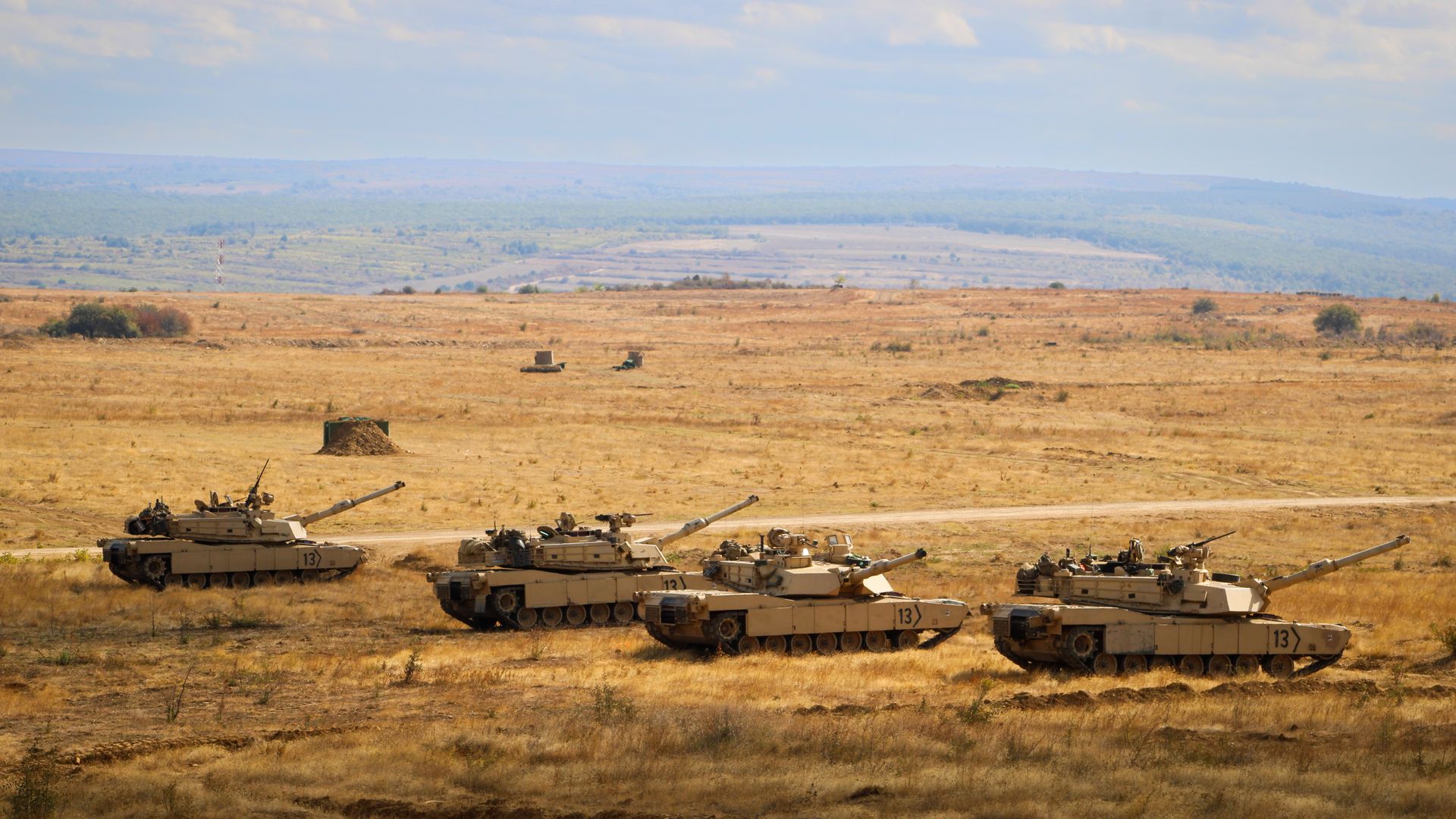
A preliminary version of the U.S. Army's next-generation tank, the M1E3 Abrams, will land in soldiers' hands by the end of 2026.
Why it matters: It's a dramatically quick timeline for such a significant project.
- "The rationale, the way that we moved faster, was we focused on commercialization," Alex Miller, the Army's chief technology adviser, said at a Defense News event this month.
- "Rather than building a bespoke power plant and a bespoke transmission ... we said, 'Hey, there are other companies that do this.'"
Follow the money: General Dynamics this summer secured a $150 million contract for the Abrams engineering program.
Flashback: The Army in 2023 said it was nixing plans to upgrade the M1A2 in favor of a new model that can "win against future threats on the battlefield of 2040 and beyond."
What we're watching: What the service learns from the M10 Booker.
Go deeper: General Dynamics eyes summer delivery of XM30 prototype
4. Exclusive: The Hanwha-Havoc huddle
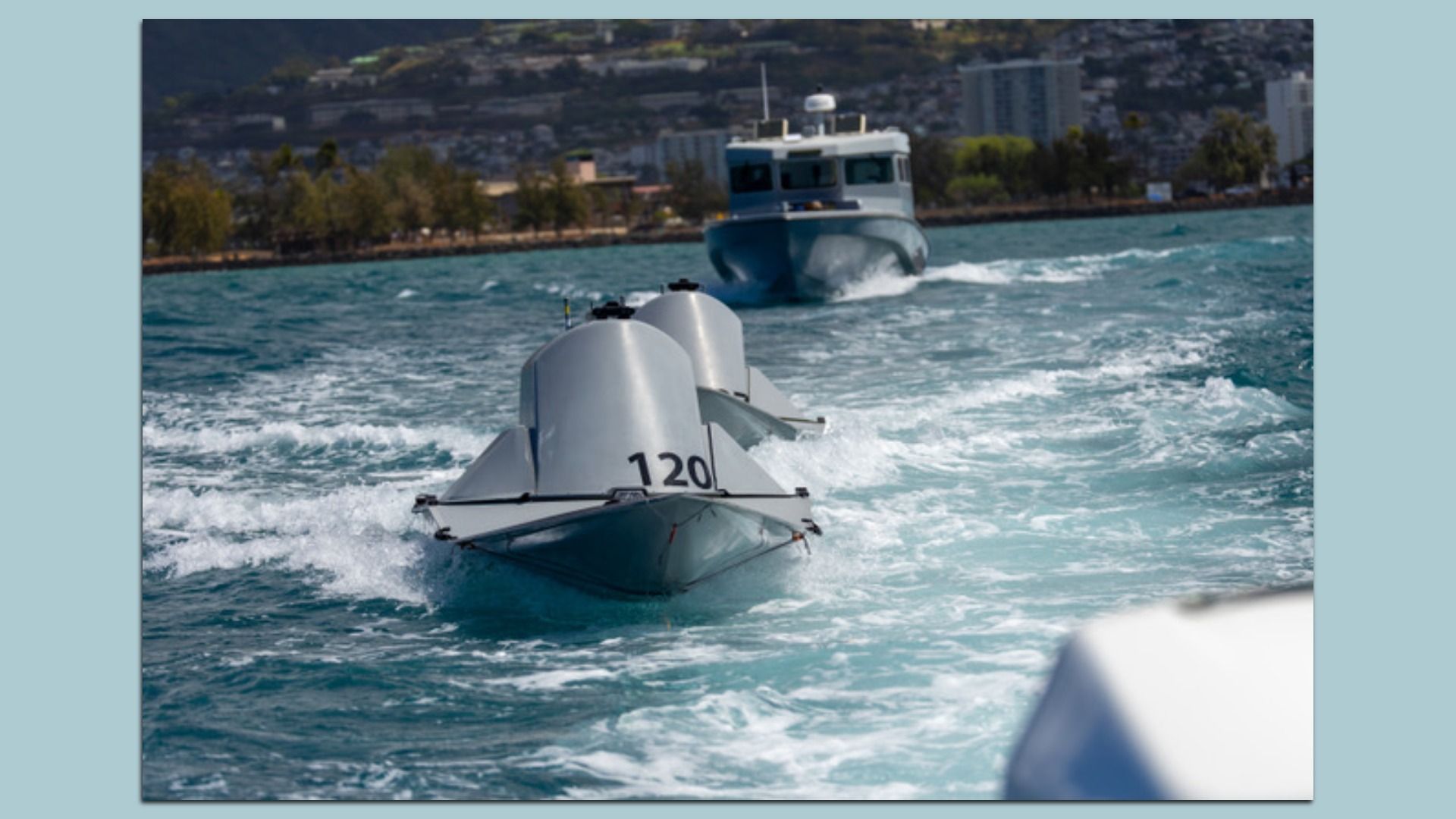
Hanwha Global Defense and HavocAI are collaborating, bringing together shipbuilding and autonomy expertise they believe will shake up the defense market.
Why it matters: The previously undisclosed partnership between a South Korean conglomerate and a U.S. startup could help Hanwha expand its U.S. foothold and Havoc scale up drone boat production.
Driving the news: Executives from both companies are in South Korea this week, getting familiar with each other's shipyard operations and autonomous surface vessel capabilities.
- "We want to push the bounds of what's possible, and do it very quickly," Michael Coulter, Hanwha Global Defense's chief executive, told me.
- "We're on a global defense journey, and we're committed to growing an American workforce and leveraging all that technology and process from our parent," he said.
- U.S. shipbuilding capacity "is just insufficient," he added, despite it being "a national security imperative."
Zoom in: On the schedule was a demonstration of Havoc's vessels, some of which were stationed off Hawai'i and were expected to be tasked from the other side of the Pacific.
- The showcase was set to include at least four 14-foot Rampages and one 42-foot Kaikoa.
What they're saying: "I think a lot of people ... are surprised by how mature our systems are," Havoc CEO Paul Lwin told me.
- The partnership with Hanwha, he added, "de-risks being able to build thousands of autonomous vessels, and we are the startup that can move fast."
- The company was founded last year. It announced $85 million in new funding weeks ago.
5. Quick hits

🔬 The Association for Uncrewed Vehicle Systems International announced a partnership with Altana, meant to enhance supply chain visibility and assurance. The news broke at AUVSI Defense 2025.
- Why it matters: Reliance on Chinese parts and producers jeopardizes U.S. military firepower.
- 💭 My thought bubble: The Government Accountability Office has a report that gets to the heart of this. Give it a read, here.
🚁 An MH-60R Sea Hawk and an F/A-18F Super Hornet plunged into the South China Sea over the weekend. The crews were rescued.
- Why it matters: It's two unusual events in quick succession, tied to the same aircraft carrier, the USS Nimitz. (President Trump suggested bad fuel was to blame.)
- 💭 My thought bubble: My colleague Rebecca Falconer has more from the day of, here.
💼 Former Defense Innovation Unit boss Doug Beck rejoined the Center for a New American Security's board of directors. He abruptly left the DIU post this summer.
- Why it matters: Beck pushed the "DIU 3.0" strategy. He also worked at Apple, where he reported directly to CEO Tim Cook.
- 💭 My thought bubble: If you know what's next for DIU, give me a shout. There's a lot of interest there.
🇸🇪 Sweden could export up to 150 Gripen fighter jets to Ukraine. The process — building, delivering — will take years.
- Why it matters: "This will strengthen both Ukraine, Sweden and Europe," Prime Minister Ulf Kristersson said in a statement.
- 💭 My thought bubble: F-16s. Mirages. Gripens. The logistics tail must be wild.
6. Axios interview: Even Rogers

This week's conversation is with Even Rogers, the chief executive at True Anomaly.
Why he matters: Rogers is — as he puts it — a former space operations officer, commercial fisherman and grease monkey.
- His company in April announced a $260 million Series C.
Q: When you hear "future of defense," what comes to mind?
A: Space warfare, flat out. And that's what I started True Anomaly to go solve for the United States and its allies.
- Warfare is becoming autonomous. It's becoming multi-domain, and it's becoming an activity that happens in the gray zone. So we need to understand not only how our adversaries intend to perform combat, but also how they intend to shape the battlespace before war begins.
- There's all this entanglement around economics, politics and warfare, and the battlefield just looks very, very different than it used to.
Q: When will wars be waged solely by robots?
A: When the robots finally wipe out humanity and fight amongst themselves.
Q: What's the biggest challenge the defense industry faces at the moment?
A: The pace of our adversaries relative to the pace of the innovation and purchasing engine within the Department of Defense.
- Most folks don't talk about both sides of that, they only talk about what's wrong with DOD acquisitions.
- The pace of adversary development of asymmetric technologies — like space weapons and hypersonic weapons and cyber weapons and low-cost autonomous and attritable drones — is really what's driving the need to have a change in buying behavior by the Defense Department.
Q: What region of the world should we be watching? Why?
A: The region of the world we should be watching isn't on the planet. It's in space. It's the orbital environment. It's cislunar space.
- The competitive landscape is now extending not just from low Earth orbit and medium Earth orbit and GEO, but now out to cislunar, as China, in particular, begins to get significant momentum in its civil and military space programs.
Q: How many emails do you get a day, and how do you deal with them?
A: I don't. My chief of staff does. I ignore them all.
Q: What's a piece of gear or tech you can't go without?
A: My Whoop.
Q: What advice would you give your younger self?
A: Don't date what's her face.
7. Check this out

Thanks to everyone who chilled with us at the second Future of Defense Summit. What a whirlwind.
The big picture: The event wouldn't have been possible without everyone above. They hustle hard and make my job easy.
Fun fact: I broke a toe the morning of. (I'll spare you the photos.)
My thought bubble: What did you like or dislike? How'd we do speaker-wise? Did we make enough news? Where should we host the next one?
- Reply to this email and hit me with your feedback!
Shoutout to Dave Lawler for editing and Matt Piper for copy editing.
👋🏼 Thanks, as always, for reading and sharing. Tell your friends to subscribe here.
Sign up for Axios Future of Defense