Axios Future of Defense
November 03, 2026

Good morning! The Future of Defense Summit nears.
- We've added Gen. Christopher LaNeve, Adm. Daryl Caudle and Rep. Gregory Meeks (D-N.Y.) to the lineup.
- Request an invite ASAP.
🇬🇷 Situational awareness: Greece inked a deal for up to six KC-390 Millennium aircraft made by Embraer. The Hellenic Air Force expects to receive the first next year.
Whoa, there: Talking Taiwan in Hawai'i, hypersonic missiles for the F-16 and a fire at the Savannah River Site.
Today's newsletter is 1,741 words, a 6.5-minute read.
1 big thing: Europe's growing pains

"European rearmament" is catchy, convenient, clean.
- But the truth, across many capitals, and in the minds and hands of those building factories and weaponry, is far more complicated.
Why it matters: The continent is at a crossroads. Unpredictability gnaws at the relationship to the west with the U.S., and stray Russian missiles and drones arrive on its doorstep to the east.
- While an influx of defense spending is a solid start, many bottlenecks remain, entrenched by regulatory, political, geographical and cultural differences.
Driving the news: This dynamic, and these observations, became clear over the course of several recent interviews, sit-downs and catch-ups, including on Zoom, at an embassy and in the twilight hours of a Washington defense conference.
What they're saying: "Europe no longer lacks money; money isn't the problem. It lacks the ability, I would say, to turn the money into delivered capability quickly," Tobias Billström, the former Swedish foreign affairs minister now at Nordic Air Defense, told me.
- "We lack factories and we lack skilled workers and we lack procurement," he said.
- "We have to think about what we mean when we talk about 'European independence' or 'European sovereignty.' It's one thing to use these words. But the reality shows a different picture."
Zoom in: A Morningstar report published last month found that defense markets are in the initial stage of "a new supercycle" and that European rearmament is a "long-term demand story," as "decades of underinvestment" have left militaries wanting.
Yes, but: The same report warned that the buildup "faces an uneven path" ahead.
- Some countries, like Poland and Latvia, already exceed NATO's 3.5% spending benchmark.
- Many others don't. (Spain last summer rejected the alliance's spending increase as unreasonable, angering President Trump.)
- "Four years ago, defense topics as a whole were much more difficult to get understood by citizens," Hervé Dammann, a Thales executive vice president, told me. "The trajectory is there."
Threat level: War in Ukraine and across the Middle East has forced a rethink of what frontline fighting looks like and what allies abroad are actually capable of.
- What was once effective no longer works; what was once cordial is now confrontational.
The bottom line: "I think people are saying the right things," but there "is less action than there are words," Joakim Sjöblom, the co-founder of SWEBAL, a TNT-making startup, told me.
- "To add another shift in your factory, it's quite low-hanging fruit, and most of the incumbents of industry have already done that. But to raise a new plant, within the bureaucracy of Europe, takes years," he said.
- "Finding the innovation is not necessarily the bottleneck, but reaching industrial manufacturing capacity is really hard."
Go deeper: Ukraine's Starlink woes spur Europe to look for Musk alternatives
2. Exclusive: Meet Corridian

Corridian, a New England-based robo-submarine maker, exited stealth this morning alongside word of its $38 million seed.
The big picture: The startup wants to build the "stealth logistics layer for the undersea," co-founder Mike Guay told me, as "cheap, swarming one-way attack drones and long-range missiles" make the "surface and sky dangerous places to operate."
- Its advisers include naval heavyweights, retired Adm. Lisa Franchetti, retired Vice Adm. Jeffrey Trussler and retired Rear Adm. Milton "Jamie" Sands III among them.
The latest: Corridian plans to unveil its flagship ultra-large autonomous undersea vehicle next year.
- It's designed to carry ISO-standard, containerized payloads long distances without a crew. (That could mean sensors or supplies. That could also mean weapons.)
- "I'd say our platform carries whatever payloads our customers choose. It's a platform in the truest sense," said Guay, a former Army field artillery officer.
- He declined to share additional specs, including how the AUV would be launched.
Friction point: U.S. shipbuilding is in a tough spot. Many of America's highest-priority warships are behind schedule.
- Corridian, though, is adopting "more of an aerospace manufacturing model," according to Guay.
- That means the startup won't "interfere with the critical work of the submarine industrial base, while also leveraging a broad commercial supply chain," he said.
- "We have railroads to move over land. We have shipping to move on the surface. We have rockets into space. But undersea, nothing like that really exists."
Follow the money: Point72 Ventures led the seed, with participation from Balerion Space Ventures, Harpoon Ventures, DCVC and Marlinspike.
- "I've invested in more than 25 companies, and I struggle to think of a more serious, elite team than the founders of Corridian," Stephen Rodriguez, an investor with DCVC, told me.
- "I backed them from the start because when the shooting starts, anything observable is gone."
What's next: Corridian expects to double its workforce over the next year.
Go deeper: Navy dishes out $76 billion for Virginia and Columbia subs
3. Taiwan at TechNet

U.S. Army Pacific is preparing for a potential Chinese invasion of Taiwan in 2027 and beyond, aligning with what has for years been known as the Davidson window.
Why it matters: The Beijing-Taipei relationship is among the most closely watched in Washington — and could quickly devolve into a bloodbath.
Driving the news: USARPAC commander Gen. Ronald Clark was asked last week about military readiness in the Indo-Pacific and if the Davidson window was still valid.
- "The answer for us at USARPAC is 'yes,'" he said, onstage at the TechNet Indo-Pacific conference in Hawai'i.
- "Again, it's not a date that we think conflict will happen — it is a period of time for which we're snapping the chalk line to say we need to be ready by," he added.
- "We'll continue to prepare. We'll continue to modernize. We'll continue to posture ourselves for the business of deterring war well beyond '27."
Context: China regards Taiwan as a renegade province and seeks control over the self-governing island.
- The Davidson window, meanwhile, is named for retired Adm. Phil Davidson, the former head of Indo-Pacific Command, who in 2021 warned lawmakers of Beijing's buildup and ambitions.
The intrigue: Clark was Davidson's chief of staff during the now-hallowed exchange.
- "We didn't know it was the Davidson window; somebody else came up with that," Clark said. "But I was, literally, in the headquarters with him, and part of the team that helped prepare for the testimony."
Friction point: The Trump administration has previously held up arms deliveries to Taiwan.
More from Axios:
How friends and foes are converging on the Philippines
Drills, deals and doubts in the Pacific as Trump visits China
What to expect of a Trump-Xi-Putin nuke meeting — if it happens
4. Falcon fast
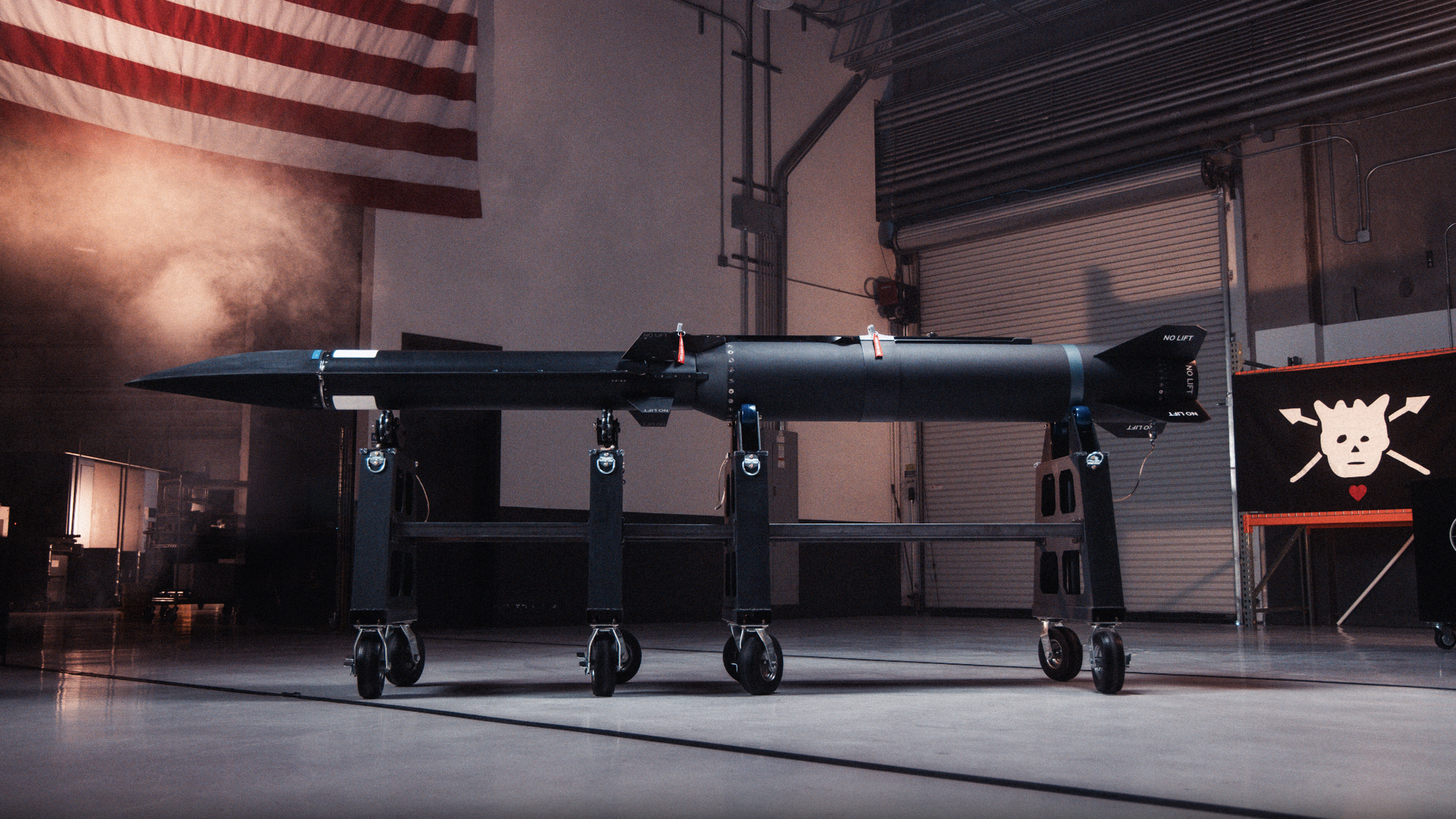
Castelion received the green light to work its Blackbeard hypersonic weapon onto the widely used F-16, newer versions of which are expected to fly well into the 2030s and 2040s.
Why it matters: The venture-backed missile maker's portfolio is growing rapidly across air, land and sea.
Driving the news: Castelion revealed the F-16 contracting update Oct. 26 on X.
- A spokesperson declined to share additional details.
My thought bubble: More than two dozen countries operate the F-16, making this market potentially huge. And Castelion previously secured money for defense exportability design modifications.
How it works: Hypersonic weapons zip at speeds greater than Mach 5, traveling miles in seconds.
- Russia and China are thought to hold the advantage here.
Flashback: Chief executive Bryon Hargis months ago told me there are plans to produce thousands of Blackbeard missiles annually.
- It's "all about scaling out an enormous production capacity," he told me at the time.
Go deeper: Castelion's Blackbeard missile will fly on F/A-18
5. ICYMI: Northwood numbers


Northwood Space raised $375 million in Series C funding that valued the Torrance, California-based satellite antenna builder and ground station provider at $2 billion.
Why it matters: Modern, fortified infrastructure on Earth becomes more crucial for commercial, civil and military missions as the number of satellites in orbit swells.
- There were just shy of 3,500 operational satellites in 2020. Today, that number has skyrocketed to more than 17,000, per the American Enterprise Institute's space data.
6. Quick hits

🏥 One person was injured in a fire at the Savannah River National Laboratory, part of the Savannah River Site in South Carolina. Workers were initially ordered to shelter in place. Radiological surveys found no contamination.
- Why it matters: This is a rare incident at one of America's most consequential nuke-producing installations. (Expect few follow-up details.)
- 💭 My thought bubble: People need to chill on X. So, so, so much misinformation and fearmongering.
🛒 Salesforce is buying Rune Technologies — but did not say for how much.
- Why it matters: It's being billed as Salesforce's "most significant national security-focused acquisition." Rune is already working with the U.S. Army and Marine Corps.
- 💭 My thought bubble: My colleague Chris Metinko with Pro Deals has the full story, here.
🏭 BWX Technologies and Antares struck a multiyear agreement for production of tri-structural isotropic nuclear fuel. It will be made at the former's Lynchburg, Virginia, facility.
- Why it matters: "We achieved criticality with BWXT fuel, and it's what will power our electricity-producing reactor, Mark-1, in 2027," Antares CEO Jordan Bramble said in a statement.
- 💭 My thought bubble: I visited BWXT and took a peek at Project Pele in September. More, here.
💵 Re:Build said it secured $2.1 billion in new funding. The investment was led by General Catalyst and JPMorgan Chase's Strategic Investment Group.
- Why it matters: "The products and companies emerging from our ecosystem prove we can help restore America's industrial might," co-founder Jeff Wilke said in a statement.
- 💭 My thought bubble: Co-founder Miles Arnone will join us onstage Nov. 19 at the Future of Defense Summit in Washington!
7. Check this out

I had a blast last week in Little Rock, Arkansas, where I helped moderate the Onward FX conference.
The big picture: Here, Fortune's Allie Garfinkle and I get grilled by Haus founder Daniel Oberhaus.
My spiciest takes from the talk?
- Spell my name right in your pitch, bare minimum.
- You're not a "market leader" if everyone else is, too.
Zoom out: Don't forget to check in with our local newsroom!
Shoutout to Jeffrey Cane for editing and Matt Piper for copy editing.
👋🏼 Thanks, as always, for reading and sharing. Tell your friends to subscribe here.
Sign up for Axios Future of Defense