Piecing together the Pele power puzzle

Add Axios as your preferred source to
see more of our stories on Google.
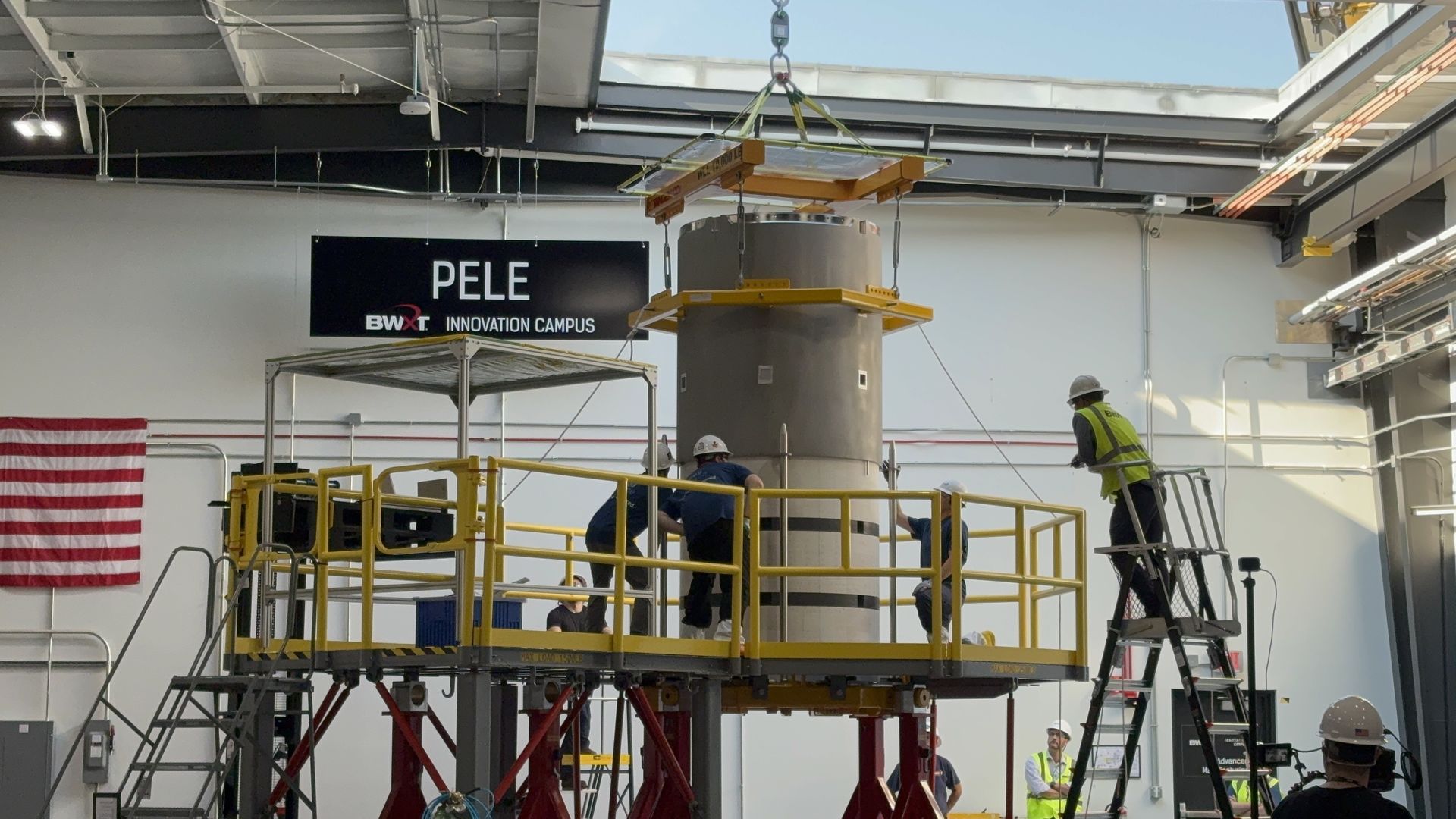
Project Pele progress in Lynchburg, Virginia. Photo: Courtesy of BWXT
LYNCHBURG, VIRGINIA — The build room at BWXT's Innovation Campus was quiet. On the far end, perched above the ground and cloaked in what looked like plastic, the reactor core stood like an altar to nuclear energy.
- Just weeks ago, crews installed the core barrel, lowering it through a hatch in the roof. That pushed Project Pele, and potentially the future of military energy, one step closer to realization.
- "We are, truly, into the fabrication and assembly cycle," Charles Graves, director of government microreactors, told Axios. "There is a huge difference between looking at a paper reactor and getting to a point like this."
The big picture: BWXT was selected by the Defense Department's Strategic Capabilities Office in 2022 to develop and deploy a mobile microreactor capable of energizing troops and their gear in remote locations.
- Much of that work is concentrated here, at a fenced-off facility along the James River, about three hours southwest of Washington. (Contributors elsewhere include Northrop Grumman, Rolls-Royce LibertyWorks and Torch Technologies.)
- The system will next year be shipped to Idaho National Laboratory, where it will be fueled, tested and operated for three years.
- Ground there was broken in 2024. Graves said the site is "progressing well."
Driving the news: Axios linked up with BWXT this month to get an up-close look at Project Pele — its plans and parts, and the mockups that streamline construction.
Threat level: Military energy demands are enormous, and the diesel daisy chain of today is deadly. Resupply runs are targeted; the loud hum of generators can give away your position.
- Small, concealable reactors promise to ease the strain.
What they're saying: "The problem for Pele that we are trying to solve is: produce as much power as you can out of a module that can still fit within that shipping container constraint," Kate Kelly, president of BWXT Advanced Technologies, told Axios.
- "The gravity of the mission that we are all supporting is quite significant," she added. "The industry can't afford a mishap. We need to be successful."
Zoom in: Pele — named for the Hawaiian goddess of volcanoes and fire — is expected to produce 1.5 megawatts of "always on" electricity. It will use tri-structural isotropic fuel, which BWXT also makes and has supplied to other players, like the startup Antares.
Zoom out: Nuclear is mounting a popular comeback.
- Interest is pouring in from all sides: the White House, Pentagon, Silicon Valley, El Segundo. A Gallup poll conducted in March found growing support among average Americans.
- "The scope of opportunities in nuclear," Kelly said, "is just bigger than it has been."
What's next: BWXT's work on Pele is informing another effort known as Janus. Under that arrangement, the company is expected to build and operate BANR, a high-temperature, gas-cooled reactor, at Fort Campbell, Kentucky.
Go deeper: Trump's Iran envoys quietly convene nuclear experts in Tennessee
