Exclusive: Why Antares is bringing nuclear power to Fort Bragg

Add Axios as your preferred source to
see more of our stories on Google.
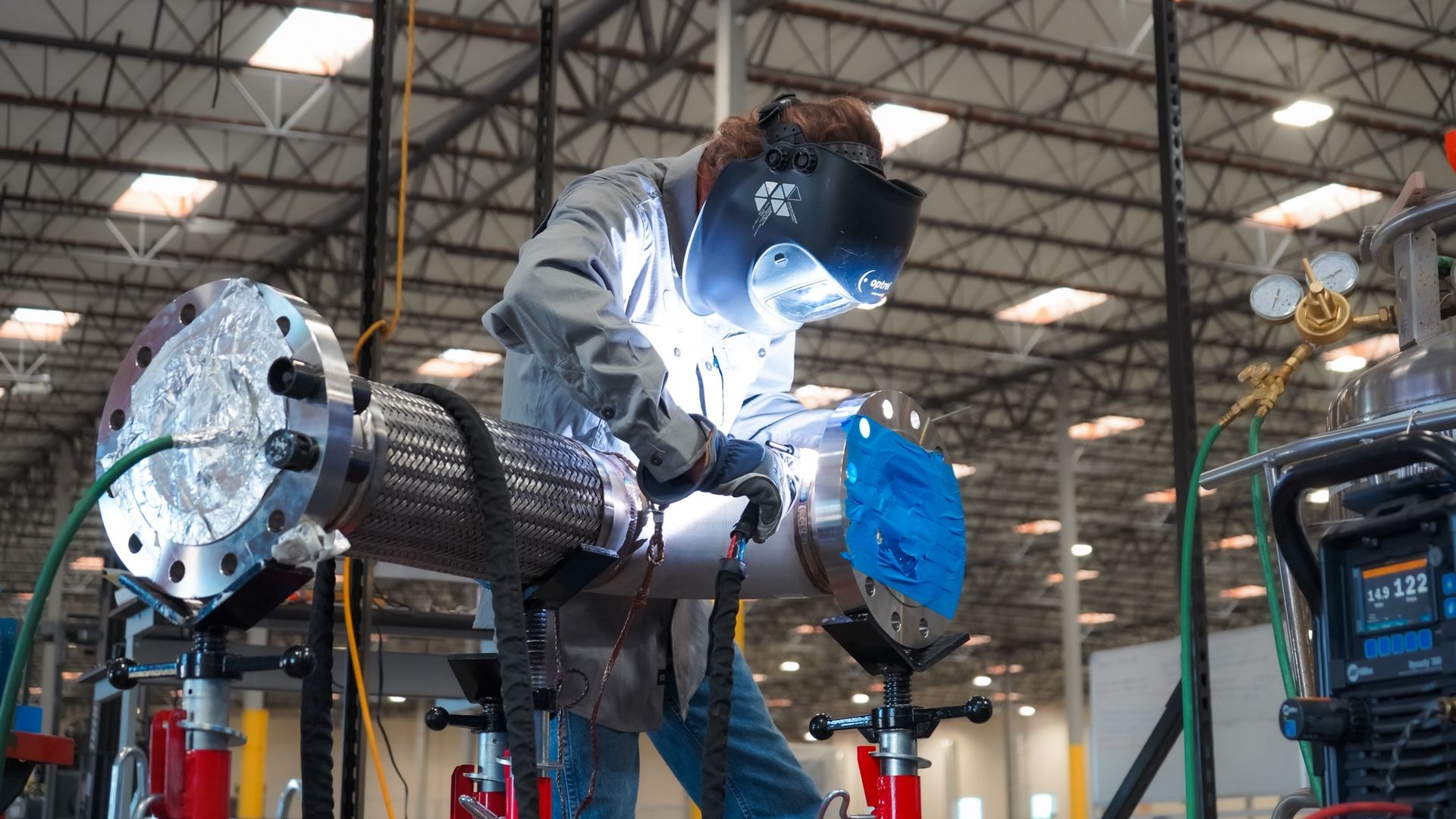
A lead Antares technician welds a component for the company's power conversion system in Torrance, California. Photo: Courtesy of Antares
The U.S. Army and the Defense Innovation Unit have selected Antares to build and operate nuclear microreactors at Fort Bragg, North Carolina, chief executive Jordan Bramble told Axios.
Why it matters: The military's sky-high energy demand — for reusable batteries, computer farms, radars, housing, weapons and more — is an ideal pressure test for nuclear, which has mounted a comeback in recent years.
Driving the news: The arrangement with Antares is one of a handful announced Wednesday under the Janus program, the Army's closely watched, multibillion-dollar answer to a White House executive order issued last year.
- Antares is expected to deliver its reactors in "three packs," according to the service.
What they're saying: "I think the military, for the last decade or so, has been between a rock and a hard place on energy. Most military services bifurcate how they think about energy," Bramble said.
- "We need to bring more of an operational energy mindset to our installations, here inside the U.S.," he added.
- "We need to be able to sustain our most critical operations without the grid, without a civilian supply chain, and nuclear power is actually the best thing we have, in terms of capacity factor, to go do that."
Context: Fort Bragg is home to the XVIII Airborne Corps as well as the Army special operations and Western Hemisphere commands. Tens of thousands of people, uniformed and civilian, are at the post.
Follow the money: Antares declined to disclose the exact dollar amount of its Janus contract. But the CEO said that between work for the Army, Air Force and Space Force, the team now has "a contract value on the order of $1 billion" and that figure is "growing rapidly."
- "Everybody wants to sell to defense — but we started the company, we developed our technology, really focused around this market," he said. "We're already in motion."
- The company recently raised a $470 million Series C.
Flashback: The Antares Mark-0 reactor hit criticality June 4 at Idaho National Laboratory. It was the first to do so for the Energy Department's Reactor Pilot Program. The Army was kept abreast.
- The reactor used tri-structural isotropic fuel, or TRISO. Enough was made for multiple reactors.
- "We actually designed our fuel around the same exact fuel spec that was developed for Project Pele," Bramble said. (Pele is a mobile reactor initiative overseen by the Pentagon's Strategic Capabilities Office.)
Zoom out: The other Janus awardees and their assigned sites are:
- BWXT Advanced Technologies at Fort Campbell, Kentucky;
- General Atomics Electromagnetic Systems at Fort Hood, Texas;
- Radiant at Fort Benning, Georgia;
- And Westinghouse Government Services at Fort Drum, New York.
The intrigue: "These are very different sorts of companies," Jeff Waksman, the Army's principal deputy assistant secretary for installations, energy and environment, told reporters Wednesday.
- "We believe this will be the spear tip," he said, "not just for microreactors, but for all advanced reactors in the United States."
What we're watching: The waste disposition pathways, and how they are negotiated.
Go deeper: Behind the scenes of Trump's advanced reactor race
