1st Cavalry gets new armor as Army bets tank is here to stay

Add Axios as your preferred source to
see more of our stories on Google.
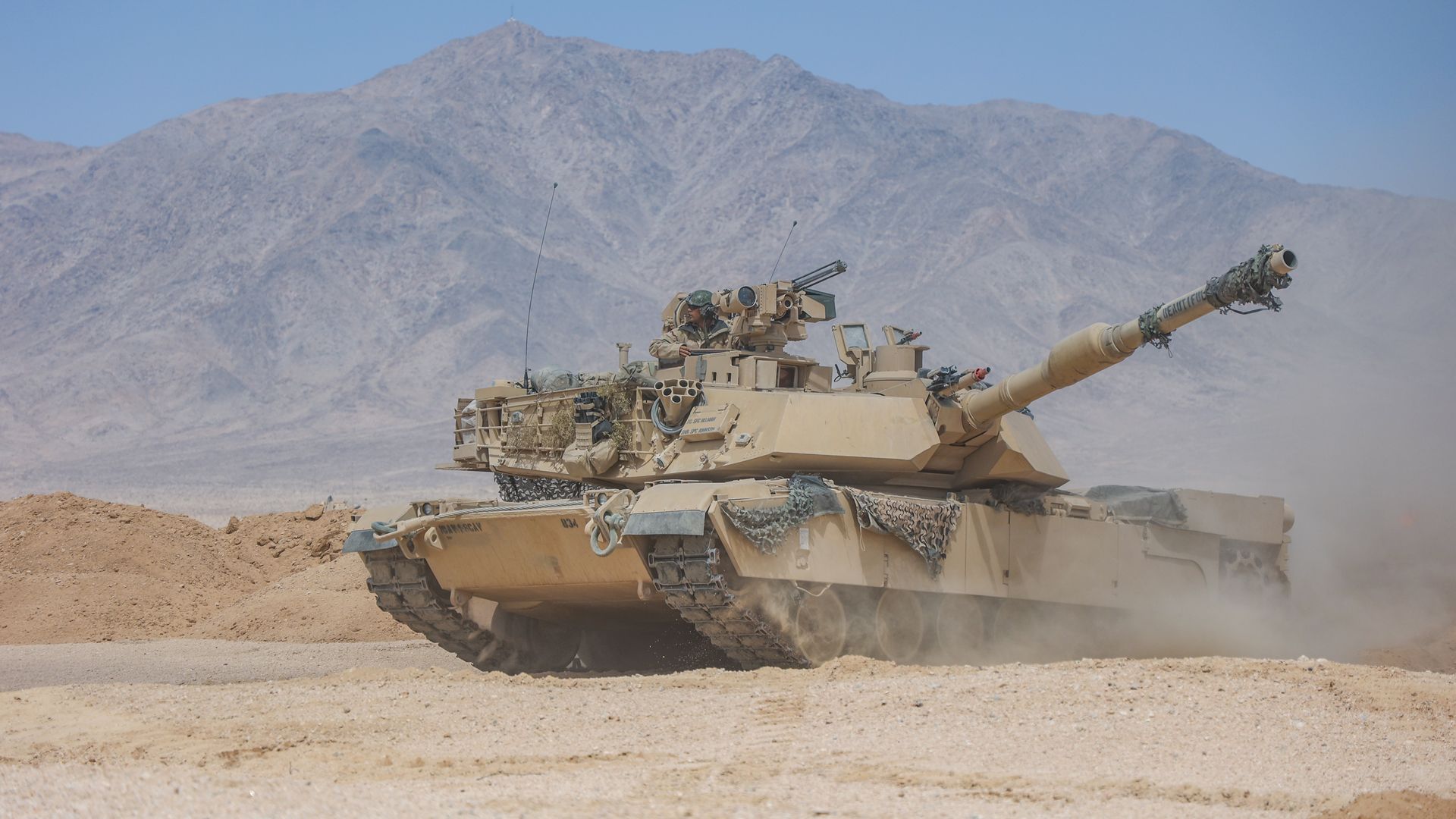
Soldiers with the 1st Cavalry Division maneuver an M1 Abrams at the National Training Center. Photo: Casey Auman/DVIDS
Soldiers with the 1st Cavalry Division will this fall get their hands on two of the U.S. Army's most anticipated machines: the XM30 combat vehicle and the M1E3 Abrams tank.
Why it matters: The Russia-Ukraine conflict has shown the grinding land wars of the tank's heyday are still with us in the 21st century — but also that drones are apex predators.
- Both the XM30 and M1E3 are years in the making, with lineages predating today's bloody battles.
- The Texas-based 1st Cavalry is helping plot the future of armored warfare amid this industrial and tactical upheaval.
Driving the news: "There are a lot of folks that will be like, 'Hey, the tank is dead. What good is the tank on the modern battlefield?' We're paying attention to this," Maj. Gen. Thomas Feltey, the 1st Cavalry commander, told a small group of reporters this month.
- "We've got to be able to break into no-man's land," he said, describing the deadly wastes separating entrenched Ukrainian and Russian positions.
- Speaking ahead of the prototype XM30 and M1E3 trials and after experiments with autonomous breaching alongside the 36th Engineer Brigade, Feltey said there is a need for a "new battlefield framework."
- "The problem we're trying to solve is: How do we restore mobility to the armored brigade combat team? How do we stay on the offense?"
The latest: Two platoons will receive the XM30. One platoon will get the M1E3. Around March 2027, Feltey said, the 1st Cavalry will be "using, shooting, moving and communicating" with them at the National Training Center in California.
- Trainers should arrive as soon as this summer.
- Soldier feedback will inform tweaks to both platforms.
Zoom in: The XM30 succeeds the Bradley. The M1E3 succeeds older Abrams, including the M1A2 SEPv3.
- Together, they provide "enhanced mobility" and signal "a major shift forward, in terms of technology," Feltey said. "They're not just incremental improvements."
- The M1E3, for example, is built with commercial parts in mind. It features hybrid propulsion that supports silent watch, modular sensors to contend with small drones and other incoming fire, and an auto-loader to pack a streamlined punch.
- "Everyone knows armor units — tanks — are thirsty. We use a lot of gas," Feltey said. "With these systems, we think we can halve our sustainment requirements because they're so fuel efficient."
Zoom out: The ubiquity of drones and cheap, trench-rigged munitions in Eastern Europe has forced a global rework of buying habits, training regimens and medicine.
- "There's been over a million infantry casualties in the last four years," Feltey said, "and nobody's saying infantry is obsolete just yet."
- Fighters are pimping out tanks and other armored vehicles for the circumstances, bolting on cages and hedgehog-like whips and spines.
What they're saying: "The M1 Abrams is already the most badass tank in the world — but it's getting better," Alex Miller, the Army's chief technology officer, told Axios.
Follow the money: The Trump administration's fiscal 2027 budget request includes $547 million to buy more than a dozen XM30s.
More from Axios:
Inside the 82nd Airborne's machine-fueled fight
Army seeks "65-year change" in weapons trying and buying
Saudi Arabia wants to buy nearly 300 U.S. tanks, White House says
