Axios Future of Defense

October 20, 2026

Welcome back! Hope y'all survived AUSA. It was slammed this year.
- Our first tranche of Future of Defense Summit speakers has been announced. Check them out, and request an invite to attend, here.
- More coming soon — including uniformed folks.
☢️ Situational awareness: President Trump wants to hold a trilateral summit with China's Xi Jinping and Russia's Vladimir Putin to discuss denuclearization, my colleague Barak Ravid reported.
On the move: Lessons from the underground, Stars and Stripes switch-ups and Aevex air-launch intrigue.
Today's newsletter is 1,811 words, a 7-minute read.
1 big thing: A matter of munitions
GRAND PRAIRIE, Texas — Hadrian is embedding a factory inside a factory not its own.
- And its machinery, capable of running around the clock, is expected to help build some of the world's most complex, in-demand and scrutinized weapons.
Why it matters: This is a major move for the $8 billion startup, and it comes as the U.S. wages war in the Middle East and as the Pentagon strikes deals, in some cases, to triple and quadruple munitions output.
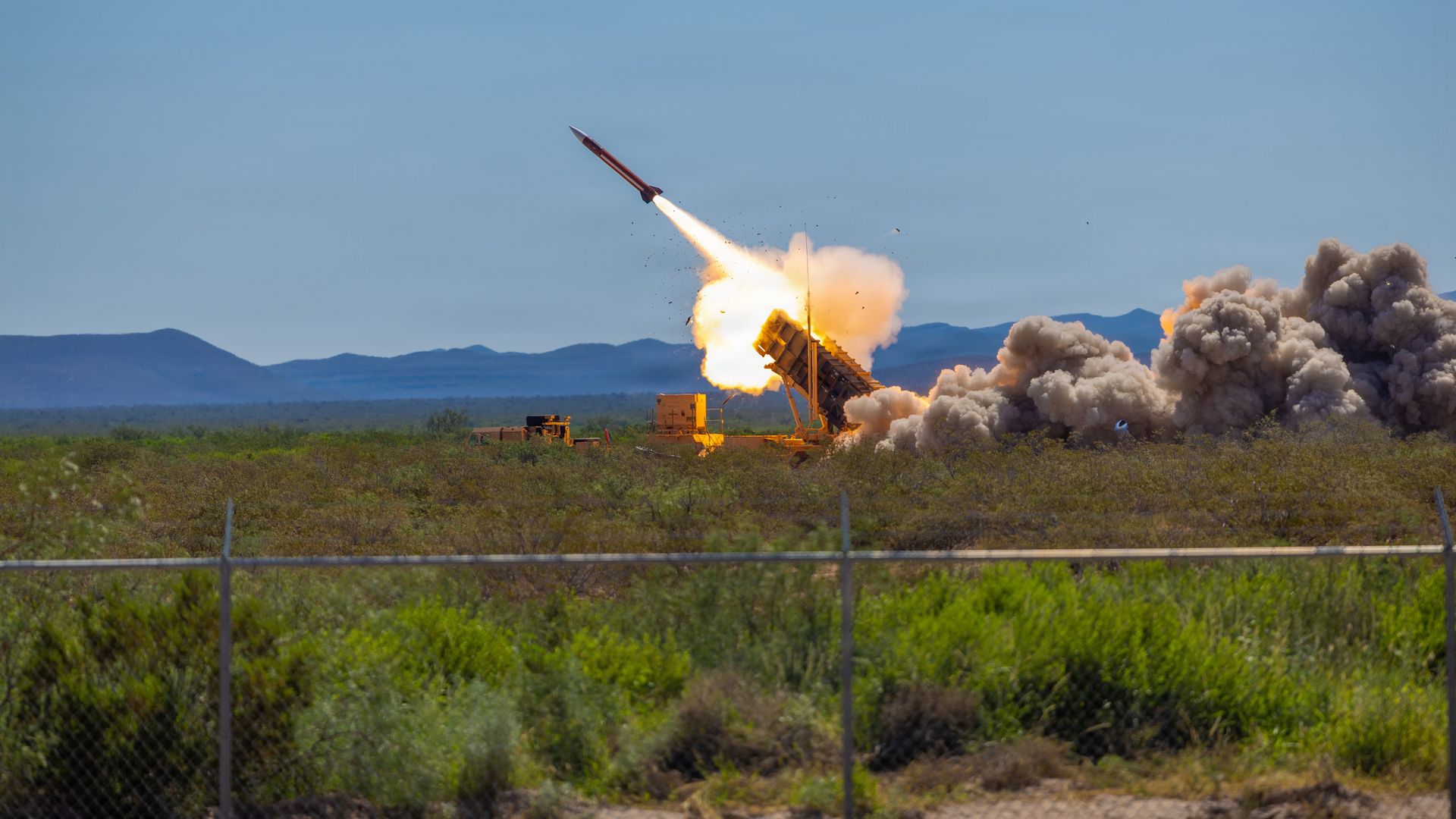
Driving the news: Lockheed Martin on Oct. 14 celebrated an expansion of its missiles and fire-control facility here, just west of Dallas. A key part of that growth — more than 100,000 square feet, all told — is the installation of Hadrian manufacturing capabilities.
- The defense contractors will benefit together from "connected systems, connected workforces, as well as what I would call an overflow to our factory in Arizona," one of a few states where Hadrian operates, CEO Chris Power told reporters.
- "If it gets full," he said, "there's actually a massive buffer."
Zoom in: The Hadrian cells will be overseen by Lockheed employees. They will help build Patriot interceptors, GMLRS rocket artillery and Precision Strike Missiles.
- On display during Wednesday's ceremony were large systems, like the HIMARS launcher, and smaller components, like internal and external fins.
- Also arranged for viewing were Javelin anti-tank kits, a Joint Air-to-Surface Standoff Missile and an Air-Launched Rapid Response Weapon.
What they're saying: "Nineteenth-century tasks, like forging metal, casting metal, machining metal, are being revolutionized" by new technologies, methods and quality control mechanisms, Lockheed CEO Jim Taiclet told reporters.
- "Systemic change has been needed to take advantage of the strengths of the United States," he said. "And that's what's happening."
- The Grand Prairie plant produced hundreds of thousands of parts last year.
Between the lines: The narrative between prime Pentagon supplier and scrappy Silicon Valley startup is changing by the day. What was once an us-versus-them gnashing of teeth has become something far more collegial and collaborative.
- "We have a big tent approach to this whole emerging entrant scenario," Taiclet said.
- Lockheed recently partnered with Saildrone and Fortem Technologies. The former makes drone boats; the latter, radars and drone countermeasures.
Zoom out: "The president says 'peace through strength.' I like to say 'peace through industrial strength,'" Pentagon chief weapons buyer Michael Duffey told reporters.
- "I do think a robust industrial base can form a deterrent in and of itself," he said. "And I think we've seen that over the last year and a half."
Threat level: A report published in March by the Ronald Reagan Institute graded American manufacturing capacity "D+" and defense modernization "D."
- Private-sector innovation received an "A-."
What's next: Hadrian also has plans for a new headquarters and research-and-development hub in California.
Go deeper: CenCore unveiling defense-contractor collaborative in Utah
2. Exclusive: Underground exploits

Few if any Western militaries are prepared for underground warfare: the kind of visceral, claustrophobic fight that's reminiscent of Vietnam War tunnel rats and plays out year after year across the Middle East, according to a Jewish Institute for National Security of America report shared with me.
Why it matters: The lengthy document, littered with warnings, was co-authored by a man known as "Col. David," an elite combat engineer who commanded Israel's counter-tunnel and subterranean warfare operations after the Oct. 7 attack.
- It contains photos of subterranean Hezbollah facilities and Hamas holding cells and tunnels in Rafah big enough to drive a Jeep through.
- "It's really unprecedented access," Yoni Tobin, the other co-author and JINSA senior policy analyst, told me.
- "The reason why they gave it to us, the reason why they want this out there, is because they really want to sound the alarm bells," he said. "Israel is one of the most adaptive militaries, arguably, in history, and they still faced enormous challenges confronting this threat."
What's inside: The report lists five key takeaways from Israel's experience. They include:
- Synchronizing above-ground and below-ground operations and viewing both fights as a "single, cohesive effort."
- Updating military concepts, language and structure to treat subterra "not as a specialized issue, but one that impacts the entire conflict."
- Monitoring and disrupting knowledge transfer and supply chains, even in peacetime.
Threat level: China, North Korea, Iran, terror groups and drug smugglers alike operate and exploit these underground warrens.
- They also share best practices.
- "We know there's so much cooperation between them on so many different fronts," Tobin said, "and this is one of them that often gets overlooked."
The intrigue: A report published by the U.S. Army in 2025 concluded American forces "may not be able to avoid a subterranean fight in the future" and recommended studying the IDF's successes and failures.
My thought bubble: Remember Northeast drone chaos?
- Among the problems then were slapdash policies, reporting chains and countermeasures. The same is true here.
The bottom line: "We're at a political moment where we actually are risking losing access to some of those lessons that our frontline partner has learned," Blaise Misztal, JINSA's vice president for policy, told me.
- The report, he said, is "about raising the profile — or the alarm — on these subterranean threats" as well as "recognizing the hard-fought lessons that Israel has learned."
3. Exclusive: Engine update

Rolls-Royce brought its engine for the MV-75 Cheyenne to full power using a new digital controller known as a FADEC, executives told me.
Why it matters: It's another milestone for this closely watched, multibillion-dollar tiltrotor project, which is expected to replace many of the U.S. Army's Black Hawk helicopters.
What they're saying: "There are so many subsystems that go into a new aircraft design, and certification by the authorities," Scott Ames, a Rolls-Royce senior vice president, told me.
- "All of those have to line up and come together," he said. "The first time this configuration MV-75 lifts off the ground, you have to have checked all those boxes along the way."
State of play: Each Cheyenne, built by Bell Textron, will be outfitted with two Rolls-Royce AE 1107 engines. (A different version can be found aboard the Bell-Boeing V-22 Osprey.)
- Engine testing kicked off in December in Indiana.
- The 101st Airborne Division at Fort Campbell, Kentucky, is expected to be the first to receive the tiltrotor.
Zoom in: The FADEC used represents a "brand-new design" with "a lot of cyber-resilience features," according to Ames.
- Test results, he said, are shared "with Bell and the Army, to demonstrate that the AE 1107 meets all the requirements they're looking for."
Go deeper: Vulcan supplying rare-earth magnets for Army drone push
4. Exclusive: Space safety


Project Omega and Charter Space want to explore how radioactive isotopes can be used to keep expensive satellites in orbit longer and prevent them from being lost to the depths of space.
Why it matters: Satellites often rely on solar power, which can be unpredictable. Reliable power could increase the odds of spacecraft survival.
- NASA has previously observed that about 41% of small satellites fail or partially fail.
Catch up quick: Project Omega is already working with the Energy Department, and this summer announced a multimillion-dollar contract with the Defense Advanced Research Projects Agency.
Zoom in: The firm wants to package its fuel source, strontium-90, into a 1-inch-by-1-inch battery box as a backup power source for spacecraft, reducing the risk of companies losing those space assets.
- Charter Space, an insurance provider, sees the research with Project Omega as a way to improve the likelihood of success and survivability of expensive spacecraft.
- The duo is researching technology like an aviation flight data recorder — or black box — that could be used to diagnose satellite mishaps and prevent future mission failures.
What they're saying: Project Omega CEO Staff Sheehan told me "now is really the time to bring radioisotope power sources to more commercial space," given the increase in providers.
- Charter Space CEO Yuk Chi Chan told me there's a "need to modernize the way that insurance is done in space, so that we can modernize the way that finance and capital can participate in space."
Go deeper: America's not ready for space war
5. ICYMI: Pentagon publishing



The Pentagon appointed a public affairs executive as acting publisher of Stars and Stripes, the military newspaper that has long operated with editorial independence, according to an Oct. 8 memo obtained by Axios.
Why it matters: This leadership shake-up is yet another front in the Pentagon's public messaging fight.
Driving the news: The memo, signed by chief Pentagon spokesperson Sean Parnell, names Christian Devine as acting publisher.
6. Quick hits
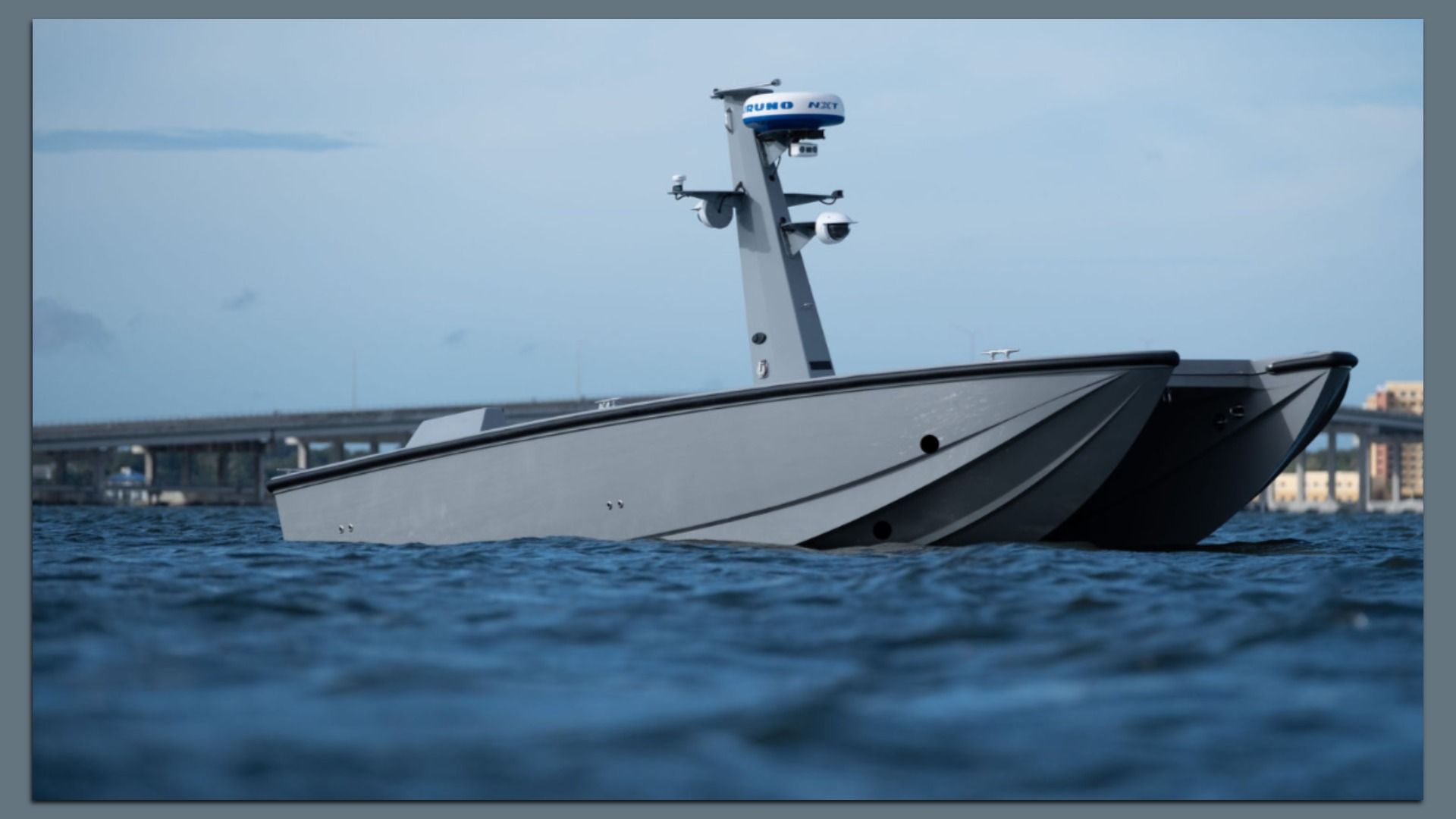
🌊 The Taiwan Coast Guard Administration is acquiring an undisclosed number of Devil Ray T24s made by American company MARTAC. The deal includes a co-production agreement with Taiwan's Confucian Co.
- Why it matters: "This pursuit by the Taiwan Coast Guard represents a landmark moment for MARTAC and for the adoption of unmanned surface vessels in the Indo-Pacific region," Seamus Flatley, MARTAC's chief growth officer, said in a statement.
- 💭 My thought bubble: It only makes sense for Taipei to stockpile drone boats.
📡 Austin Sensing Company emerged from stealth with $15 million in funding, including an $11 million seed. Backers include Bling Capital, Draper Associates and Ensemble VC.
- Why it matters: CEO Tucker Dordevic was named the Premier Lacrosse League's rookie of the year in 2023 and has a background in aerospace-and-defense banking. "I loved working with people building physical things," he told me, "in a space that was really cool."
- 💭 My thought bubble: Tectonic broke the news. (And Dordevic was a very fun interview.)
🪽 Aevex is "prepping for" an air-launched variant of its Specter deep-strike drone, chief technology officer Manan Patel told me on the sidelines of the Association of the U.S. Army conference.
- Why it matters: "Once we design this airframe architecture, we're able to make it bigger and smaller based on what the mission needs are," he said. "You go from requirements to production in months, versus years."
- 💭 My thought bubble: Deep-strike drones are becoming a market unto themselves. Thank Ukraine for the inspiration.
7. Check this out

Thanks to everyone who came out to our aerospace workforce event in Dallas last week.
The three biggest takeaways, you ask?
- Vinegar-based barbecue is superior.
- Hutchins BBQ is a local favorite.
- Skip the Corona. Grab a Lone Star.
Go deeper: Aviation jobs take off in Dallas
Shoutout to Jeffrey Cane for editing and Matt Piper for copy editing.
👋🏼 Thanks, as always, for reading and sharing. Tell your friends to subscribe here.
Sign up for Axios Future of Defense