Axios Future of Defense
September 24, 2025

It's Air, Space & Cyber week. And, man, it's been busy.
- We're a month out from the Future of Defense Summit. Request an invite and chill with the Axios crew!
‼️ Situational awareness: President Trump yesterday said Ukraine can win the war against Russia and recover territory lost to Moscow.
- My thought bubble: It's a stunning change of tone. (For the latest, check out reporting from my colleagues, Barak Ravid and Zachary Basu.)
Hit it: Blue Water Autonomy's shipbuilder of choice, a notebook dump and a plea to address GPS jamming.
Today's newsletter is 2,078 words, an 8-minute read.
1 big thing: Batten down the hatches

The Pentagon is clamping down on press access while simultaneously restricting where, when and how the military and civilian officials engage with the public.
Why it matters: It's a double whammy that could damage not only the public's understanding of national security matters and how taxpayer money is being spent, but also the department's own ability to drive narratives and wage information warfare.
- This is the Pentagon's bunker mentality.
Driving the news: Defense Secretary Pete Hegseth in a memo this month codified changes to how DOD handles "external engagements," noting that past participation in conferences and interviews "tended to canalize toward certain types of institutions."
- Pentagon spokesperson Sean Parnell told me the directive is the result of a process that kicked off this summer "to thoroughly vet all external engagements to ensure the department does not lend its name and credibility to organizations, forums and events that run counter to the values of this administration."
- It comes as the Pentagon also rolls out rules that require reporters to sign a pledge not to gather information that hasn't been officially authorized for release, or risk losing their credentials.
Friction point: The moves come at a moment when tempers are already frayed.
- The Pentagon has held far fewer public press briefings than in previous administrations.
- It's replaced the offices of several mainstream outlets with friendlier, conservative networks.
- It's yanked military officials — last-minute — from well-established events, including the Aspen Security Forum and Defense News Conference.
- And Hegseth and others have taken every opportunity to bash the mainstream: media, think tanks, science.
What they're saying: "When you don't regularly brief and you just go on TV or to outlets that cater to just one audience, you are neglecting that there's a whole world stage out there that takes guidance from what the United States says," Sabrina Singh, a Pentagon spokesperson under the Biden administration, told me.
- "When you're restricting information and choking information off, it actually is going to come at your detriment."
My thought bubble: Trump 2.0 is obsessed with appearances.
- The president has his "central casting" motif. Hegseth has his "warrior ethos" motto and his stars-and-stripes sartorial flair. Pentagon social media channels are bedazzled with hype videos.
Go deeper: Trump 2.0 refashions U.S. military muscle
2. Exclusive: Blue Water on the water
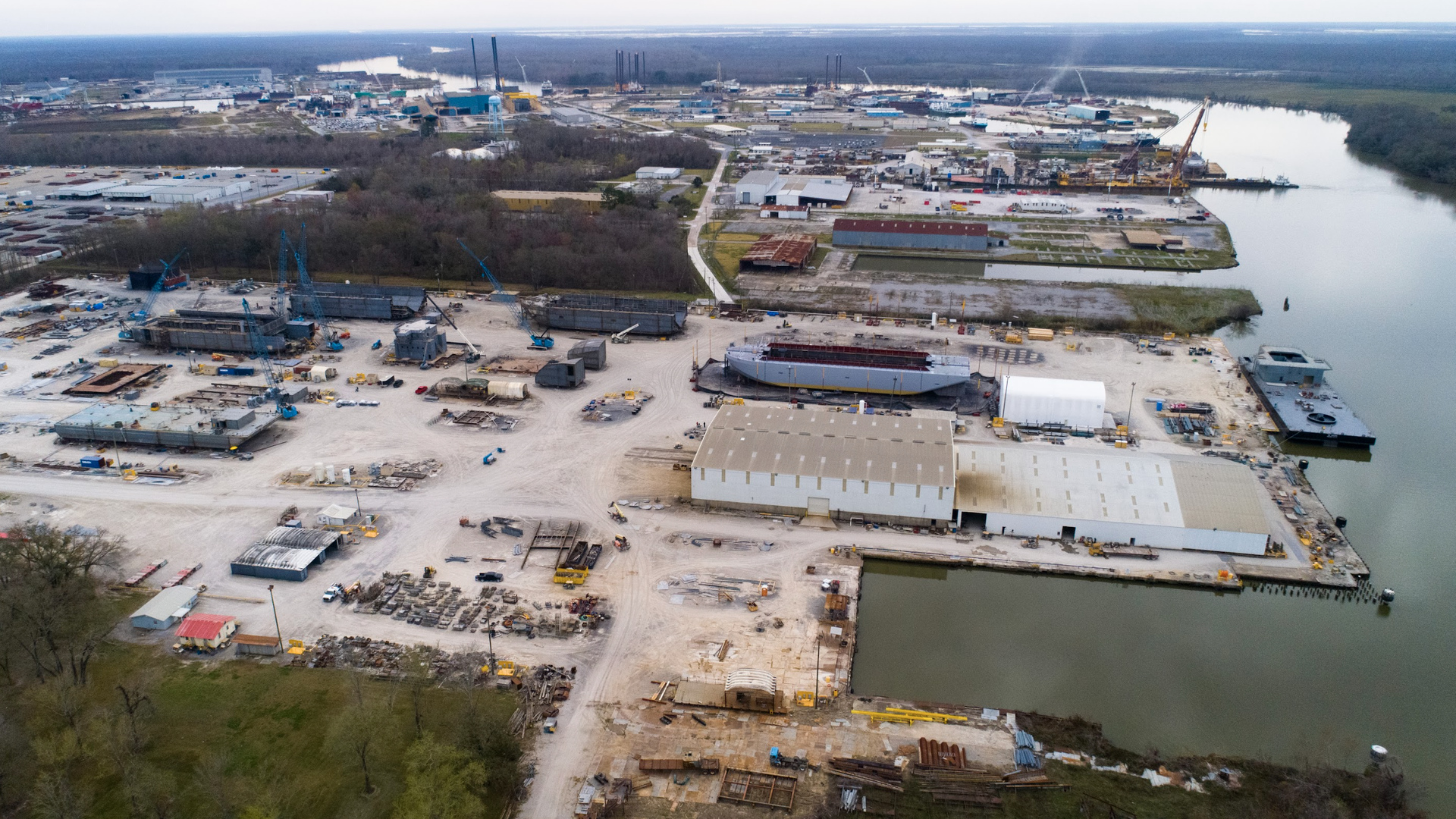
Massachusetts-based startup Blue Water Autonomy picked Louisiana's Conrad Shipyard to build its unmanned autonomous ships, with the first expected to hit the water next year.
Why it matters: The production deal sits at the intersection of two do-or-die issues for the U.S. Navy:
- The revitalization of stateside shipbuilding at a time of Chinese dominance.
- The pursuit of a hybrid fleet that augments sailors and Marines alike.
Driving the news: Blue Water CEO Rylan Hamilton told me the arrangement aligns with the company's "crawl, walk, run mentality," which has thus far involved "building some of the early tech" and constructing a 145-ton test vessel outside of Boston, "where we're taking it out of the harbor and testing it out at sea."
- "With Conrad, we're going to build a true, full-scale production ship — fully autonomous, no people on board — that we designed from keel up," Hamilton said.
- "There's no space on board for sailors. There's no bridge. There's no berthing. There are no galleys. There's not even a gym."
Zoom in: Blue Water's vessel will be 150 feet long and crafted for multiple missions. Design is underway now; physical construction, what Hamilton called "welding of steel," will begin in a few months.
- "The payloads are carried in containers on the back," he said. "Think of it like the F-150 of the open ocean."
Zoom out: Louisiana is becoming a drone-boat hotspot.
- Saronic earlier this year scooped up Gulf Craft, securing 100 acres in Franklin, where it plans to build large surface vessels.
The bottom line: "The beating heart of shipbuilding is in the Gulf," Hamilton said.
- "We've looked all over the country, and we've really found that the Gulf is the place to kind of build these ships, and Conrad's the best suited to do this."
Go deeper: Navy secretary wants "maritime supremacy" from new office
3. Exclusive: A Middle East moment

The U.S. must collaborate with friendly Middle Eastern governments to strengthen a global industrial base and prepare for large-scale wars that will chew through raw materials and high-end munitions alike, according to a new study from Joseph Dunford, a former Joint Chiefs chairman, and Eric Edelman, a former undersecretary of defense for policy.
Why it matters: Conflicts are no longer regional. They are worldwide.
- Supply chains crisscross borders. Fights transcend singular domains. And countries long considered national security threats in Washington are growing intimate.
Driving the news: "Partners in Production: U.S.-Middle East Cooperation to Enhance Our Collective Defense Industrial Base" was published today by the Jewish Institute for National Security of America.
- I got an early look.
What they're saying: "I'm one who buys into the fact that our center of gravity was — and continues to be — the network of allies and partners that we have around the world," Dunford told me.
- "The natural thing to do would be to look for ways to make our partners more capable and increase ... the aggregate defense industrial base of like-minded nations."
Zoom in: Cooperation could be as simple as procuring raw materials and as complex as codevelopment and coproduction of missile interceptors and clean-sheet weaponry, the authors argue.
Between the lines: The foundation is already built.
- The U.S. engages in defense-tech diplomacy overseas, mainly in Europe and the Indo-Pacific.
- U.S. defense contractors have fruitful relationships with Israeli counterparts, including Rafael and IAI.
- The Trump administration is courting Gulf states. It's also advocating for foreign military sales reform.
The bottom line: "The alignment of Russia, China, Iran, North Korea and other like-minded states — that's problem No. 1," Dunford said.
- "Problem two is the inadequacy of the defense industrial base," he added. "That's been exposed with operations in Ukraine, operations in Israel, planning to support Taiwan, and then U.S. requirements for U.S. military forces."
4. The National Harbor notebook
The annual Air, Space & Cyber conference just south of the Capitol brimmed with news — a reversal of fortunes compared with recent ghost-town defense gatherings.
The big picture: Military leaders and defense contractors typically stockpile announcements for these sorts of conventions.
Here's a smattering of the latest headlines:
🪽 The F-47 will fly by 2028, according to U.S. Air Force Chief of Staff Gen. David Allvin. The first fighter is already being manufactured. (Boeing won the multibillion-dollar contract earlier this year.)
🌊 Anduril Industries' conceptual U.S. Navy drone wingman will not look like its Fury collaborative combat aircraft, designated YFQ-44A for the Air Force.
✈️ Northrop Grumman is flight testing its Litening Large Aperture targeting pod aboard an F-16 in Tucson, Arizona, this week.
🐺 L3Harris Technologies is considering communications relay; intelligence, surveillance and reconnaissance; and decoy payloads for its next Wolf Pack launched effect.
🤝 Embraer struck a deal with Sierra Nevada Corporation to sell one A-29 Super Tucano.
🔥 GE Aerospace successfully demonstrated two different rotating detonation combustion engines: a missile-scale ramjet and a dual-mode ramjet for speedy aircraft. The tests were conducted at the company's Aerospace Research Center in New York.
🛜 Bombardier Defense delivered its ninth Global aircraft to the U.S. Air Force for the Battlefield Airborne Communications Node program, often referred to as "WiFi in the sky."
🐝 Beehive Industries, a propulsion startup, said it successfully tested four of its Frenzy engines in six months. The campaign was executed across facilities in Colorado, Ohio and Tennessee.
🔢 Boeing and Palantir Technologies revealed their partnership. The latter's AI expertise will be applied to "a number of" classified and proprietary projects.
📈 General Atomics drones surpassed a total 9 million flight hours. The company makes the Predator, Reaper and Gray Eagle, among other unmanned aircraft.
🤖 Raft, an AI company, announced it won an indefinite delivery, indefinite quantity contract with U.S. Special Operations Command. It's worth as much as $349 million.
⏯️ The Scaled Composites Model 437 resumed flight tests as it's readied for Beacon, an autonomy experiment involving Shield AI, Merlin and other participants.
🚀 Honeywell unveiled the HON1600 engine, specifically targeting the drone market.
Go deeper: Defense firms flex new weapons and contracts at Paris Air Show
5. Skunk Works' latest
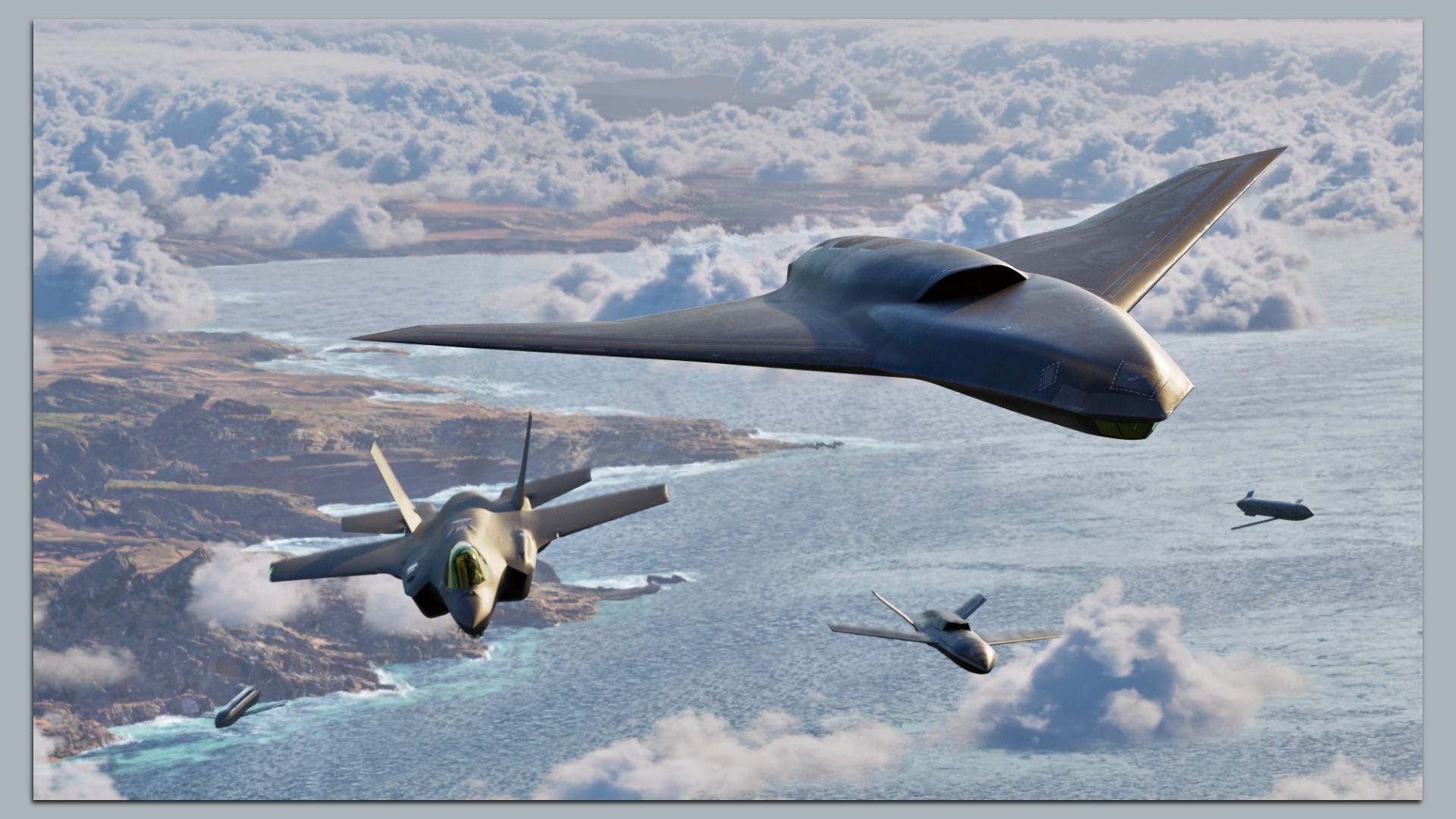
Lockheed Martin's clandestine Skunk Works division is developing a drone wingman known as Vectis, designed for surveillance, electronic warfare, precision strikes and aerial combat.
Why it matters: Public rollouts from such a secretive group are rare.
- Its emergence Sunday — ahead of an annual defense conference just outside of Washington — was no mistake.
Driving the news: OJ Sanchez, the head of Skunk Works, briefed reporters on the aircraft, which he said is smaller than an F-16 fighter but larger than a Common Multi-Mission Truck missile. (Lockheed makes both.)
- "Whether you call them drones, autonomous collaborative platforms or collaborative combat aircraft, we've been developing and fielding them since the early 1960s," he said.
Here's how the largest defense contractor in the world by revenue is pitching Vectis:
- Stealthy, reusable and runway-dependent;
- Useful in the Indo-Pacific, Middle East and Europe;
- Compatible with other aircraft, including F-22 and F-35;
- Competitively priced, but not designed for any one specific contract.
Context: "You don't just come up with a cool design and then instantly start on it. You burn down that risk over time," Sanchez said. "The ability to get to this concept did not happen overnight."
- Skunk Works was involved with the U-2, SR-71, F-117 and RQ-170, among other warplanes.
Friction point: Sanchez declined to discuss Vectis' engine. He said specific "specs and weights" will be discussed "another time."
The bottom line: Both the Air Force and Navy are seeking robo-wingmen to accompany pilots in the near future.
- The latter service tapped Lockheed to build a common control system.
6. Quick hits

🚀 Anduril Industries successfully tested a surface-launched Barracuda-500 at one of the company's ranges. It's part of an internally funded effort to expand the missile's applications.
- Why it matters: "There is much more to come on surface-launched Barracuda-500," Pat Morris, vice president of advanced effects, wrote in a blog post. "This most recent test is just a moment in its development process."
- 💭 My thought bubble: Everyone's favorite neo-prime raises billions but shared a photo straight off an iPhone 3?
⁉️ More than a dozen business groups and industry associations asked Pete Hegseth and Sean Duffy, the defense and transportation secretaries, to address the growing threat of GPS jamming and spoofing.
- Why it matters: "In short, all aspects of defense, U.S. national security, and public safety rely upon continuous, accurate, and available civil GPS," they said in their letter.
- 💭 My thought bubble: Good call. The national security conversation goes deeper — and more digital — than stockpile numbers.
💰 Auterion raised $130 million in Series B funding. The round was led by Bessemer Venture Partners.
- Why it matters: "The future of warfare is software-defined, unmanned, and at scale," CEO Lorenz Meier said in a statement. "Auterion's customers are taking the lessons from Ukraine and applying them to deploying drone swarms."
- 💭 My thought bubble: The defense-tech money machine goes brrrrrr.
7. Check this out

Thanks to everyone who kicked it with us at AI+ DC last week.
The big picture: I interviewed Steve Simoni, the president at Allen Control Systems, maker of the autonomous Bullfrog turret.
Threat level: "All of our weapon systems need to be enhanced with some form of additional autonomy," Simoni told me.
- "Iran, Russia, China — these countries are all making advanced drones. And, from a manufacturing perspective, we're definitely behind on that."
Behind the scenes: The military operates in greens and browns and blues and blacks. But there exists a rose-gold Bullfrog.
- Ask Simoni about it on X.
Go deeper: U.S. is "behind" on drone warfare, defense exec says
Shoutout to Dave Lawler for editing and Matt Piper for copy editing.
👋🏼 Thanks, as always, for reading and sharing. Tell your friends to subscribe here.
Sign up for Axios Future of Defense