Axios Future of Defense
November 05, 2025

G'morning from the passenger seat of a Pennsylvania-bound car, where today's newsletter was polished.
- Axios Pro Deals managing editor George Moriarty and I are chatting about the defense-tech investing boom at noon. Register for the conversation, here.
🪪 Situational awareness: Far-right activist and conspiracy theorist Laura Loomer secured a Pentagon press credential. She joins a cluster of right-wing outlets and personalities that agreed to the building's polarizing press policy.
Served fresh: International Bullfrogs, quantum unicorns and money for nuclear expertise.
Today's newsletter is 1,688 words, a 6.5-minute read.
1 big thing: Here comes the Ford
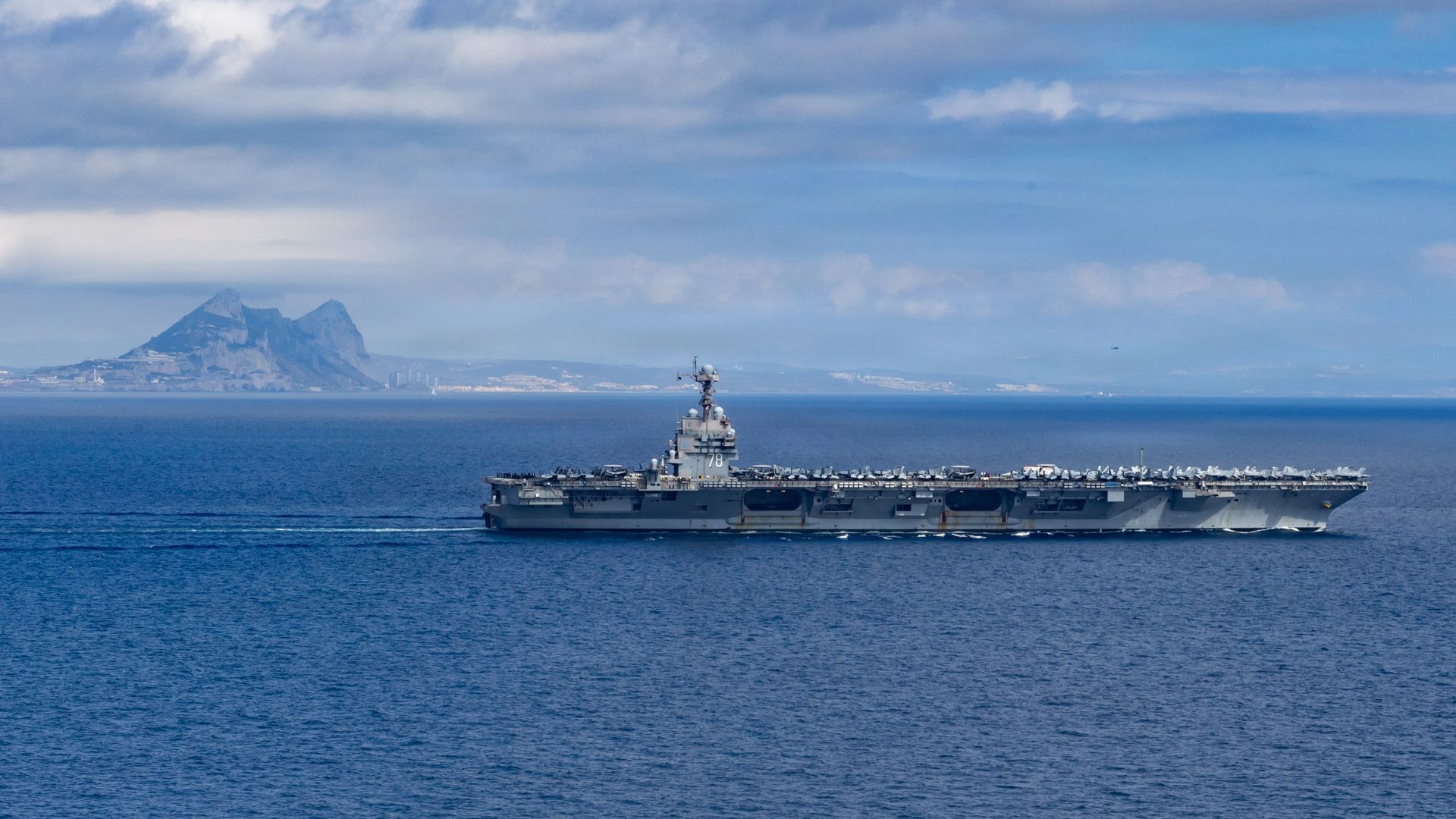
Incredible amounts of U.S. firepower are coalescing in the Caribbean as President Trump plays geopolitical chicken with Venezuelan dictator Nicolás Maduro.
The big picture: U.S. Southern Command, which is executing Trump's strikes and would oversee operations in Venezuela, is now at the heart of the action after decades of Pentagon priority paid to the Middle East and Indo-Pacific.
Driving the news: America's largest warship, the USS Gerald R. Ford, is steaming toward the region. Observers are tracking its progress via satellite imagery.
- The Ford and its escorts bring with them offensive and defensive punch — such as fighter, transport and early warning aircraft; helicopters; missiles; and jamming-and-spying tools — as well as thousands of troops.
- Vessels already in the region include the Iwo Jima, Gravely and Stockdale. Some are packing Tomahawks. Overhead, bombers are ducking in and out, prodding Caracas.
- The U.S. has thus far killed at least 65 people in 15 strikes on alleged drug-smuggling vessels off South America. Trump has made clear he's considering land targets in Venezuela next.
The intrigue: The carrier strike group's tasking and eventual arrival is additional evidence of the Trump administration shifting its focus closer to home.
- Stateside, there's the $175 billion Golden Dome project and the dispatch of troops to U.S. cities and the southern border.
- Zooming out, Trump's war on the cartels is poised to expand further — possibly to Mexico.
What they're saying: "SOUTHCOM has traditionally been a backwater," Mark Cancian, a retired colonel and senior adviser at the Center for Strategic and International Studies, told me.
- "Once in a generation something happened, but the administration's focus on homeland and hemispheric security has produced more attention, and we're seeing that being implemented with this military buildup."
Friction point: An overextension of ships and those embarked could have cascading readiness consequences for other theaters.
- The U.S. has 11 carriers. Two or three are typically at sea at any one time.
- "I think there needs to be a complete discussion about how important this is to us," Bradley Martin, a RAND senior policy researcher and former surface warfare officer, told me.
- "What resources are we using, what types of things are we forgoing as a result of carrying this action out, and how long do we want to be doing this?" he said. "When do we say we've done enough?"
By the numbers: The Navy's presence around Venezuela — where clandestine CIA operations are underway, according to Trump — is becoming less popular, according to YouGov polls of 2,000-plus U.S. adults.
- The biggest dip, it found, was among Republicans: 58% support the armada now, compared with 68% in September. Disapproval, meanwhile, has grown from 13% to 17%.
What we're hearing: Comparisons, and plenty of them.
- Popular ones include Operation Uphold Democracy in Haiti in 1994, the invasions of Grenada and Panama in the 1980s, and even the Cuban missile crisis, in terms of scale and concern. (Reuters described the military buildup as the "largest unrelated to disaster relief" in three decades.)
More from Axios:
2. Exclusive: Poseidon raises $11 million
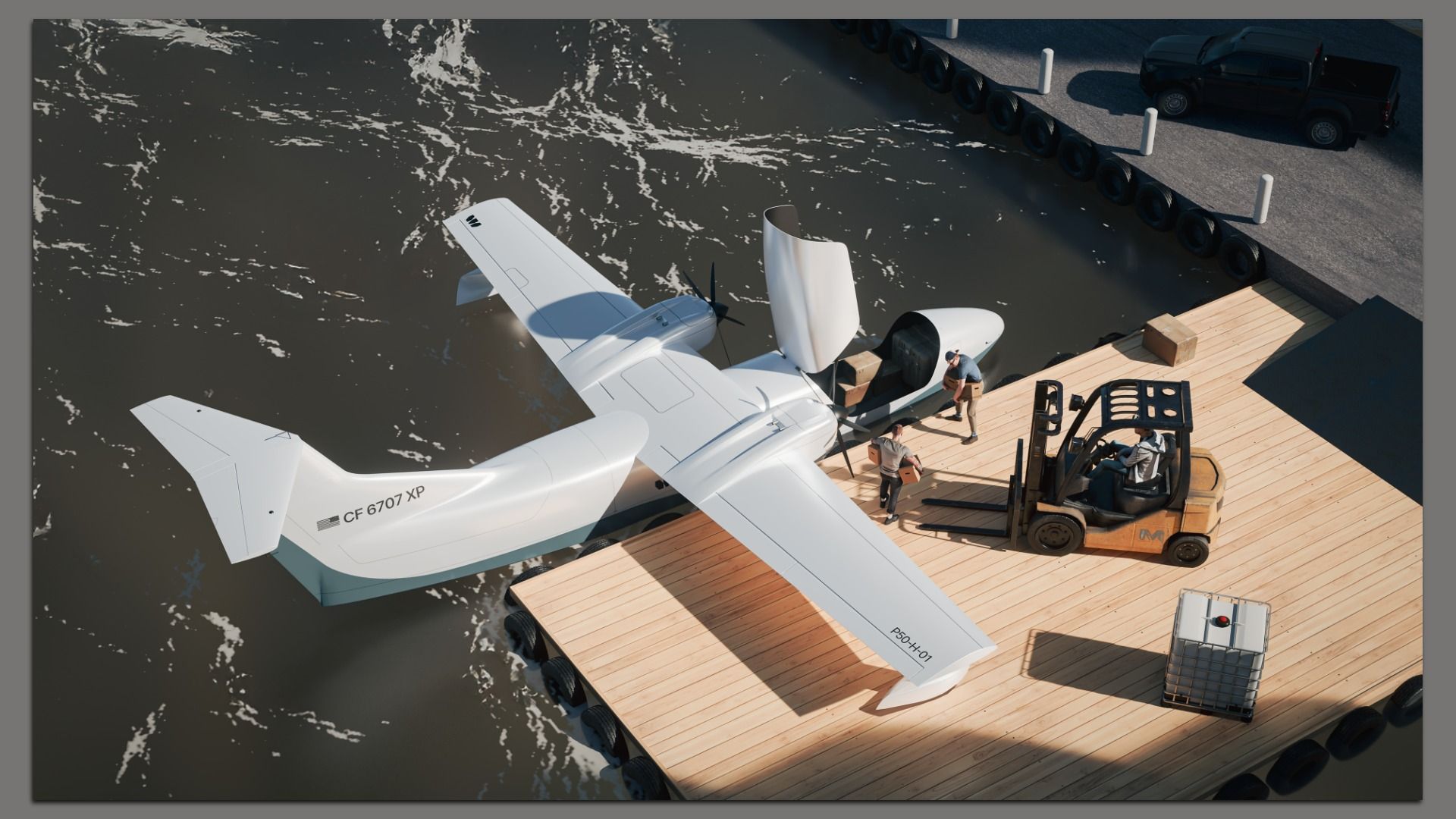
Poseidon Aerospace secured $11 million in seed funding and is using the cash to develop two cargo-hauling unmanned aircraft, Egret and Heron.
Why it matters: "A lot of people are thinking about kinetics and forward effects and what those look like," David Zagaynov, the company's chief executive, told me.
- "But wars are fought and won with logistics and supply chains. That is the backbone of any actual offensive."
Driving the news: Egret and Heron are both mid-build. Flight testing is expected in 2026.
- Both are about 50 feet across and designed to carry up to 2 tons of whatever: food, medical supplies, ammunition, missiles.
- Egret, specifically, is meant for short takeoffs and landings on runways. Heron, on the other hand, is a seaplane. (Both are applicable in the Indo-Pacific.)
- "We're in an absolute sprint to deliver these capabilities and get them in the water and in the air as quickly as possible," Zagaynov said. "Anything that fits we will fly."
State of play: Poseidon is almost 2 years old and employs 18 people, including Amazon, L3Harris Technologies and Lockheed Martin alumni.
- The company is headquartered in California, where it does — for now — most of its manufacturing. Its other facilities are in Washington and Maine.
Follow the money: Tamarack Global led the seed round. Other backers include Drover Ventures, Draper Associates and Starship Ventures.
- "Air cargo is fundamentally a legacy industry where little has changed over decades," Jamie Lee, a managing partner at Tamarack, told me.
- "Poseidon is one of the few teams with the ambition to rethink it from the ground up and the execution ability to make unmanned air freight practical in the near term and the status quo in the long term."
What we're watching: If and when the robo-logistics conversation overtakes first-person-view-drone mania.
Go deeper: U.S. military gets "smart" on warehouses
3. Exclusive: A semester abroad for ACS
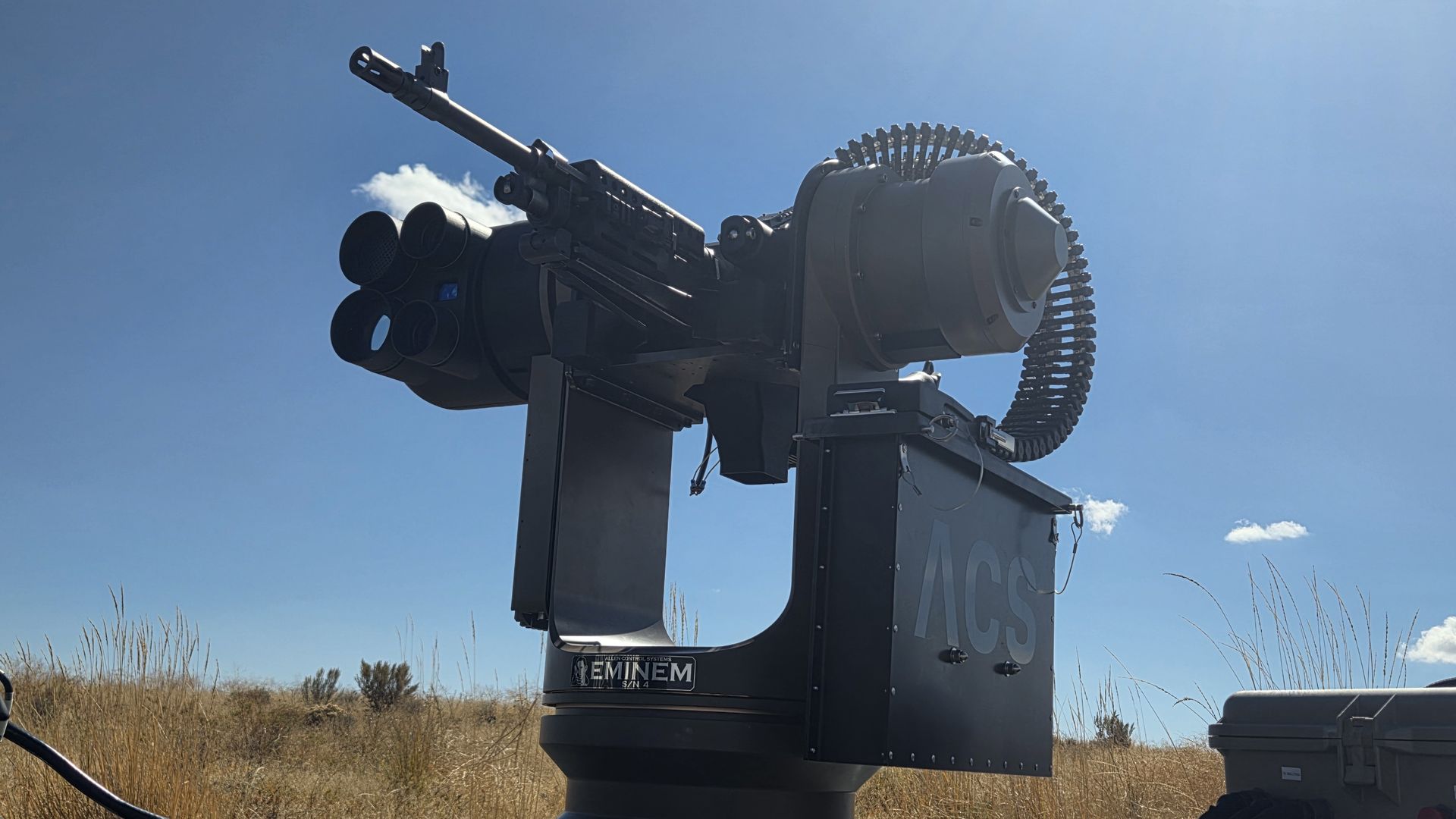
American defense-tech company Allen Control Systems is on an international tear, selling Bullfrog autonomous turrets to South Korea and the United Arab Emirates and striking a local coproduction agreement with Romania.
Why it matters: The deals underscore two things:
- Just how seriously militaries are taking the drone threat, as seen in Eastern Europe and the Middle East
- The growth of ACS, especially on the heels of a recent Special Operations Command contract
Zoom in: Bullfrog combines artificial intelligence, sensors and widely available weaponry, including the M240, M2, M230 and M134, to shoot down drones.
- The weapon has been trotted out at defense conferences in the back of a pickup truck and on top of an unmanned ground vehicle, creating futuristic technicals.
Friction point: ACS would not say exactly how many Bullfrogs are shipping out and did not disclose the overall value of the deals.
Flashback: Steve Simoni, the company's president, gave U.S. drone defenses a D grade on stage with me in September.
- "We're not doing well currently, but we have a path to do a lot better," he said.
- "We've invested in some of the wrong things. You're starting to see a lot of the industry try to change that and catch back up. The soft-kill measures aren't going to work that well for the next couple of years."
Go deeper: Simoni says U.S. military needs more "smaller, cheaper" weapons
4. Exclusive: Quantum meets aerospace

Lockheed Martin is teaming up with quantum-computing unicorn PsiQuantum for its work in areas like materials science, modeling and simulation.
The big picture: The companies announced this week their newly inked memorandum of understanding. A key piece of the aerospace-and-defense agreement is Construct, a software suite in which quantum algorithms are designed and optimized.
What we're hearing: Quantum today is being likened to cyber 10 years ago and artificial intelligence five years ago.
- "Real, useful quantum computing will begin transforming the aerospace industry in a few short years, and now is the time for companies to prepare to seize the fullest potential of this technology," Mark Brunner, a PsiQuantum executive vice president, told me.
Zoom out: Quantum tech promises to solve the incredibly intricate problems that classical computers can't — or at least can't do quickly enough.
- Defense contractors already use American supercomputers, like Frontier.
Follow the money: Lockheed is the world's largest defense contractor by revenue. PsiQuantum in September disclosed a $1 billion Series E, valued at $7 billion.
What we're watching: How the Trump administration handles the quantum question. Executive orders were on the table earlier this year, CyberScoop reported.
5. Quick hits
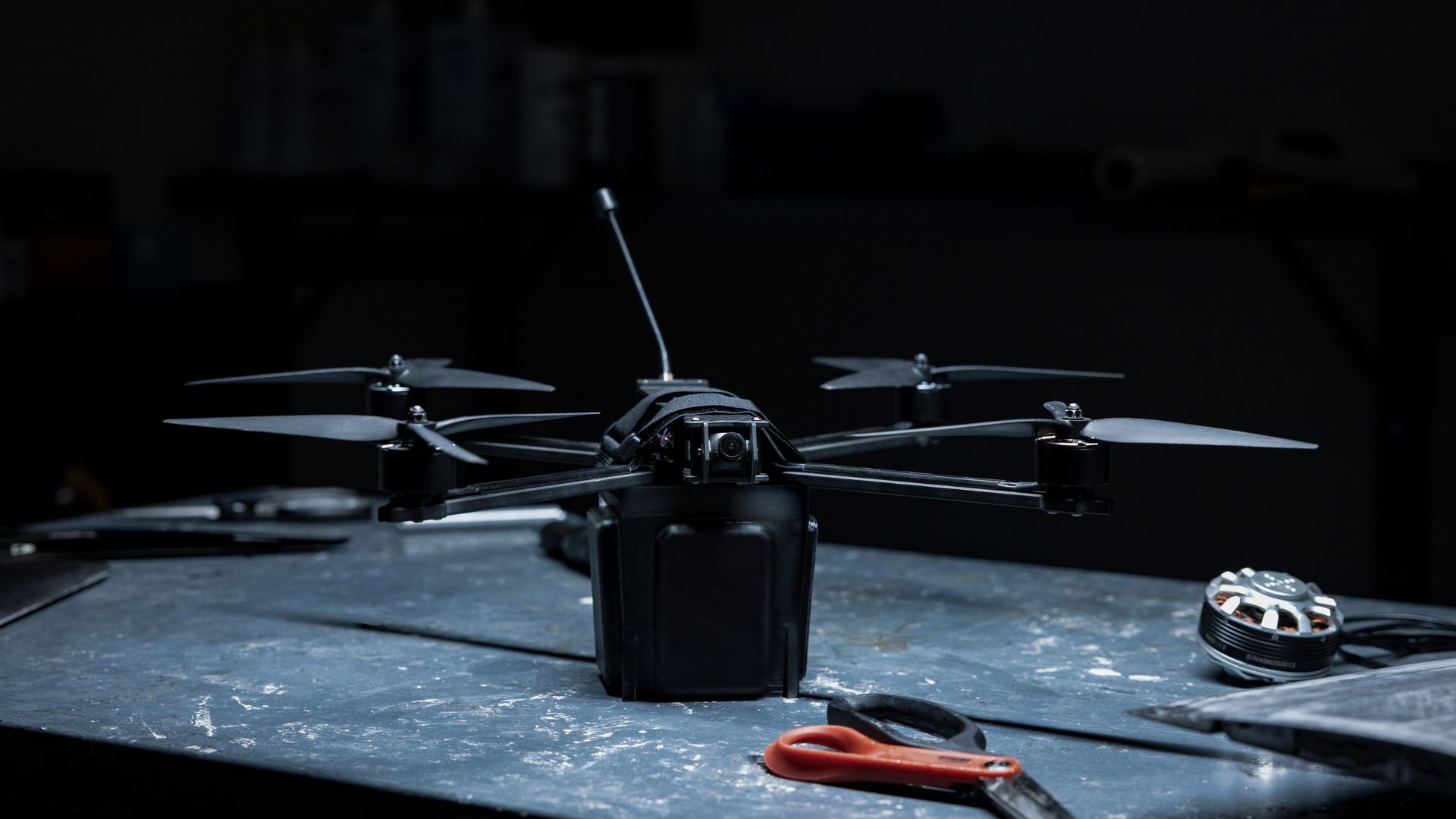
🔌 CX2 unveiled Vadris, a radio-frequency seeker that attaches to first-person-view drones. It weighs just over 1 pound.
- Why it matters: "When swarms arrive, you don't chase every drone. You find who's launching them," CEO Nathan Mintz said in a statement. "Vadris targets the archer, not the arrow."
- 💭 My thought bubble: I broke news of CX2's Series A back in May. Give that a read, here.
☢️ The Carnegie Corporation of New York awarded $3.2 million in grants to study the risks of emerging technologies and nuclear war. The seven grantees include the Arms Control Association, Federation of American Scientists and Foreign Policy Research Institute.
- Why it matters: The nuclear rhetoric — from presidents Trump and Vladimir Putin, among others — is very real right now.
- 💭 My thought bubble: Support your local nuke expert.
🔗 Astranis rolled out Vanguard, a satellite-enabled mobile ad-hoc network. A live demo was executed in partnership with Persistent Systems, Kymeta Corporation and Satcube.
- Why it matters: Connectivity is king. Vanguard's potential commercial and defense applications underscore that.
- 💭 My thought bubble: Would y'all like to see more space news in this newsletter? Reply to this email and let me know.
💵 Lockheed Martin is investing $50 million into Saildrone.
- Why it matters: The latter's unmanned surface vessels will be equipped with the former's missile launchers. Live-fire testing is expected next year.
- 💭 My thought bubble: I can't shake the "sharks with frickin' laser beams attached to their heads" feeling.
6. Check this out
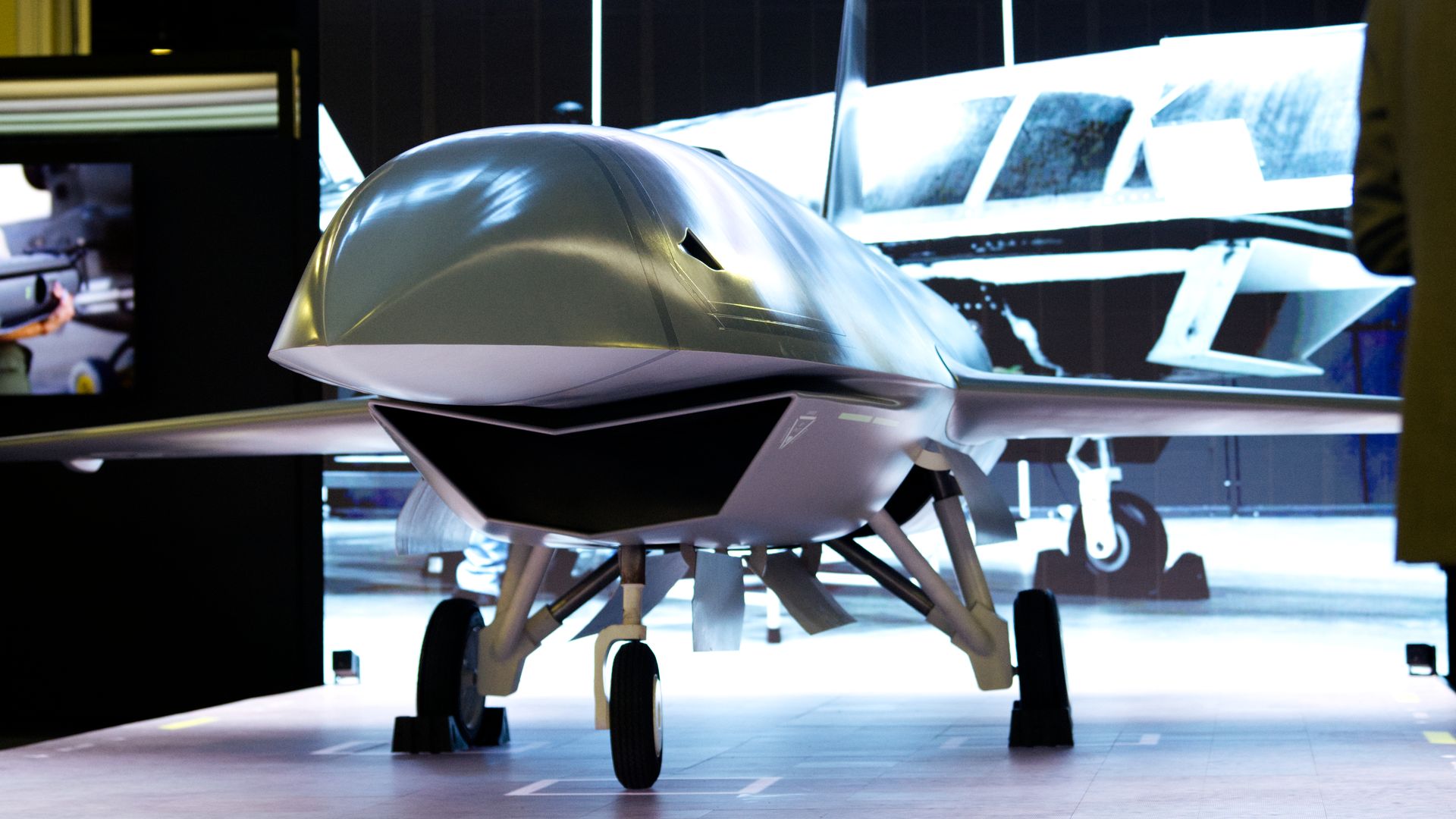
The Collaborative Combat Aircraft competition is heating up.
The big picture: Anduril Industries last Friday announced the first flight of its U.S. Air Force robo-wingman, YFQ-44A.
- It comes weeks after General Atomics did the same for its YFQ-42A.
- The timing — who went first, what that means, how long they were airborne, et cetera — has been top of mind for defense industry reporters.
What they're saying: "This milestone shows how competition drives innovation & accelerates delivery," Air Force Secretary Troy Meink said on X.
The intrigue: Plane-spotters broke the news, at least for me.
Shoutout to Dave Lawler for editing and Matt Piper for copy editing.
👋🏼 Thanks, as always, for reading and sharing. Tell your friends to subscribe here.
Sign up for Axios Future of Defense