Why the U.S. and South Korea need each other

Add Axios as your preferred source to
see more of our stories on Google.
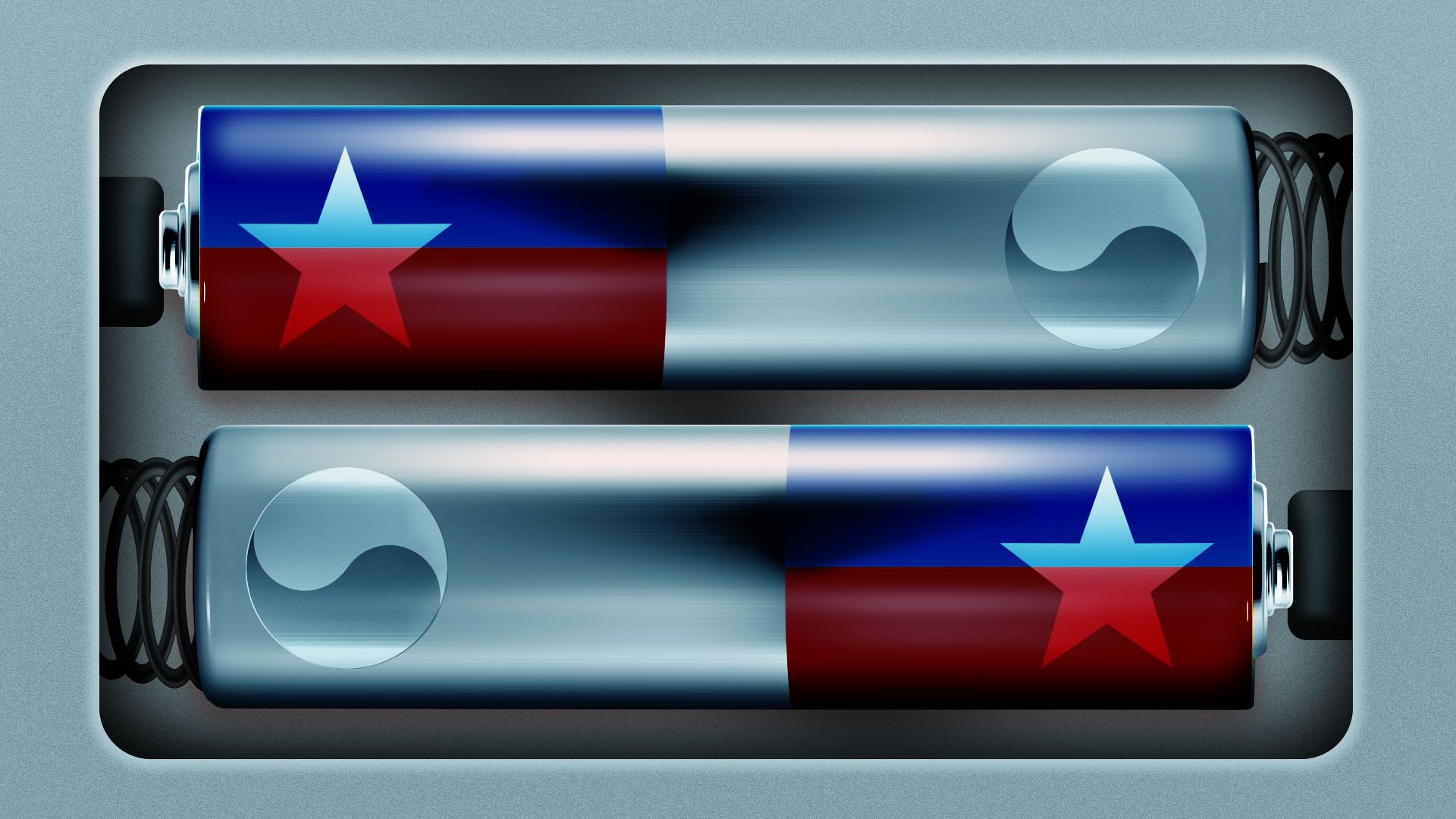
Illustration: Sarah Grillo/Axios
When it comes to batteries, South Korea needs the U.S. as badly as we need them.
The big picture: America lacks the know-how to make advanced batteries to power EVs and data centers, so it has to lean on South Korean experts.
- For South Korea, the economic opportunity is too lucrative to ignore the U.S. market, despite its seething anger over the arrest and alleged mistreatment of hundreds of its citizens at a Georgia factory owned by two of Korea's largest companies.
- In short, there are heavy incentives on both sides to repair their fractured relationship quickly.
Catch up quick: On Sept. 4, ICE raided the site of a battery plant under construction by Hyundai Motor Group and LG Energy Solutions.
- Hundreds of workers were arrested, shackled and transported to a detention center, where they were held for a week before returning to Seoul. Most worked for affiliates of LG, a huge Korean conglomerate.
- The incident sparked national outrage in South Korea, whose government says it will investigate possible human rights violations because of the harsh conditions workers reported during their detention.
The rupture of one of America's most important alliances in Asia, and the risk that South Korea would renege on $350 billion in investment pledges, seemed to trigger an about-face at the White House over the weekend.
- Deputy Secretary of State Christopher Landau was dispatched to Seoul, where he reportedly conveyed "deep regrets" for the arrests, according to South Korean media.
President Trump himself acknowledged in an extraordinary Truth Social post that the U.S. must welcome foreigners to train American workers.
- "If we didn't do this, all of that massive Investment will never come in the first place — Chips, Semiconductors, Computers, Ships, Trains, and so many other products that we have to learn from others how to make, or, in many cases, relearn, because we used to be great at it, but not anymore," he wrote.
- "I don't want to frighten off or disincentivize Investment into America by outside Countries or Companies. We welcome them, we welcome their employees, and we are willing to proudly say we will learn from them, and do even better than them at their own 'game,' sometime into the not too distant future!" he wrote.
Between the lines: Whether it's German stamping presses or Japanese robots, specialized technicians are often needed to install equipment and then train U.S. workers how to use it.
- That's true for lithium-ion batteries, too. While the technology originated in the U.S., most battery manufacturing occurs in Asia.
- The U.S. is trying to correct that, but it's a highly specialized field, and re-shoring supply chains will take years.
For now, carmakers in the U.S. are relying heavily on Korean partners like LG, SK On and Samsung, in part to avoid restrictions on sourcing batteries from China.
- General Motors, for example, owns battery plants with LG in Ohio and Tennessee, and is planning another with Samsung.
- Ford Motor has joint ventures with SK On in Kentucky and Tennessee, while Stellantis plans two battery factories with Samsung in Indiana and Honda is building a battery plant with LG in Ohio.
- Tesla, meanwhile, plans to buy Michigan-made batteries from LG to reduce its reliance on China for its growing energy storage business, per Reuters.
Zoom in: In Michigan, Ford licensed a lower-cost technology from CATL, China's largest battery manufacturer, because it believes that's the fastest way to catch up on battery innovation.
- But that meant importing equipment from China and enlisting skilled Chinese workers to install it and train about 100 U.S. managers. Ford has yet to begin hiring operators for the Michigan battery plant.
- "We're creating jobs with technology we need to complete globally. We need to learn to do it by ourselves," Lisa Drake, Ford's vice president of technology platform programs and EV systems, told Axios in June.
What to watch: Trade talks between the U.S. and South Korea have been stalled for a while, and the blowup over the Georgia battery plant certainly hasn't helped.
- But both sides say they're optimistic they can work out an improved system for granting visas to skilled workers in such circumstances.
