Axios Future of Defense
March 26, 2025

Spring has sprung. Took long enough.
- Also, last call for questions for the event I'm moderating tomorrow. Reply to this email, send a carrier pigeon, get the smoke signals going, whatever.
📲 Situational awareness: The White House on Tuesday downplayed the 👊🇺🇸🔥 group chat revelations, saying no classified material was shared.
- My thought bubble: This misses the point. The operational security issues alone are damning. The saga also underscores just how fed up some people are with government IT.
Coming right up: Hanwha howitzers, a U.S. Navy confirmation and a state-by-state look at F-35 jobs.
Today's newsletter is 1,567 words, a 6-minute read.
1 big thing: Exclusive ... Soft(ware) power

There's a balance to be struck between defense software and hardware; without one, your targeting's bricked, and without the other, you're not seizing airfields.
- The problem is the Pentagon has yet to find the sweet spot.
Why it matters: In a world of robots, autonomous weapons and global supply chains, conflicts will be swayed by the team that refreshes its code quicker and shares its information more accurately.
- A hypothetical war with China in 2027 will be fought with what the U.S. military has in hand right now.
Driving the news: An Atlantic Council report — the product of more than a year of work and 60-plus interviews, first shared with me — sheds light on this era of "software-defined warfare."
- Such a dynamic "is about ensuring we have sufficient numbers of systems, as technologically advanced as possible, at the moment of need," Stephen Rodriguez, the commission director, told me.
What's inside: Here are some of the commission's conclusions:
- The U.S. military is still moored to an acquisition system "ill-suited to the rapid tempo of modern technological innovation." This status quo puts the country "at significant risk."
- The Defense Department lacks "sufficient software expertise," hamstringing capabilities that harness "critical technology areas including AI, autonomy, and cyber." Training is needed all the way up the chain. Academia can help.
- While long-term reform is necessary, what's needed today is "near-term, high-impact initiatives to bridge" the gap and "reestablish an advantage." Beijing, meanwhile, is aligning industrial policies and resources to the digital domain.
- Stateside service chiefs should identify a program executive office to oversee how — and ensure that — disparate tech can communicate. This is Combined Joint All-Domain Command and Control in action.
- The Defense Department should, by default, purchase software, not build it. When the department "decides to develop custom software, this often results in higher costs, longer schedules, and increased risks."
- It also needs a software cadre, and that requires recruiting dozens of specialists to be spread far and wide, including at operational commands and in budget offices.
What they're saying: "DoD has made some decent progress on software adoption, but we're still doing it in siloed fiefdoms and not always with broader, more strategic outcomes in mind," Whitney McNamara, one of the report's authors, told me.
- "Our software-enabled capabilities won't move the mark on the battlefield if they can't talk to one another."
Inside the room: The commissioners, contributors and staff are a who's who of industry, government and financiers. The roster includes:
- Lockheed Martin CEO Jim Taiclet
- Helsing cofounder Gundbert Scherf
- Trae Stephens of Founders Fund and Anduril Industries fame
- Saab executive and former Task Force 59 commodore Michael Brasseur
- Adam Hammer at Roadrunner Venture Studios
- Former Defense Secretary Mark Esper
- Former Pentagon weapons buyer Ellen Lord
- Retired Air Force Lt. Gen. Jack Shanahan
- Retired Air Force Lt. Gen. Clinton Hinote
The bottom line: The Pentagon "buys metal well, because buying metal is an Industrial Age process. They perfectly define a requirement, then they spend years building the thing," Second Front CEO Tyler Sweatt, also a study commissioner, told me.
- "That is in no way shape or form a Knowledge Age approach to buying or building — you can't do software like that."
2. What we know about the F-47
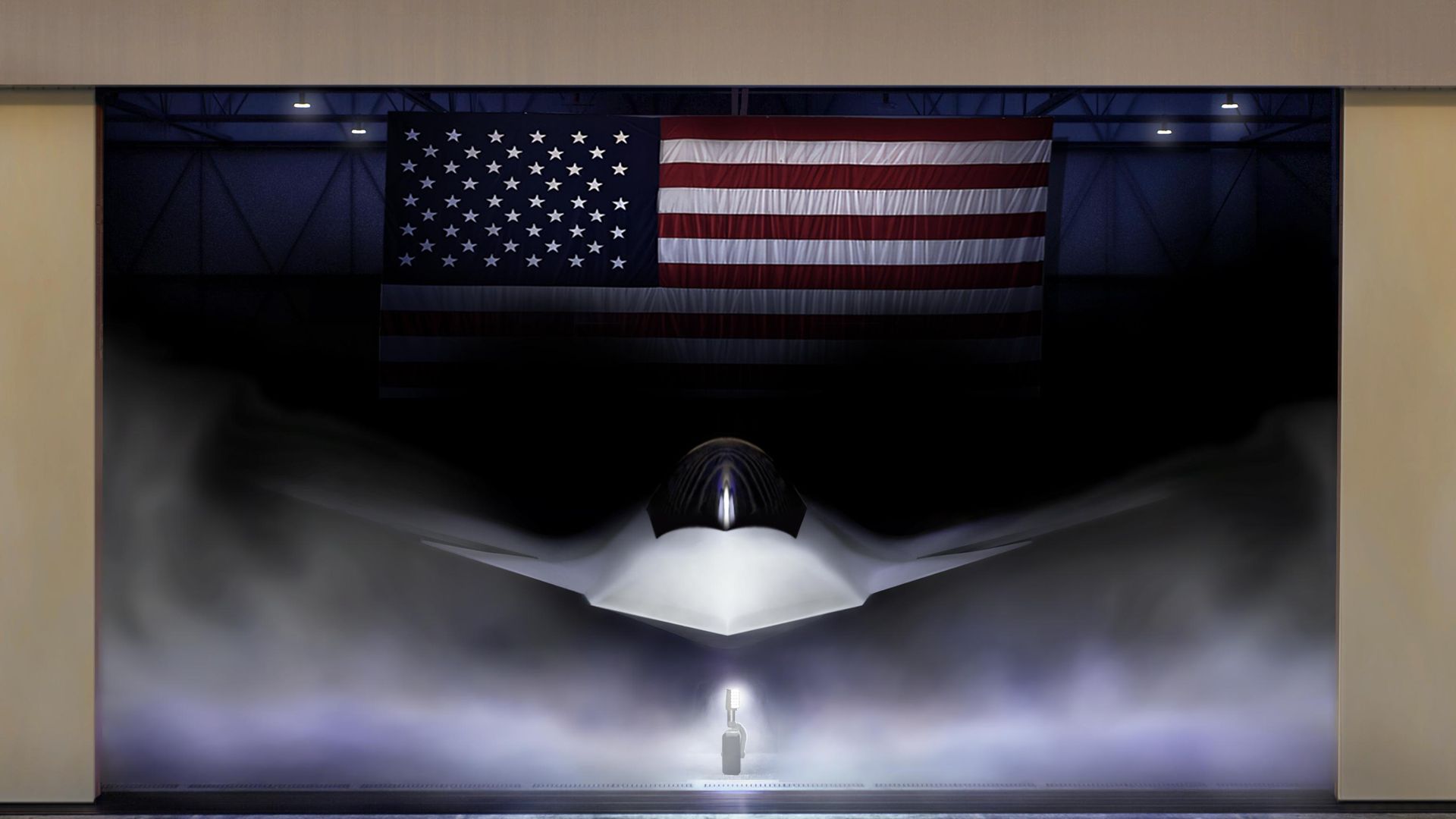
The speculation floodgates flung open in the minutes following Boeing's win of the U.S. Air Force Next Generation Air Dominance fighter contract.
Why it matters: The F-47, as it's now known, is highly secretive. President Trump said he couldn't disclose the per-tail cost because it would reveal "some of the technology and some of the size of the plane."
- "America's enemies will never see it coming," he added.
But experts and fanboys are obsessing over every shred of evidence. Their findings give the wider public a better understanding of the futuristic fighter designed to collaborate with drones.
Here's what's been gleaned so far:
- It's manned.
- It will cost less than the F-22, which it supersedes, according to Air Force Chief of Staff Gen. David Allvin. There are plans to buy more F-47s than F-22s, which were cut well short of 750.
- Early stages included X-planes from both Boeing and Lockheed Martin. The aircraft first flew in 2019 and 2022, logging hundreds of hours each, according to the Defense Advanced Research Projects Agency. Its involvement dates back to 2014.
- The F-47 is expected to fly during the Trump administration — in a little less than four years.
- Its designation is a reference to the World War II-era P-47 and Trump, the 47th president. In an Oval Office address last week, he said it was "a beautiful number."
- The plane might — might! — have canards. Look near the spade-shaped nose. (This debate is getting spicy on social media.)
- It's reminiscent of Boeing's X-45 combat drone and Bird of Prey, a single-seat stealth demonstrator.
- The initial contract is thought to be $20 billion. That's a windfall for Boeing, which has struggled in the commercial and defense markets, and a blow to Lockheed, which is now shut out of the public sixth-generation race.
What they're saying: "We argued that Boeing was likely to win this award as its victory would ensure that the U.S. can maintain a diverse defense industrial base, specifically, in this case, the ability to produce stealth fighters," Capstone investment researchers said in recent analysis.
- "The health of the DIB is a priority for the Trump administration."
What we're watching: How the Navy proceeds with its advanced fighter, F/A-XX. News could come as soon as this week, according to Reuters.
What's next: Lockheed in a statement said it "will await further discussions" with the Air Force. It did not mention a contract protest.
3. Hitting Houthis
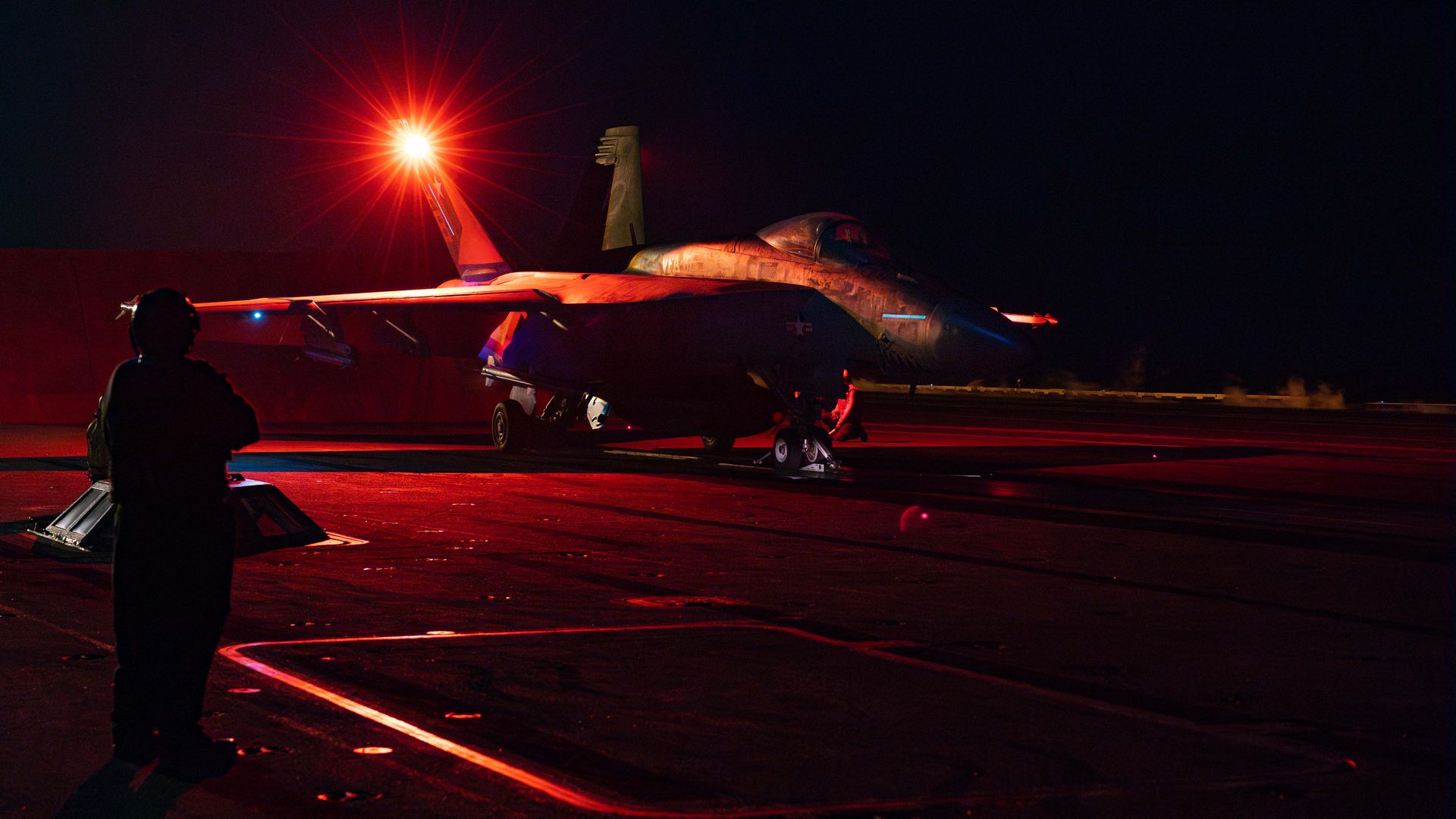
The U.S. is pounding Houthi drone experts and infrastructure as well as command-and-control nodes across Yemen at a pace previously unseen.
Why it matters: The rebel group has for months held the Red Sea and its surroundings hostage, despite international firepower levied against it.
- Key to its stranglehold are unmanned, explosive-strapped vehicles in the air and on the sea.
What they're saying: "No doubt the Houthis have proven that they can take a punch," Behnam Ben Taleblu, a senior director of the Iran program at the Foundation for Defense of Democracies, told me.
- "But over time? That remains the big question."
Catch up quick: An initial wave of attacks hit 30-plus targets, including "a terrorist compound where we know several senior Houthi unmanned aerial vehicle experts were located," Air Force Lt. Gen. Alex Grynkewich told reporters at the Pentagon.
- "Those were key individuals who led their unmanned aerial vehicle enterprise and were some of the technical experts."
That was more than a week ago. The action hasn't stopped since.
By the numbers: The U.S. launched at least 612% more strikes in March than it did during all of its operations targeting the Iran-backed group since November, according to a Jewish Institute for National Security of America tally.
- More than 749 strikes were executed since January 2024.
My thought bubble: The U.S. could again be mired in the Middle East if this operation has no publicly stated end goal or metrics of success.
- That said, experts told me a land invasion is unlikely.
Go deeper: Exclusive: Houthi arsenal shocks the Pentagon's top weapons buyer
4. Quick hits

🇰🇷 South Korea's Hanwha continues to pitch its K9 howitzer to U.S. buyers. In a Monday briefing with reporters, executives touted a global network of adopters, including NATO allies, and lessons learned from the scrapped Extended Range Cannon Artillery and Crusader efforts.
- Why it matters: The Army "is looking for a [commercial, off-the-shelf] solution that could be customized," said Hanwha Defense USA senior director Jason Pak.
- 💭 My thought bubble: The Russia-Ukraine war, for all its drones and robotics, is still a cannon competition.
🌊 The U.S. Senate confirmed John Phelan, 62-30, as Navy secretary.
- Why it matters: He's the second service secretary to be confirmed in Trump 2.0. He's an outsider, too, with no Navy background.
- 💭 My thought bubble: Don't forget about Hung Cao, who was nominated by the president to be the service's undersecretary.
🌠 The U.S. military observed Chinese "dogfighting in space," according to Vice Chief of Space Operations Gen. Michael Guetlein. It involved three Shiyan-24C experimental satellites and two other experimental spacecraft, the Shijian-605 A and B, Defense News reported.
- Why it matters: "Our entire U.S. economy relies on space-based assets, which most people take for granted," Jeff Thornburg, the Portal Space Systems CEO, told me. "Those U.S. assets are now at risk in ways that they have never been before."
- 💭 My thought bubble: Imagine the classified observations so many of us are not privy to. This is serious.
🗺️ Maxar Intelligence introduced Raptor, software that combines a drone's native camera feed and the company's 3D maps of the world to enable navigation sans GPS.
- Why it matters: Electronic warfare is wreaking havoc on unmanned tech. This could clear the precision-targeting hurdle.
- 💭 My thought bubble: I did a satellite-imaging lightning round with Maxar's Peter Wilczynski a few months back. Watch that, here.
5. Check this out
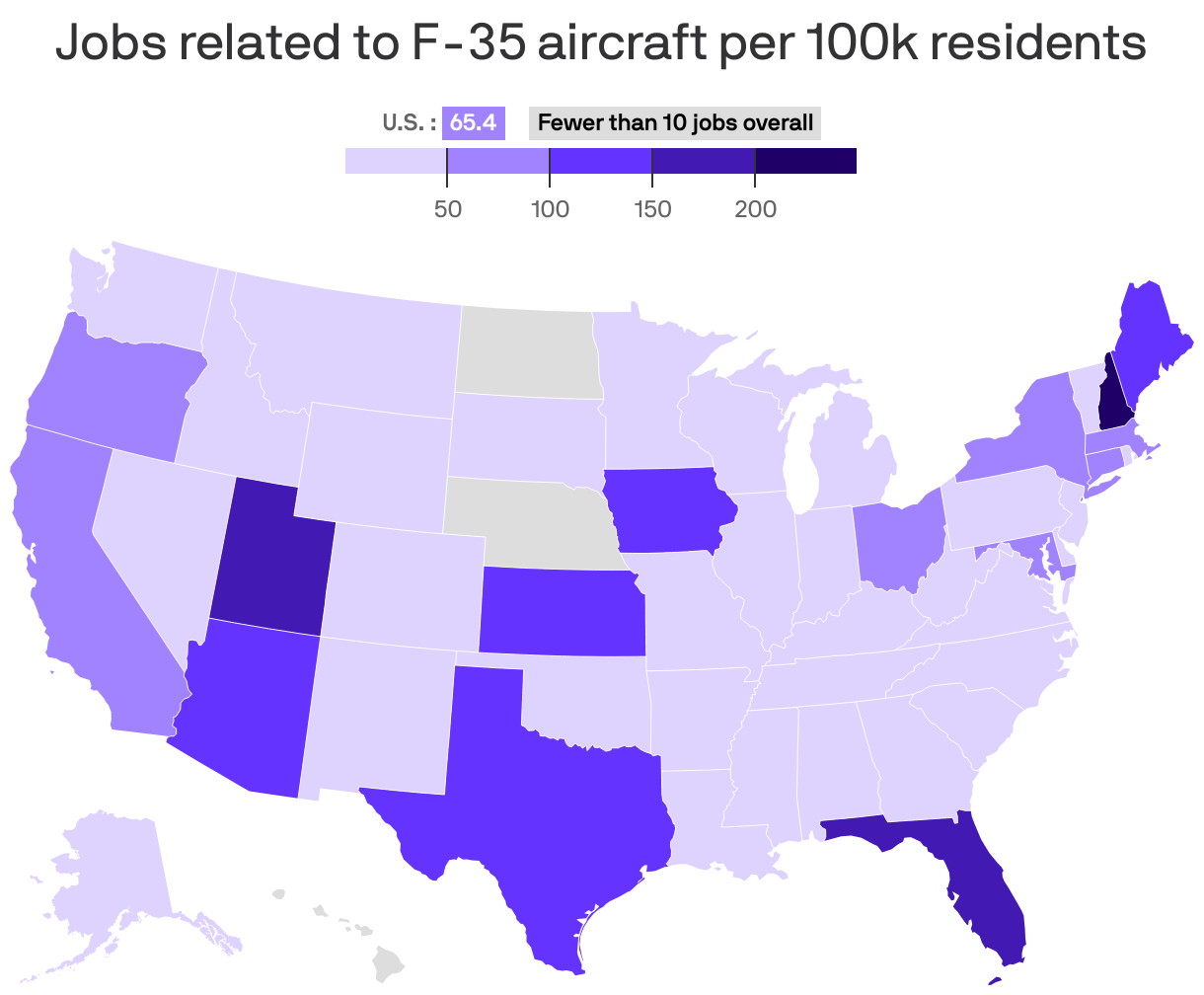
Take a look at the reach of the F-35. Not on the battlefield, but in the boardroom and Congress.
How it works: These numbers, collated by my colleague Alex Fitzpatrick, include both direct and indirect jobs related to the F-35, a flying computer.
Shoutout to Nicholas Johnston and David Lawler for editing and Matt Piper for copy editing.
👋🏼 Thanks, as always, for reading and sharing. Tell your friends to subscribe, here.
Sign up for Axios Future of Defense