Axios Future of Defense

October 15, 2025

Hello from the final day of AUSA. Thanks to everyone who kicked it at my talks yesterday.
- Side note: No, I will not be signing the new Pentagon press rules. Bye-bye, badge.
🏭 Situational awareness: Boeing will deliver more than 3,000 PAC-3 seekers through 2030 under new contracts totaling $2.7 billion.
Recommended reading: Chaos Industries and Forterra team up, Valinor steps out of the shadows, and an XM30 update from General Dynamics Land Systems.
Today's newsletter is 2,101 words, an 8-minute read.
1 big thing: Everyone's watching Ukraine

The war in Ukraine has changed the way every modern military will fight its next conflict.
Why it matters: Everyone is watching Eastern Europe for an edge.
- Alistair Carns, the U.K. minister for the armed forces, described it to me as an "Air Force moment," akin to the period in World War I when belligerents saw the effectiveness of air power and scrambled to catch up.
The big picture: In 2022, then-Ukraine Defense Minister Oleksii Reznikov noted that the war had become a "testing ground" for new weapons.
- Dan Driscoll, the U.S. Army secretary, more recently described Ukraine as the "Silicon Valley of warfare."
- Ukrainian President Volodymyr Zelensky, who will visit the White House this week in hopes of securing Tomahawk missiles, has noted that Ukraine has been forced through brutal necessity to learn how to wage a 21st century war.
Zoom in: Here are some of the insights Carns is finding on the front lines, plucked from our recent discussion at the British embassy:
⚡ On electronic warfare. "The EW in Ukraine is the most effective [anti-access, area-denial] screen in the world. And it's layers upon layers upon layers, from tactical to strategic. ... We need to develop our own EW capability. I do think we've lost muscle memory from the Cold War, when we were really good at it."
- U.S. military leaders, including former Joint Chiefs Chair Gen. Charles "CQ" Brown Jr., have made similar assessments.
🛩️ On drones and robo-wingmen. "An F-35 is the Spitfire of the future, but you ain't going to see it in a dogfight. You'll see it 200 miles behind the front line, coordinating swarms and swarms of drones that have [multiple purposes and multiple targets.]"
- The Royal Air Force earlier this year launched StormShroud, a combination of Tekever AR3 unmanned aerial vehicles and Leonardo U.K. BriteStorm electronic warfare payloads meant to draw fire and blind radars.
- Meantime, the U.S. Air Force is working through its Collaborative Combat Aircraft competition with General Atomics and Anduril Industries. The Navy is contracted with the same two, plus Boeing and Northrop Grumman.
🛡️ On tanks. "There will always be a requirement for armor. But if the armor isn't integrated with a very sophisticated uncrewed system, or system of systems, then it's not going to last long."
- Losses of older, Western-supplied tanks in Ukraine have raised questions about their future effectiveness. (The U.S. sent Abrams; the U.K., Challengers.)
What we're watching: How different the war will look in 2026 compared with 2022.
More from Axios:
Ukraine's "Spiderweb" drone assault is a wake-up call for all
2. Exclusive: Chaos and Forterra in the field
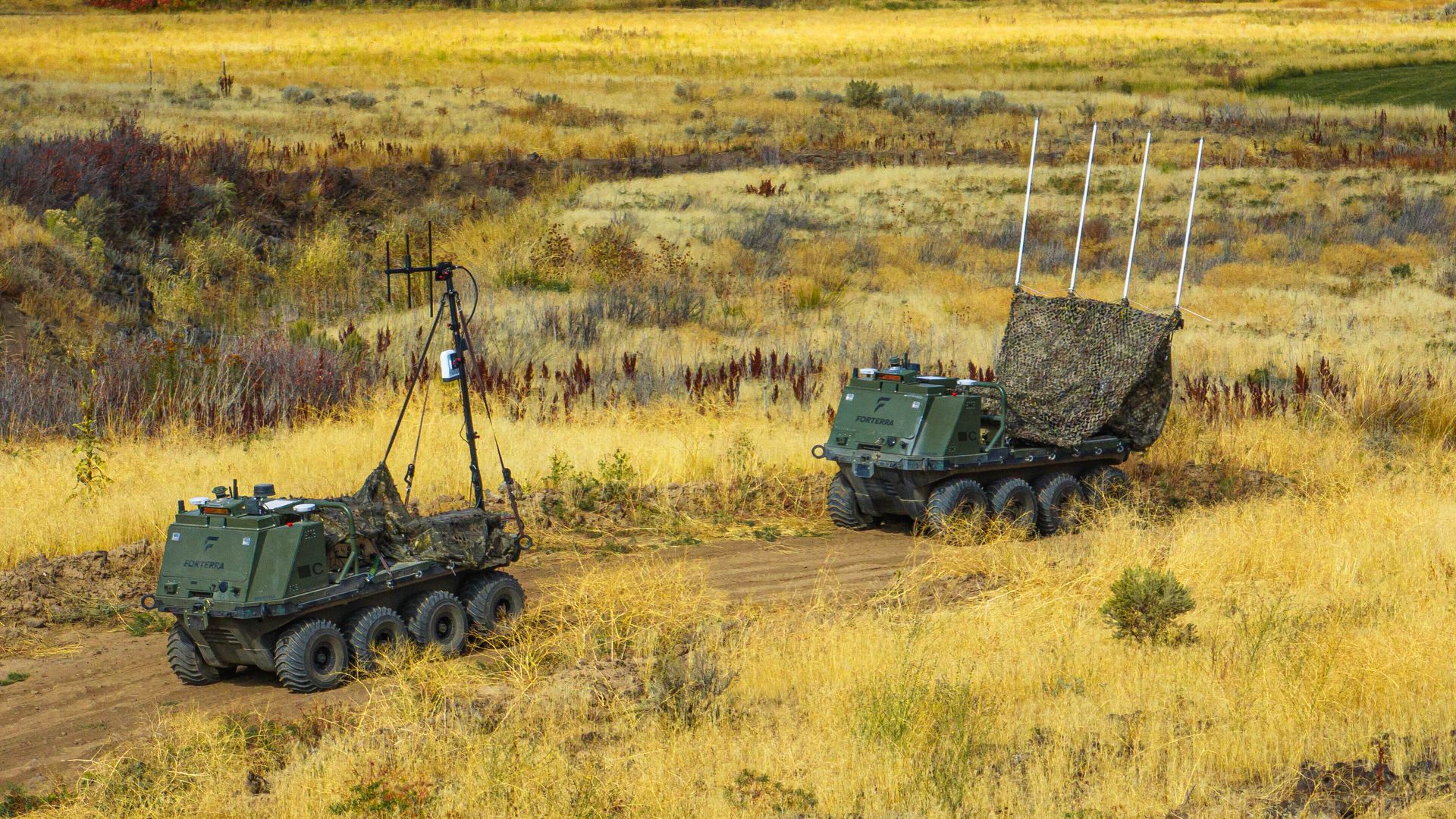
Chaos Industries and Forterra are developing a previously undisclosed robotic air-defense system that, in testing, successfully detected and tracked small drones.
Why it matters: It's a meeting of two buzzy defense-tech companies at the intersection of overhead protections and smart machinery — exactly the kind of thing that piques Pentagon interest.
Driving the news: Chaos and Forterra tested a combination of their Vanquish distributed radar system and AutoDrive autonomy aboard a Squad Multipurpose Equipment Transport vehicle at a range in Idaho.
- Government trials are expected later this month.
Zoom in: The two have been collaborating for at least a half-year. When asked, both left the door open to soft- and hard-kill countermeasures being added in the future.
What they're saying: "We're trying to make force protection not so hard," Chris Musselman, chief mission officer at Chaos, told me. "How can we help folks — our forces — maneuver more safely without all the cognitive load?"
- "If we can show the government what we showed ourselves recently, with the tests, that's the objective."
Zoom out: The U.S. military is increasingly interested in making first contact with and fighting alongside machines.
- The Army has discussed human-machine integrated formations. The Air Force has its drone wingman plans. And the Navy is pursuing a hybrid fleet.
The bottom line: "One of the critical uses for autonomous systems is to be that forward, blunting force," Scott Sanders, chief growth officer at Forterra, told me.
- "Getting your detection system out ahead of your capability buys you more standoff," he said. "It also means if it's targeted there aren't people around it."
Go deeper: Chaos Industries, armed with overseas experience, heads to Eglin
3. AUSA action

Here's the latest from the Association of the U.S. Army show floor:
🎯 Auterion has been conducting counter-drone trials, according to CEO Lorenz Meier. "Ground attack drones will merge with air defense drones as a category, and we're treating that as one," he told me.
🦂 BAE Systems said it successfully tested its Scorpio-XR artillery projectile using a 155 mm howitzer alongside the Combat Capabilities Development Command Armaments Center.
💥 American Rheinmetall Munitions and Solugen said they are working together to expand the availability of U.S.-made energetics. They inked a memorandum of understanding yesterday.
🚁 Lockheed Martin's Sikorsky business pulled back the curtain on U-Hawk, a cockpit-less Black Hawk helicopter that can launch waves of drones and haul an unmanned ground vehicle. It's expected to fly next year.
🪽 AeroVironment rolled out the Switchblade 600 Block 2, Switchblade 400 and a new armor-penetrating warhead for the smallest of the bunch, Switchblade 300 Block 20.
🚛 Epirus and General Dynamics Land Systems built Leonidas Autonomous Robotic, a drone zapper mounted to a 10-ton unmanned ground vehicle. It has not yet been tested, Breaking Defense reported.
🦇 L3Harris Technologies is expanding its Vampire line of counter-drone tools. The company touted variants aboard ground vehicles, boats, helicopters and watchtowers, among other integrations.
🔫 Moog revealed its newest turret, the Lightweight Reconfigurable Integrated-weapons Platform. The company is eyeing the Army's mobile, short-ranged air defense needs and said it can arm lighter vehicles, like the ISV.
🤖 Boeing unveiled a tiltrotor drone known as the Collaborative Transformational Rotorcraft, or CxR. The concept could pair with Apache or Little Bird helicopters.
4. Exclusive: Meet Valinor

Valinor has over the course of a year quietly assembled several firms to address defense-tech wants and needs that have flown under the radar.
Why it matters: "There's probably 1,000 times more picks and shovels in the government than the moon shots, but there's really no model to serve them," chief executive Julie Bush told me.
- "That's what Valinor does."
Driving the news: Valinor unveiled Harbor, a field hospital in a box. It's one of several products being revealed this month by the company of companies, as it bills itself.
- Others include "contact charging for your iPhone, but for any unmanned aerial system" and a "smart optics wearable," according to Bush.
Zoom in: Valinor is based in Washington, with offices in Chinatown. Its teams comprise subject-matter experts and are built based on market interest.
- "We are a very seasoned team of capital allocators, market experts and engineers that have .... lived the new neo-prime world," Bush said.
- "It doesn't have to be the Golden Dome, but it might be critical to a component of the Golden Dome," she said. "It doesn't have to be the next-generation fighter jet, but it's a critical part of that."
The intrigue: Bush has more than a decade of experience at Palantir Technologies. Trae Stephens at Founders Fund, Paul Kwan at General Catalyst and Grant Verstandig at Red Cell Partners are considered founding partners of the company.
- "A lot of the problem sets that I was coming across in the defense sector were interesting and needed to be solved, but they're not like moon shots with enormous markets," Stephens told me.
- "The concept was: What if we were to incubate companies that are solving real problems that aren't attached to this crazy hype-cycle moment?"
Go deeper: U.S. Army adopts "venture capital mindset" with new Fuze program
5. Lockheed's "extreme" missile

Lockheed Martin is "progressing toward" flight testing an extreme-range cruise missile amid "significant customer interest," a company executive told me.
The big picture: The company unveiled the AGM-158 XR, which it's developing on its own dime, a little more than one year ago.
- Its pedigree includes the Joint Air-to-Surface Standoff Missile and the Long Range Anti-Ship Missile made for the U.S. Air Force and Navy.
- It totes a 1,000-pound warhead and is stretched to accommodate additional fuel.
What they're saying: "What we're doing with JASSM and LRASM is, fundamentally, modularizing it," Tim Cahill, Lockheed's missiles and fire control president, told me.
Follow the money: The U.S. government is expected to support the upcoming trial. Cahill described it as "range time" and "things of that nature."
- Conversations with potential buyers have thus far been largely stateside.
Go deeper: Lockheed's Skunk Works unveils Vectis, a stealthy drone wingman
6. GDLS and XM30
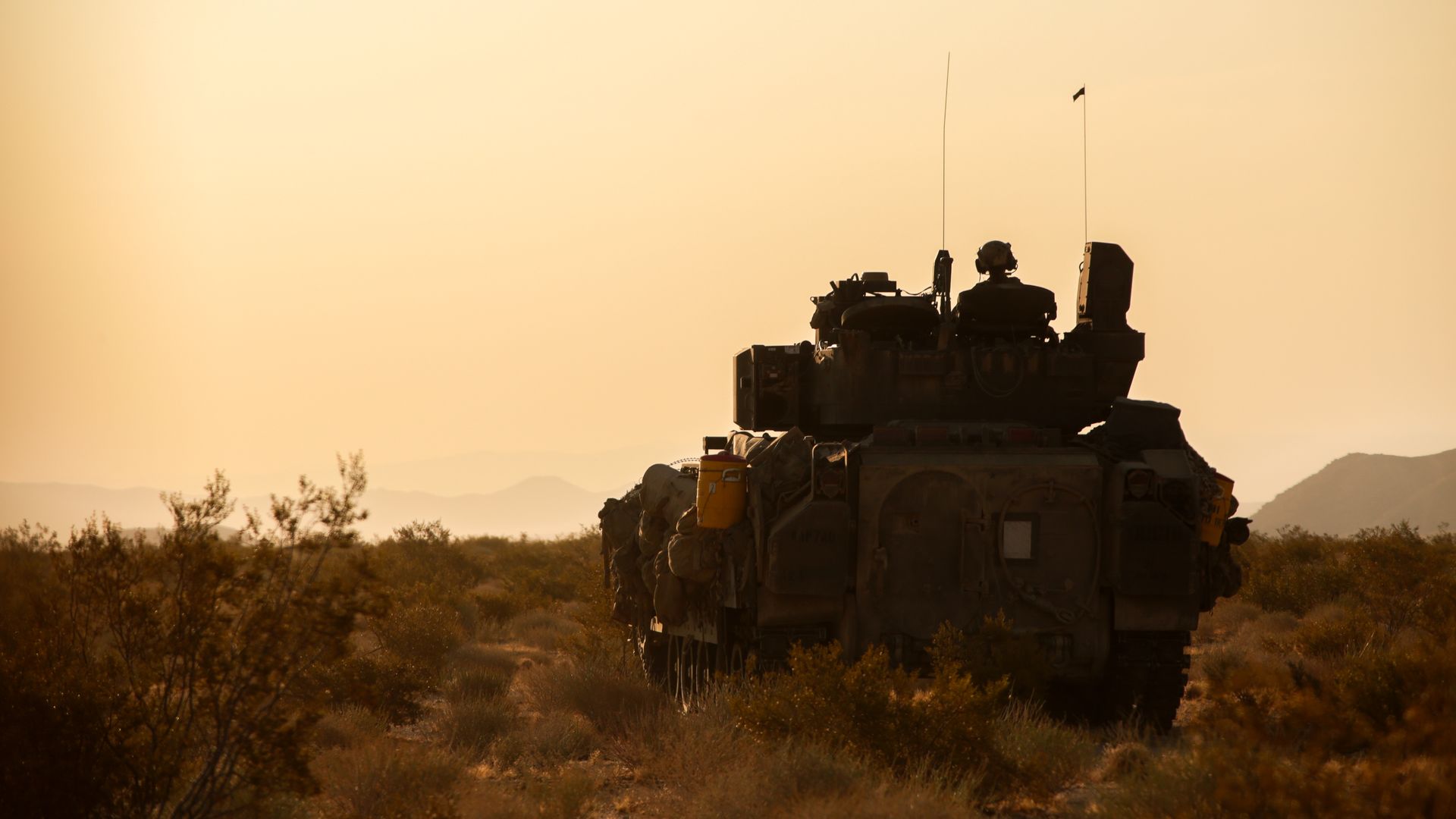
General Dynamics Land Systems expects to deliver its first XM30 prototype to the U.S. Army in July, after passing critical design review earlier this year.
Why it matters: The XM30 is slated to replace the Bradley Infantry Fighting Vehicle, which has been used for decades and has proven its mettle in Eastern Europe.
Driving the news: Company executives were bullish on their design, supply chain and artificial intelligence options in conversation with me ahead of the annual Association of the U.S. Army convention.
- "We're moving out with getting hardware developed. Our hulls and turrets are being built, the various components and subsystems we're taking possession of, and we're working toward the integration," said Ray Kiernan, XM30 program director.
- "We're very comfortable … that we have all the infrastructure in place that we need to pursue a major production program in the United States like this. We have the facilities."
Zoom in: GDLS's design has was morphed over the years — even after the critical design review.
- "We've had the opportunity to make some fairly significant changes" in line with soldier feedback, Kiernan said.
- That includes livability: changes "to some of the internals, the way we have things organized, availability of open space."
Zoom out: The XM30 competition, valued at billions of dollars, is down to two teams. One is led by GDLS. The other, American Rheinmetall.
- The project, years old, was once known as the Optionally Manned Fighting Vehicle. (This is far from the first time a Bradley replacement has been sought.)
The bottom line: "The Bradley's been a great platform for 40 years for the Army," Geoff Norman, director of U.S. strategy (and former head of the Army's Next Generation Combat Vehicles Cross-Functional Team), told me.
- "Not taking anything away from it … but it's at the point where it can't be upgraded further."
7. Quick hits

🧊 The U.S. will acquire four icebreakers — Arctic Security Cutters — from Finnish shipyards. Another seven could be built stateside.
- Why it matters: "Nobody makes them like Finland. I've heard that for a long time," President Trump said in the Oval Office. "We were making them, but we didn't make them right."
- 💭 My thought bubble: The president's Arctic fixation is good for national security.
🇮🇳 The U.K. will sell Thales-made multi-role missiles to India, in a deal valued at £350 million ($468 million).
- Why it matters: "The deal paves the way for a broader complex weapons partnership between the U.K. and India, currently under negotiation between the two governments," according to a defense ministry announcement.
- 💭 My thought bubble: If the Indo-Pacific matters to you, you need to be watching New Delhi.
🏚️ Defense Secretary Pete Hegseth assembled a barracks task force to improve the standard of living for U.S. troops across the world.
- Why it matters: A federal watchdog in 2023 issued a scathing report on military housing, documenting methane leaks, hot-water outages and more.
- 💭 My thought bubble: I tagged along with Army Secretary Dan Driscoll when he toured barracks at Fort Stewart, Georgia. More on that experience, here.
8. Check this out

Vantor on Oct. 10 collected satellite images over Gaza, documenting the destruction.
The big picture: My colleague Barak Ravid has been closely following the Middle East — its politics, its wars and their consequences. Here are some of his recent headlines you may have missed:
Shoutout to Dave Lawler for editing and Matt Piper for copy editing.
👋🏼 Thanks, as always, for reading and sharing. Tell your friends to subscribe here.
Sign up for Axios Future of Defense