Axios Future of Defense
October 08, 2025

Good morning. Strap in for a wild two weeks.
- AUSA runs Oct. 13-15. Got news? Hosting a happy hour? Lemme know.
- The Future of Defense Summit is Oct. 22. RSVP here.
βοΈ Situational awareness: The winner of the U.S. Navy's F/A-XX competition could be selected as soon as this week, following months of delay, Reuters reported. It's down to Boeing and Northrop Grumman.
- My thought bubble: Industry is adamant it can handle F-47 and F/A-XX simultaneously. We shall see!
What's up: Lockheed's Nomad, a chat with Google's Karen Dahut and the complicated world of Pentagon pizza-tracking.
Today's newsletter is 1,953 words, a 7.5-minute read.
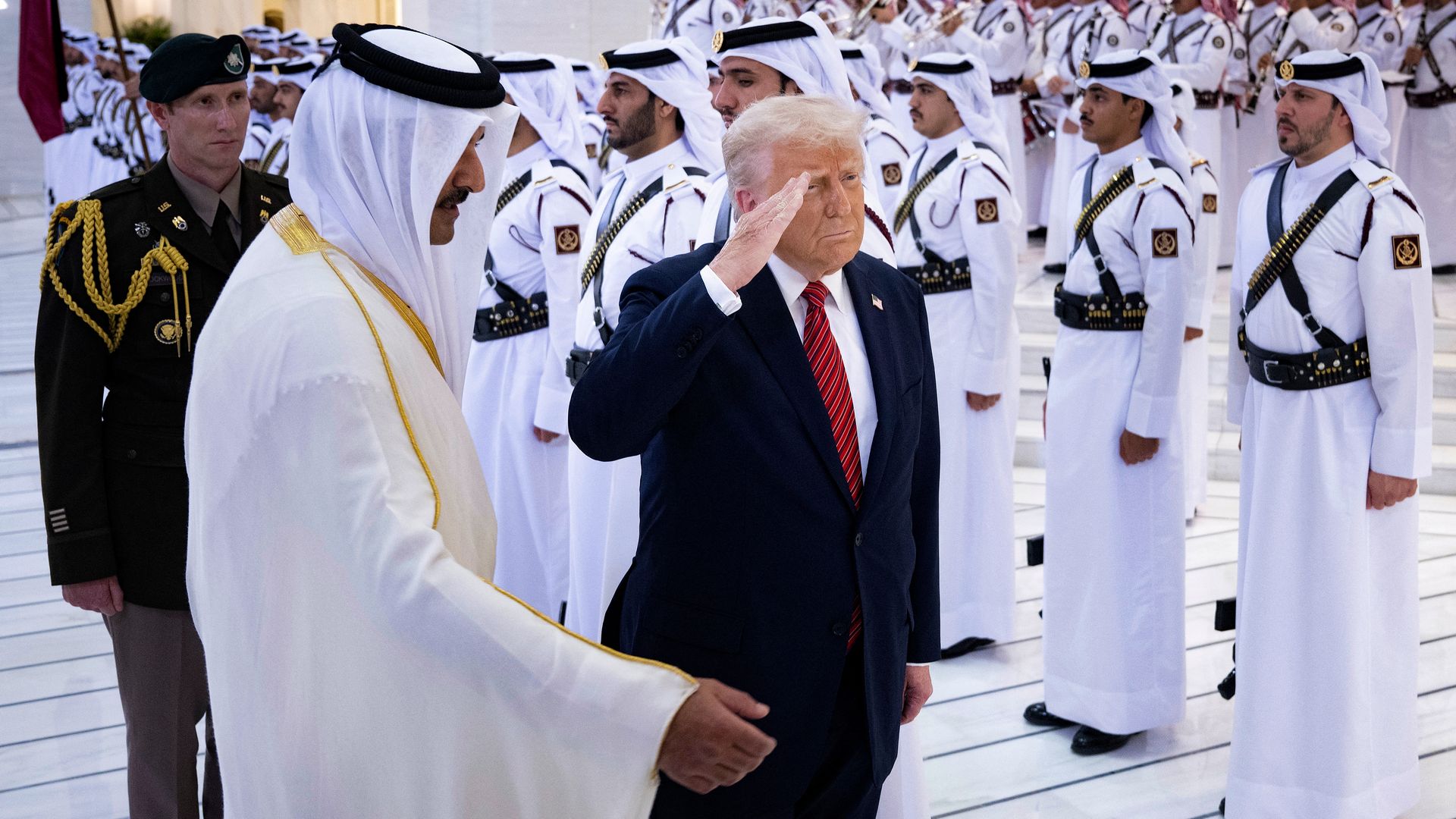
1 big thing: Qatar's diet Article 5
The United States is promising to treat Qatar's security like its own.
- That single Trump administration decision sets in motion a geopolitical cluster. There's confusion and jealousy among Gulf states; questions of burden-sharing among NATO allies amid Trump's push for them to spend more money; and a political meltdown in Israel, among other drama.
Why it matters: There now exists a diet Article 5 between Washington and Doha β an arrangement several Middle East watchers described to me as unprecedented.
- "The Trump administration may well have intended it one way, and the region could interpret it in another. It could take on a life of its own, in a sense," Mona Yacoubian at the Center for Strategic and International Studies told me.
- Now Qatar "has something that the others don't."
The big picture: These are the factors, nuances and influences experts are thinking through:
ποΈ White House, not Senate. The new U.S.-Qatar dynamic is the result of executive order, not Senate ratification. Its unilateral nature peeved some on the Hill while also rendering it susceptible to the whims of the next βΒ or even current β president.
- "These guarantees only go so far as the executive branch. That's significant, because Qatar has had huge issues in Congress, too," Yacoubian said. (Qatar has been accused of human rights abuses as well as associating with terrorists, which Doha denies.)
- "There's certainly been legislative moves against the state of Qatar. This doesn't address that, right?"
β° The timing. Trump's fiat arrives on the heels of Israel's attack on Doha, not Iran's attack on Al Udeid Air Base, America's largest in the region. The former killed no top Hamas officials, the intended targets. The latter required so many Patriot interceptors that the Joint Chiefs chairman publicly marveled at the exchange.
- "I've been reading a lot of the Gulf responses as a Gulf realization that the Iranians are not their friends and the Israelis are also not going to be their friends," Brian Carter at the American Enterprise Institute told me.
- Beyond Qatar, "I think the Saudis and the Gulf states, overall, were very frustrated with how Israel's been operating in Syria after the fall of the [Assad regime]."
βοΈ Lopsidedness. Not once is the word "mutual" written in Trump's executive order. Only once is "our" used.
- "This deal with Qatar basically shows that checkbook diplomacy can be more successful than doing the actual burden-sharing that we officially ask β and even demand β of our allies," Jonathan Ruhe at the Jewish Institute for National Security of America told me.
- "We're putting our necks on the line much more than Qatar is."
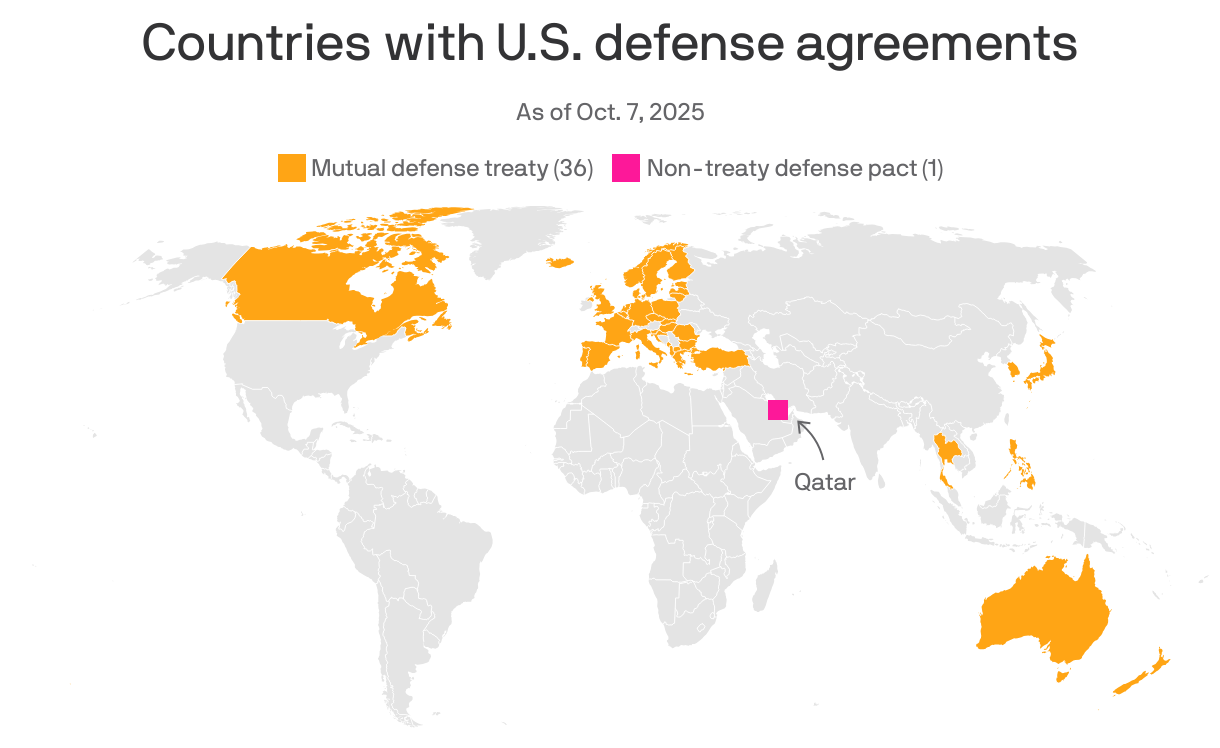
π The other pact. Saudi Arabia doesn't have a similar defense deal with the U.S. but did sign one with Pakistan in September. It's received less mainstream examination despite its nuclear overtones.
- It also signals Saudi Arabia's diminishing trust in American guarantees.
βοΈ Air Force One woes. Qatar gifted the U.S. a Boeing 747 earlier this year. Trump, who has been courting Gulf states and pining for a new flying fortress, said it would be "stupid" not to accept it.
- The move set off political and counterintelligence alarms. The Air Force said it would cost up to $400 million to renovate the plane; critics said the cost would be closer to $1 billion.
Zoom out: The U.S. spent $9.6-$12 billion on military operations in Iran, Yemen and other parts of the Middle East between October 2023 and September 2025, according to a Costs of War analysis out yesterday.
- That includes the dispatch of aircraft carriers to the region, the loss of Super Hornets as well as the Rough Rider and Midnight Hammer operations.
- So much for the Pacific pivot.
The bottom line: The ground is shifting in the Middle East, but the U.S. is bound to stick around.
- "Traditionally it's assumed that bases offer Washington leverage with the host capital," Behnam Ben Taleblu at the Foundation for Defense of Democracies told me.
- "Now, in the Middle East, base politics seem to be operating in the background of larger strategic deliberations, offering the host more β not less βΒ leverage the longer the relationship continues."
More from Axios:
The U.S. military can't quit the Middle East
U.S. moves Patriot defenses to Middle East with dozens of C-17 flights
Defense industry must collaborate more in Middle East, says Dunford
2. Exclusive: Fortem's foreign deals
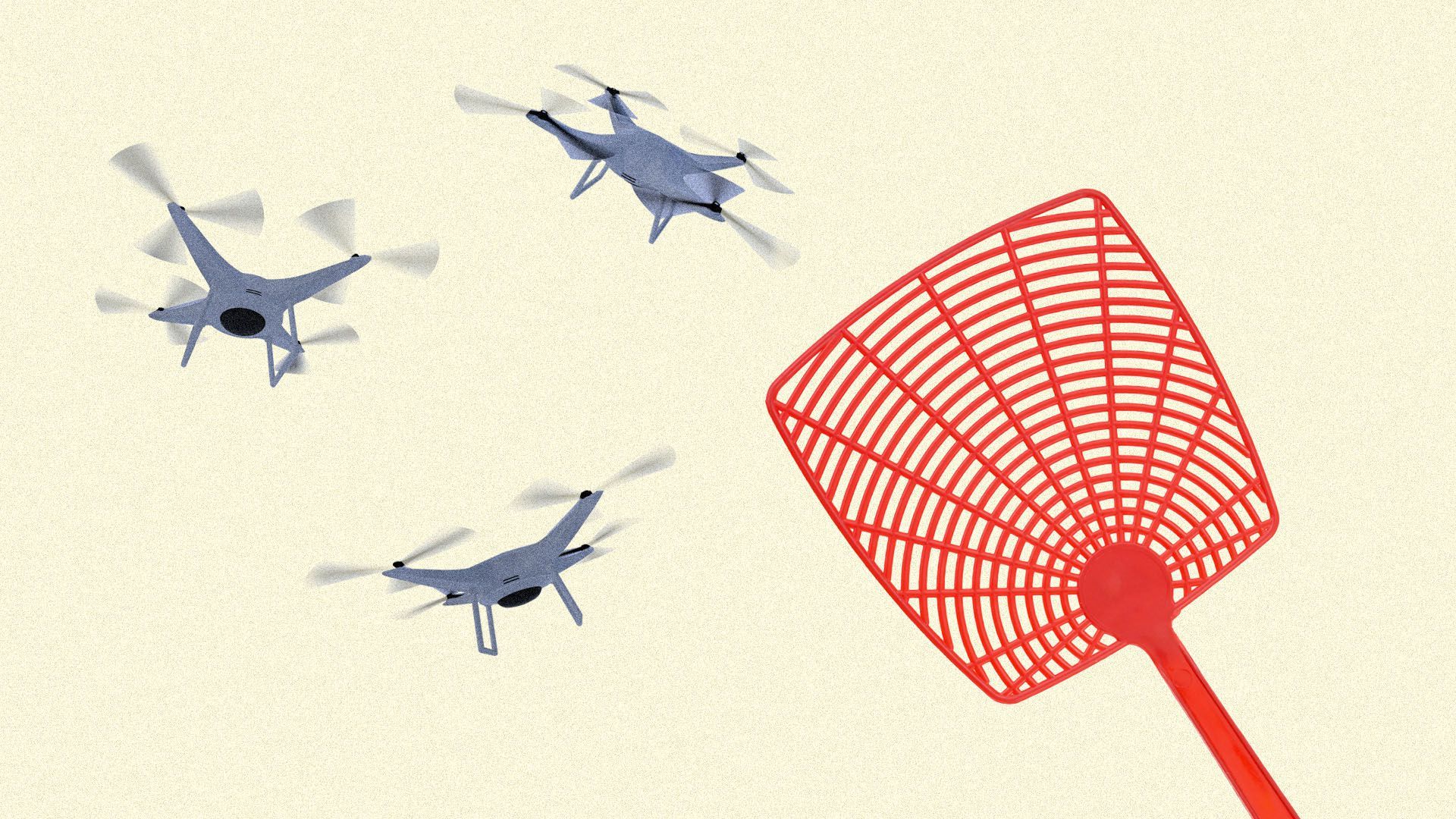
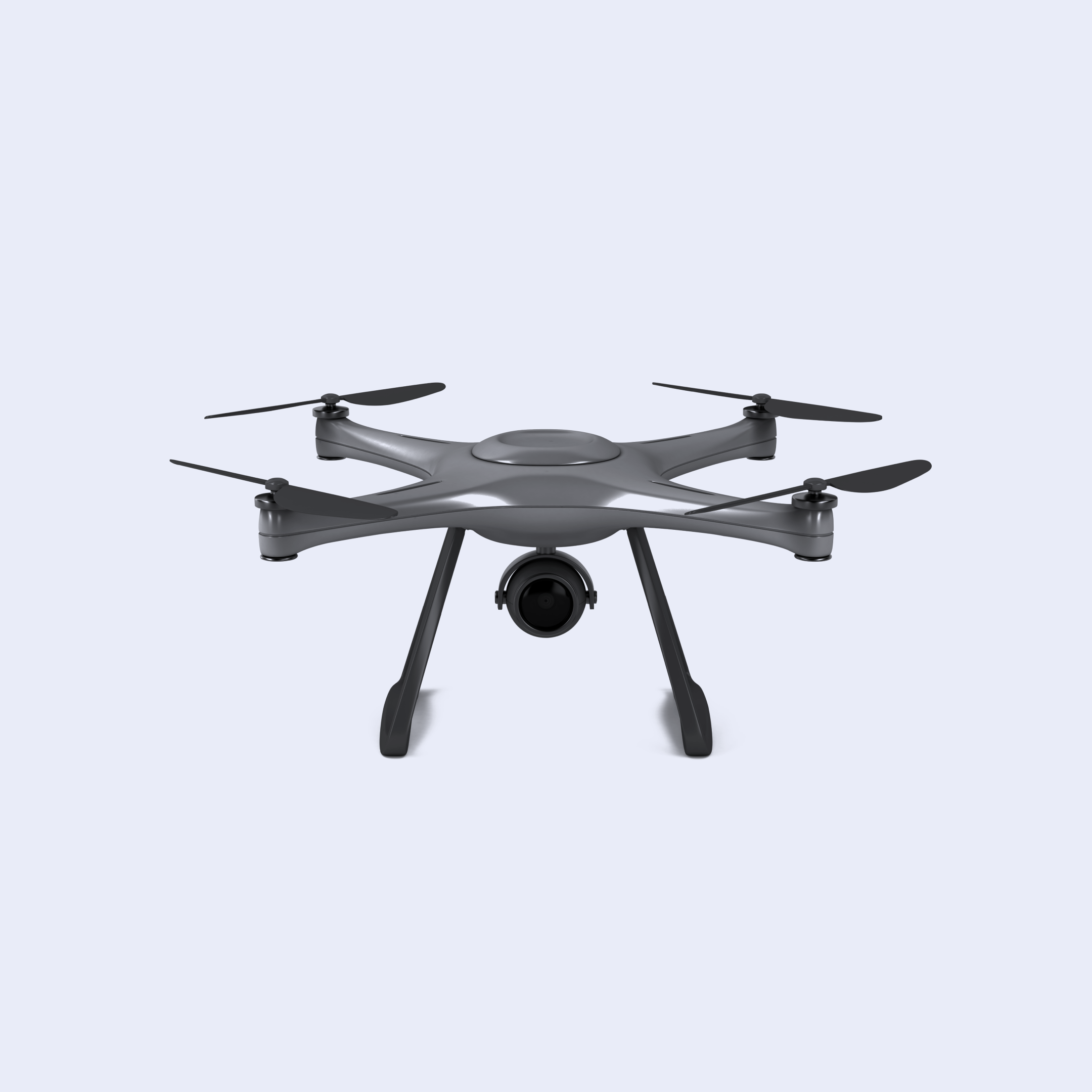
U.S. allies in Europe and the Middle East ordered a dozen counter-drone systems from Utah-based Fortem Technologies in the third quarter, doubling its business vs. the same period last year.
Why it matters: The drone-counter-drone game is white hot, and Russian violations of NATO airspace are stoking the fire.
The latest: Fortem's SkyDome countermeasures will be deployed in protection of military bases and other critical infrastructure, CEO Jon Gruen told me.
- "There's no shortage of issues happening, whether it's Russia into Eastern Europe or it's the conflict in Israel or the continuation of the conflict down in Yemen," he said.
- "Drones are the choice of the threat actors today."
Friction point: Gruen declined to say how many systems were bound for each region.
State of play: Fortem, just south of Salt Lake City, can produce hundreds of SkyDome components per month. The company has been approached by governments to hit a rate of thousands per month, according to Gruen.
- "They call on a Friday and say, 'By Monday, send me everything you have on your shelf.' And we did, last week."
- "We build everything in house. All the radars, all the drones, all the effectors, the command-and-control itself. We build all that in Utah."
The intrigue: Fortem's gear has been deployed in Ukraine for three years. It's also been used along the U.S. southern border.
Follow the money: The company is backed by DCVC, Signia Venture Partners and Lockheed Martin's investing arm, among others.
Go deeper: U.S. Army-led task force seeks counter-drone coordination
3. Quick hits
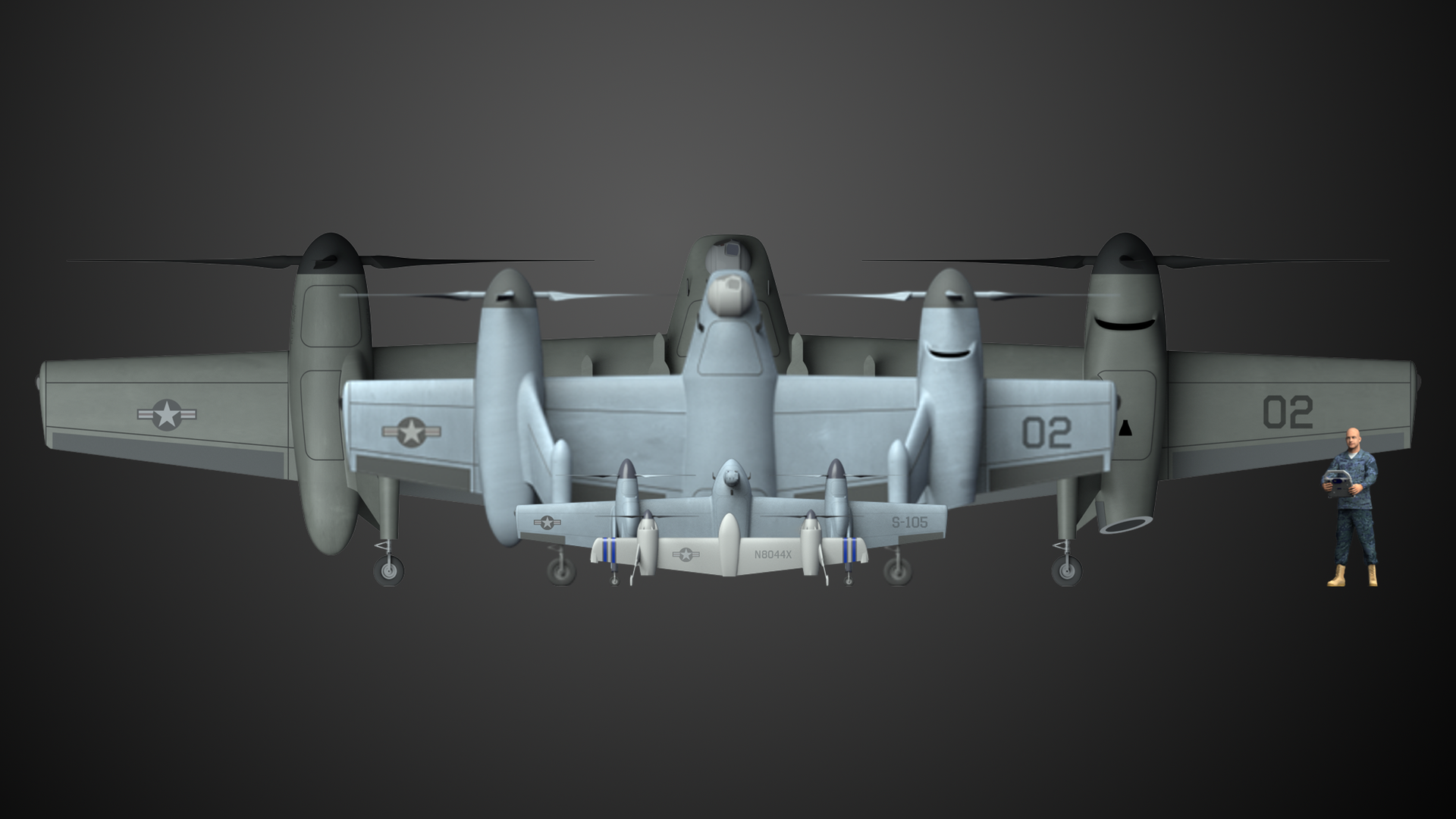
π Lockheed Martin's Sikorsky business unveiled its Nomad line of rotor-blown-wing autonomous aircraft, which take off and land vertically and don't require a runway.
- Why it matters: The Nomad 100, with an 18-foot wingspan, is being built right now. It's expected to fly in the coming months. A smaller prototype, Nomad 50, flew months ago.
- π My thought bubble: Do I spy Shadow and Gray Eagle successors?
π£ββοΈ President Trump decided the U.S. is in "armed conflict" with cartels, according to a document distributed on the Hill. Meantime, CNN reported, a classified Justice Department opinion authorized strikes against suspected drug traffickers.
- Why it matters: The U.S. military has killed handfuls of people in international waters. The administration has accused them of being smugglers but has offered the public little evidence.
- π My thought bubble: The al-Qaeda comparisons wielded by Trump 2.0 laid the groundwork for this.
π¦ Tycho AI announced a $10 million Series A led by FirstMark.
- Why it matters: "Tycho AI is not simply building autonomy technology, we are laying the foundation for how humans and machines will interoperate in the real world," CEO Thom Kenney, a U.S. Army veteran, said in a statement.
- π My thought bubble: Cal Biesecker at Defense Daily had it first. Give his article a read, here.
β The Senate confirmed Hung Cao to be the undersecretary of the U.S. Navy. The vote for the service's No. 2 civilian was 52-45.
- Why it matters: Cao is special operations veteran. He previously ran for a Senate seat representing Virginia, but was bested by Democratic Sen. Tim Kaine.
- π My thought bubble: Cao is also the "What we need is alpha males and alpha females who are going to rip out their own guts, eat them and ask for seconds" guy.
4. Axios interview: Karen Dahut
This week's conversation is with Karen Dahut, the chief executive at Google Public Sector.
- We've known each other for a few years. For this conversation, we linked up at Google's office in Washington, south of Shaw.
Why she matters: Dahut has decades of experience in the tech space. She's a former U.S. Navy officer and spent time with Booz Allen Hamilton's global defense business.
Q: When you hear "future of defense," what comes to mind?
A: This question has been on my mind for some time. I've actually been saying data and software are really the future of defense.
- Quick story. I started some of my technology consulting in the automotive industry, and one of my key customers at that time was Toyota Motor Corporation. The chief information officer at that time said 65% of the cost of a car is software. That was an aha moment for me.
- I don't think about hardware. I think about the software and the data that drive that hardware and the ability to make a much more agile defense force.
Q: What's the biggest challenge the defense industry faces at the moment? What can be done to alleviate it?
A: I think defense is not adopting technology β and emerging technology β as quickly as it should be.
- I think that is a mindset challenge. I think it's a cultural challenge. I think it's a process challenge, and I think it's an acquisition challenge.
- Legacy providers are motivated to maintain the status quo. That's a challenge for the Department of Defense.
Q: What region of the world should we be watching? Why?
A: We have to be paying close attention to Indo-Pacific Command. It's where so many things are coming together: economics, population, threats.
- How do we really invest there to make sure that America stays strong and ahead of any threats β but also stays strong economically?
Q: How many emails do you get a day, and how do you deal with them?
A: I love this question, I have to say. I get hundreds of emails a day. I don't use any filtering; I don't use any sorting mechanism. I feel like I'm probably old school. I need to put eyes on the email, and I sort my work based on who the emails are coming from.
- External customers, external partners, that, sort of, takes precedence.
Q: What's your secret to a successful overnight flight?
A: Very simple: Have no expectations of sleep. It's impossible.
Q: What advice would you give your younger self?
A: Enjoy the ride more.
- I joined the Navy right out of college, and it was always about, "What's the next achievement? What am I going to do next?" And I really wish I had sat back and, maybe, enjoyed being in the moment a little more than I was.
- I'm trying to do that at Google.
5. Check this out
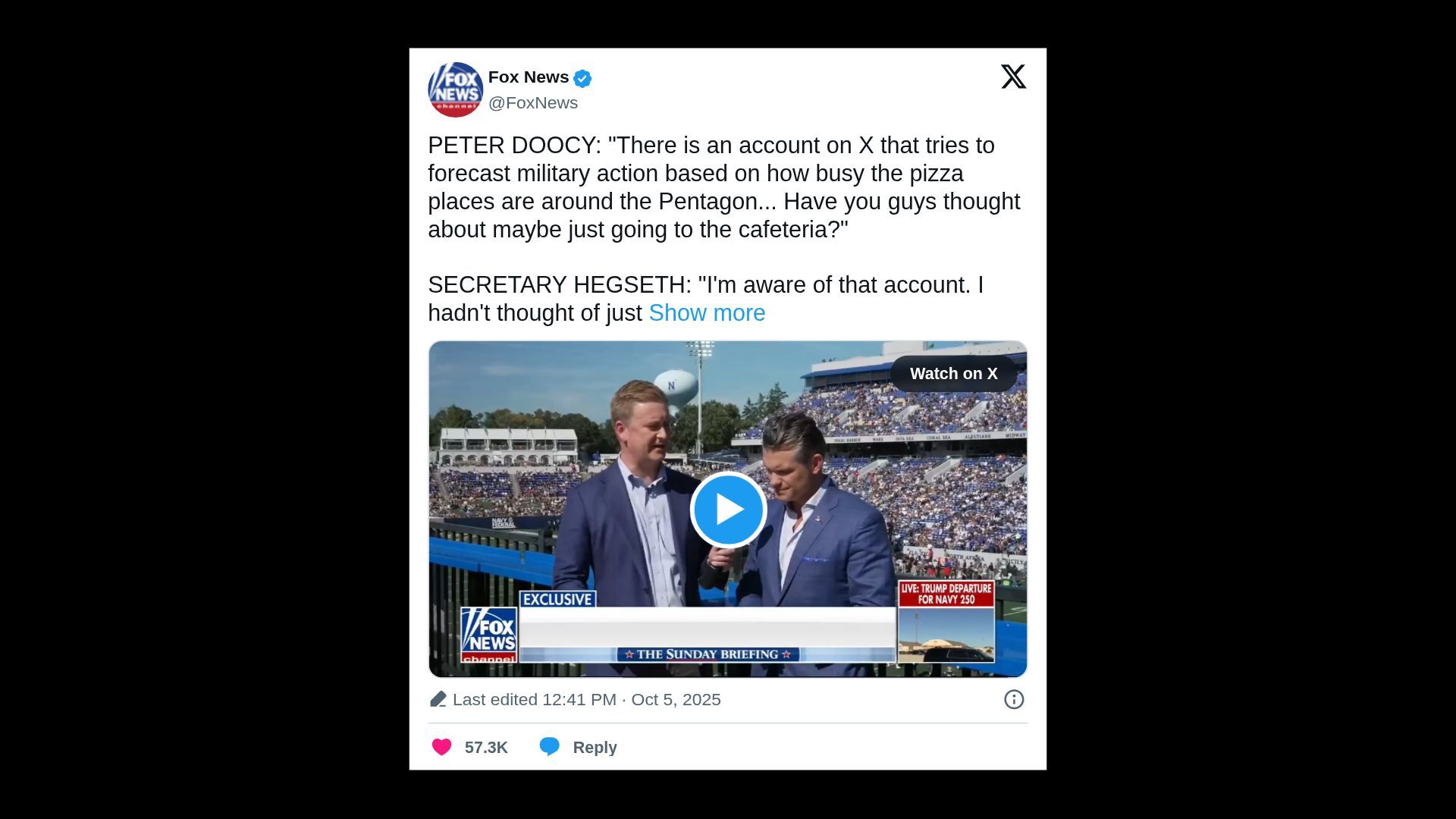
The Pentagon pizza tracker conspiracy theorists are in shambles.
The big picture: Defense Secretary Pete Hegseth told Peter Doocy of Fox News he's debated "ordering lots of pizza on random nights, just to throw everybody off."
The intrigue: People have for years linked a surge in pizza purchases near the Pentagon with war, clandestine operations and disaster.
- "Some Friday night, when you see a bunch of Domino's orders, it might just be me on an app," Hegseth said.
π My thought bubble: Domino's > Marco's Pizza > Little Caesars > Pizza Hut > Papa John's. Easy.
Shoutout to Dave Lawler for editing and Matt Piper for copy editing.
ππΌ Thanks, as always, for reading and sharing. Tell your friends to subscribe here.
Sign up for Axios Future of Defense