Axios Future of Defense
October 22, 2025

Today's the day. See y'all at the Future of Defense Summit. Doors open at 3pm.
- Got questions you want asked? Reply to this email and I'll work 'em in.
- Can't make it? We've got a livestream!
🗳️ Situational awareness: President Trump nominated Lt. Gen. Christopher LaNeve to be the next U.S. Army vice chief of staff. He will succeed Gen. James Mingus pending Senate confirmation.
Order up: Shield AI unveils X-BAT, the Army gets giddy for balloons, and a cat-ears question for Palmer Luckey.
Today's newsletter is 2,211 words, an 8.5-minute read.
1 big thing: Ukraine's other Tomahawk dilemma
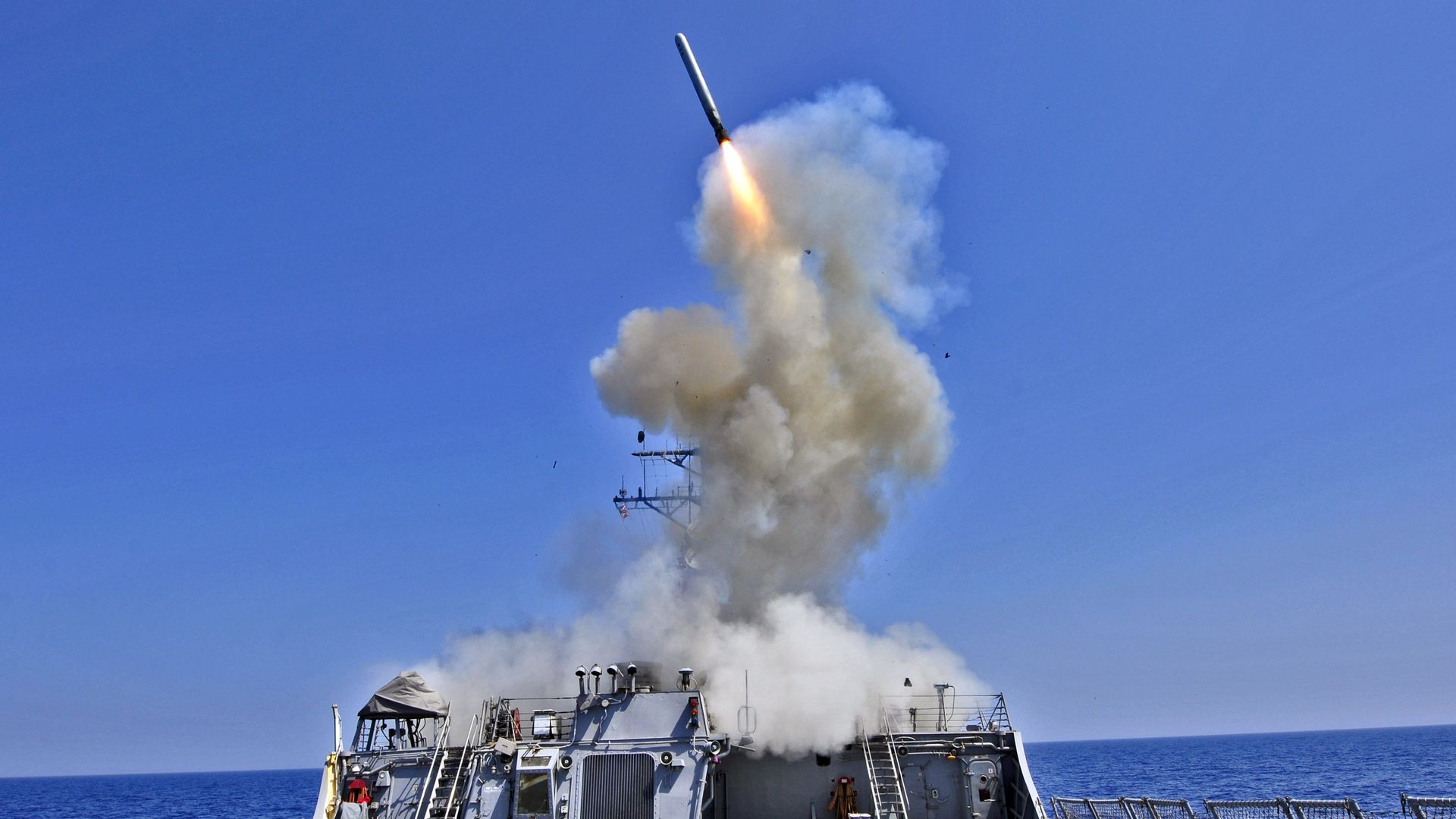
Days of Tomahawks-for-Ukraine discourse at the highest levels publicly elided one topic, arguably the most critical: how they'd actually fire them.
Why it matters: A bullet is nothing without a gun. Likewise, a pallet of sophisticated missiles is a target — not a threat — without a way to let them loose.
- Kyiv's lack of readily available launchers likely further complicated the high-wire act of sharing weapons that would bring Moscow within range.
Driving the news: President Trump sent Ukrainian President Volodymyr Zelensky home empty-handed on Friday, postponing any plans to supply Tomahawks and shifting his attention to diplomacy with Russia.
- While those developments grabbed the headlines, the launcher question lingered in the background.
What they're saying: "Yes, the launcher is a challenge, but it's not exactly a surprise and it's not exactly something that folks haven't been thinking about for a while now," Tom Karako, an expert at the Center for Strategic and International Studies, told me.
- "The potential decision to transfer the missiles implies a decision to transfer the means to use them well."
Between the lines: Ukraine has been applauded for its frontline ingenuity — its ability to slap together weapons and repurpose Soviet stockpiles. Consider the Flamingo, which one outlet referred to as a "junkyard missile," and the broader category of FrankenSAM air defenses.
- In the case of Tomahawks, though, it "probably isn't something you do as a Frankenstein," Karako said.
Zoom in: The RTX-made Tomahawk, employed around the world thousands of times, is mostly launched at sea by surface ships and submarines. Ukraine lacks both.
- Ground launches are therefore the clearest path forward.
Behind the scenes: Ukrainian officials told Axios last week they were hoping to get their hands on Lockheed Martin's Typhon, which can fling SM-6 and Tomahawk missiles alike.
- Typhon was recently dispatched to the Philippines, Australia and Japan. The Ukrainians acknowledged to Axios that the system was in relatively short supply.
- Zelensky and his chief of staff, Andriy Yermak, held separate meetings with executives from Lockheed and RTX while in D.C.
- Yermak told Axios those get-togethers focused both on the systems Ukraine wants and on how to move up on the priority list for shipments if they do gain access.
The other side: A Lockheed spokesperson told me the company will "continue to support the U.S. government's response to the conflict in Ukraine and remain in close coordination with the Trump administration."
Zoom out: There are ground-launch options beyond Typhon. They include Oshkosh Defense's trailer-less Extreme Multi-Mission Autonomous Vehicle, which rolled out at last week's Association of the U.S. Army convention.
The intrigue: "I would not be surprised if we have other things in the warehouse that are not public for this sort of thing," Karako said.
The bottom line: Trump kicked the can down the road. But the debate over Tomahawks isn't over.
More from Axios:
Trump rejects Zelensky on Tomahawk missiles in "tough" meeting
Trump says he and Putin will hold second summit on Ukraine in Budapest
2. Shield AI shows off X-BAT
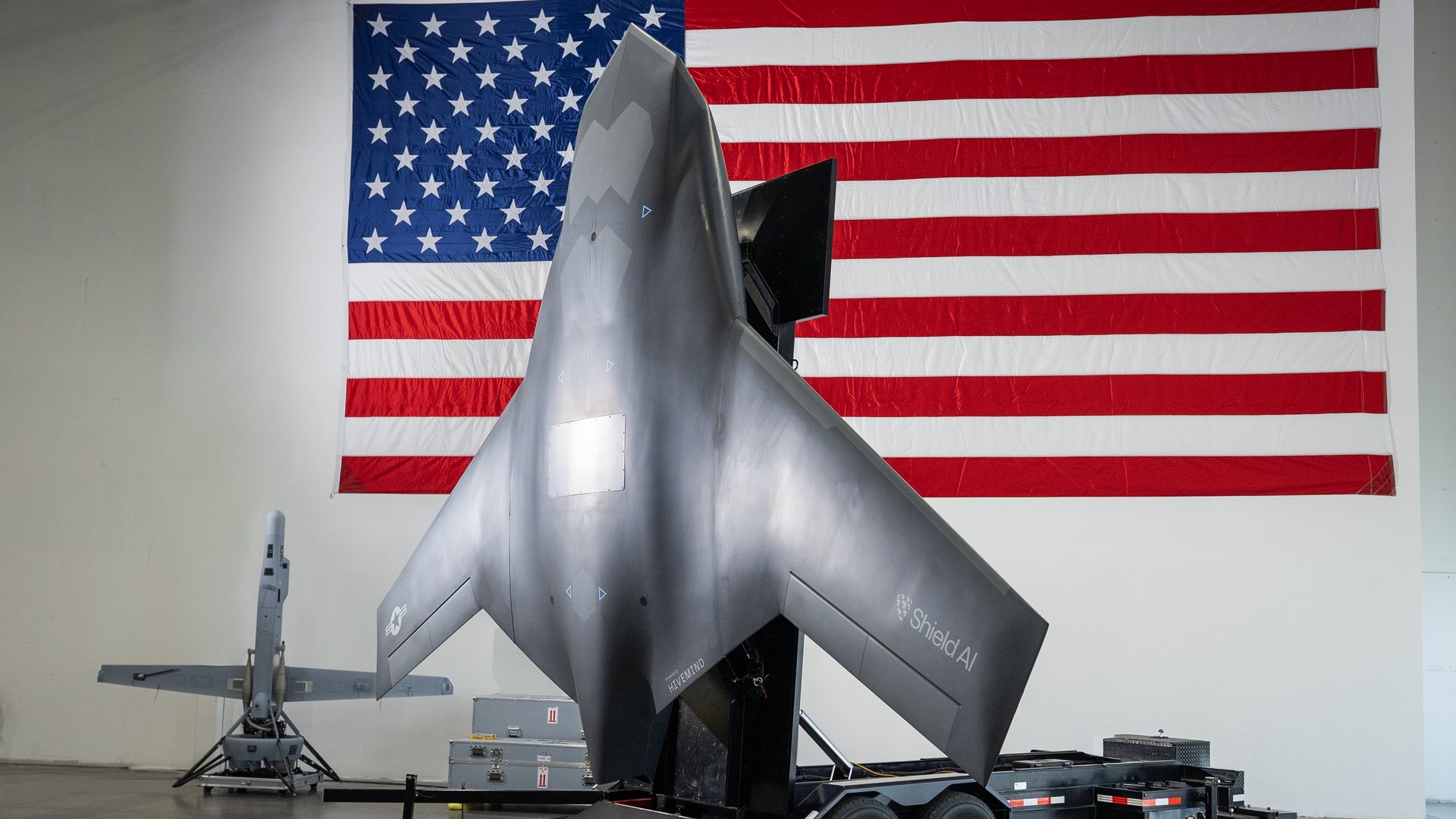
Shield AI today pulled back the curtain on X-BAT, an autonomous aircraft it has for weeks teased as the future of air power.
Why it matters: It's Shield's largest airframe to date as well as its entry into the lucrative robo-wingman space.
- It's also the latest application for Hivemind, a digital brain that's flown on everything from a General Atomics MQ-20 to a Kratos BQM-177A to an Airbus H145.
Zoom in: X-BAT is designed to take off and land vertically, requiring no runway. Three can fit into the deck space of one regular fighter or helicopter, according to the company.
- Conceptual videos shared by Shield show X-BAT is 26 feet long with a nearly 40-foot wingspan. Its range is greater than 2,000 nautical miles.
- That same footage depicts its potential load-outs. One frame shows a Lockheed Martin-made Long Range Anti-Ship Missile. A second shows two RTX-made AIM-120 Advanced Medium-Range Air-to-Air Missiles. A third shows an electronic warfare package.
State of play: Vertical-takeoff-and-launch testing is set for 2026. "Fully operational flight" is expected in 2028.
What they're saying: "VTOL plus range solves survivability on the ground and dependency on tankers," Armor Harris, senior vice president of aircraft, said in a statement.
- Meanwhile, "X-BAT's ability to autonomously operate standalone or collaboratively allows it to project power when other assets aren't around and simplifies kill chains."
Zoom out: The Defense Department is seeking smart machinery to augment troops across ground, sea and air.
- The department was in 2022 juggling more than 685 artificial intelligence projects, including some tied to major weapons systems.
Go deeper: Shield AI delivering V-BAT drones to Japan's navy early this year
3. Putin's plan beyond Ukraine
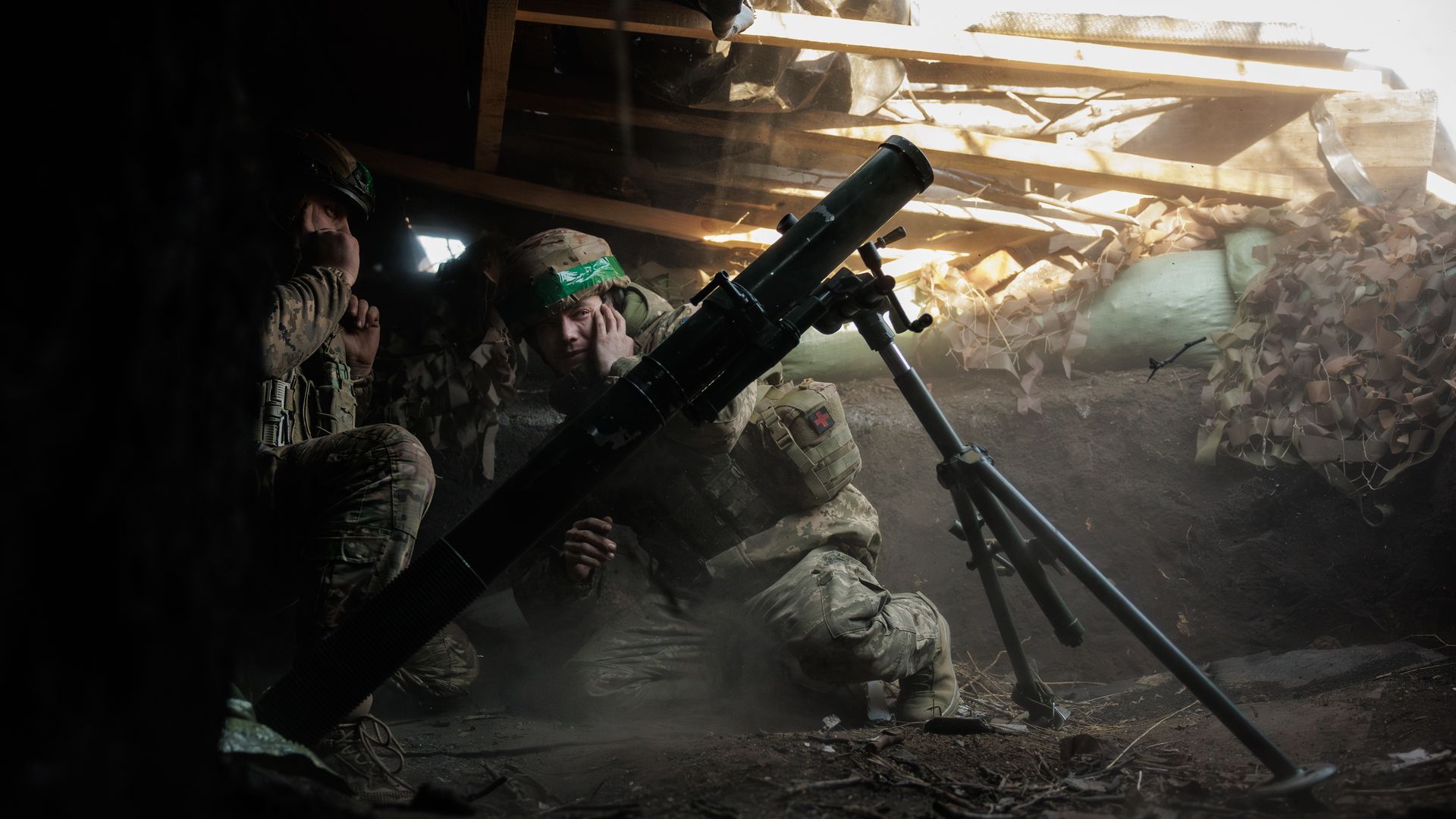
Vladimir Putin's invasion of Ukraine is "not only about territory" but also about rewiring global norms and "reestablishing a Russian vision of how things should be run," Estonia's ambassador to the U.S. told me.
Why it matters: There has long been concern about Russia not stopping its bloody march at Ukraine's borders, particularly within NATO's eastern bloc.
What they're saying: "We firmly believe that this war is not just about Ukraine," ambassador Kristjan Prikk said in an interview at the Estonian embassy.
- "If this war was to end with an outcome that would for Putin and his supporters in a way verify or vindicate what they have done, this is a recipe for further trouble."
Threat level: Exactly what or when that trouble would emerge, Prikk didn't specify. But Moscow is already waging a surveillance-and-sabotage campaign across Europe.
Zoom out: Estonian officials this month closed a road that cuts through a part of Russia known as the Saatse Boot after spotting an unusually large contingent of troops nearby, and NATO forces in September ran off Russian warplanes as they neared the capital, Tallinn.
- Prikk said NATO's reaction "was an adequate one." Critics have called for a more aggressive tack, including shoot-downs.
- "We believe that the message was sent that incidents like this are not tolerated," he said.
- "There is no, let's say, difference between allied airspace in one part of the alliance or another part of the alliance. There is no 'Class A' and 'Class B.'"
What we're watching: Estonia's defense spending, which is expected to exceed 5% of GDP over the next few years.
Go deeper: Russia-Ukraine war has forever changed combat, says U.K. armed forces minister
4. Exclusive: Vermeer nabs $10 million

Defense-tech startup Vermeer closed a $10 million Series A.
Why it matters: It has a presence in the U.S. and Ukraine, and has worked with Lockheed Martin, Northrop Grumman and Firestorm Labs, among others.
How it works: Vermeer builds an optical-navigation system that helps drones fly amid electronic harassment, a well-documented challenge across the front lines in Eastern Europe.
What they're saying: "Innovating with AI and creating a platform for overcoming GPS denial and jamming systems has allowed us to support the American foreign policy program in Ukraine," CEO Brian Streem told me.
- Streem previously told Defense News that "fighting a war and also trying to innovate at the same time are two brutally challenging things to do."
Follow the money: Draper Associates led the Series A. Other backers include Rockaway Ventures and Aero X Ventures.
- "People may not realize how big this moment is in modern history. We're transitioning from human-based warfare to machine-based," Andy Tang, a partner at Draper, told me.
- "I think Vermeer is going to prove to be that gold standard for resilience."
Fun fact: The company's name is a reference to Johannes Vermeer, the 17th century Dutch master.
Go deeper: A defense-tech perfect storm brews in Europe
5. 999 luftballons
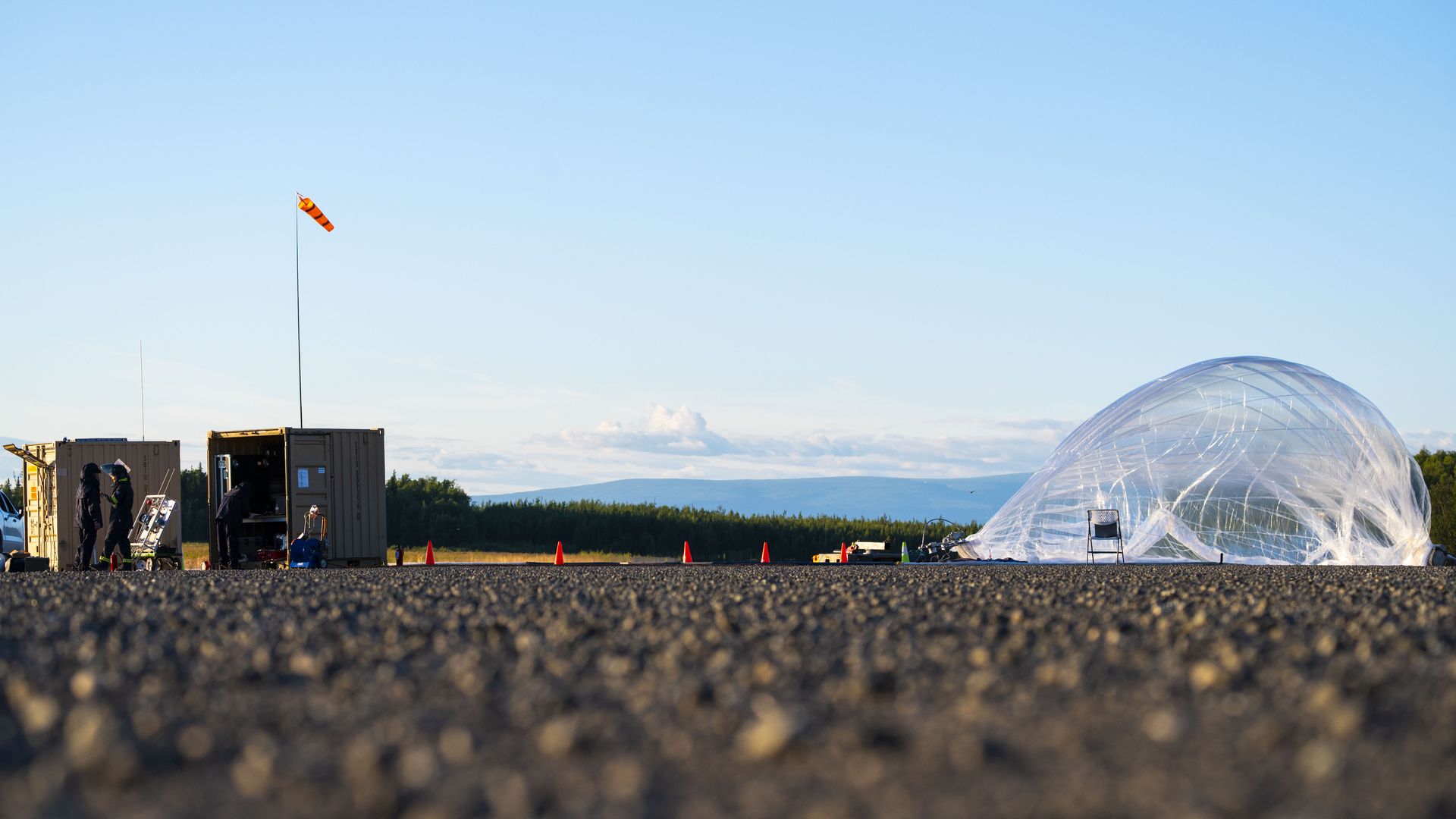
The U.S. Army is planning a "mass experiment" next year involving balloons, solar gliders and other high-altitude technologies aloft over the Indo-Pacific.
Why it matters: The service is trying to nail down the best uses of the equipment, which appear rudimentary but can complicate adversary targeting and reap battlefield intelligence for cheap.
The latest: "We're going to demonstrate what it would look like to put hundreds of capabilities up, nearly simultaneous," Andrew Evans, formerly the head of the Army ISR Task Force and now at the strategy-and-transformation directorate inside the deputy chief of staff for intelligence shop, told me.
How it works: It's a numbers game.
- "Historically, we were floating one or two or maybe three high-altitude balloons," Evans said. That was the wrong approach.
- "We believe there's some significant value in operationalizing the stratosphere, if you start pairing it with ... scale and volume."
The intrigue: The experiment is catching the attention of North American Aerospace Defense Command, which in recent weeks detected and tracked Russian aircraft off Alaska.
Flashback: The Army in early April announced a 10-year contract to sustain and upgrade its aerostat arsenal. The deal's worth as much as $4.2 billion.
- "Balloons are one of the very first intelligence, surveillance and reconnaissance capabilities used in air warfare," Brandon Pollachek, a spokesperson for the Program Executive Office for Intelligence, Electronic Warfare and Sensors, told me at the time.
Go deeper: Aventra emerges as the "Harbor Freight of guided munitions"
6. Fly, Freedom Eagle, fly
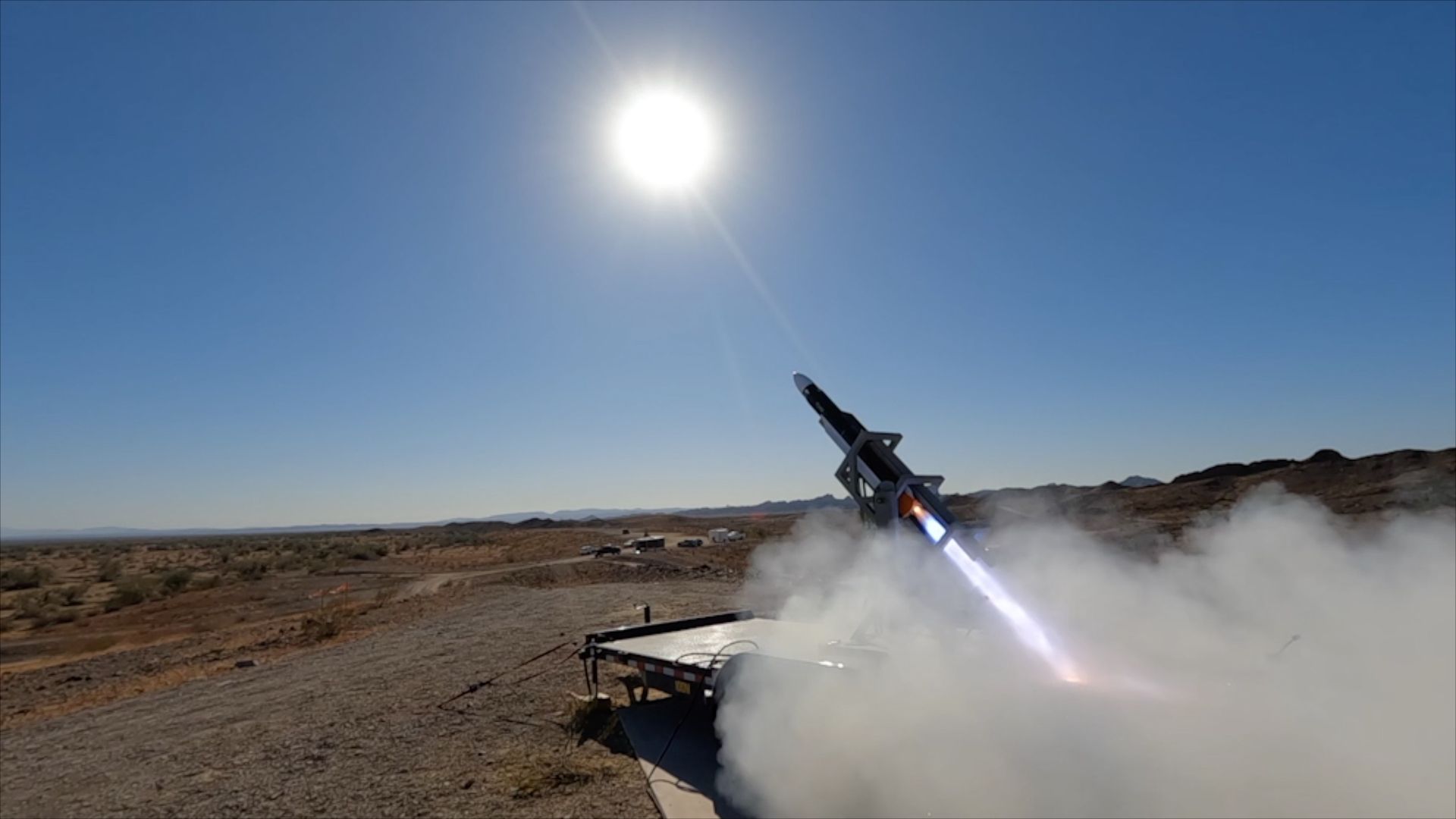
The U.S. Army picked AeroVironment to build counter-drone missiles in an initial deal worth $96 million.
Why it matters: "I told the secretary of the Army last week, when I was briefing him, that for the first time in our lifetimes ... there's a new missile manufacturer on the street," Jimmy Jenkins, the executive vice president of AV's precision strike and defense systems group, told me.
- "If you wanted to build a missile, you had to go to five places, in general," he said. "Now you've got a nimble, young company that can do things at a rate that gives us options as a nation."
The latest: AV bested RTX, the second-largest defense contractor in world by revenue, to make the service's Next-Generation C-UAS Missile.
- The company now plans to deliver 80 prototype Freedom Eagle interceptors (FE-1) — capable of blasting Group 2 and Group 3 drones, as well as subsonic cruise missiles — for testing and evaluation over the course of two years.
- It also believes FE-1 is applicable across services, including the Navy.
Threat level: The proliferation of cheap, deadly drones has forced a rethink of overhead defenses and their price tags.
Zoom in: A majority of FE-1 manufacturing will happen in Huntsville, Alabama. Work is also expected to take place in Arkansas, Arizona and Florida.
The intrigue: FE-1 began its life at BlueHalo. AV acquired the company this year in a multibillion-dollar deal.
The bottom line: "This is a franchise program," Jenkins said.
- "We've got to perform, obviously. We've got to produce and scale," he added. "Those are good problems to have, vice the alternative."
7. Quick hits

☢️ The Waste Treatment and Immobilization Plant at the Hanford Site, Washington, began operations last week. This is decades — and lots of arguments — in the making.
- Why it matters: Hanford is home to tens of millions of gallons of radioactive and chemical waste, stored in potentially leaky underground tanks.
- 💭 My thought bubble: So many people texted me about this. What does that say about my hobbies?
👾 Apex is planning to test space-based interceptor technologies within a year as part of what it's calling Project Shadow. The company "isn't waiting for handouts or contracts; we are developing this orbital magazine technology on our own dime and moving incredibly fast," CEO Ian Cinnamon said in a statement.
- Why it matters: The clock is ticking on Golden Dome.
- 💭 My thought bubble: I guarantee this one will be closely watched and scrutinized.
🇰🇷 South Korea tapped L3Harris Technologies to deliver airborne early warning and control aircraft. The company is partnering with Bombardier, Israel Aerospace Industries' ELTA Systems and Korean Air.
- Why it matters: The program is valued at more than $2.2 billion.
- 💭 My thought bubble: The business-jet-to-spy-plane pipeline is very real! More on that, here.
🇳🇱 General Atomics will develop a small intelligence-and-reconnaissance drone alongside the Dutch defense ministry. The deal was inked at the NL-US Defense Industry Days event.
- Why it matters: "This contract is the first step in a strategic partnership with the Dutch MoD that will ultimately contribute to the defense of Ukraine and NATO by creating a versatile European defense system," General Atomics Aeronautical Systems CEO Linden Blue said in a statement.
- 💭 My thought bubble: Also notable is the Netherlands' entrance into the American Collaborative Combat Aircraft program.
8. Check this out
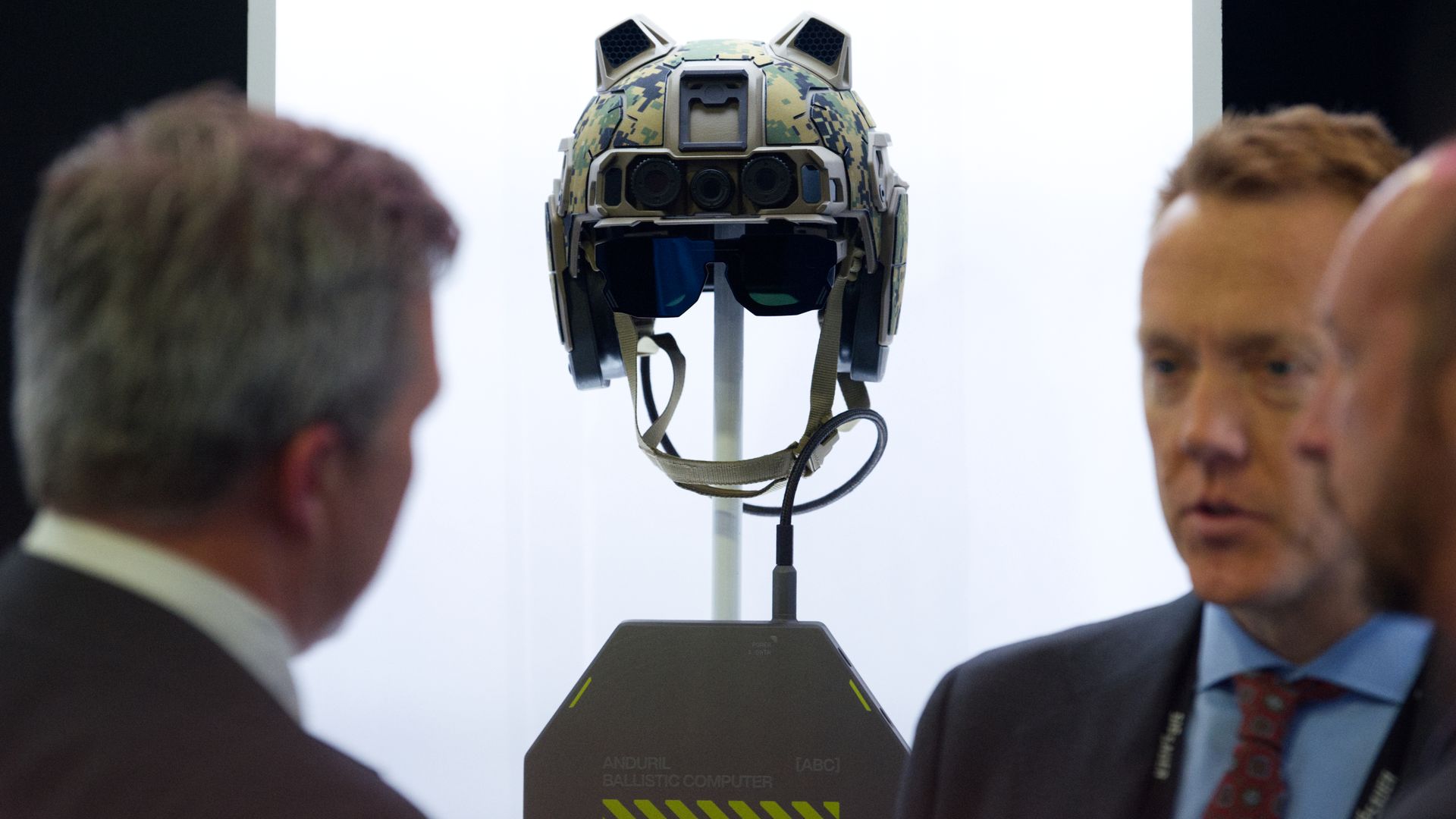
Palmer Luckey, if you are reading this, I have one question for you.
- Does EagleEye have cat ears?
Why it matters: The internet needs to know. (And I failed Axios readers by not asking during the pre-AUSA media brief.)
By the numbers: There are at least four EagleEye variants in the works. One involves Oakley.
Go deeper: It's "go time" for Anduril after defense-tech hat trick
Shoutout to Dave Lawler for editing and Matt Piper for copy editing.
👋🏼 Thanks, as always, for reading and sharing. Tell your friends to subscribe here.
Sign up for Axios Future of Defense