Army inks potential $4.2 billion deal for intel-gathering blimps

Add Axios as your preferred source to
see more of our stories on Google.
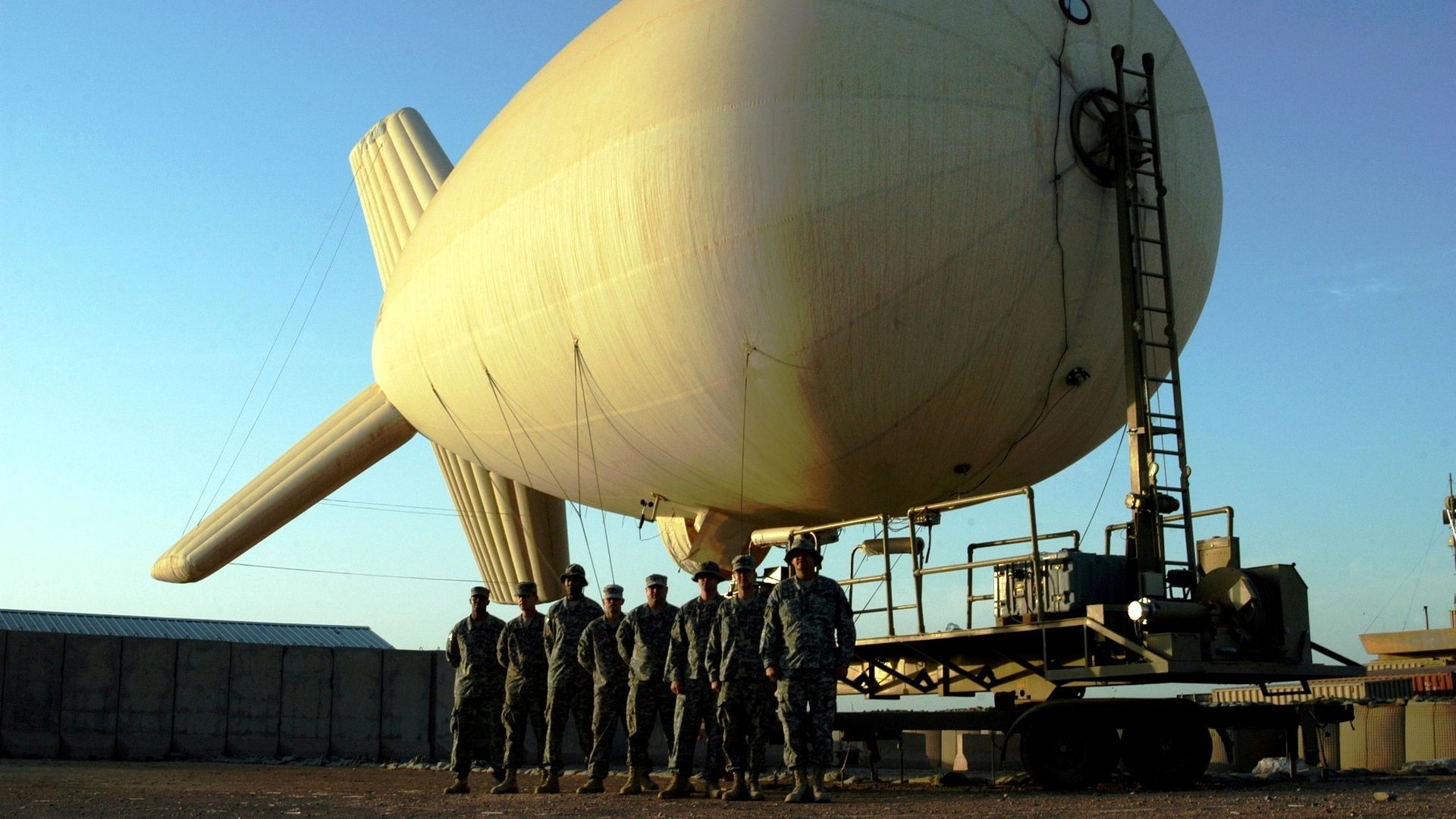
Aerostat crew members are seen in Iraq in 2009. Photo: Murray Shugars/DVIDS
The future, chock-full of super-stealth warplanes, blinding-fast missiles and network-crippling hacks, will also feature aerostats — specialty blimps, for the uninitiated.
Why it matters: For all the hoopla bleeding-edge technologies generate, it can be the simplest tools that prove most effective and long-standing.
- Plus, the juxtaposition is absolutely wild.
Driving the news: The U.S. Army could spend as much as $4.2 billion over the next 10 years to sustain and upgrade its aerostat arsenal, according to a contract announced April 3.
- Ten companies, including Leidos, Qinetiq and TCOM, will compete for work overseen by the service's intelligence, electronic warfare and sensors shop, PEO IEW&S.
- Foreign military sales could also happen across European and Central commands. Poland last year announced a $1 billion arrangement.
How it works: The Army has long deployed and experimented with aerostats and lighter-than-air systems; they contribute to communications relay, jamming, shot-spotting and more.
- One example, the Joint Land Attack Cruise Missile Defense Elevated Netted Sensor System, made headlines a decade ago when it broke free of its mooring in Maryland and floated into Pennsylvania.
- "Balloons are one of the very first intelligence, surveillance and reconnaissance capabilities used in air warfare," Brandon Pollachek, a PEO IEW&S spokesperson, told Axios.
- Today's aerostats "provide an essential and persistent 24/7 eye in the sky," he said. They're also "extremely cost-effective." (A Qinetiq spokesperson made the same point when asked about the contract.)
My thought bubble: These beacons of U.S. presence in the Middle East are being modernized with China and Russia in mind — like all things Pentagon.
The bottom line: "The United States of America needs to get over our JLENS problem, and we need to do it fast. There's just too much utility to these kind of platforms," Tom Karako, an expert at the Center for Strategic and International Studies, said in an interview.
- "These are the F-150s of the sky, or they should be," he added. "They're multi-mission pickup trucks."
