Axios Future of Defense
September 09, 2026

Long weekend. Shorter newsletter.
- I'm interviewing Pentagon chief technology officer Emil Michael onstage tomorrow. Send me your questions!
🧠 Situational awareness: Chariot Defense will announce its board of advisers this morning. It includes retired Gen. James Rainey and retired Brig. Gen. Samuel Peterson; Ellen Lord, formerly the Pentagon's top weapons buyer; and Stephen Rodriguez, a defense investor at DCVC.
Stay awhile and listen: An Allen Control Systems expansion, a Palantir-Anduril combo and some Space Force fits.
Today's newsletter is 1,674 words, a 6.5-minute read.
1 big thing: A sizzling summer

The summer of love happened in 1967. The summer of lasers is happening right now.
- Both upset the status quo.
The big picture: These weapons, so often associated with science fiction or Congressional Research Service reports, are clawing into reality after decades of investment and experimentation.
Recent progress and other milestones include:
- The U.S. Army awarding a first-ever high-energy laser production contract, worth $465 million, to AeroVironment. The company will deliver dozens of Locust X3s over the coming years.
- Troops on the U.S.-Mexico border zapping at least 11 cartel-linked drones — what the Laser Wars blog described as the Pentagon's "first known 'kill'" with such a system.
- Ground A and Inleap Photonics, German startups building laser countermeasures, raising €9 million and €20 million, respectively. (That's almost $34 million total.)
- Chief of Naval Operations Adm. Daryl Caudle committing a service-wide memo to directed energy, arguing that the "question is no longer whether these systems work — it is how quickly we can field them across the fleet and place them in the hands of sailors."
- U.S. Air Forces in Europe and Air Forces Africa saying that it was using Boeing's Compact Laser Weapon System in "locations across the theater" and not in "isolation."
- Lockheed Martin and nLight winning contracts for the Joint Laser Weapon System, with the ceiling pegged at $847 million. Initial prototypes will be 150 kW strong; future versions will hit 300–500 kW.
- And both Defense Secretary Pete Hegseth and Pentagon chief technology officer Emil Michael attending a laser- and microwave-weapon demonstration in New Mexico.
Friction point: The promise of lasers is fantastic: dirt-cheap cost per shot, near-endless magazines and the opportunity to save bigger guns, such as Patriot interceptors or Standard Missiles, for juicier targets.
- But they are no panacea.
- Lasers can be thrown off by atmospheric conditions, like fog and sand, are reliant on power production, which can be disrupted (or take up precious space aboard a warship), and require line of sight, which means proximity to the thing trying to kill you.
- Experts have also warned of supply-chain vulnerabilities, including foreign and sole-source dependencies.
Follow the money: The Trump administration's fiscal 2027 budget blueprint included more than $2 billion for directed-energy research, development and testing.
- That's markedly more spending — proposed, at least — than in prior years, according to the Government Accountability Office's math.
- At least 31 directed-energy initiatives were underway across the U.S. military in 2024.
What we're watching: CBS News reported "a roughly 75% decrease in the number of drones probing the southern border in the Rio Grande Valley" following employment of lasers.
The bottom line: This feels like an inflection point.
Go deeper: Electromagnetic weapon zaps drone swarm in seconds
2. Exclusive: Ramping up Ramjet-X

Hermeus is building what it's calling Ramjet-X — a super-fast aircraft that blurs the line between large drone, air-defense target and test bed for propulsion and materials science.
Why it matters: It's another big bet on unmanned speed from the company, which this year was valued at $1 billion post-money and moved its headquarters from Georgia to California.
Driving the news: Hermeus unveiled Ramjet-X this morning, offering the defense world "high-Mach flight test as a service" and highlighting the national-security insights that come with it.
- "I can monetize this as a test asset — B2B, B2G. But it's also an in-house test asset that gets me ramjet flight data and long-duration thermal management flight data now," chief executive Zach Shore told me.
- "This can seriously drop testing costs, and also advance our propulsion work."
Zoom in: Ramjet-X, about 22 feet long and 7 feet across, is designed to launch midair from underneath Quarterhorse, the F-16-sized unmanned aircraft that Hermeus is known for.
- First flight of Ramjet-X is expected less than a year from now. Eventually, one Quarterhorse will be able to carry two Ramjet-Xs slung underwing, according to Shore.
- "The first-stage booster is the airplane," he said.
- "When the plane gets up to Mach 3, I can release a ramjet-only system that's going to accelerate, climb, get up to about 100,000-ish feet, Mach 4-ish speed, and it's going to cruise for tens of minutes."
The intrigue: There are echoes of the Cold War-era D-21, M-21 and piggybacking configuration here.
- "There is a very clear historical precedent that's really exciting," Shore said.
- "Things that we thought were impossible, that we did in the '60s with slide rules — we can do them again."
What we're watching: Which companies sign up, and where this endeavor intersects with Pentagon programming, like the Multi-Service Advanced Capability Hypersonics Test Bed.
The bottom line: "It's very early, but people are definitely intrigued," Shore said. "Tomorrow is now today."
More from Axios:
U.S. seeks super-mobile missile defense radar
Hermeus co-founder has a mysterious new defense startup
U.S. trails China and Russia on hypersonic weapons, task force finds
3. Exclusive: Bullfrog boom
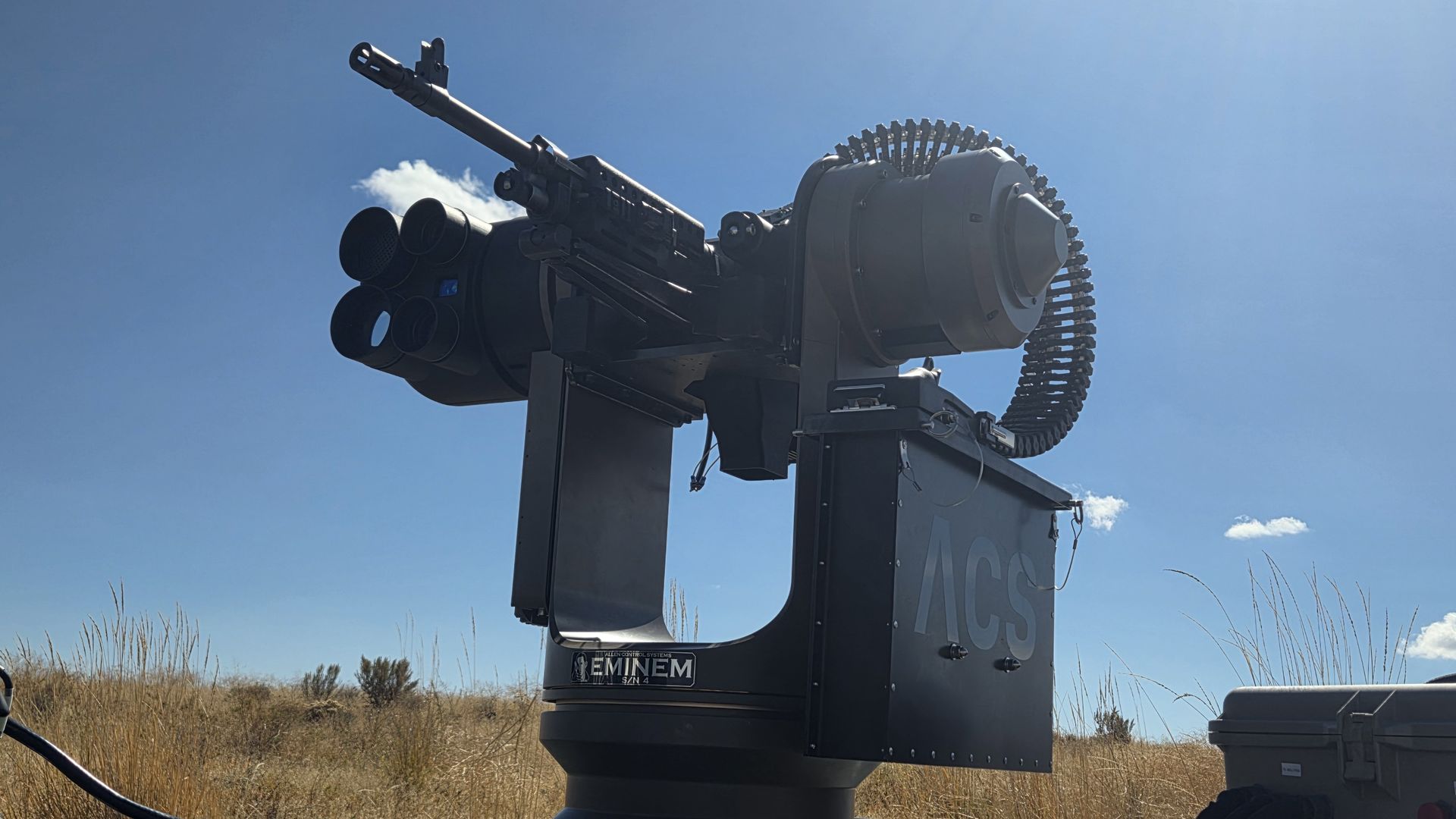
Allen Control Systems is expanding its manufacturing footprint in Austin, Texas, to meet what the startup is calling "accelerating demand" for drone countermeasures.
Why it matters: The state capital has cemented itself as a haven for defense tech.
Driving the news: ACS is cutting the ribbon on a 191,000-square-foot facility. The setup will help dramatically increase production of Bullfrog turrets, CEO Mike Wior told me.
Catch up quick: Bullfrog combines precision robotics, computer vision and autonomous control to enable widely available weapons, like the M240, M2, M230 and M134, to shoot down small and fast-moving drones.
- "Getting this into the fight, leveraging the unlimited arsenal of 7.62 bullets that we have all over the world, is just a critical layer to being able to free up" other resources, like high-end interceptors, Wior said.
- Bullfrog also works with laser dazzlers and less-than-lethal ammunition, like rubber bullets.
Follow the money: ACS raised $200 million this summer and was valued north of $2 billion. Eighty turrets have been committed this year.
- The startup has signed contracts with the Army, Marine Corps and Special Operations Command, among others. It also has buyers in South Korea and the United Arab Emirates.
- "The ones that we sell to the Army will be every bit as salt resistant and water resistant as what we sell to the Navy," Wior said. "I think the most interesting thing has been the shock and vibe requirements."
Fun fact: There exists a rose-gold Bullfrog. It's called Rosie.
What's next: ACS is also opening an engineering facility in Silicon Valley.
4. ICYMI: Palantir production
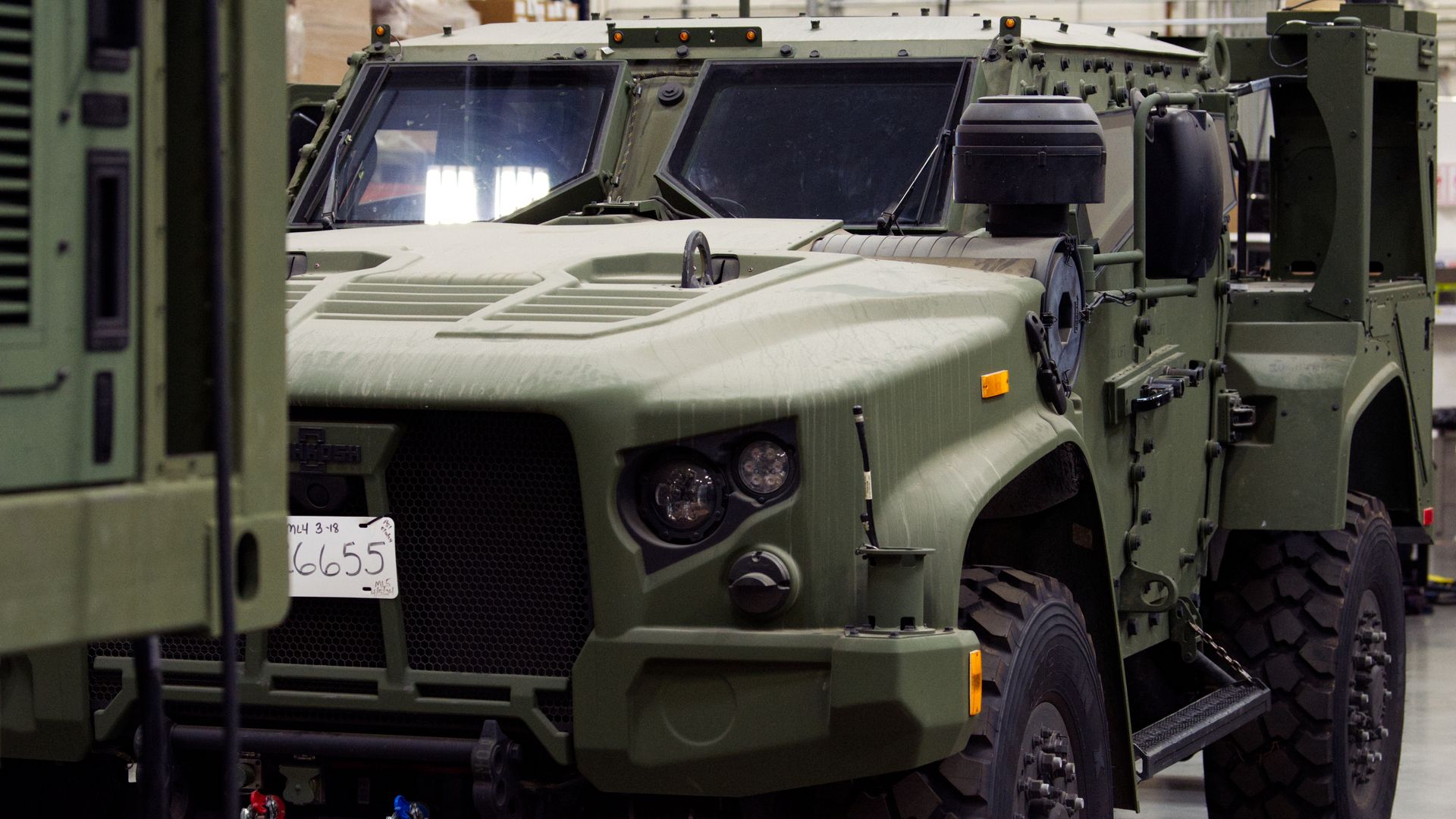
The U.S. Army has inked contracts worth a total of $192 million with Palantir Technologies and Anduril Industries for the production of eight Tactical Intelligence Targeting Access Nodes.
Why it matters: State-of-the-art TITAN trucks are cornerstones of the service's deep-sensing and long-range precision fires goals — in other words, the ability to find, track, shoot and kill more accurately from farther away.
- They are also key contributors to the Joint All-Domain Command and Control networking nirvana the Pentagon has for years sought to achieve.
Driving the news: Four advanced variants and four basic variants of TITAN will be delivered over the next year and a half, according to the Army.
- The former is based on the Family of Medium Tactical Vehicles. The latter is based on the Joint Light Tactical Vehicle.
- Additional configurations are being considered. An Infantry Squad Vehicle version was previously spotted at the Association of the U.S. Army conference.
- The finished products will join prototypes the service already has on hand. (An early version was delivered to Joint Base Lewis-McChord, Washington, in 2024.)
How it works: TITAN trades sticky notes for artificial intelligence. It hoovers up battlefield information — including from space — and parses it to give troops quicker, sharper insights.
5. Quick hits

💥 Covenant emerged from stealth today, logging more than $250 million raised across three rounds. Backers include Andreessen Horowitz and Founders Fund. Advisers include former Deputy Defense Secretary Kathleen Hicks.
- Why it matters: The D.C.-based startup already completed a live-fire test of its Anthem cruise missile at the U.S. Army's Project Convergence.
- 💭 My thought bubble: Where it builds is notable. The U.S. Germany. Israel.
📊 The Pentagon's Chief Digital and Artificial Intelligence Office has turned to Red Cell Partners to pilot a shared-savings contracting framework. The arrangement is worth up to $100 million.
- Why it matters: "For nearly two years, we have worked alongside CDAO and the Navy to define how shared savings could eliminate inefficiencies via agentic AI," Red Cell founder Grant Verstandig wrote in a blog post. "Now it's time to execute."
- 💭 My thought bubble: A venture studio prime, with portfolio companies as subs? Interesting.
🇸🇦 The State Department approved the potential sale of Joint Direct Attack Munitions-Extended Range and AGT-1500 engines, used in M1 Abrams tanks, to Saudi Arabia.
- Why it matters: The deals are together valued at $5.75 billion.
- 💭 My thought bubble: Remember when the White House said Saudi Arabia wants to buy hundreds of American tanks?
🗳️ President Trump nominated Hung Cao to be the next Navy secretary. Trump on social media described him as a "true warrior."
- Why it matters: Cao is already in the role — in an acting capacity — following the sudden dismissal of John Phelan.
- 💭 My thought bubble: Riley Ceder at Military Times has a months-old rundown on Cao's priorities, including "alpha males and alpha females."
6. Check this out

Be honest. Is the fit 🔥🔥🔥?
The big picture: MilTwitter has some thoughts. So does Derek Guy, of "Die, Workwear!" fame.
What they're saying: "The moon is ours," according to President Trump.
- Such an assertion violates the Outer Space Treaty of 1967, according to critics.
Go deeper: The space warfare president
Shoutout to Jeffrey Cane for editing and Matt Piper for copy editing.
👋🏼 Thanks, as always, for reading and sharing. Tell your friends to subscribe here.
Sign up for Axios Future of Defense