Army turns "the dials up" on next-gen networking in California desert

Add Axios as your preferred source to
see more of our stories on Google.
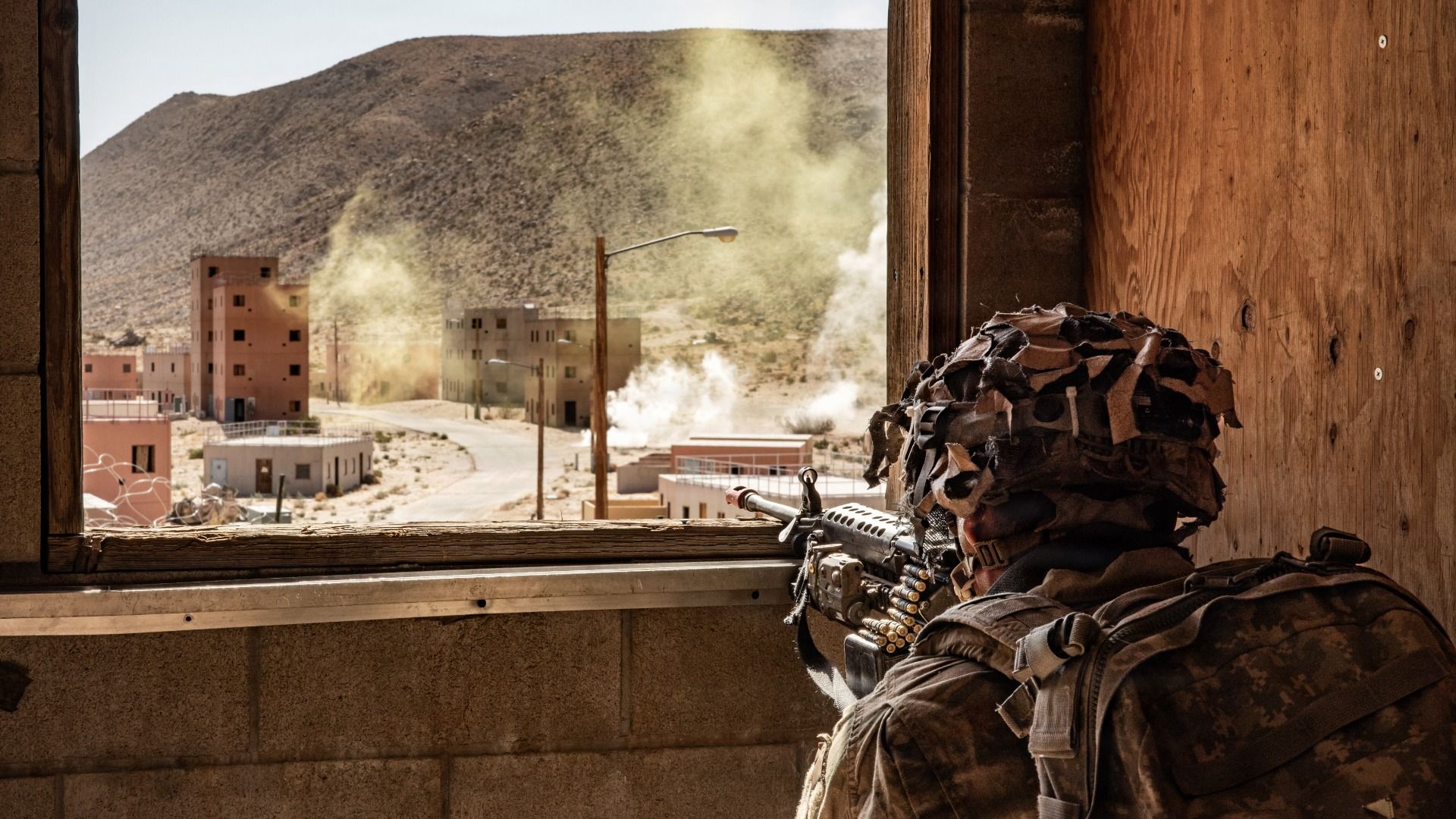
A 4th Infantry Division soldier at Project Convergence Capstone 6 at Fort Irwin, California. Photo: Jonathan Reyes/DVIDS
The U.S. Army's latest swing at streamlining networks and communications, known as Next-Generation Command and Control, proved effective at one of the service's largest experiments to date and will soon be distributed among larger units, according to military leaders.
Why it matters: The Army has tried and tried again to future-proof its command and control, juggling its relationships with the Air Force and Navy, the rapid commercialization of tech, the widespread availability of artificial intelligence, and threats posed by hackers, electromagnetic sensors and ever-evolving tactics in wars abroad.
- "Next-Generation Command and Control, or what I call Army Command and Control, is not a replacement for how we fight. That's fundamental, and that's often misunderstood," Gen. Christopher LaNeve, the vice chief of staff, told reporters.
- "It does not replace what a commander has always had to do and will always have to do — but it enables them to do it on the move and while distributed, which is incredibly important."
Driving the news: A version of NGC2 was in late July put to the test at Project Convergence Capstone 6, a massive exercise at scorching-hot Fort Irwin, California.
- Thousands of troops participated. More than 90 technologies were tinkered with.
- "When we rolled in here, we had expectations that we were going to come to a really challenging environment and that we were going to fight for nine continuous days using our systems," Maj. Gen. Patrick Ellis, the commander of the 4th Infantry Division, told reporters.
- "What really worked was the common visualization: our ability to see where the soldiers were on the battlefield, where we perceived the enemy to be on the battlefield, and then that enabled us to bring fires to bear, to maneuver forces faster."
Yes, but: Some soldiers battled with connectivity and overheating issues.
Zoom out: The U.S. military has for years pursued a communications nirvana, known as Combined Joint All-Domain Command and Control, in which the right information gets to the right people at the right time no matter the source, distance or interference.
- If achieved, it would mean the best-placed and -equipped shooter takes the best shot.
- Project Convergence was part of the original CJADC2 recipe, alongside the Air Force's Advanced Battle Management System and the Navy's Project Overmatch.
Zoom in: Both the 4th and 25th Infantry Divisions have been workshopping NGC2. The former, based in Colorado, conducted smaller trials known as Ivy Sting and Ivy Mass in the lead-up to PCC6.
What they're saying: "Building upon Ivy Mass, we wanted to have larger scope and scale. Larger from a number of command nodes, larger from the number of combat vehicles out here in the terrain, larger from an area coverage," Lt. Gen. Michael McCurry, the PCC6 director, told reporters.
- "During this rotation, as the division flowed from west to east, we began to turn the dials up."
Follow the money: More than 60 companies, including Anduril Industries and Lockheed Martin, are chipping into NGC2. The Army in its latest budget request sought nearly $4 billion for development and delivery.
What's next: The I Corps, based in Washington state and focused on the Asia-Pacific, is next on the NGC2 list.
