Axios Future of Defense
August 12, 2026

Hello, again. I turn 32 today. Time flies.
- What's the big buzz at Space and Missile Defense? And who's headed to Air, Space & Cyber next month? Lemme know!
‼️ Situational awareness: The International Atomic Energy Agency will soon remove nuclear material from a site in Syria, after the U.S. reached understandings with the country and Israel, my colleague Barak Ravid reported.
Scroll, baby, scroll: Demining Azerbaijan, Joby Aviation's defense play and the cost of Trump-class battleships.
Today's newsletter is 1,669 words, a 6.5-minute read.
1 big thing: Exclusive ... California love

REDONDO BEACH, California — The bus departed Impulse Space and was hurtling down the highway, bound for an In-N-Out Burger somewhere southeast. Inside, JPMorgan Chase CEO Jamie Dimon and other executives were discussing defense tech: its ups, its downs, its risks, its opportunities.
- How could they help? Where were the relevant watering holes? And what would it mean to get creative, to avoid the pitfalls of the past?
- "The notion that this country is behind is frustrating, but I'm very uplifted by what they're doing," Dimon said. "You walk around companies like Impulse Space — they're doing amazing stuff."
The big picture: In October, JPMorgan Chase tossed $1.5 trillion into the national-security ring with its Security and Resiliency Initiative. At first a stateside push, it has since extended to include Canada, Europe and the U.K.
- Billions of dollars have already been committed. Billions more could be poured on top.
- "My real concerns started with the war in Ukraine in 2022," Dimon said, referencing a fight that has forced a rethink of weapons, tactics and global power.
- "Talking with some retired generals about the challenges really opened my eyes."
Driving the news: I tagged along with Dimon and crew last week as they toured Impulse, a space-mobility startup led by SpaceX's first employee, and talked with missile, drone and aircraft makers, energy specialists, manufacturers, and data whizzes.
- The back-to-back engagements were part of an annual bus tour, in which Dimon and other top bank execs consult with employees, clients and communities across the country.
- This year's trip was dedicated to California, starting in Healdsburg and zipping through San Francisco, Modesto, Santa Barbara and Los Angeles. It wrapped in Orange County.
State of play: Defense was once a dirty word in some West Coast circles. Now, startups and neo-primes nestled around LAX and SFO are sinking their teeth into the Pentagon budget and boxing out older, more orthodox companies from the headlines.
- "Being a 30-year veteran of Silicon Valley, I've never seen this kind of effort, this manufacturing push. It's real. I can feel it," said John China, the co-leader of JPMorgan Chase's innovation economy practice.
- JPMorgan sponsored this year's NatSec100, an inventory of prominent private-capital-backed companies and their defense contracts. A dozen previous listees have IPO'd.
- "We have to be out here regularly," China said. "We have to be in front of these folks."
Zoom in: The Security and Resiliency Initiative is dedicated to critical industries such as aerospace and defense, manufacturing, energy and health tech.
- Its more than two dozen subcategories include battery storage, command and control, critical minerals, munitions, shipbuilding and space launch.
- And there are big names advising it: former Defense Secretary Robert Gates, retired Gens. Chris Cavoli and Paul Nakasone, and former Speaker of the House Paul Ryan among them.
- "We're bringing our human capital and financial capital to help give oxygen to this important effort," said Doug Petno, a JPMorgan Chase co-president.
- "This couldn't be a symbolic gesture — it needed to be a meaningful commitment backed by visible, measurable action."
Threat level: Should the U.S. fail to kick its defense-industrial base into high gear, fail to excise Beijing from its most-sensitive stockpiles, fail to juggle the Asia-Pacific with the Middle East with the Arctic, it risks losing the next war.
The bottom line: "It looks like the engine behind the arsenal of democracy has been ignited, from nuclear energy to missile defense and shipbuilding to supply chains," Dimon said.
- "We're here to help. We're here to learn."
2. Exclusive: Mine-hunting momentum
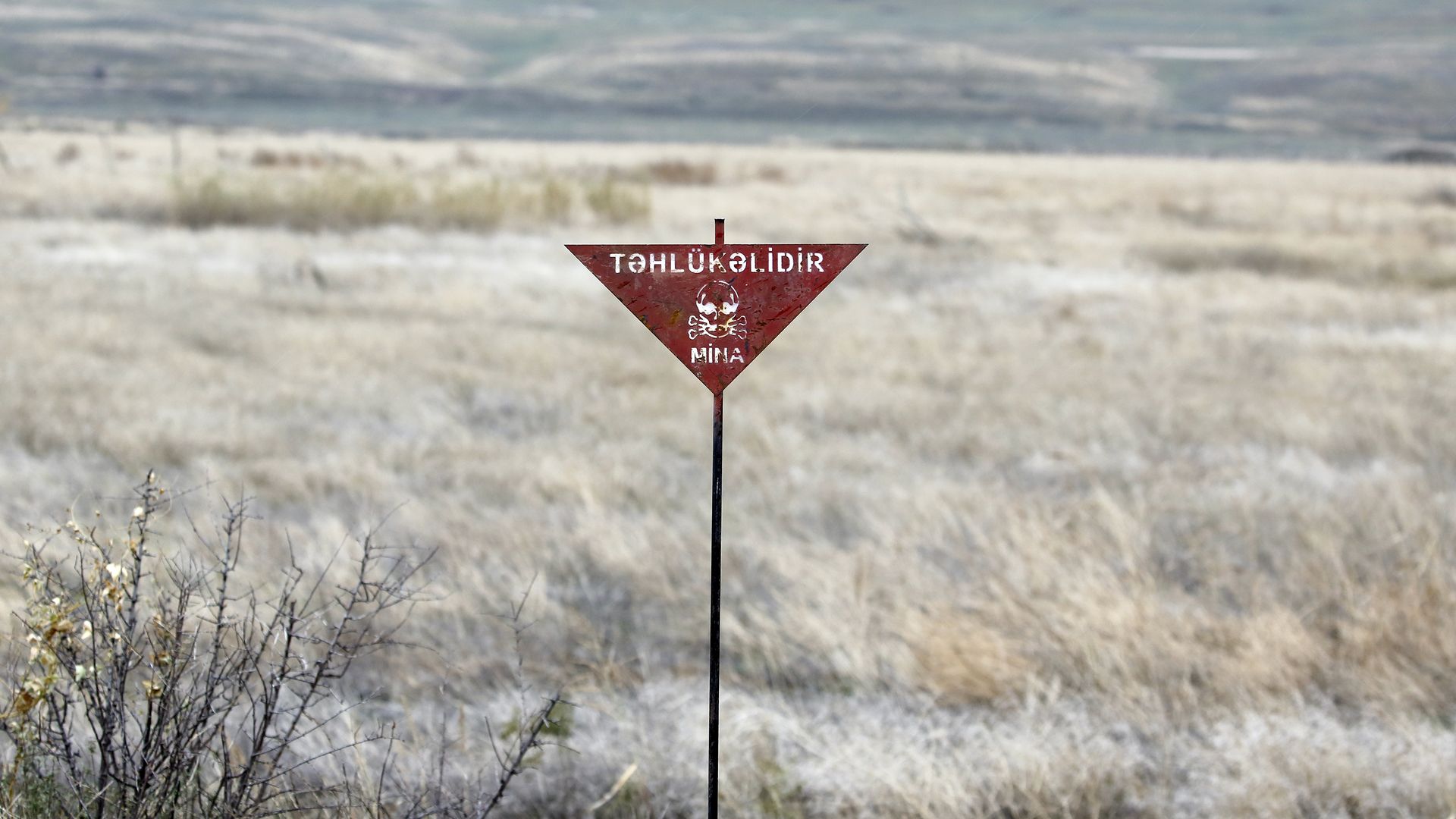
Azerbaijan is on the hunt for demining technologies and techniques, and hopes the U.S. can lend a hand, ambassador Khazar Ibrahim told me.
Why it matters: The collapse of the USSR and years of conflict between Azerbaijan and Armenia have saturated the region with unexploded ordnance, which can maim or kill and scare off industry.
Driving the news: I spoke with Ibrahim around the one-year anniversary of the U.S.-brokered peace declaration between Azerbaijan and Armenia.
- Our conversation also came months after Washington and Baku inked a partnership charter that, among other things, recognized the latter's "serious challenges" with landmines and pledged future financial support.
What they're saying: "Azerbaijan is, if you look at per-capita, one of the most landmine-contaminated countries in the world," Ibrahim told me.
- "There are many, many, many technological advances in the world that can help," he said. "We hope we can work with the United States also on this issue."
Friction point: Clearing land is expensive, time-consuming and dangerous. Countless mines are in the ground around the world.
Zoom in: The Marshall Legacy Institute has since 2005 donated more than 90 mine-detection dogs to the Azerbaijan National Agency for Mine Action.
- "One of the critical things is actually having correct mapping," Ibrahim said.
Zoom out: Azerbaijan has sought closer ties with the U.S. post-peace pact and post-partnership agreement in everything from artificial intelligence to energy. Azerbaijani President Ilham Aliyev was named a founding member of President Trump's peace board.
- "The good thing about the current U.S. administration," Ibrahim said, "is that whatever you agree upon, you immediately start working on."
Go deeper: Azerbaijan wants "official explanation" from Iran after drone attack
3. ICYMI 1.0: Joby's big buy

Joby Aviation is buying defense contractor Resonant Sciences in a $500 million deal.
The big picture: Joby's commercial aircraft business will stick to electric air-taxi initiatives, while Resonant will become its dedicated defense unit.
The intrigue: Much of what Resonant is up to is kept hush-hush — or is cloaked in Pentagon-ese. The company, employing around 250 people, advertises radomes and antennas, aircraft testing and stealth designs.
- Its website is dotted with images of an anechoic chamber as well as the Lockheed Martin F-35 and Northrop Grumman B-2.
What they're saying: Joby CEO JoeBen Bevirt told me the acquisition will provide the company a "deep bench of defense expertise" while also boosting its presence across the U.S. (Almost all of Resonant's employees have security clearances.)
4. ICYMI 2.0: Factory funds

Hadrian, the factory builder and defense manufacturer, raised $1.37 billion in venture capital and is now valued just shy of $8 billion, post-money.
Why it matters: American reindustrialization is catching on beyond niche national-security and investor communities.
What they're saying: "We were early," chief executive Chris Power told me.
- "This has been a five-year slog, and only 18 months ago everyone went, 'Oh, God, manufacturing is super important, and we really need to create new American manufacturing jobs fast.'"
How it works: Hadrian pumps out precision parts and provides factories-as-a-service for aerospace and defense markets. It employs skilled human workers and augments that workforce with artificial intelligence, automation and robotics. (Its proprietary software is known as Opus.)
- Hadrian today has nearly 3 million square feet across four sites, and a new headquarters in Los Angeles and an engineering and research-and-development hub in San Francisco are being planned.
Zoom in: Hadrian works with the world's largest arms makers, including Lockheed Martin and RTX, as well as neo-primes and smaller outfits, like Anduril Industries.
5. Quick hits
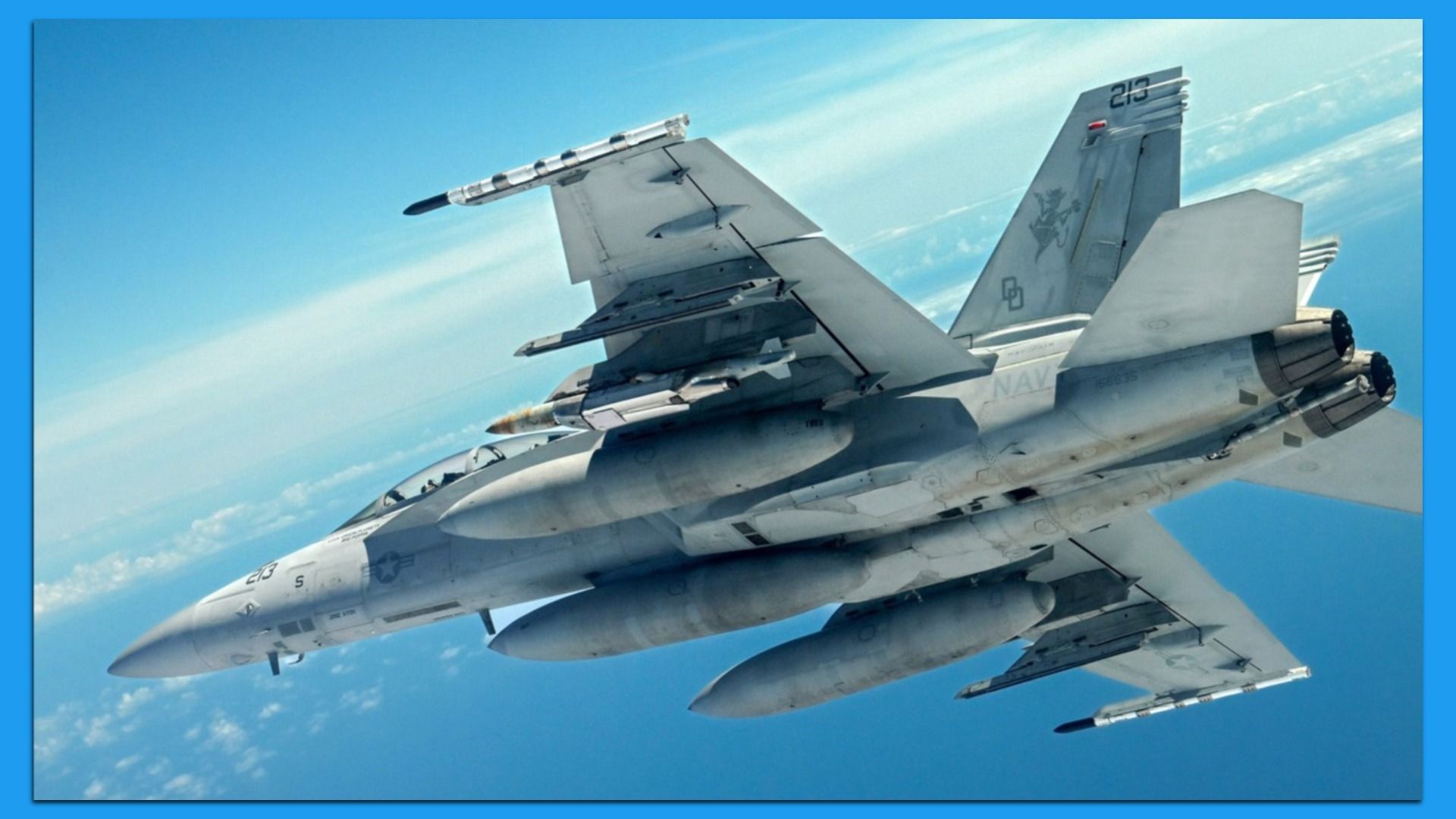
✅ The U.S. Air Force greenlit production of a turbojet-boosted Joint Direct Attack Munition to the tune of $75 million, according to Boeing. First flight was conducted off California.
- Why it matters: The JDAM Long Range "gives operators an affordable, mass-producible option for striking targets from beyond the effective range of enemy defenses," according to Bob Ciesla, vice president of precision engagement systems.
- 💭 My thought bubble: Pairing cheap(er) munitions with long(er) reach is a win, especially considering America's big-picture stockpile concerns.
👛 Heaviside Industries raised $60 million and announced a partnership with Norway's Nammo. The Series B was led by Felicis. Other backers include Hedosophia and Menlo Ventures.
- Why it matters: "In defense, reputation and proven experience are paramount. The team at Heaviside has both," Jake Storm, a Felicis general partner, said in a statement. The startup is now valued at $600 million.
- 💭 My thought bubble: And this is all three-ish months after exiting stealth.
🛜 Lockheed Martin collaborated with Verizon, Nvidia, Keysight, ODC and Astris AI to detect and track drones in the Miami area with what they are calling Netsense. The demonstration happened last month.
- Why it matters: Netsense relies on today's commercially available technologies, including AI and 5G. Pilot deployments are expected as soon as this year and early next year.
- 💭 My thought bubble: Existing towers make this pretty easy to proliferate, no?
💳 The first Trump-class battleship will cost a little more than $23 billion, with subsequent vessels costing around $18 billion, according to the Congressional Budget Office's latest analysis.
- Why it matters: "The laws of physics aren't broken just because of who is building the class of ship. Everything is more expensive and harder than it looks on paper," Wilson Grossman-Trawick, a shipbuilding analyst at The Asia Group, told me. "I think this is a missed opportunity to better spend the Navy's limited time, talents and resources on pursuing the highest possible ROI capabilities."
- 💭 My thought bubble: I've been watching this one since the reveal. More info here, here and here.
6. Check this out
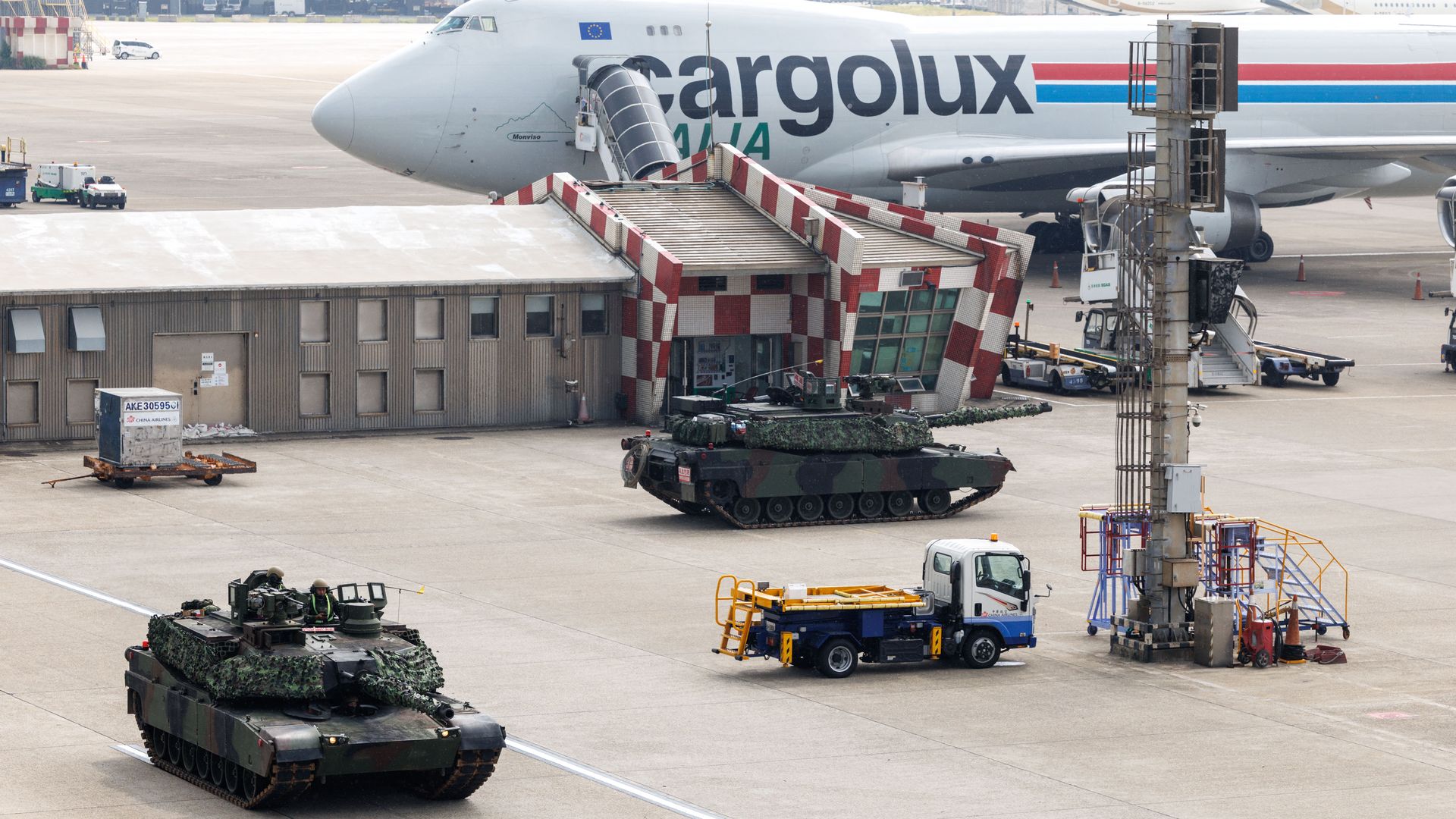
The Taiwanese military deployed M1A2T Abrams tanks to Taoyuan International Airport, west of Taipei, during the Han Kuang 42 live-fire drills.
Why it matters: The imagery is striking.
- Plus, it's a reminder of the island's everyday preparations to repel — or even slow — a potential Chinese invasion.
More from Axios:
Shahed fever spreads to Taiwan
Taiwan tests Lockheed launchers in China's direction
Taiwan soldiers on through Xi's threats and Trump's ambivalence
Shoutout to Jeffrey Cane for editing and Matt Piper for copy editing.
👋🏼 Thanks, as always, for reading and sharing. Tell your friends to subscribe here.
Sign up for Axios Future of Defense