Taiwan soldiers on through Xi's threats and Trump's ambivalence

Add Axios as your preferred source to
see more of our stories on Google.
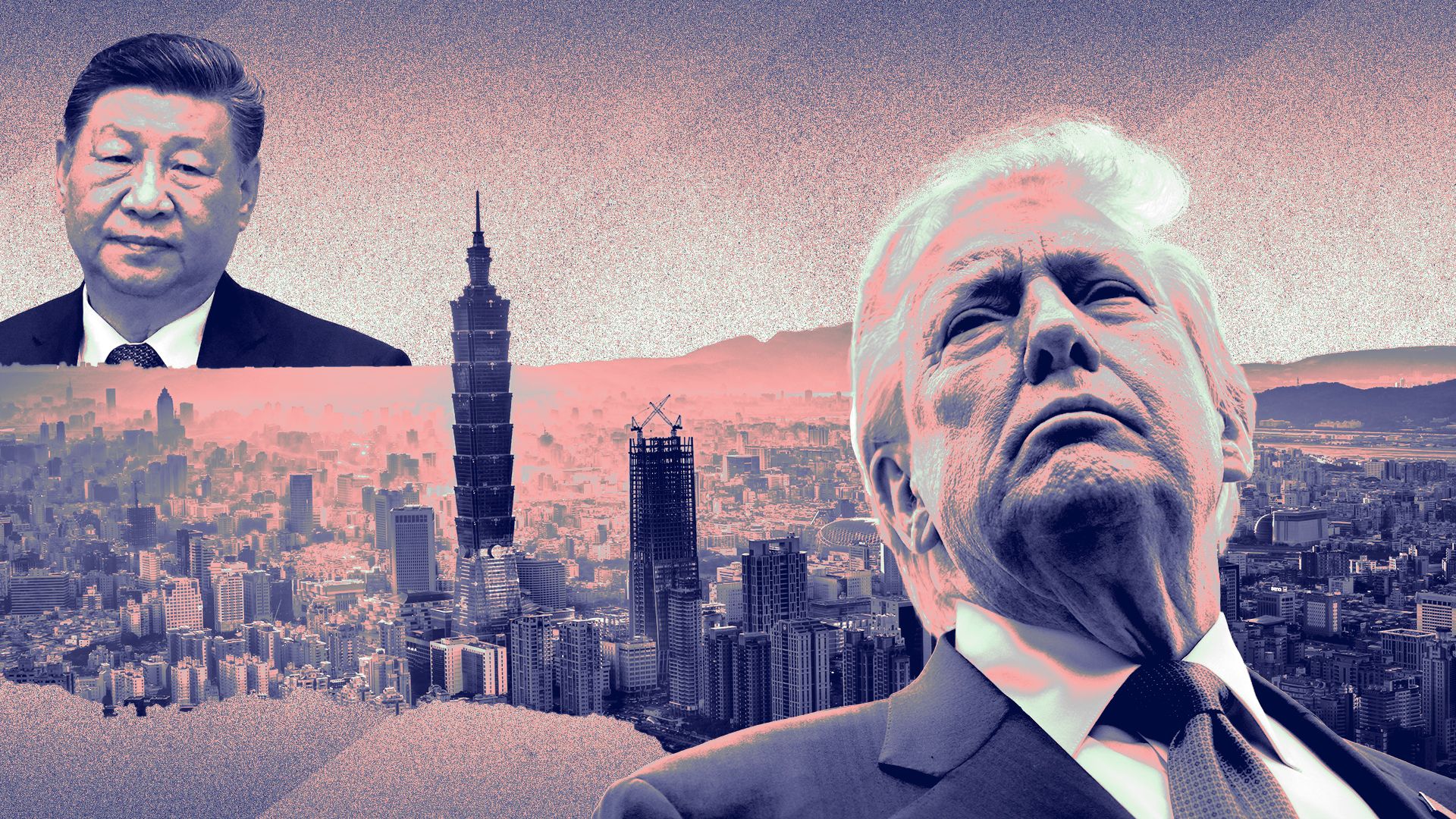
Photo illustration: Brendan Lynch/Axios. Photos: Getty Images
TAIPEI — There's a postmortem playing out here after Chinese President Xi Jinping warned President Trump to be careful on Taiwan, and Trump responded with ambivalence about U.S. arms sales and the island's chances in any conflict.
Why it matters: Some Trump advisers left the summit thinking a Chinese move on Taiwan was growing more likely. But in Taipei there was no panic, at least on the surface.
- Taiwanese officials continue to advocate for arms deliveries, while also emphasizing the need to shore up self-defense initiatives, indigenous defense-tech and critical infrastructure.
- And while Trump and Xi's remarks were closely scrutinized, Taiwanese officials and citizens tell Axios they're accustomed to life in the shadow of potential war.
There is unsurprisingly a "very high degree of sensitivity" in Taiwan about military aggression and information warfare from China, said Tsung-Yi Tang, a representative for civil-defense organization Kuma Academy.
- "But in terms of the daily operations, actually we are still more relaxed."
What they're saying: Luo Wen-jia, secretary-general of the Straits Exchange Foundation, on Monday told visiting journalists the world must understand Taiwan will neither provoke China nor let it trample over the island.
- It's a delicate dance.
- "Taiwan needs to strengthen our own self-defense. We need to make adjustments in terms of national defense," he said through an interpreter. "We also have to think about Taiwan's uniqueness, our geopolitics and what kind of risks will arise."
- The SEF is a semi-official organization that handles civil and business affairs between Taiwan and China. It has offices just blocks from the national defense ministry.
- "It's not that Taiwanese people are naive. We do know that, given this hostility and difficult situation, we still need to be optimistic," he added. "Of course we do not want to see war."
State of play: Trump said after the meeting that he was unsure whether he'd approve a $14 billion arms package for Taiwan, which his administration has delayed despite bipartisan support.
- He also suggested the weapons wouldn't make a difference should Beijing make a move.
- "When you look at the odds, China is a very powerful, big country. That's a very small island," he told Fox News. "It's 59 miles away. 59 miles. We are 9,500 miles away."
- "They ought to both cool it," Trump said of China and Taiwan.
The other side: Leaders including President Lai Ching-te pushed back on Trump's characterization of the weapons as a bargaining chip in the U.S.-China relationship.
- "China's military threat remains the primary source of regional instability, driving countries in the first island chain to strengthen their defense capabilities in coordination with the United States," the foreign affairs ministry said in a statement.
- "U.S. arms sales to Taiwan are both part of U.S. security commitments under the Taiwan Relations Act and a key element of collective deterrence against regional threats."
- Washington has been arming Taipei for decades. Trump 2.0 in December blessed an $11 billion weapons shipment that included HIMARS launchers and howitzers.
Threat level: Xi has instructed his military to be prepared for a takeover as soon as 2027.
- While many doubt that timetable, preparations are undoubtedly ongoing. The People's Liberation Army encircled the island in 2025 and entered its air defense identification zone more than 3,000 times in 2024.
- Digital networks, too, are bombarded daily.
Between the lines: Despite Trump's skepticism, Taiwan is no easy target, even for a force as large as the PLA.
- It's insulated by rough seas and steep mountains, and its whole-of-society approach to defense has been invigorated by Ukraine's fortitude.
- Ahead of the Trump-Xi summit, Taiwan's military kicked off live-fire beach defense drills.
More from Axios:
Lockheed tapped for Taiwan F-16 sensors
U.S. and China could agree on AI guidelines, says Hicks
Drills, deals and doubts in the Pacific as Trump visits China
Editor's note: This trip, attended by more than a dozen members of the media, was organized and partially funded by the Taiwanese government.
