Axios Future of Defense
October 13, 2026

I know, I know. It's Tuesday! Here's what's up:
- Beginning today, Future of Defense will arrive twice weekly.
- I'll be handling the Tuesday edition. Thomas Novelly will handle the Thursday edition. I'm stickin' to my schtick; Thomas has you covered on everything space.
- Questions? Complaints? Happy hour invites? Reply to this email.
🏭 Situational awareness: L3Harris Technologies secured a $250 million contract from Lockheed Martin to manufacture standard-range Guided Multiple Launch Rocket System propulsion. Work will be done in a new facility in Camden, Arkansas.
What else: Countless new munitions, the Coast Guard's drone buy and South Korea's hypersonic glide vehicle success.
Today's newsletter is 1,475 words, a 5.5-minute read.
1 big thing: Nuclear sensitivities

The National Nuclear Security Administration recently conducted an underground explosive test in Nevada to better understand and potentially identify foreign nuclear detonations.
Why it matters: NNSA boss Brandon Williams previously told me China is "clearly" conducting explosive nuclear testing and "trying to hide it," amplifying accusations made this year by State Department arms officials.
- Beijing has denied such a regime and accused the U.S. of stirring the pot.
- Both have signed the Comprehensive Nuclear-Test-Ban Treaty. Neither has ratified it.
Zoom in: The NNSA test was done inside P Tunnel, cut into the side of a mesa, at Area 12 of the Nevada National Security Site, a massive reserve northwest of Las Vegas.
- It relied on chemical high explosives and radiotracers. Data collected from the trial will refine detection models and algorithms, according to the administration.
- "Detection is only as credible as the data behind it," Fuse founder JC Btaiche told me.
Context: This type of work is critical "to strengthening our ability to detect low-yield nuclear tests, an essential component of U.S. nuclear nonproliferation and national security efforts," Frank Rose, a former NNSA deputy, told me.
- Such trials, he added, "are the product of many years of sustained scientific, technical, and policy work across multiple administrations."
Flashback: President Trump last fall ordered the U.S. to resume nuclear testing equal to Russia and China.
- Few details followed — and questions remain about whether he was addressing the Energy Department or the Defense Department. (The latter conducts missile flight tests.)
Zoom out: American and Russian nuclear arsenals dwarf all others; Washington and Moscow together wield some 90% of the world's warheads.
- China, meanwhile, is undertaking a historic buildout.
- Just a small portion of these weapons could devastate life on Earth.
The bottom line: A former U.S. official described the NNSA test to me as "keeping a thumb on PRC."
Go deeper: Russian nuke threats signal "weakness," NNSA boss says
2. Corps eyes U-Hawk
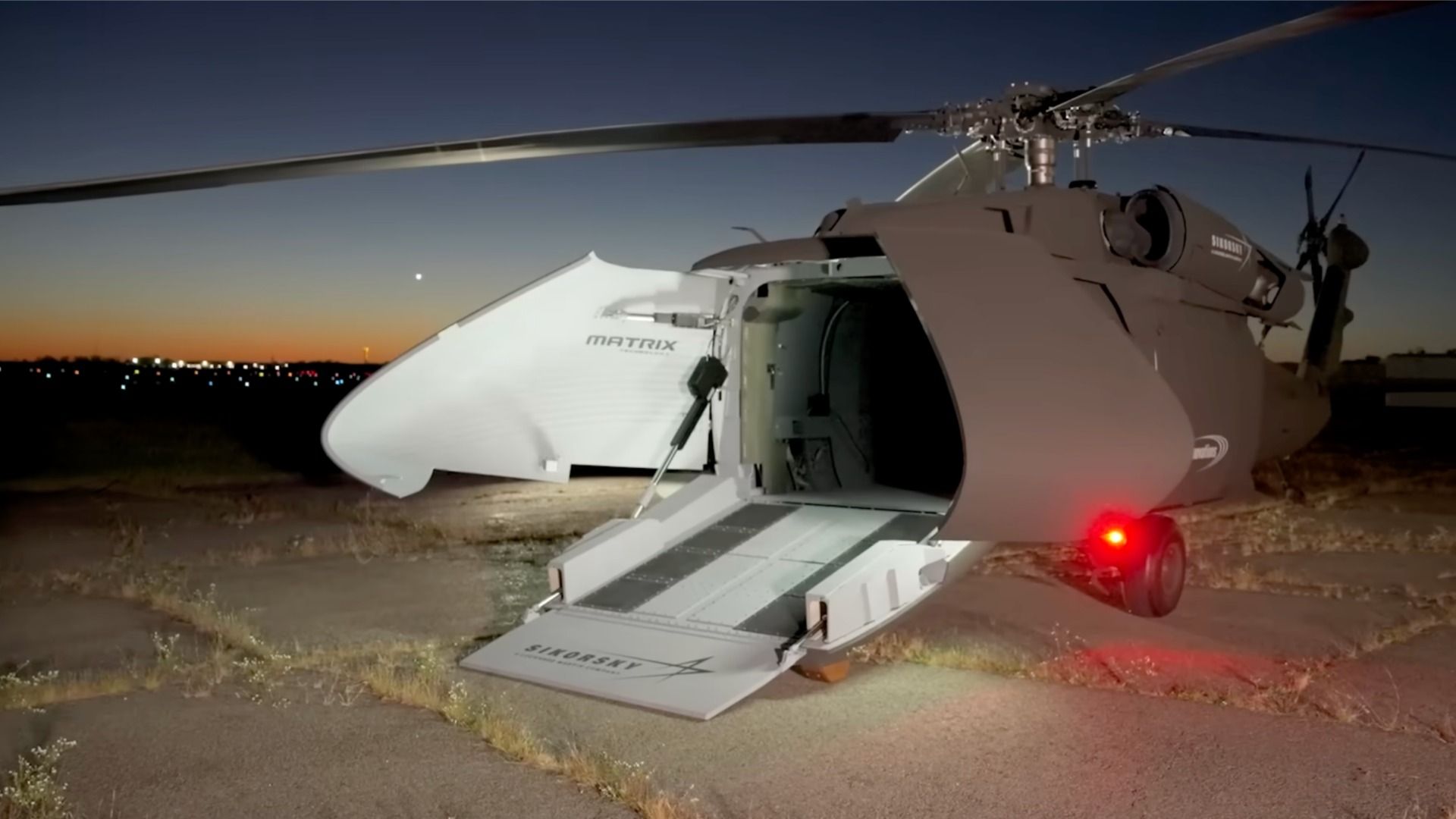
The U.S. Marine Corps is "very interested" in the U-Hawk, a cockpitless, cargo-hauling variant of the Black Hawk helicopter, Sikorsky chief Richard Benton told me.
Why it matters: The military autonomy boom times continue — and are service-agnostic.
Catch up quick: Sikorsky, a subsidiary of Lockheed Martin, unveiled the U-Hawk at the Association of the U.S. Army conference last October. It's expected to fly for the first time this year.
- "This has really been: 'Hey, we're going to build it because we think you need it,' and having it available will create the need or the demand," Benton said.
- "And that's what we've been seeing."
Zoom in: The U-Hawk prototype is based on an older UH-60L, also known as Lima.
- Designed to shuttle tons of materiel, including drones, rockets or ground robotics, its cockpit was traded for storage space and its nose now opens with clamshell doors and a ramp.
- "You want to have metal-on-metal contact, or you don't want to put people in harm's way? It works for that," Benton said. "But it's quickly evolved to: 'I need to move stuff, and I need to move it en masse.'"
The intrigue: There are also plans to convert UH-60Ms, or Mikes. Physical conversion kits are also on the table.
The bottom line: "We don't have a version with the Marine gray on it yet," Benton said, "but I do anticipate there will be a Marine gray U-Hawk very soon."
Go deeper: Overland AI unveils autonomous Ibex vehicle
3. AUSA weapons

The annual Association of the U.S. Army bonanza is underway, and defense contractors are unveiling new weapons, countermeasures and milestones.
Why it matters: Companies save big announcements for big shows. This year is no exception.
Here's some of what's caught my eye:
🧨 Heaviside Industries, which recently raised $60 million, rolled out Tyr, its first in a line of precision munitions.
- It works with four Nammo warheads, including anti-tank and anti-personnel variants, can fly for more than an hour and hits speeds greater than 150 mph.
🔥 Raytheon, part of RTX, discussed Coyote Block 2C+RM, which involves a rocket motor and other improvements for the widely used interceptor.
- "You get upgraded propulsion for faster launch and higher-velocity flight, and with the seeker-warhead it really gets after the more cutting-edge drone capabilities we're seeing from the adversary," Tom Laliberty, president of land and air defense systems, told reporters.
🚀 Chaos Industries, valued north of $4 billion, debuted Vespid, a line of cheap interceptors that work with its existing multistatic radar systems.
- The company said it can initially produce 12,000 and push those numbers much higher depending on demand.
🦈 Anduril Industries uncloaked Steelfin, a reconfigurable, two-stage surface-to-air missile the neo-prime said is compatible with Patriot launchers, the Mk 41 Vertical Launch System and the Typhon mid-range capability.
- "The intent is to build most of the subassemblies and content at Arsenal-1, and then do the final integration with a handful of our partners," Steve Milano, Anduril's senior director of missiles, told reporters.
🛜 Leonardo DRS announced initial production of the C-Band Extended Multi-Mission Hemispheric Radar.
- The cxMHR, as it's abbreviated, is designed to detect, identify and track multiple ballistic and cruise missiles, rockets and drones at the same time. It can be deployed on a single vehicle.
Go deeper: NATO goes aircraft shopping at Turkey summit
4. ICYMI 1.0: Gallatin gains

Gallatin AI raised a $50 million Series A, with defense-tech frequent fliers 8VC and Silent Ventures pitching in, CEO Woody Glier told me.
Why it matters: This isn't another drone builder. The California startup is, instead, focused on digitizing and streamlining the nitty-gritty of military logistics and sustainment.
- "A lot of the logistics data that is generated today is very manual," Glier said. "It's very messy — literally like clipboard and pen and paper."
The big picture: The Pentagon considers contested logistics — getting bullets, blood, fuel, food and more to their destinations, especially under fire — a critical technology area. Others include biomanufacturing and hypersonic weapons.
Catch up quick: Gallatin's Navigator, an AI-powered tool that provides sustainment insights and supply distribution planning, is being used by U.S. military units around the world.
5. ICYMI 2.0: Cashing in


Defense tech investment continues to expand, in dollars raised and in the types of companies getting funded, per new PitchBook data.
The big picture: Third-quarter data underscore the maturation of the sector, as it spreads out beyond physical projects to software and more.
By the numbers: Globally, defense-tech VC has reached $67.4 billion across 726 deals so far this year, with $27.2 billion in Q3 alone.
6. Quick hits
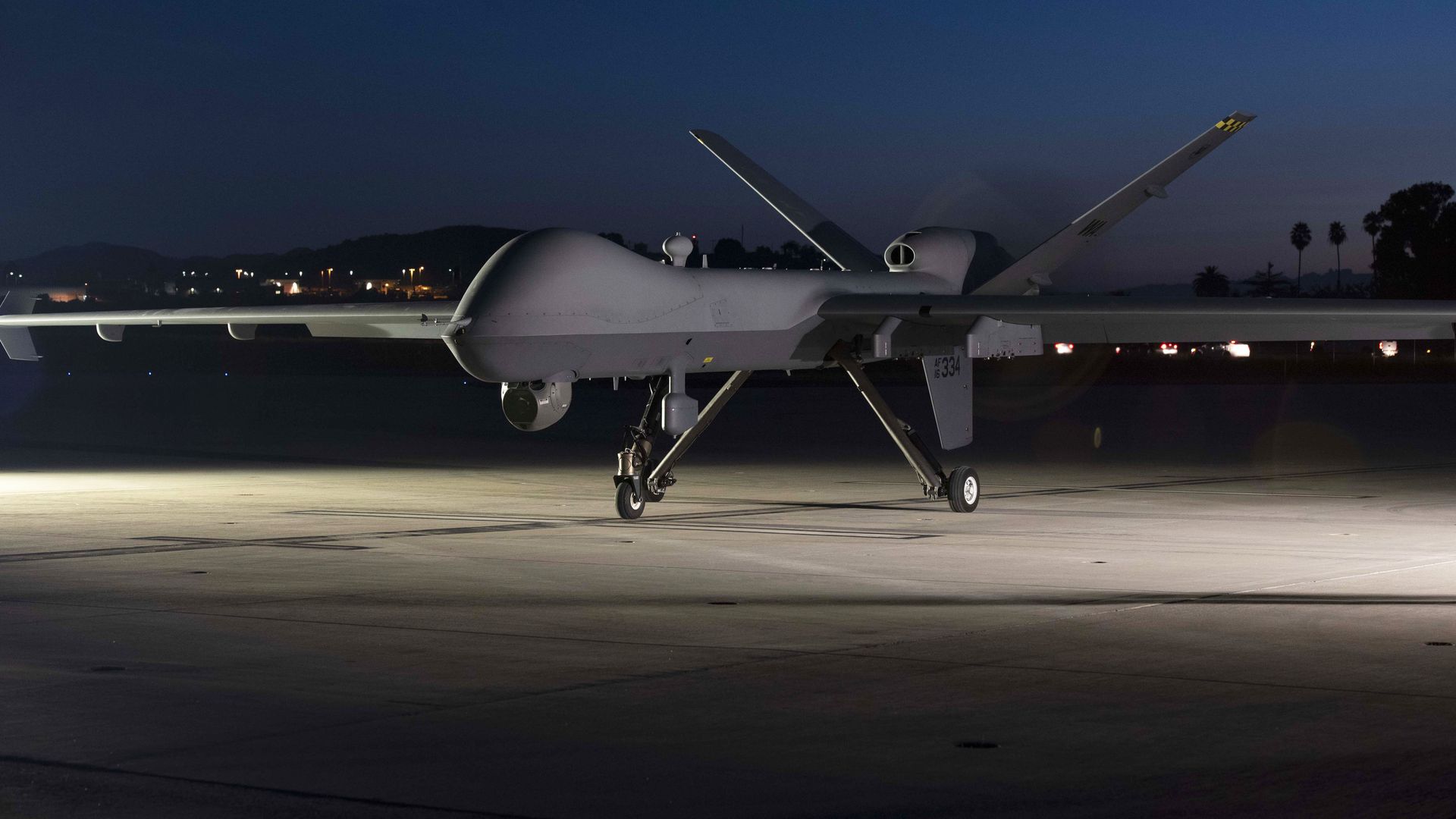
🇺🇸 The U.S. Coast Guard is buying four General Atomics-made MQ-9B drones and related equipment for almost $248 million. The contract is through Customs and Border Protection.
- Why it matters: "This investment will give Coast Guard crews a longer-range view of our maritime domain, helping them detect threats earlier," Anthony Antognoli, assistant commandant and program executive officer for robotics and autonomous systems, said in a statement.
- 💭 My thought bubble: The Coast Guard's unmanned strategy is worth rereading.
✈️ The "script has flipped on power projection" and adversaries "no longer need comparable forces to hold American bases at risk," Hidden Level chief executive Jeff Cole told me in a recent conversation. "The most capable aircraft in the world simply cannot project power if they are vulnerable on the ground."
- Why it matters: Ukraine's Spiderweb operation was not a one-off. In fact, it's a source of inspiration for would-be attackers.
- 💭 My thought bubble: Tectonic has a great recent rundown on Hidden Level here.
📡 Israel Aerospace Industries unveiled Point@Air, an aerostat-based radar for long-range surveillance. It's based on the ELM-2083.
- Why it matters: Elevation has its benefits. "Seeing the battlespace is the starting point for every effective defense," IAI chief executive Guy Bar Lev said in a statement.
- 💭 My thought bubble: Aerostats (blimps!) deserve more love.
7. Check this out
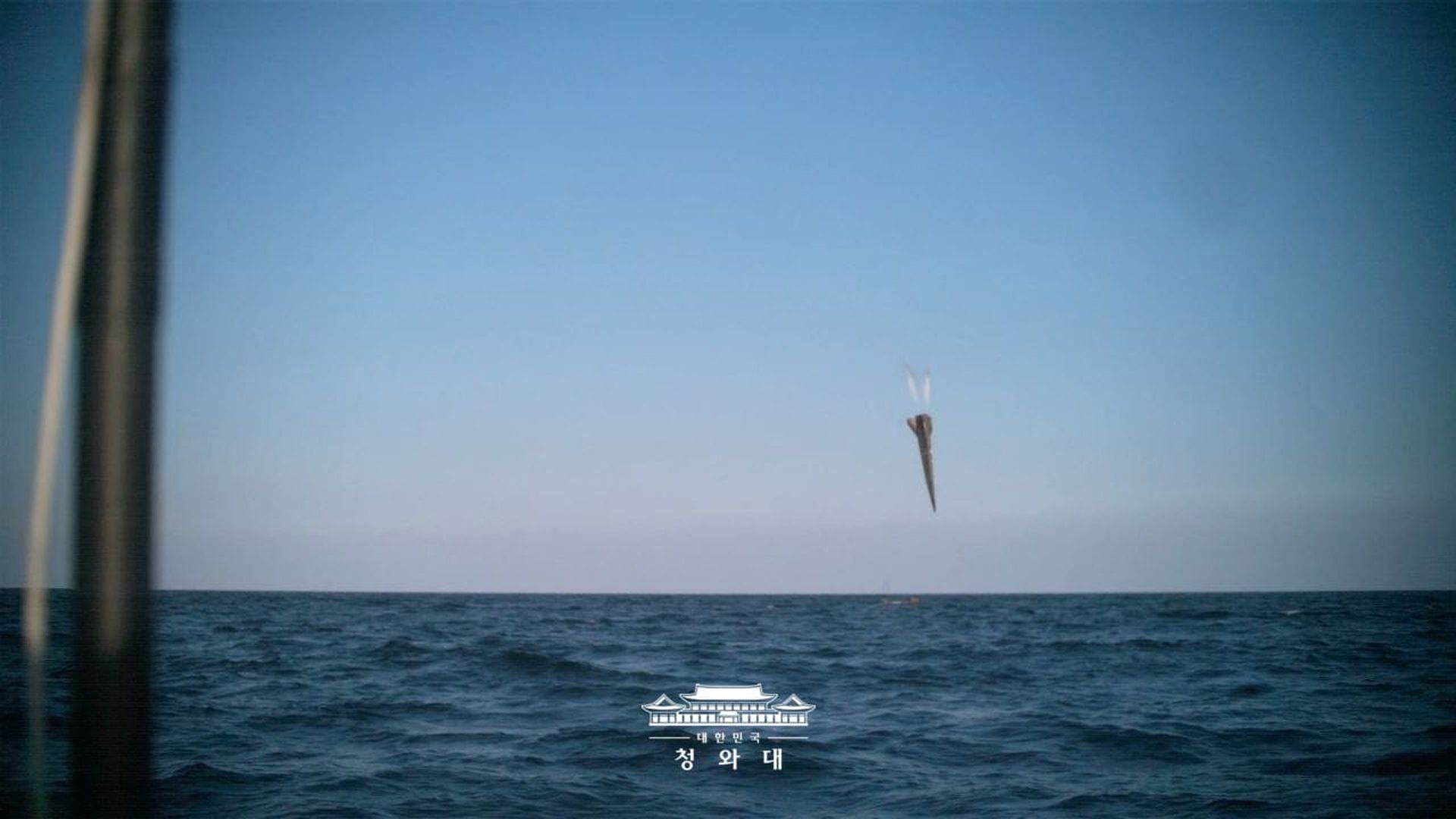
South Korea successfully test-launched a domestically developed HGV Oct. 8.
The big picture: President Lee Jae Myung observed the trial.
- "Our security is secured through our own strength," he said in a translated statement.
Go deeper: Trump tells Hegseth to cut back U.S.-South Korea drills
Shoutout to Mike Zapler for editing and Matt Piper for copy editing.
👋🏼 Thanks, as always, for reading and sharing. Tell your friends to subscribe here.
Sign up for Axios Future of Defense