Axios Crypto

October 05, 2023

It's Day 3 of the SBF trial. We're getting into the thick of it now. Yesterday, jury selection, opening statements and first witnesses.
Today's newsletter is 1,196 words, a 4.5-minute read.
💁♂️ 1 big thing: SBF's defense leans on old charm offensive
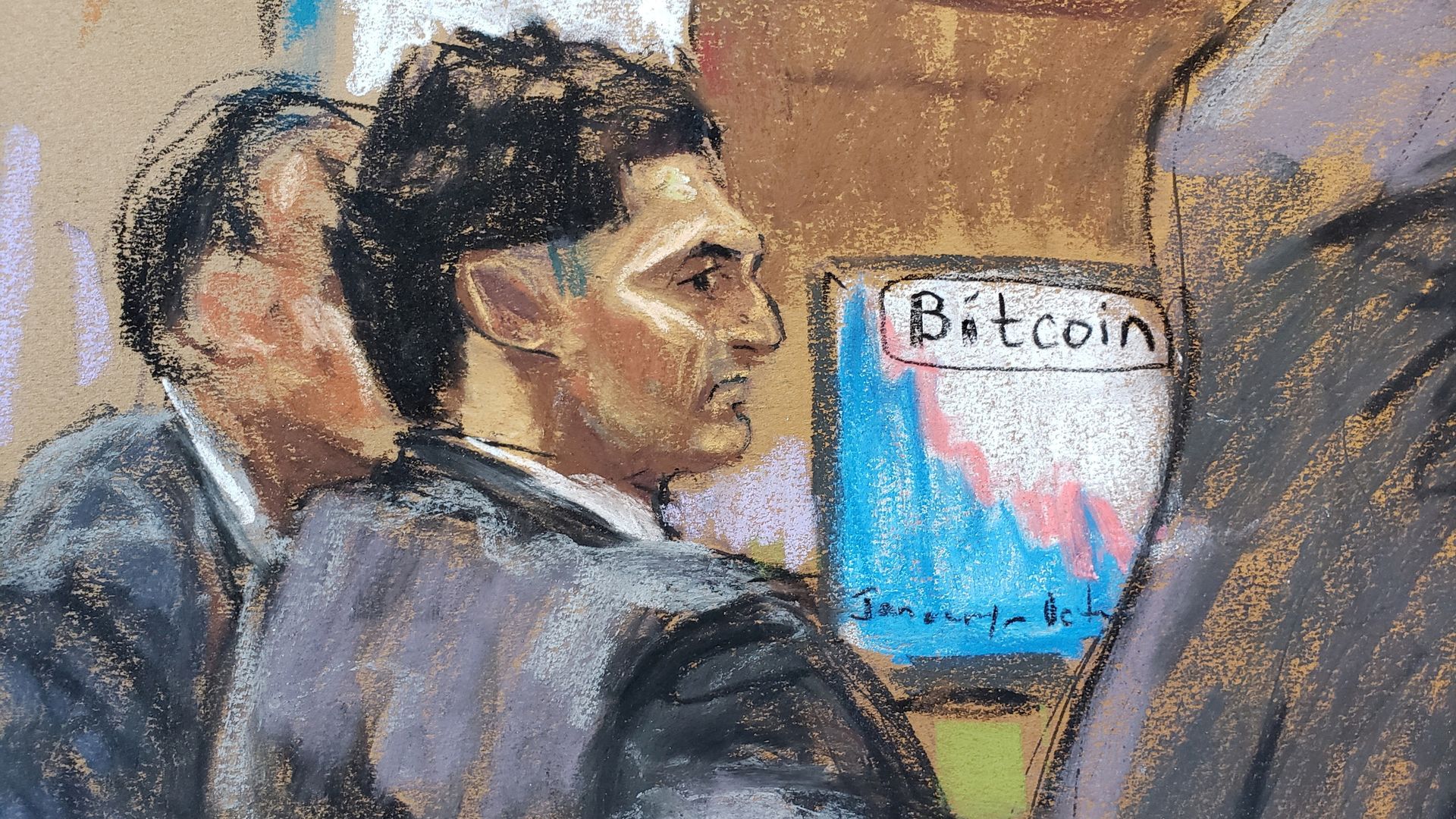
Sam Bankman-Fried yesterday in court as his lawyer Mark Cohen addresses the jury. Image: Jane Rosenberg/Reuters
The opening statement from Sam Bankman-Fried's legal defense leaned on a familiar charm offensive that married his dueling images as the shy boy next door and the smartest guy in the room.
Why it matters: Perhaps the fallen crypto wunderkind is hoping it will land with jurors the way it did with politicians, investors and financial writers.
Driving the news: The U.S. government and Bankman-Fried's legal counsel presented opening statements to a jury of 12 (plus six alternates) yesterday in federal court in New York.
- Opening statements are "trailers for the movies" for the rest of the trial, according to Judge Lewis Kaplan.
Zoom in: Mark Cohen of Cohen & Gresser, SBF's main lawyer, balanced talking about Bankman-Fried's character with the events that led to the collapse of the two companies he founded, FTX and the hedge fund Alameda Research.
- He referred to the former FTX chief simply as "Sam" — "a math nerd who didn't drink or party."
- "Sam didn't steal from anyone," he said. "There was no theft."
What they're saying: "Rather, you will learn that Sam believed, reasonably believed, that loans that FTX made to Alameda were permitted and backed by reasonable security and collateral."
- "This case is in many ways about the crypto world from 2017 to 2022," he added. (Number go up, number go down)
- He also showed the price of bitcoin falling sharply in 2022 — FTX's collapse following a series of "market shocks."
Between the lines: Cohen got into the weeds — using financial terms and concepts such as market making, margin loans and collateral — to explain why funds moved between Alameda and FTX were permissible in context.
Meanwhile, he said the government's case against SBF "turns" on the testimony of three witnesses, people who he said had an incentive to cooperate with the prosecution.
- That's Caroline Ellison, Gary Wang and Nishad Singh.
- Cohen said Ellison failed to hedge Alameda'a investment positions, despite SBF advising her to do so and saying later that it would become a problem "when the storm hit."
The other side: The prosecution's opening statements focused on the fraud, those hurt by it and the extent SBF and those close to him were enriched.
- "One year ago it looked like SBF was on top of the world," assistant U.S. attorney Thane Rehn said. "He had wealth, power and influence — all of it was built on lies."
- Rehn referenced Bankman-Fried's previously deleted tweets in which he promised that customer deposits were safe and said the U.S. government would later produce inter-company messages and documents that show how SBF committed fraud.
- "The defendant wasn't able to delete everything," he said.
- Of note: Rehn said Bankman used Ellison as "a front" at Alameda when he was in fact calling the shots
💭 CK's thought bubble: The prosecution's opening statement seemed relatively more compelling by the looks of jurors (saying "fraud" a bunch helps).
👥 2. The people to sway

Illustration: Eniola Odetunde/Axios
SBF's fate lies in the hands of the 12 people selected as jurors, Crystal writes.
Details: They skew female, ages ranging from 33 to 69, though a few declined to offer that information. Here they are:
- 39-year-old physician's assistant, 10-weeks pregnant with a husband in web development
- 55-year-old native of Bermuda who teaches special education
- 40-year-old unemployed social worker with an undergraduate degree from Princeton
- 38-year-old on the board of a nonprofit with a partner who's a professor at New York University
- 59-year-old who did not specify what he did for a living, but said his company is being sued by another company
- 50-year-old Metro North train conductor
- 47-year-old who works for the New York Department of Education and has a British Shorthair cat
- 65-year-old retired corrections officer
- 61-year-old who has a high school degree and works for the U.S. Postal Service
- Ukrainian working in advertising, divorced with two children
- 33-year-old pediatric nurse in Westchester County
- 69-year-old retired investment banker, with an MBA from Stanford, who previously worked at Salomon Brothers.
Flashback: There are a couple of interesting people in the initial pool that weren't selected.
👁️🗨️ 3. The first witness
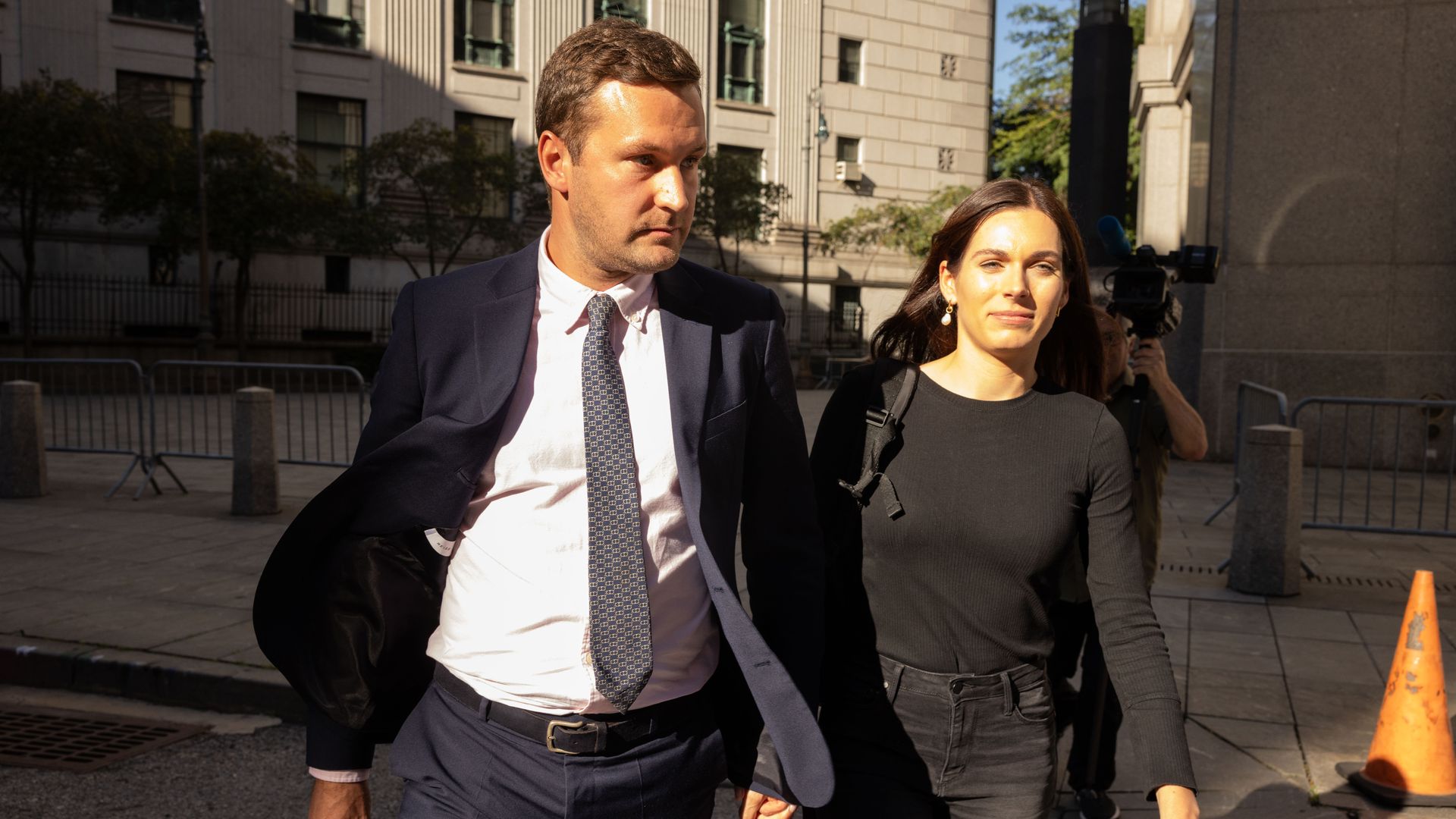
Marc-Antoine Julliard, a commodities broker, left, leaves court yesterday. Yuki Iwamura/Bloomberg via Getty Images
The first witness called by the U.S. government was Marc-Antoine Julliard.
Zoom in: The commodities trader and jilted FTX customer said he had around $100,000 in crypto and fiat in his account when the crypto exchange collapsed, Crystal writes.
- By Nov. 9, he couldn't withdraw. FTX filed for bankruptcy two days later.
What he said: Julliard said he was drawn in by the size of FTX — the second biggest of the Top 3 crypto exchanges.
- He picked FTX because of the liquidity implied by its size, the number of users on the exchange, commitments from venture capital firms and endorsements from celebrities like Gisele Bundchen.
- He said he followed SBF on social media: "I remember seeing videos with him and politicians. I remember him bailing out companies, other cryptocurrency companies, and pledging money to help customers that were detrimentally affected."
Of note: Prosecutors later presented the jury with Exhibit 1469.
- A photo of SBF with former President Clinton and former U.K. Prime Minister Tony Blair.
The other side: SBF's lawyer Cohen during his cross-examination of Julliard sought to establish that this was not the biggest sob story in crypto.
- "So just to understand this, at the company you worked for, you were able to trade crypto because it wasn't regulated?" Cohen asked, to which Julliard answered, "Correct."
- Because crypto was unregulated, Julliard — who traded cocoa beans — wouldn't have to disclose his holdings to his employer.
- "And you understood that crypto was new and also a risky asset, didn't you, sir?" Cohen said. "You could make a lot, but you could lose a lot?"
Who we're watching next: Adam Yedidia, SBF's "close friend" from MIT. Yedidia was among SBF's inner circle in the Bahamas, writing code for FTX, and is the second witness — his testimony continues this morning.
- Matt Huang, cofounder of venture capital firm Paradigm, is up next.
- Gary Wang, FTX co-founder, closes the week.
🏃 4. Catch up quick

Illustration: Natalie Peeples/Axios
🛩️ 🛩️ The DOJ wants to seize SBF's two jets. (CourtListener)
🇭🇰 Hong Kong police and security regulators are teaming up to watch crypto exchanges. (Decrypt)
🐕 Owners of the meme of the original Doge announced a plan to unveil a statue of the dog that inspired it all in Japan (CoinDesk)
🧼 $7 billion has been laundered through cross-chain swaps, according to a blockchain surveillance firm. (Elliptic)
🙋 5. Report: An FTX insider was pushed out after flagging code backdoor

Illustration: Annelise Capossela/Axios
A report in the Wall Street Journal today cites people with knowledge of the matter as saying staff at LedgerX found evidence of special treatment of Alameda in the codebase of FTX.
Why it matters: It bolsters the case that staff at FTX were aware that arrangements for Alameda were exceptional and inappropriate, Brady writes.
Catch up fast: LedgerX was a derivatives trading platform acquired by FTX.US in 2021.
- It was sold to Miami International Holdings in 2023.
The intrigue: LedgerX chief risk officer Julie Schoening is credited with taking evidence of the code irregularities found by a member of her staff and running it up the chain of command.
- Not long after, Schoening was fired.
- After retaining a lawyer, Schoening was prepared to dispute the propriety of her termination. The report claims a payout was under discussion as the company declared bankruptcy.
This newsletter was edited by Pete Gannon and copy edited by Carolyn DiPaolo.
U.S. government exhibit 1566 was an old FTX ad called "Get to Know Crypto." We can't find it anymore, but if you see it, send it to us! —B & C.
Sign up for Axios Crypto

Brady Dale covers crypto and blockchain impacts on markets and regulation.