
Axios Crypto

October 22, 2024

Good afternoon! We read the tea leaves today (that is, the FEC filings) to discern the industry's true partisan preference in this election.
- Brady's at the Real World Asset Summit later today, so we could meet in the real world.
Today's newsletter is 1,244 words, a 4½-minute read.
1 big thing: 🎰 Betting on the GOP
Groups trying to elect pro-crypto candidates to Congress are set to spend around $21 million more on ads to boost Republicans than they'll spend on Democrats in the run-up to the Nov. 5 election, Axios has learned.
Why it matters: The crypto industry is proving to be a new, formidable force in this year's elections, dropping tens of millions of dollars on races that could decide which party will control Congress.
- The industry has been cultivating lawmakers in both parties, with its main PAC — Fairshake — endorsing equal numbers of candidates on each side.
- But the tens of millions of campaign ad dollars flowing from its affiliate super PACs point to the GOP as the preferred party among the crypto set.
By the numbers: Since Jan. 1, Fairshake and affiliated PACs have spent $54.6 million to run and reserve election ads backing Republican candidates, and $33.7 million on ads boosting Democrats, according to AdImpact.
- That's 62% more spent on ads for Republicans than Democrats.
What to watch: Fairshake just raised an additional $800,000 from blockchain development firm Consensys Software Inc., in September, according to a new FEC filing.
- That means the crypto industry could spend even more in the crucial final two weeks before Nov. 5.
- With several key Senate and House races expected to be nail-biters, any last minute rush of influence ads could make a difference.
Zoom in: Crypto's No. 1 focus? The Ohio Senate race.
- Crypto groups linked to Fairshake have dropped more than $40 million during this election cycle to back Republican challenger Bernie Moreno. The investment could be paying off — Moreno has been up in recent polls.
- Fairshake is aiming for a twofer in the election: It's trying to help Moreno — a blockchain entrepreneur — defeat Sen. Sherrod Brown, a Democrat who's been a critic of the crypto industry.
The other side: Protect Progress, the Fairshake-affiliated PAC for Democrats, is supporting two competitive Democratic Senate candidates this cycle —Rep. Ruben Gallego in Arizona and Rep. Elissa Slotkin in Michigan.
- It has also contributed to 14 House candidates, according to the most recent data from OpenSecrets.
- Defend American Jobs, the Republican counterpart, has supported four Senate candidates and 13 House candidates this cycle, according to OpenSecrets.
- Fairshake itself has supported candidates on both sides.
What they're saying: "I think a slightly Republican Senate would be good because it neutralizes Elizabeth Warren's ability to influence," Kristin Smith, CEO of the Blockchain Association, told Axios during an interview at an industry event this month.
- Warren, a Massachusetts Democrat, has been seen as the crypto industry's most vocal opponent and is likely to be the senior Democrat on the Banking Committee if Brown loses to Moreno.
2. Quoted: 🗣️ A Fed governor on DeFi
While there are certain services emerging through DeFi [decentralized finance] that cannot be provided by centralized finance, the technological innovations stemming from DeFi are largely complementary to centralized finance.— Federal Reserve Governor Christopher J. Waller, at the Vienna Macroeconomics Workshop in Austria last week
3. 🍂 September nets $10 million in crypto for Harris
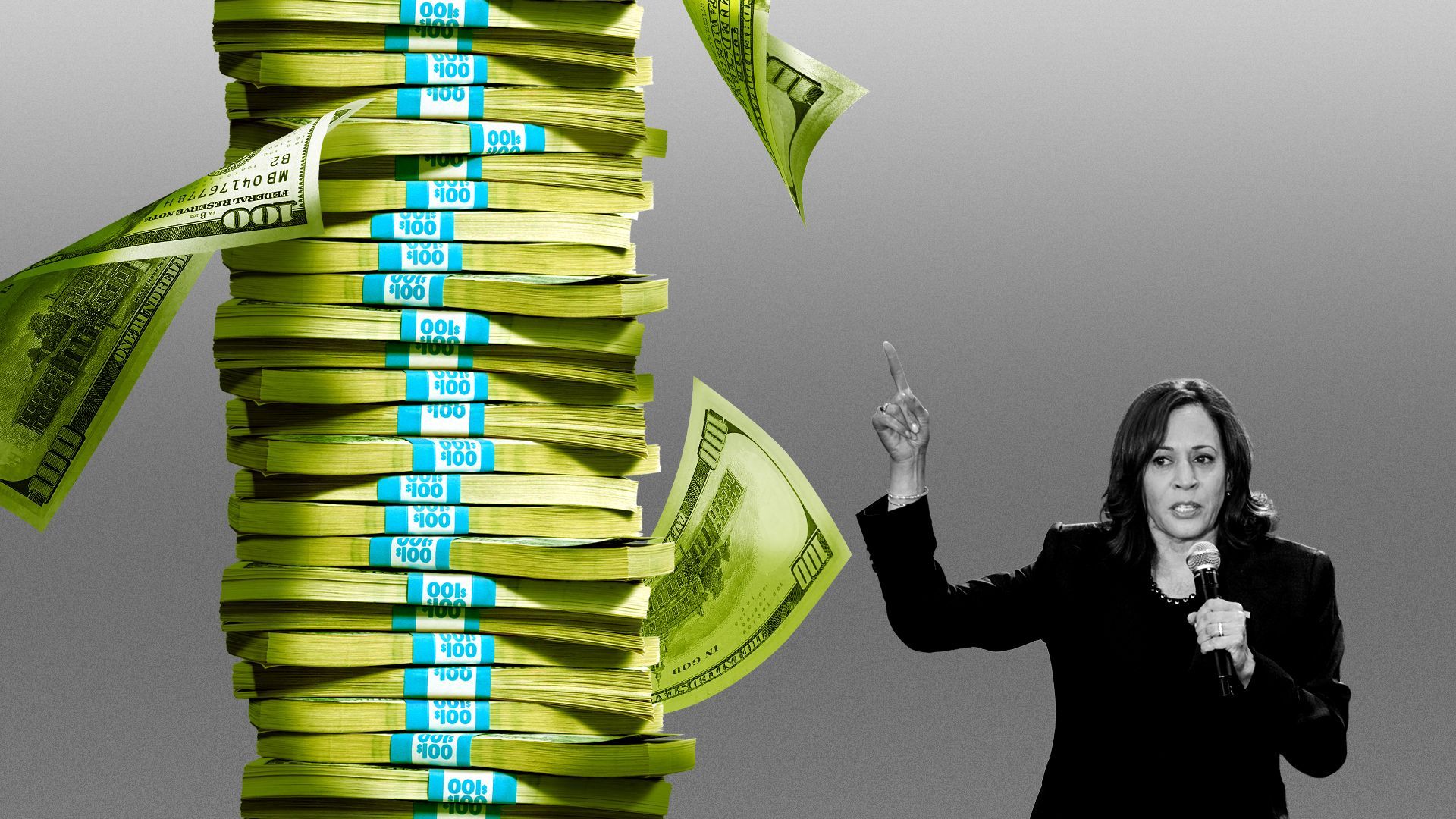
Chris Larsen, CEO of Ripple, the blockchain company that created the cryptocurrency XRP, gave Future Forward USA Action PAC almost $10 million at the end of September.
Why it matters: Crypto's richest are not, apparently, monolithic on the choice for president.
- The Trump campaign and Trump supporting PACs have raised millions of dollars from crypto sources.
The latest: FEC filings show Larsen making three different donations at the end of September.
- He also gave $1 million to the PAC in August, along with hundreds of thousands of dollars to other Democratic party entities.
The intrigue: He made the contributions in XRP, writing on X, " I believe @KamalaHarris will ensure that American technology dominates the world."
Context: The New York Times describes Future Forward as a PAC attempting to replicate Moneyball, but for politics, founded by veterans of the Obama campaign.
- The organization has spent many, many millions of dollars in support of Vice President Kamala Harris' bid for the White House, according to OpenSecrets.
- Notably, Ripple itself is one of the biggest backers of Fairshake, the giant crypto super PAC working to elect crypto-friendly members of Congress.
Background: Ripple has been in the middle of a ferocious battle with the Securities and Exchange Commission.
- In the conclusion of that case, when the judge found that XRP traded on the secondary market was not a security, crypto had one of its most significant court victories ever.
- The SEC recently filed an appeal.
Fun fact: XRP has enjoyed one of the longest standing "armies" of the online obnoxious, ever ready to rally against anyone doubting the asset Ripple built.
4. 📢 Catch up fast
📱 A suspect was arrested in the hacking of the SEC's social media. (Axios)
⛽️ Top memecoin platform Pump.fun has hit a new all-time high for active addresses as it teases a new token. (The Defiant)
🤖 To build the robot brains of the future, the AI industry needs crypto, at least according to this investor. (Axios Pro)
🔮 Two regulated exchanges in the U.S. have been approved to list options for spot bitcoin funds. (Blockworks)
🏦 BONUS: The Debanking of America (The Free Press)
5. 💳 Stripe buys Bridge for a billy bill
Payments giant Stripe announced plans yesterday to acquire stablecoin startup Bridge, with reports pegging the price at $1.1 billion.
Why it matters: In the long term, this could be Stripe's play to create a payments system that eventually cuts out some of the middlemen.
Behind the scenes: Swipe a credit card, and a complex, multiparty system comes online to process the payment — involving a payment processor (like Stripe), the customer's bank, the merchant's bank, and the card networks that help the two banks communicate.
- "If you look at the traditional financial rails, Stripe is one of the many layers a dollar has to move through to process a payment," says Haun Ventures partner Chris Ahn. "Crypto allows them to own more of that stack or skip parts of that stack." (Haun Ventures invested in Bridge's Series A round.)
The big picture: The Bridge acquisition could eventually become a way for Stripe to go after "The Big Idea" in payments — creating rails that cut out some of the Visas and banks in the traditional process.
- Bridge's blog post announcing the acquisition said, "Stablecoins represent an entirely new payments platform."
Zoom in: Stablecoin and crypto are not the only technologies that Stripe has explored that compete with the existing payments ecosystem.
- The company has launched a number of partnerships and products around pay-by-bank, which allows customers to pay directly from their accounts.
Reality check: Simplifying the payments process is no new idea — and has been slow to come to fruition, especially in countries like the U.S. where a system has been entrenched for decades.
- Making stablecoins usable in the physical world today often also still requires a third-party to "off-ramp" it.
- In the near-term, the Bridge acquisition may be more about international expansion for Stripe, and about exploring areas including micropayments.
"Where Bridge was serving was at this intersection of cross border payments, real-quick payments, and micro payments," Ahn says.
- Bridge's largest source of revenue came from stablecoin orchestration, in which the company would take a certain percentage of payments volume for helping companies move money across borders.
What we're watching: "My personal hypothesis is that the adoption you see in more developing countries will pull developed countries into the crypto ecosystem," Stripe president of product and business Will Gaybrick told Axios earlier this month.
This newsletter was edited by Pete Gannon and copy edited by Anjelica Tan.
🎸 If anyone in Akron goes to Stand With Crypto's Black Keys show on 10/25, please email me about it. —Brady
Sign up for Axios Crypto