Axios Crypto

March 20, 2023

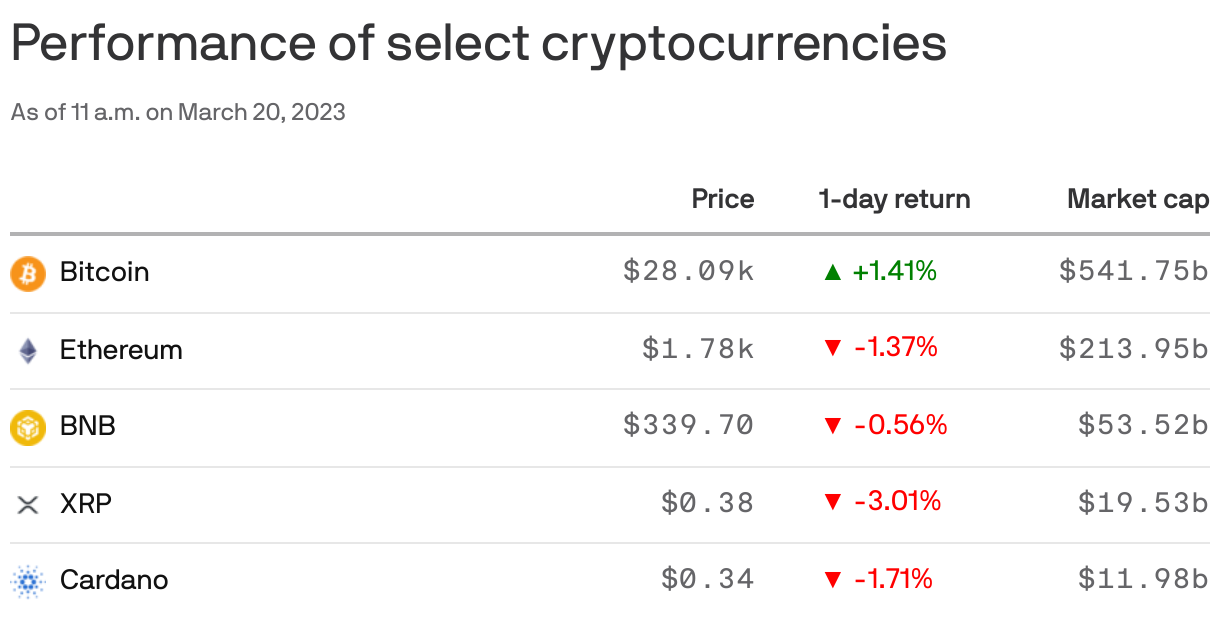
Bitcoin is back over $28,000 which is terrible news for everyone because it's looking more and more like that action is driven by people placing bets against the whole world's economy. So: 😱
- Are you freaking out or cruising along? Let us know your take: [email protected].
Today's newsletter is 1,257 words, a 5-minute read.
🌌 1 big thing: Balaji's bet against the dollar
Illustration: Aïda Amer/Axios
Crypto thinkfluencer Balaji Srinivasan has predicted that bitcoin's price will go to a million dollars by July, and it would be terrible for basically everyone if he were right, Brady writes.
Why it matters: Srinivasan isn't really predicting that bitcoin is going to rapidly appreciate, exactly. He's predicting that the dollar will rapidly depreciate.
- Said another way: One bitcoin is worth enough today to buy you a decent car. In July, if he's right, it should still basically buy you a car, but $28,000 definitely, definitely won't. See the difference?
Driving the news: He's put up $2 million in a smart contract in two separate bets of a million dollars each. It's winner take all.
- If he's right, he gets the bitcoin and the much less valuable money. If he loses, he loses the money and his counterparty gets their BTC back.
Zoom in: Srinivasan thinks the banking crisis is going to spread rapidly.
- "Hiking [interest rates] from ten years of near zero interest rates in the 2010s was a surprise attack on every dollar holder," he said on Twitter. "So anyone who bet on long-term Treasuries got killed in 2021."
- Caitlin Long, a banking entrepreneur and fellow bitcoiner, tweeted, "WORLD WAKING UP to the fact that a bank deposit is an unsecured loan to a leveraged counterparty, that the FDIC insurance fund only has $128bn, that total deposits in US commercial banks=$17.6 trillion."
Yes, but: Global authorities have swung into action.
Be smart: Srinivasan is probably wrong, but he can also afford to lose a million dollars to try to make a point.
- The story's worth highlighting here to illustrate bitcoiners' disdain for the way the U.S. keeps printing money.
- They might overdo it sometimes, but there's some truth to their worldview. Case in point, in 2021 when "transitory inflation" was the line, bitcoiners were saying, "No, it is not." That was not wrong.
Bloomberg's Matt Levine and others have floated the idea that Srinivasan could be trying to manipulate the market to his own benefit, as a large holder of bitcoin.
- He is, it should be noted, already at least a centimillionaire from making big exits. There's a decent chance money isn't super motivating to him any longer.
- Longtime watchers of Srinivasan, however, know that what he wants is influence more than cash.
Flashback: He's been right before. In January 2020, he was sounding the alarm about COVID-19. As hard as it is to believe from today's perspective, he was roundly dismissed and even vilified at the time.
- Getting COVID right gave him a huge signal boost in 2020. He's going for a sequel.
The bottom line: Srinivasan could be directionally right and still lose the bet (that is, there could be banking failures and severe inflation that falls short of hyperinflation).
- In that case, those who heeded the warning might still appreciate the heads up, even if he's out a million dollars.
In other words, he could lose the money and still win.
🕵️♂️ 2. ETHBTC
Screenshot: @robustus (Twitter)
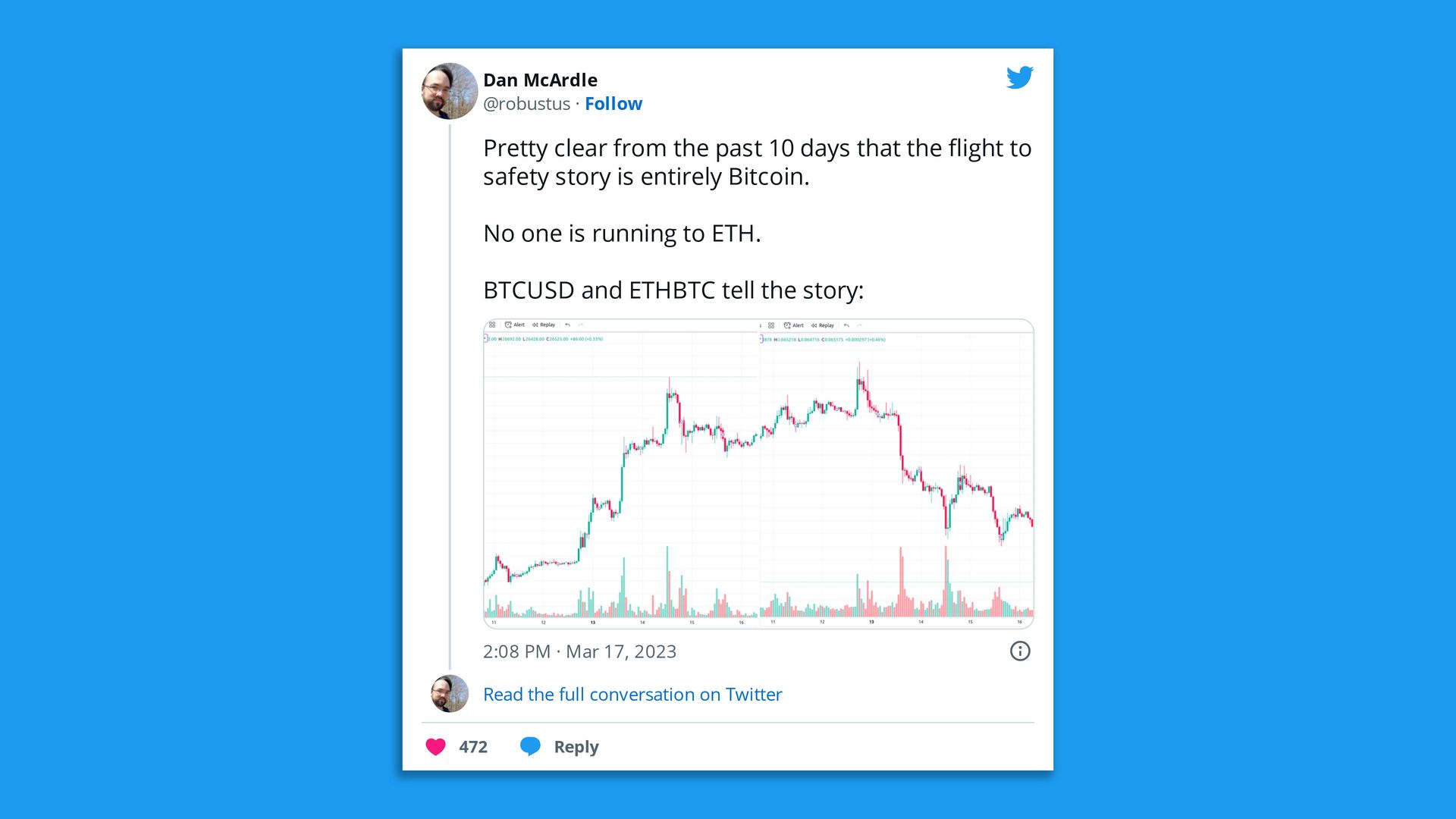
One way to look at markets is to see how different tokens are doing relative to each other over time. That can reveal deeper insights, Brady writes.
For example: (and it might be the most important example) When you look at CoinMarketCap on a good day, you might notice that everything is green. Or, on a bad day, everything is red.
- The market moves together. Everyone knows that. But it's not the whole story.
Be smart: The most important ratio in crypto is USD:BTC because that's bitcoin price. The second most important one, though, is probably ETH:BTC.
- ETH:BTC measures the number of ETH it takes to buy one BTC. If it's going up, the market thinks ETH is rising in importance relative to the original cryptocurrency.
- It went up a lot in the boom of 2021. All the chatter then was about Ethereum.
Reality check: It's really down now. People are exiting crypto or they're flying to the safety of the big orange granddad in the sky, bitcoin.
🏝 3. FTX's old bankruptcy beef
Photo: Jakub Porzycki/NurPhoto via Getty Images
FTX's bankruptcy proceeding can't move forward without a resolution between two sparring authorities, Crystal writes.
Driving the news: The battle over where FTX's bankruptcy proceeding should take place — the U.S. or the Bahamas — is reaching fever pitch.
- FTX’s new management, in a court filing yesterday, called the Bahamas-registered FTX Digital Markets (FTX DM) a "front to facilitate a conspiracy to defraud" FTX customers with no real property in a new attempt to wrestle control over the bankruptcy proceedings in the U.S.
Between the lines: The now-defunct crypto exchange is effectively asking a U.S. judge to rule that the Bahamas-registered FTX DM has no ownership interest in any FTX property.
- Of note: That would include any fiat and cryptocurrency.
Quick take: If FTX succeeds in making this argument stick, it would make moot the issue of bankruptcy venue, as there would be no FTX DM-specific property issue to resolve.
What they're saying: "Without this Court’s prompt intervention, the [Bahamas-based joint provisional liquidators] — fiduciaries with no constituency but themselves — will continue to assert baseless claims that will harm FTX.com customers and all other creditors of the FTX Debtors," FTX said in court documents.
Details: FTX's lawyers say that FTX DM was nothing but a "short-lived provider" charged with matching up customer-to-customer transactions.
- Case in point: Over 90% of customers who used FTX.com were customers of the exchange before FTX DM became operational in May 2022.
- Also, FTX DM never earned any third-party revenue.
The other side: Bahamian authorities claim that FTX DM is at the center of the entire FTX enterprise.
- FTX's plea to the U.S. judge follows a similar one from Bahamas authorities to a Bahamian judge, in which it asked for "binding directions and declarations” saying that FTX and stakeholders do not own core assets, per the FTX court document.
- The Securities Commission of the Bahamas did not respond to Axios' emailed query for a comment.
Flashback: The battle between the two entities is not new, though they appeared to be playing nice as recently as January.
- The fresh fight brewing over FTX property, and to which unit that property belonged, points back to that original beef.
The intrigue: Sam Bankman-Fried, the disgraced c0-founder and former chief of FTX, previously told a Vox reporter that much of the firm's insolvency issues would be solved if he wins a "jurisdictional battle vs. Delaware."
- FTX is now saying that SBF "can no longer fight that battle" after the U.S. District Court of the Southern District of New York imposed "strict pretrial release conditions."
Top coins
🏠🔨 4. Catch up quick: Global precipice edition
🎧 5. Culture hash: From the microphones

From the most recent episode of "The Chopping Block." Screenshot: @UnchainedPodcast (YouTube)
One occasional podcast on the Unchained Podcast network is "The Chopping Block," where four crypto insiders talk about some of the weekly news, Brady writes.
- The first topic in this one: the banking crisis and crypto.
Zoom in: Haseeb Qureshi of Dragonfly Capital explains why the depegging of the stablecoin USDC was not simply a product of Silicon Valley Bank (where the USDC issuer had 8% of the coin's reserved stashed) going down. In fact, he explains, the closing of Signature and Silvergate were crucial to the crisis.
Teaser quote: "The thing that keeps USDC stable is not having reserves. The thing that keeps USDC stable is the arbitrage," Qureshi said.
This newsletter was edited by Pete Gannon and copy edited by Carolyn DiPaolo.
📆 Tomorrow, Coinbase will argue before the U.S. Supreme Court in defense of its practice that its users submit to binding arbitration in a case that doesn't really seem to be about crypto but who knows? The court livestreams audio of its oral arguments. —C & B
Sign up for Axios Crypto

Brady Dale covers crypto and blockchain impacts on markets and regulation.