Axios Communicators

August 08, 2024

💯 Welcome to the 100th edition of Axios Communicators.
- 🗓️ Mark your calendars: Axios co-founders Mike Allen and Jim VandeHei will host a call with Communicator Pro members on Tuesday, Aug. 13, to discuss the evolving dynamics of the 2024 election. Don't miss out, become a member today!
- 🇺🇸 Axios House is heading to the DNC in Chicago on Aug. 19 and 20 — join us.
Today's newsletter is 1,729 words, a 6.5-minute read.
1 big thing: Delta ignites a war of words
/2024/08/05/1722887944079.gif?w=3840)
Delta and CrowdStrike have entered a public war of words following last month's IT outage that led to more than 5,000 flight cancellations and an estimated $500 million in losses for the airline.
Why it matters: The blame game rarely improves corporate reputation — and Delta's recent messaging strategy could backfire.
Catch-up quick: In an interview with CNBC last week — staged in front of the Eiffel Tower at the Olympic Games — Delta CEO Ed Bastian apologized to the impacted travelers before pointing the finger at "big tech" for its slow recovery, stating the airline has "no choice" but to seek damages.
- Bastian also contended CrowdStrike made zero offers to help the company financially, but the cybersecurity provider rejected that claim.
What they're saying: Both Microsoft and CrowdStrike were quick to point out that Delta's competitors — and those affected in other industries — were much quicker to rebound after the IT collapse.
- According to CrowdStrike, Delta is peddling a "misleading narrative" by blaming the cybersecurity vendor for the airline's slow response to the outage.
- When asked for comment, a Delta spokesperson brought up Bastian's CNBC interview and added the airline "has a long track record of investing in safe, reliable and elevated service for our customers and employees. Since 2016, Delta has invested billions of dollars in IT capital expenditures, in addition to the billions spent annually in IT operating costs."
Between the lines: Bastian's appearance on the network was likely meant to calm the shareholder audience. However, when it comes to litigation communications, experts advise corporations against threatening legal action in the public sphere.
- This approach also confines corporate communication teams from speaking on the record, given looming threats of litigation.
- As one litigation comms expert told Axios, doing so previews legal arguments (which allows your opponent more time to prepare), dilutes the impact of the actual filing and sets up possible defamation counterclaims.
- "Bastian should have focused crisis management and reputation repair efforts on the most directly impacted stakeholders — Delta's passengers," the expert said. "Then, after evaluating whether [its] claims have any merit, Delta should have sandbagged its defendants with a filing that was shared under embargo with a trusted reporter."
The big picture: Airlines continue to face heightened public scrutiny.
- As United Airlines EVP of advertising and communications Josh Earnest told Hope King at a recent Axios Communicators event, "A crazy thing could happen at a chain hotel and nobody would care, but if it happens on board an airplane, it's going to be leading the 'Today' show the next day."
- Many rely on banking goodwill with frequent flyers through consistent and transparent communications.
Flashback: Southwest CEO Bob Jordan said as much during his apology tour following the 2022 operational meltdown.
- He communicated directly with consumers, shareholders and legislators to explain the operational issue. "You've got to be transparent and not defensive. That builds trust," he said at the time.
Zoom in: Delta's response to the outage affects the "premium" airline brand it has worked hard to build.
- As such, the airline is striving to keep affected flyers up to date on refunds, waivers and reimbursements.
- "Most recently, during the global IT outage, we worked diligently to deliver information in an open, honest and accountable way to support Delta's customers and our people during an unprecedented and difficult time," added a spokesperson.
The bottom line: It remains to be seen how far the legal threats go and if the claims will hold up in a court of law — but corporate finger-pointing rarely bodes well in the court of public opinion.
❓Speaking of litigation comms, did you see the video Linda Yaccarino posted to X? Send me your thoughts on that strategy.
2. Media cuts persist amid ad market slowdown, AI fears


A slew of cuts announced Tuesday suggest the media industry's struggle to regain the advertising and subscription momentum will persist for the foreseeable future.
Driving the news: The Tampa Bay Times on Tuesday said it needs to reduce payroll by 20% and will offer buyouts to its roughly 270 full-time employees.
- Axios said on Tuesday it's laying off 50 employees, according to an internal memo from CEO Jim VandeHei.
- Future said it plans to shutter the print magazines and newsletters for Broadcasting & Cable, Multichannel News and NextTV and replace them with one newsletter and a section on nexttv.com.
- GameStop last week said it would shut down Game Informer, the oldest gaming magazine in the U.S., and lay off staff.
Zoom in: Layoffs and various cost-cutting measures have affected nearly every major publication this year, including CNN, Warner Bros Discovery, The Messenger, Sports Illustrated, Los Angeles Times, Wall Street Journal, Engadget, Intercept, Bustle Digital Group, Vice Media, The Daily Beast, BuzzFeed, NowThis, Paramount, Disney, TechCrunch, Forbes, Insider and others.
Between the lines: More newsrooms are trying to cut costs while shifting focus to premium products, like events, that don't compete with Big Tech firms for ad dollars.
3. End of the op-ed era
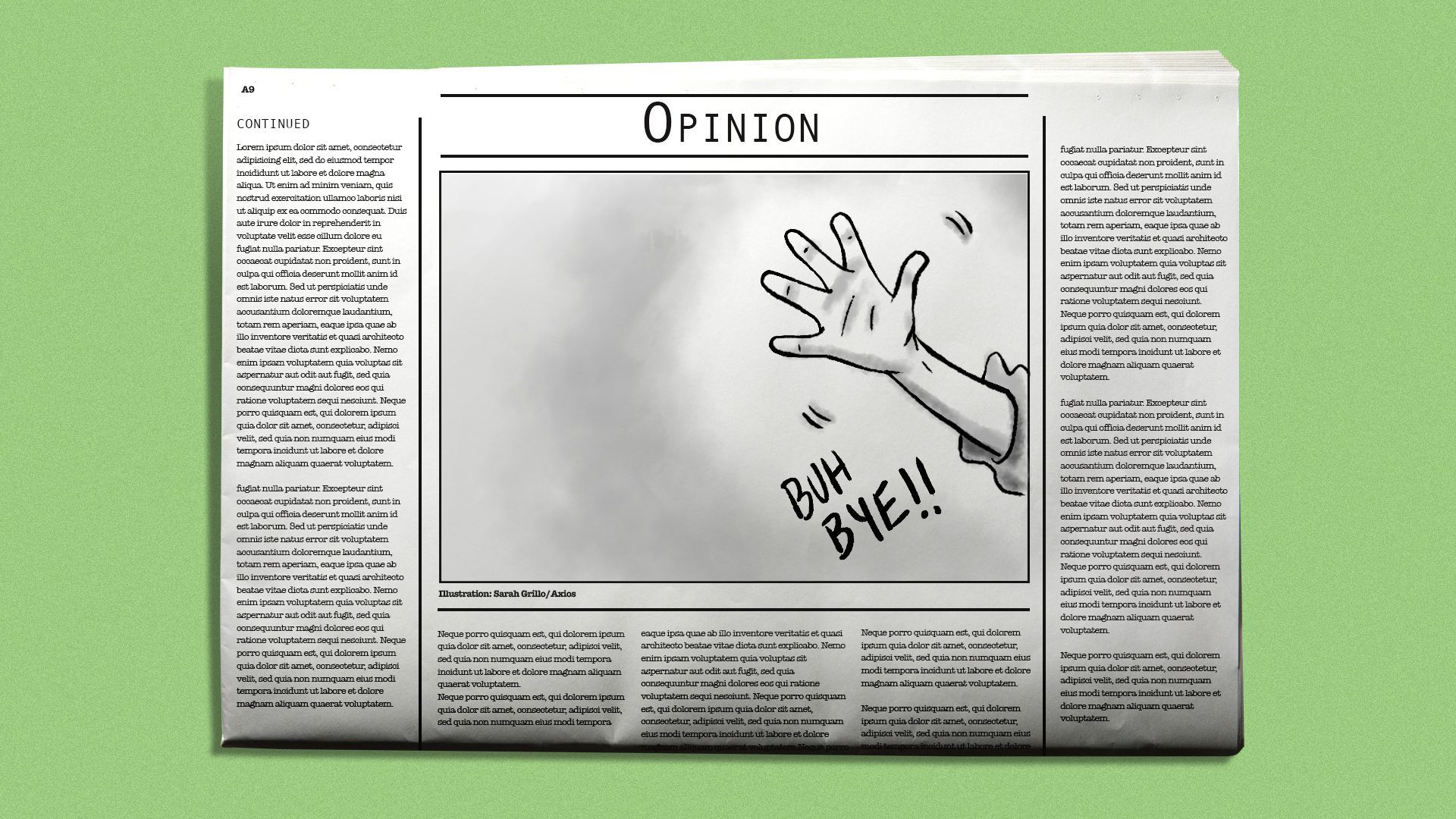
Major news publications are shuttering their opinion sections, forcing more business leaders, elected officials and subject matter experts to go direct with their message.
Why it matters: Unless you're George Clooney or Jamie Dimon, your op-eds are unlikely to be accepted and even more unlikely to drive conversation.
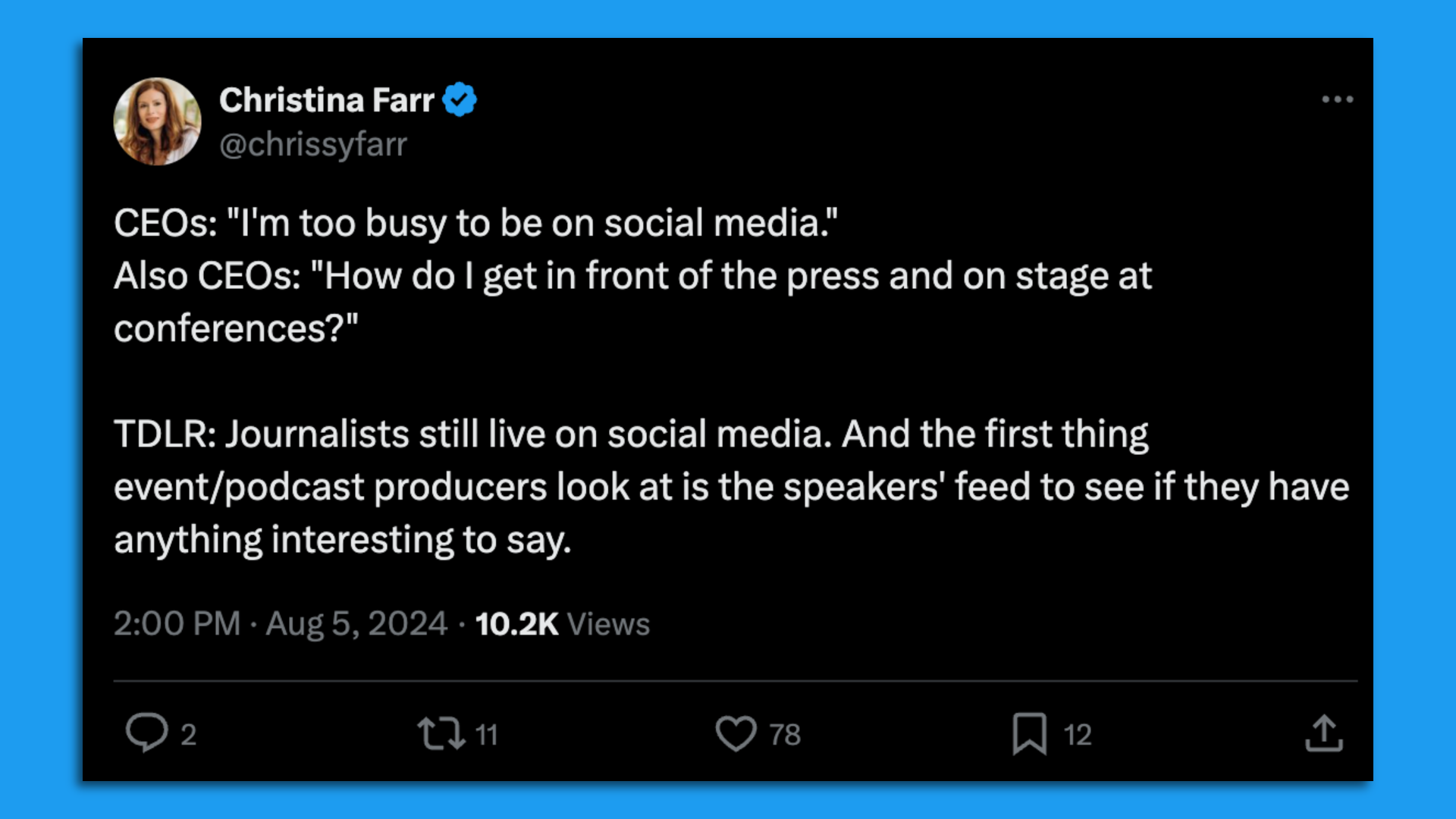
Between the lines: Agenda setting is increasingly taking place across social media, with many executives flocking to LinkedIn to share their thoughts and opinions.
- The site has seen a 23% increase in posts from chief executives in the past year, leading to a 39% increase in followers for CEOs.
- On average, posts from CEOs receive eight times more impressions and four times more engagements than other posts, according to LinkedIn data shared with Axios.
Zoom in: Ford CEO Jim Farley's recent LinkedIn op-ed garnered coverage in Barron's and Electrek, while Spotify CEO Daniel Ek drove 5.3 million post impressions, added over 130,000 followers during his first nine months on the platform and continues to gain media coverage through his posts.
- Other executives, like Bastian, former Starbucks CEO Howard Schultz and Albert Bourla of Pfizer, are going direct with their messages.
However, placing an op-ed at a major national publication still carries cachet — and guarantees eyeballs.
- According to Memo readership data shared with Axios, in the last 30 days, New York Times opinion articles saw 37% more readers than its general news coverage, while op-eds in the Wall Street Journal attracted a whopping 571% more eyeballs than its general news.
Reality check: The likelihood of securing those placements is made smaller by the shrinking landscape, says Alex Sommer, senior vice president and associate counsel at Tusk Strategies.
- "It's a bifurcated market now for business leaders looking to share their views and expertise," Sommer said.
- "You still have the Wall Street Journal, the New York Times and the Washington Post for broad, national reach, and local op-eds can still be very impactful from a public affairs standpoint, but those are really the only remaining media avenues."
State of play: CNN recently closed its opinion section amid newsroom restructuring and Gannett — the publisher behind hundreds of local newspapers and USA Today — has said it will cut back on opinion columns.
- Meanwhile, many of the newer digital outlets like Punchbowl News, Puck and Axios never launched opinion pages to begin with.
- Critics allege opinion pages can damage journalistic integrity and further blur the lines between editorial and paid— or "advertorial" — content.
Yes, but: There are still more than 1,100 U.S.-based news outlets that accept outside contributor content, according to Muck Rack's database.
- TIME has invested more in thought leadership with the launch of TIME 100 Voices, U.S. News and World Report has expanded its opinion desk and Forbes has long monetized its thought leadership offerings through its Forbes Councils.
4. Bonus: AI's role in ending op-eds

AI is expediting the end of the op-ed era, as business and trade publications crack down on AI-assisted content.
- Why it matters: This could hamstring communications teams that have incorporated AI in their workflows.
State of play: The Hill and Entrepreneur Magazine will not accept content that has been touched by AI, while Harvard Business Review requires AI-supported work — like brainstorming or research — to be disclosed.
- Medium does "not welcome" AI-assisted work, while AI is currently allowed to create content on Substack and LinkedIn as long as it does not violate pre-existing guidelines.
Zoom in: Most news outlets are allowing some use of AI under editorial supervision, even if they aren't accepting it from outside contributors.
- For example, the Associated Press told its reporters to view AI-generated content as "unvetted source material."
- This leads to such questions as can public relations professionals use AI when preparing these source materials, and if they do, should it be disclosed?
What they're saying: Qwoted — a platform that connects journalists with subject matter experts — seeks to guard against AI use in commentary, statements or pitches.
- "We go with what reporters are looking for, [which is] legitimate expertise and human-based responses," said Matt Kneller, co-founder of Qwoted.
- To better flag AI-generated content, Qwoted is releasing an "AI checker" for all reporter inboxes, Kneller added.
What to watch: There's a fine line between AI assistance in the public relations workflow and AI-generated press releases, statements and social content.
- This gray area could slow down the AI hype bubble in PR and comms space.
5. WPP sells majority stake in comms firm FGS to KKR
KKR has agreed to buy a majority stake in consultancy FGS Global from WPP in a deal that values the communications specialist at $1.7 billion.
Why it matters: The agreement boosts KKR's existing stake in the firm and is another example of private equity's pull to the communication advisory space.
By the numbers: WPP, the London-based advertising giant, also backs communications group Burson and public relations and marketing agency Ogilvy.
- WPP said yesterday it agreed to sell all of its roughly 50% stake in FGS to KKR for $775 million. FGS firm partners will retain a 26% stake in the firm.
The big picture: Communication advisories remain in high demand due to ongoing corporate reputational risks brought on by stakeholder management, geopolitical tensions and increased regulatory scrutiny.
- Comms firms have relatively few costs other than its people, so major client lists produces heavy cash flows, a key attraction for PE firms.
- The number of private equity deals in the space has more than doubled to 146 in the last five years, according to LSEG.
📚 Thanks again for reading! And thanks to editors Nicholas Johnston, Michael Flaherty and Kathie Bozanich.
Want more Axios Communicators? Become a Comms Pro member today.
Sign up for Axios Communicators