Axios Communicators

October 24, 2024

👋🏻 Welcome back! This week we are turning the page on press releases and shifting focus to AI.
- 📧 Reminder: The next Monthly Moves newsletter hits inboxes on Nov. 1. Submit job moves here.
Today's newsletter is 1,472 words, 5.5 minutes.
1 big thing: AI divide in the workplace


There's an enthusiasm gap between senior executives and the general workforce when it comes to incorporating AI into the workplace, according to a new report from stakeholder solutions firm Penta.
Why it matters: The communication industry is trying to be a first-mover when it comes to integrating AI into the work, but the lack of training is leaving younger workers behind.
By the numbers: Penta surveyed corporate employees from companies with at least 5,000 full-time workers between July 15-20, 2024, and found that senior executives are more optimistic and more trusting of AI than junior-level employees.
- They are also using AI tools more frequently, with 43% of senior executives reporting using it at least once per day, compared to only 21% of directors or managers, and 11% of associates.
- In fact, 34% of associates say they have never used an AI tool, per the report.
Between the lines: Slow adoption of AI can be tied to the general concerns about job displacement.
- 46% of associates believe AI will replace workers, compared to 31% of executives who agree.
The apprehension can also be linked to the lack of training and resources currently available.
- 67% of directors and managers and 57% of associates believe that ongoing training and workshops will help with adoption, followed by more pilot programs and demonstrations.
Zoom in: According to a recent Muck Rack survey, only 21% of workplaces have AI policies in place and only 1 in 5 offer AI training for employees.
- So while most PR professionals have played around with the technology, many don't know how best to incorporate it on a daily basis.
What they're saying: "Senior leaders are using GenAI more than junior staff, which may surprise some since younger people tend to adopt new technology early," says Andrea Christianson, partner at Penta.
- "The difference here is GenAI causes job security concerns for junior staff. Successful incorporation of GenAI will require cultural adoption at all levels, which means leaders should be transparent, include junior employees, and encourage peer-led knowledge sharing."
Case in point... 👇🏻
2. How communicators are using AI

One question that always comes up when I'm speaking to corporate communication teams or PR agencies is, "How are people using AI?"
Zoom in: Here are some ways I've seen communicators integrate these tools into their work:
- Content creation, duh. Using generative AI to draft press releases, pitches, social media posts, talking points or FAQs is the most obvious way some teams are using AI.
- AI can also help you "create once, repurpose everywhere" — a phrase coined by UPS president of global communications Deisha Barnett.
- Increase efficiency. AI can help with basic research, scheduling requests, formatting, list building, pulling data, transcribing interviews and summarizing meetings or large documents.
- Translation. AI can help translate between languages, but it can also help craft key messages for specific audiences.
- For example, one smart communicator from a tech company used AI to tailor an event invitation for a Gen Z influencer and then enlisted AI to help craft an invite to the same event for a member of a foreign delegation, which requires specific protocol and language.
- Message testing. Teams are using AI to predict how certain messaging might be received, whether it's seeing how specific language could appeal to a certain analyst on an earnings call or how a brand campaign might land in a new emerging market.
- Try this out: Next time you're putting out a statement, run it through AI after it's been edited and red-lined to the brink.
- Ask AI what the key takeaway of the statement is, and if the technology can't find the point, then it's unlikely your target audience will either.
- AI archivist. Record keeping is one of the most time-consuming and thankless roles of a communications team.
- Use AI as your unofficial archivist to help keep records of the team's success, corporate history, product launches, community anecdotes or key digital assets.
- It's a way to pay it forward to future teams or new hires, which will allow everyone to move faster and be more aligned.
- Personalization. Generative AI can help teams personalize communications, which will keep people more engaged.
- An example I always point to is Accenture, which increased internal email open rates by 10x by tailoring to each employee based on their location, department, function and interests.
- Discoverability. As AI supports search (or replaces it completely), the information these chatbots have about your company will become more important.
- Companies want to make sure that chatbots are using their brand-approved language and that they are not associated with problematic messaging or narratives.
- In response, many are combing through their digital presence and investing more in owned content that could help influence the bots.
- One fun thing: I previously asked ChatGPT how a brand can influence it. Check out the response here.
What to watch: AI can help communication professionals work smarter, faster. That's a good thing, but it also means that the billable hours model and agency landscape is ripe for disruption.
❓How else are you using AI? Let me know.
3. Why Chick-fil-A is launching an entertainment app
Chick-fil-A has gone Hollywood, launching a new app to serve original content including games, shows and podcasts.
Why it matters: This is the modern-day equivalent of the Happy Meal toy — a brand extension that helps the chain stay connected to customers even when they're not at the restaurant.
Driving the news: Chick-fil-A's new app, dubbed Play, will feature animated shows starring the brand's famous cows, scripted podcasts, recipe and craft videos, as well as e-books, the company announced this week.
- Themes of generosity, friendship, creativity and entrepreneurship will be woven throughout, Khalilah Cooper, Chick-fil-A's vice president of brand strategy, advertising and media, told CNBC.
The big picture: The move is indicative of a larger trend of noncontent-native businesses building their own media properties to tell brand stories.
- Chick-fil-A peers Starbucks and Chuck E. Cheese announced media projects in collaboration with external producers earlier this year to capitalize on "human connection" and supersized arcade games.
- Lyft and Airbnb have experimented in recent years with producing a digital series and a film centered around Lyft rides and local inclusive communities, respectively.
- And it's no surprise that Chick-fil-A, known for its conservative values, will focus on family-friendly storylines within its content strategy.
Between the lines: Content coming out of brand studios, especially that directed at kids, can help companies avoid the "stink" evoked from direct advertising, CNBC notes.
- And the risk of failure isn't as existentially threatening as it would be if a pure Hollywood studio made the same bets.
4. Communicator Spotlight: Amy Hufft of Klaviyo

Amy Hufft joined Klaviyo as vice president of brand and communications earlier this year to help the marketing software company scale globally.
- Why it matters: Klaviyo went public in 2023 and since then has been working to build its brand awareness beyond the B2B audience.
🗣️ What she's saying: "When you are a B2B company that is servicing a B2C business, you sit in this interesting space where you need to think beyond your core buyer," says Hufft. "And when you do that, you need to act a little more brand forward than a traditional B2B company."
📍 How she got here: Hufft started her career in the agency world, where she spent a decade working for big consumer brands.
- She pivoted to the tech space by taking an in-house role at Shopify, where she oversaw global brand marketing and communications. She also led brand communications at Zoom before joining Klaviyo in 2024.
🏗️ How it's structured: Hufft reports to Klaviyo CMO Jamie Domenici and oversees the team responsible for internal and external communications, brand marketing, integrated marketing, social media, community and customer advocacy.
💡 Every CEO should know the power of a strongly articulated mission, she says.
- "Everything comes from that year over year. Your annual strategy may change, your pillars may change, your growth target may change and what you're going after from a product perspective might change. But having that mission there that the CEO believes in and aligns to and repeats... that's the secret weapon."
📈 Trend spot: The rise of customer advocacy within comms.
🍎 Content plate: She recently read "Doppelganger" by Naomi Klein. However, she often tunes into Bravo's "Real Housewives" as a palate cleanser.
🧠 Best advice comes from Shopify CEO Tobi Lütke: "When you let everybody pick their favorite color, you end up with brown."
- "It's something I think about when working on messaging, because it's a good reminder that when you have a messaging document and you let everybody edit it, at some point, it dilutes the messaging down. Collaboration is good, but losing your point of view is bad."
5. 🍔 1 note to-go
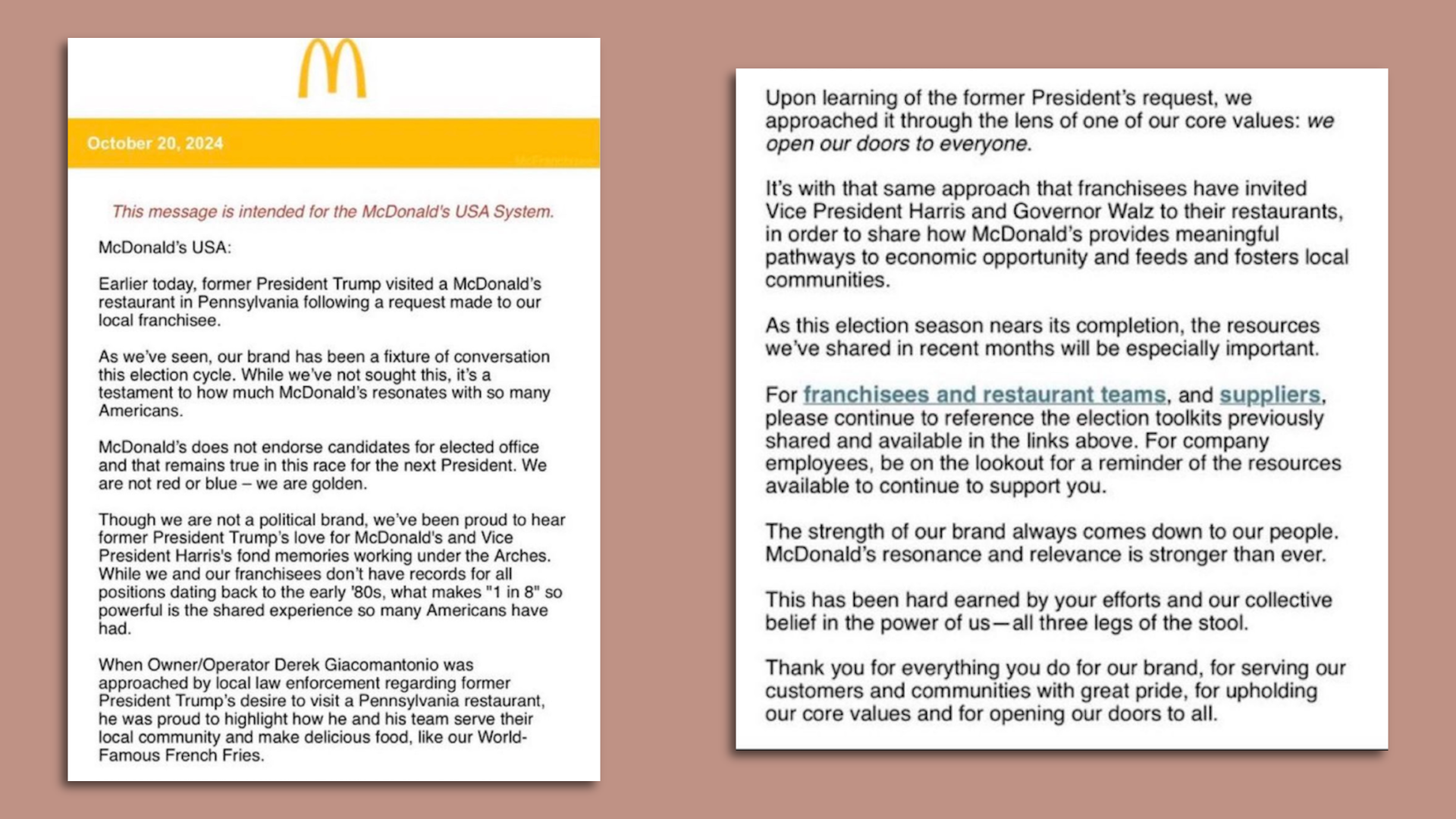
Following former President Donald Trump's viral work shift at a Pennsylvania McDonald's, the food chain sent this very smart note to its U.S. team.
🙏🏻 Thanks to editors Nicholas Johnston and Chris Speckhard. And extra thanks to you for reading each week!
If this was forwarded to you, subscribe here.
Sign up for Axios Communicators