Axios Communicators

January 04, 2024

✨ Happy 2024! A lot happened over the break — so this week I'm emptying my notebook and examining everything from the latest in AI to Pop-Tarts and labor battles.
- 💼 But first: Monthly Moves will hit inboxes tomorrow. Remember to submit your job updates here.
Today's newsletter is 1,894 words, a 7-minute read.
1 big thing: AI as a key audience
In 2023, communicators used generative artificial intelligence to complete basic tasks like writing social copy or press releases. In 2024, they are taking it up a notch by using it for predictive measures.
Why it matters: AI technology can predict how select stakeholder groups will react to certain messaging, test specific narratives and detect when these narratives might go awry.
Communicators can use these AI tools to pinpoint key audiences and anticipate potential issues before they bubble over, says PRophet founder and CEO Aaron Kwittken.
- "A lot of it's going to be predictive in terms of who's going to which stakeholder — whether it's a reporter, an influencer or podcaster — and identify who's going to be most interested in this narrative. [AI] can also predict which issues are lurking and which ones might pop up and threaten a brand's reputation."
The big picture: AI has the ability to serve as an amazing proxy for various audiences, says Sparky Zivin, senior managing director and global head of Teneo research.
- "You can train generative agents to think like a very specific analyst, NGO or an activist investor — and then we can run simulations and actually test a lot of our communications in a private, closed space. We can even test things as sensitive as earnings material before they go public."
Yes, but: This tech serves as more than just an artificial focus group — it's also a type of stakeholder unto itself.
- "With everything that companies are putting out there, the biggest audience for that are machines," says Zivin. "When all that content gets sucked up by machines, they create content based on it. … AI has become an intermediary and it [could] be that supreme influencer which shapes public view in the way that historically media or social media influencers have."
Driving the news: Consulting firms are quickly investing in these predictive capabilities.
- In November, BCW rolled out its Decipher Index, which uses AI to monitor global trends, test messaging and predict the virality, believability and potential impact of particular narratives.
- And last April, PricewaterhouseCoopers (PwC) announced a $1 billion investment in AI and is currently in the process of upskilling its 75,000 employees on the use of these tools.
What they're saying: "The Decipher Index was in direct reaction to clients demanding better data and the ability to predict impact in a much more specific way — especially as we were heading into what we anticipate will be a very disruptive year," said BCW chief innovation officer Chad Latz.
Zoom in: The spread of dis-and misinformation remains a key concern for 2024, but AI tools can quickly flag and predict how misinformation about a brand, leader or company might spread.
- "We can detect accelerators of influence — and that could be bots or foreign actors that may be acting on behalf of a particular issue or trying to move public sentiment on a particular issue," says Latz.
The bottom line: Using AI for content creation barely scratches the surface of its capabilities, and communicators are in a unique position to embrace the technology for more strategic, high-level purposes.
- "This isn't something that's going to take your job," says Megan DiSciullo, PwC's U.S. & Mexico communication lead. "It's just another productivity tool in the toolbox."
Case in point👇🏻... Share this story
2. New report: PR pros flock to AI tools
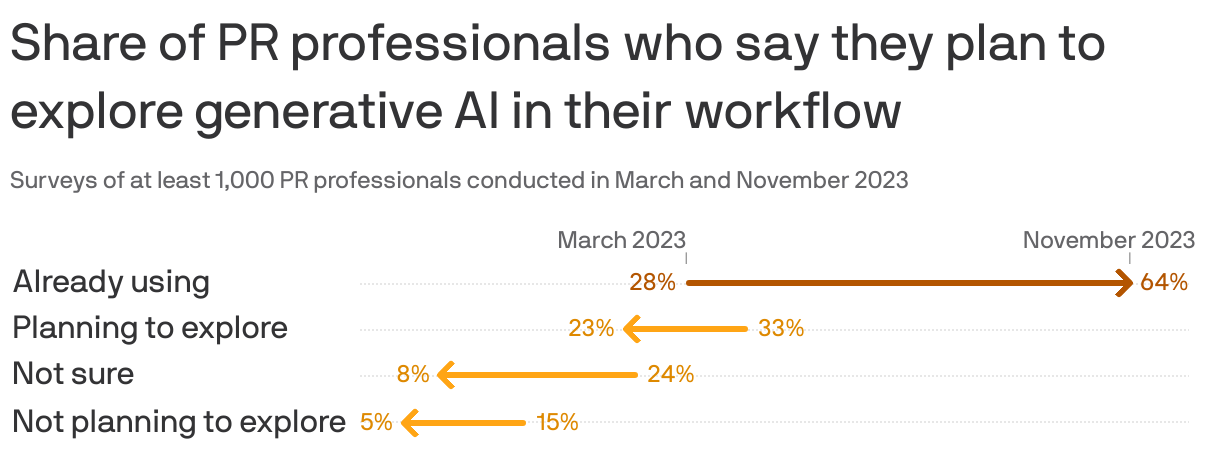
The number of PR professionals who use generative AI has more than doubled since March 2023, according to a new Muck Rack report shared first with Axios.
Driving the news: Muck Rack surveyed 1,001 PR professionals from Nov. 2 to Dec. 14 and found 64% have incorporated generative AI tools into their workflow, compared to just 28% in March of last year.
Yes, but: Only 21% of workplaces have AI policies in place and only 1 in 5 offer AI training for employees, per the survey.
By the numbers: 74% report AI has increased the quality of their work, while 89% say AI has increased their productivity and speed.
- Writing social media copy is the most common use case, followed by conducting research, writing press releases and crafting pitches.
Zoom in: 70% of those surveyed are concerned clients might think AI can replace them — specifically when it comes to content creation.
- This could explain the disconnect between agencies and clients when it comes to disclosing AI use.
- More than one-third of in-house communicators think AI use should always be disclosed by their agency partners, while only 19% of those within agencies agree.
The other side: Some PR practitioners still remain skeptical.
- Of those that are not interested in using AI tools, 43% say the output is too unpredictable, 40% have concerns about privacy, and about 1 in 3 don't believe AI can help them do their job better.
What they're saying: "2023 was the year of experimentation with this new technology and it appears most communications and PR professionals have embraced it ... showing that generative AI is likely to have a permanent place in the communicators toolbox," says Muck Rack CEO and co-founder Greg Galant.
3. Social media in a Pop-Tarts frenzy


Sponsoring a college football bowl game can be worthwhile if you do your research and hit upon attention-getters like cheeky mascots. Just ask Kellanova — the brand behind Pop-Tarts and Cheez-It.
Why it matters: When in lock-step, communication and marketing teams can increase brand awareness and generate palpable buzz from something as simple as a sponsorship deal.
What they're saying: "We leaned heavily on our partners at Weber Shandwick [for] their expertise in both earning attention and leaning into real-time culture to amplify our activation in-stadium, on television, in social media conversations and beyond to make our brands' games not just another sporting event, but a part of the current cultural zeitgeist," Kellanova chief marketing officer Julie Bowerman told Axios.
By the numbers: Social media chatter and earned media placements generated enormous interest for both Pop-Tarts and Cheez-It.
- According to Newswhip data shared with Axios, Pop-Tarts saw an 11,734% increase in interactions across X and a 10,746% increase across Instagram following the bowl game shenanigans.
- Interactions with Cheez-Its were up 24,648% across X and 18,700% across Facebook compared to the week prior.
- "To date, Pop-Tarts and Cheez-It have secured thousands of earned media placements and social mentions, amassing unprecedented, Super Bowl-levels of reach across the brands," added Bowerman.
What to watch: Charismatic mascots aside, brands are finding more creative ways to get in front of eyeballs by embracing concepts like ad-supported water fountains or digital billboards in elevators, gas pumps and gyms, writes Axios Media Deals author Kerry Flynn.
Go deeper ... Investors eye out-of-home advertising.
4. 🧠 Tips for the new year
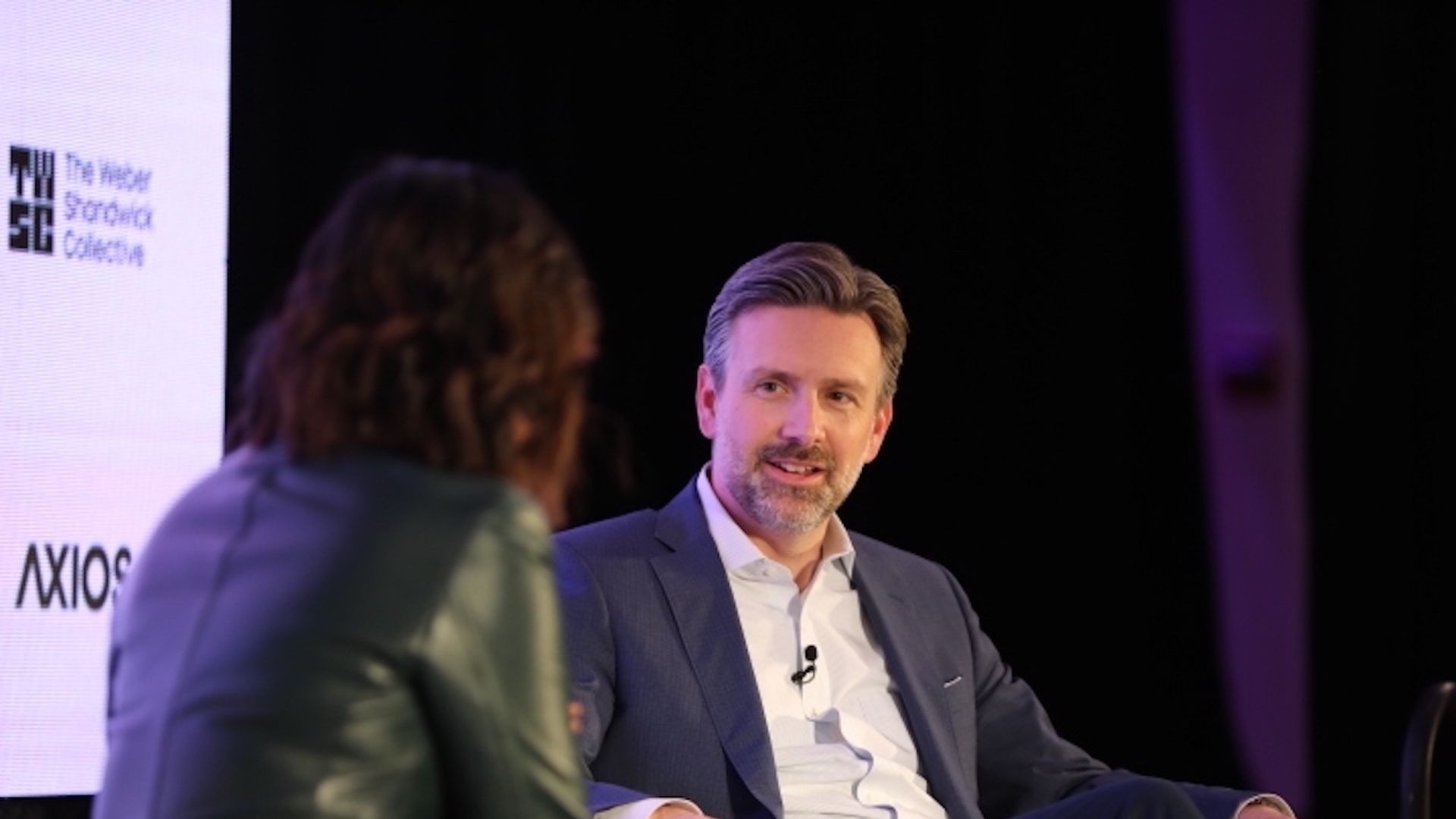
Axios convened top communicators at a recent event in NYC to learn what's in store for the profession in 2024.
Here are some words of wisdom to take into the new year...
✈️ United Airlines EVP of communications and advertising Josh Earnest on the importance of rapid response:
- "There definitely have been times where information was coming in on social media that helped inform operational decisions," Earnest said.
- He added the airline more often sees "weird things on social media" or its public relations team gets calls about incidents, and "having a direct line to the people who are running the operation of the airline is critical to our ability to respond in a timely fashion."
Go deeper … Viral encounters forever change how airlines communicate, United Airlines executive says
📱Crisis communication expert Molly McPherson on social media's influence:
- "Traditional media used to control most of the narrative, but now the public, when they mobilize together and quickly, have such tremendous power. ... That's what's changed."
Go deeper … Managing reputation on TikTok is key to staying on top of viral trends, crisis expert says
🎮Activision Blizzard EVP corporate affairs and chief communications officer Lulu Cheng Meservey on crisis comms:
- "I think about communications as a counterinsurgency strategy of waging a campaign to win hearts and minds," she said.
- "If you are able to sharpen your message to a point and refine it to reach a precise type of person with the precise thing that's going to make them just stay awake at 3am to think about it, that's going to puncture through."
- "We all have insane information overload, so if you try to spread yourself too thin and you're saying 10 different things to appeal to everyone, people are just going to forget about it."
Go deeper … Activision Blizzard's corporate affairs chief uses wartime communication strategies
5. Communicator Spotlight: Deidrea Miller, formerly of Christie's Americas

Deidrea Miller has spent the past two years as senior vice president, head of communications for Christie's Americas.
Why it matters: During her tenure at Christie's, Miller was tasked with broadening the auction houses' appeal by reaching out to new, younger audiences.
🗣What she's saying: "Christie's [has] a reputation of being extremely aspirational, so how do we demystify it and make it more approachable? That [was] one of the challenges of the job," Miller told Axios.
- Yes, but: "You have to be very creative in how you tell those stories, and kind of change the way you interact with the press. Art trade media has been very much at the center of who we've communicated with for a very long time. What I've done is essentially open that circle up to include lifestyle, women's fashion, entertainment, sports and political press."
- "My favorite outlet is Taxi TV or ABC7 NY. You wouldn't believe how many eyeballs see Taxi Teller content."
📍How she got here: Before joining Christie's, she spent much of her career in the public sector — with stints at the NYC Department of Education, New York Power Authority and in the office of NYC Mayor Bill de Blasio — and most recently served as a director at Brunswick Group.
📈 Trend spot: She sees a growing emphasis on content creation for platforms and mediums.
💡 Best advice comes from her stepmother:
- "Whenever I think I'm having a problem or going through a crisis, she'll say to me, 'OK, now tell me what's going on and don't use the words I, me or my.' And that has taught me how other people perceive an issue or a problem."
🔮 What's next: Miller plans to take some time off before starting a new role that speaks to a broader audience and emphasizes storytelling and reputation management.
Go deeper ... Read her spotlight in its entirety
6. 📝 1 note to-go
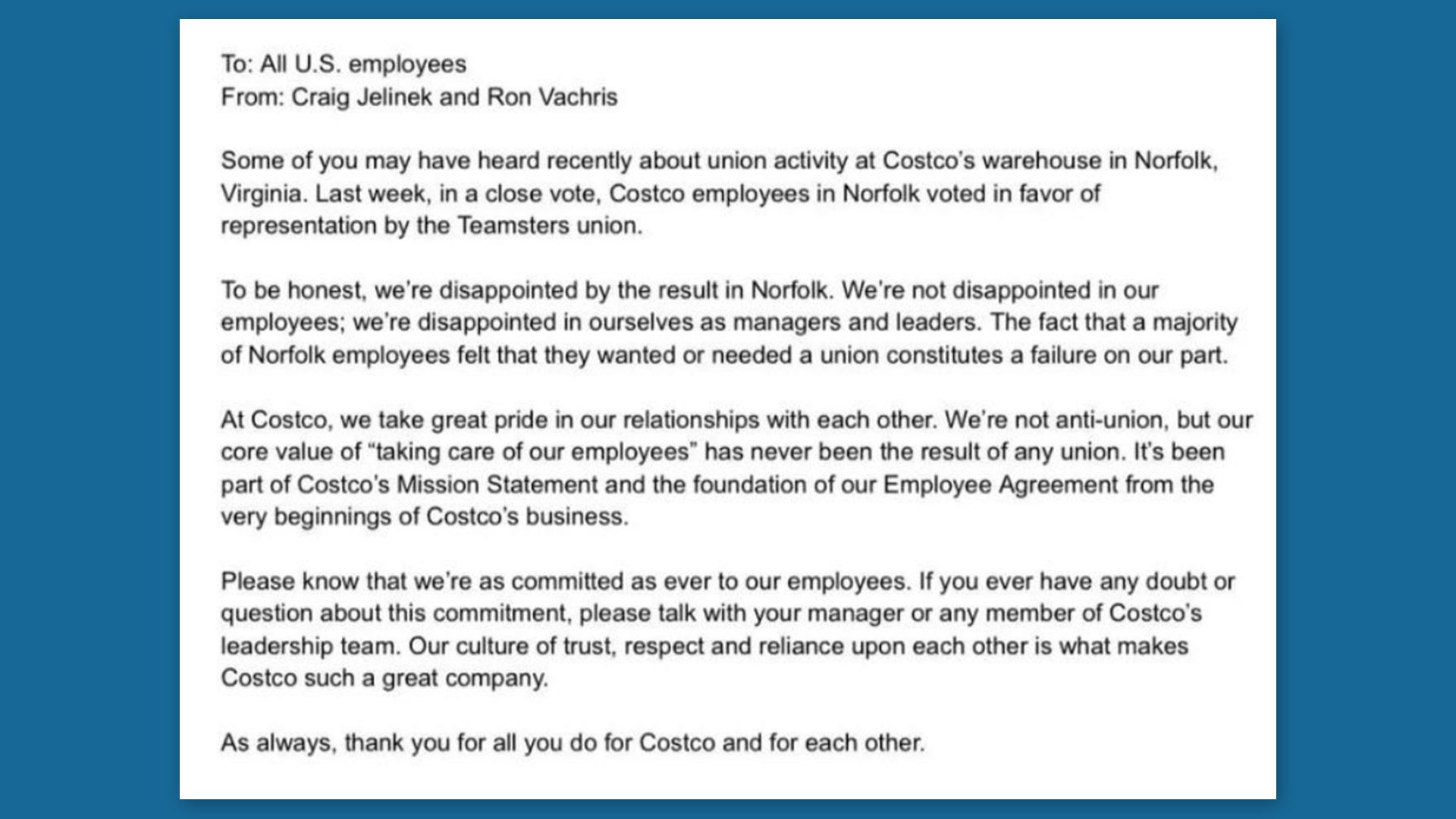
Labor battles have continued into 2024, with employees at Costco's Norfolk warehouse the latest to unionize.
Driving the news: In what appears to be an attempt to appeal to its remaining non-union employees, Costco CEO Craig Jelinek and president Ron Vachris issued an internal note taking responsibility.
- What they're saying: "The fact that a majority of Norfolk employees felt that they wanted or needed a union constitutes a failure on our part."
✨ Thanks for reading! And an extra thanks to editors Nicholas Johnston and Kathie Bozanich for making this newsletter happen each week.
Tell you friends and colleagues to subscribe.
Sign up for Axios Communicators


/2024/01/02/1704160672779.gif?w=3840)