Axios Communicators
August 21, 2025

🎶 Welcome back! Who here spotted the two song references in the subject line of this newsletter?
- 🍎 Join Axios for our fourth annual Communicators Live event in NYC on Dec. 4, featuring the biggest industry voices shaping strategy and trust in a rapidly changing world, where every word matters. Get your tickets here.
Today's newsletter, edited by Christine Wang and Kathie Bozanich, is 1,449 words, 5.5 minutes.
1 big thing: No more apologies
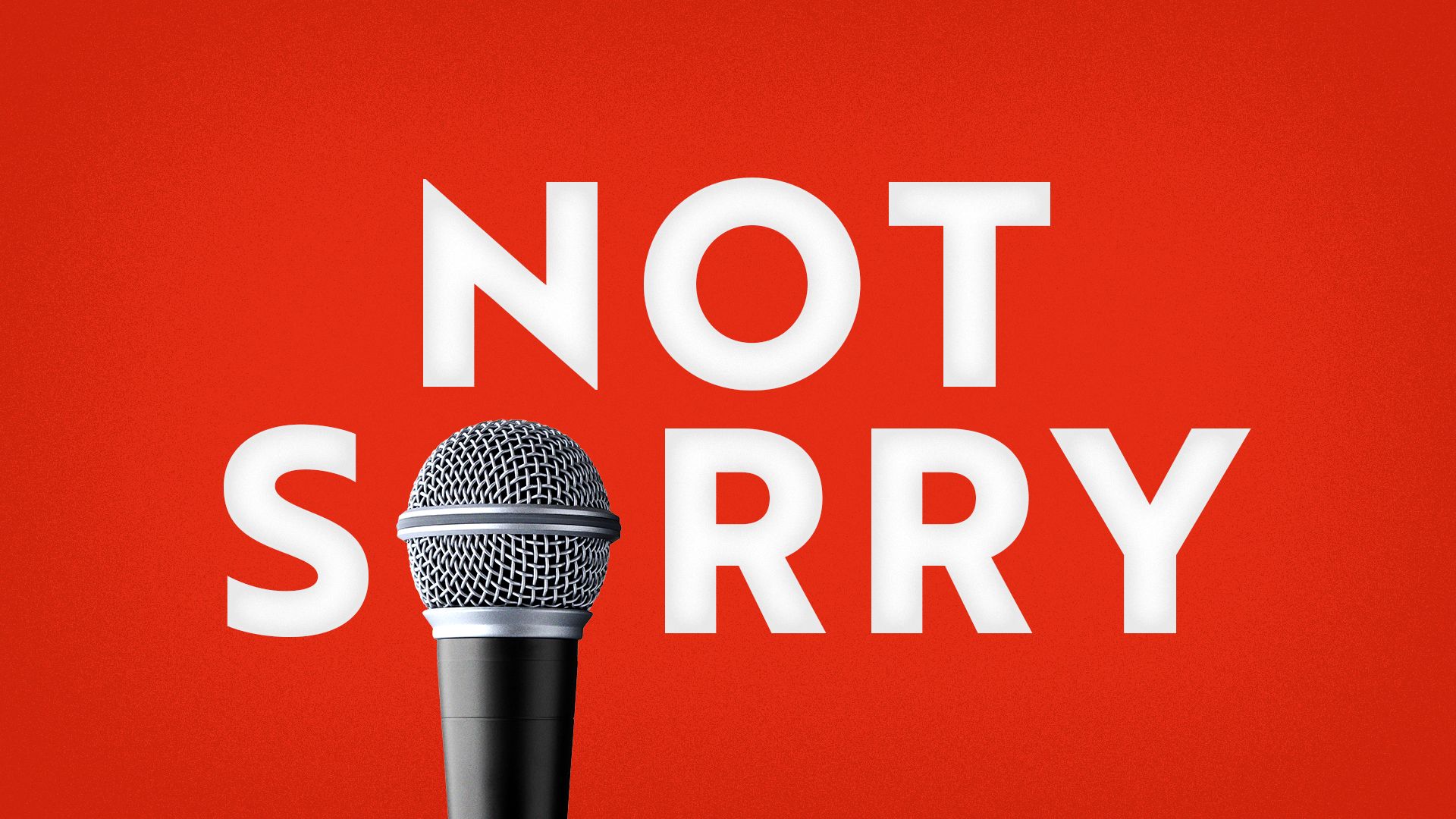
The age of the public apology is over, as more brands, public figures and companies dig in their heels amid backlash or dodge accountability amid operational snafus.
Why it matters: This is a major shift in communication style and reflects the current zeitgeist.
State of play: American Eagle doubled down on its controversial ad featuring Sydney Sweeney, women's dating advice app Tea didn't apologize after user data was hacked and leaked, and Crowdstrike left out the "sorry" initially when its global outage took out airlines and more last year.
- While phony statements from Astronomer executives littered the internet, the executives have yet to issue public apologies following the recent kiss cam scandal.
- Replit CEO Amjad Masad had choice words for X users who were offended by his stance on the Gaza conflict, writing, "I've been reflecting and going back and forth on how to handle this. I finally realized that I must, from the bottom of my heart, apologize to — absolutely nobody."
Zoom out: This isn't happening in a vacuum, according to communication experts. The no-apology, hardline stance is a response to desensitized audiences, political polarization and cancel culture fatigue.
- "People are simply tired of the outrage cycles and cancellation campaigns," crisis communications expert Molly McPherson says. "And the public is splitting because they don't want to jump on someone else's grievance bandwagon."
- Plus, there's no guarantee the apology will placate people, as it may be seen as a weakness to some or insufficient to others.
- The rapid pace of the news cycle is another major consideration. Controversy could quickly blow over without the need for a public apology, which could threaten to drive more coverage and conversation.
What they're saying: Instead of making sweeping public apologies, some are opting for more targeted outreach, says Paul Argenti, professor of corporate communications at Dartmouth's Tuck School of Business.
- "Leaders are reconsidering whether it's the right tool, and we're watching companies experiment here, defending their decision, ignoring the noise or addressing constituencies privately instead of making a public spectacle," he adds.
Context: An apology signals a reset. It is an acknowledgement that something went wrong and will be corrected.
- However, if a change in strategy or action isn't taken, then apologizing looks inauthentic and can worsen the backlash.
- "Not every crisis demands a loud response ... but it's almost as if the more personal the crisis, the more personal the response needs to be," McPherson says.
Yes, but: American consumers are still boycotting brands that don't align with their values.
- 1 in 4 Americans report boycotting a brand, with Democrats twice as likely to boycott as Republicans, a recent Ipsos survey found.
The bottom line: Taking accountability and being transparent can build trust in place of an apology.
- "The real risk is confusing avoiding an apology with avoiding accountability," Argenti says. "The best leaders aren't abandoning responsibility, they're just finding different ways to communicate it."
2. CEOs still prioritizing internal comms
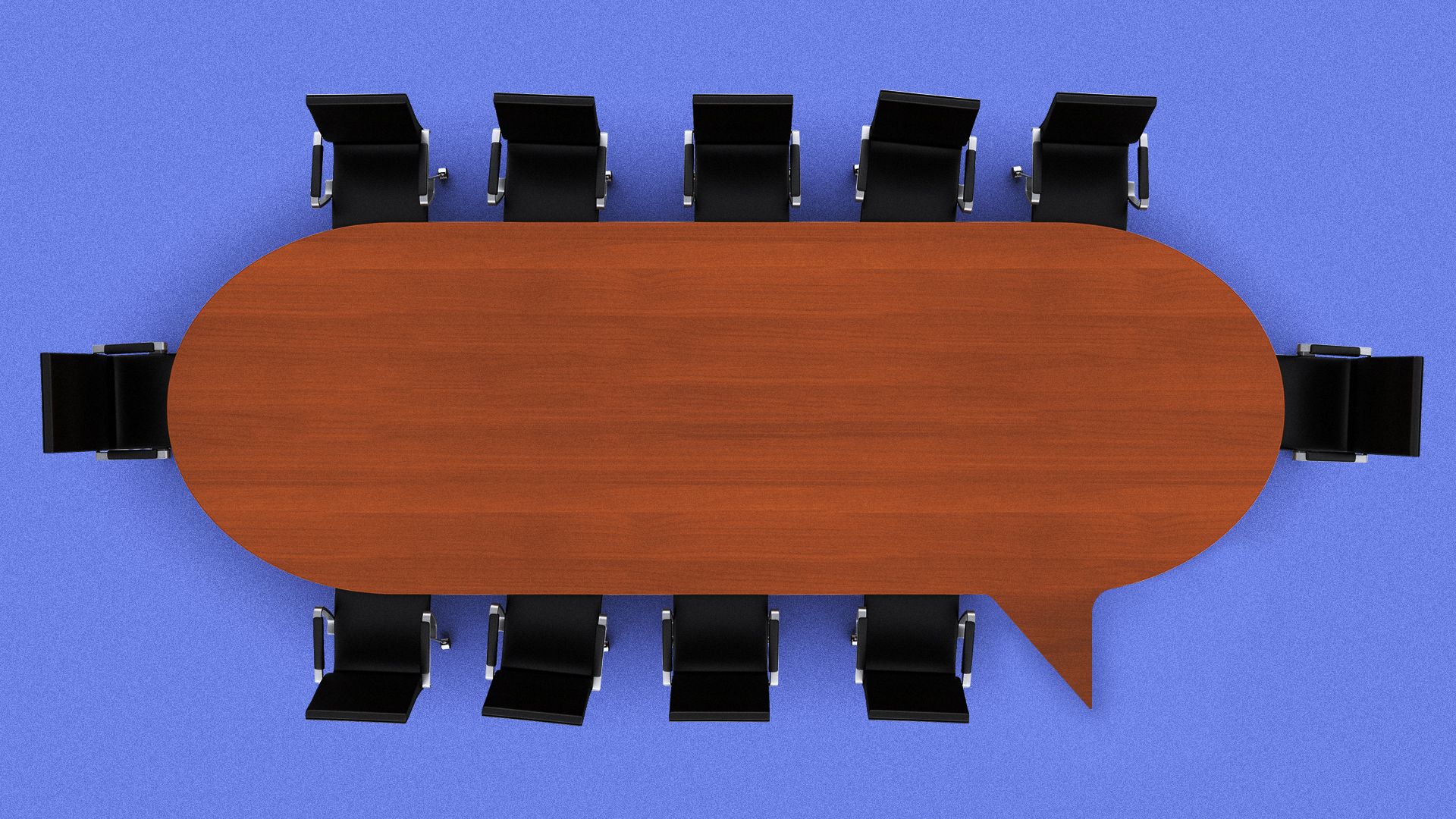
CEOs are communicating more with employees and internal audiences than they were in 2020, according to a new report by Shallot Communications and Censuswide.
Why it matters: If business leaders must address hot-button issues, they are going to do it internally.
By the numbers: Shallot surveyed 508 internal communications leaders and found that almost all of them have seen fundamental changes to communication strategies since the COVID-19 pandemic.
- Roughly 5 in 10 say their companies are using more channels like intranets, email and messaging apps to reach employees. Also, 46% say their internal communications teams are better funded than before the pandemic.
- 47% say CEOs are more interested in communicating with employees and roughly 4 in 10 say they are communicating more proactively compared with during the first Trump administration.
Yes, but: Employee notes or internal statements are often leaked or intentionally repurposed for external consumption.
- For example, Boeing treated its internal communications as external statements amid last year's manufacturing and safety concerns.
- After President Trump called for Intel CEO Lip-Bu Tan's resignation this month, the company posted its employee note on its website.
- Shopify CEO Tobi Lutke recently posted an employee note about AI workplace expectations on X.
What they're saying: Most leaders don't have the luxury of dodging political or social issues in their internal communications, Shallot co-founder Tim Granholm says. However, they are becoming more clinical in how they communicate with these audiences.
- "Some companies have taken very public stances, but a majority took a more low-key approach if there were changes to business policies during Trump's second term," he said. "Internally, particular employee bases might need more explanation or context, and comms teams are approaching this in a more targeted way to avoid confusion or leaks."
- "As opposed to all-company emails, they are spending more time going directly to the people, departments or employee resource groups that need to know."
Zoom in: 90% of internal communication leaders say their companies are regularly weighing in on external issues that affect the business.
- An example of this might be tariff policies or changes to DEI programs, says Granholm.
What to watch: Americans across demographics and political affiliations have an increased appetite for businesses to take a public stance on issues like free speech, immigration policy, diversity, climate change and health care issues, per a recent Bentley University-Gallup report.
- 51% said they believe companies should take public stances on current issues — a 13-percentage-point increase from last year and a reversal of a downward trend that began after 2022.
3. 📚 Reading list
📱 The White House launched an official TikTok account, while continuing the platform's reprieve from a U.S. ban. (Reuters)
- See the first video, with Trump saying: "I am YOUR VOICE!"
🦉 Duolingo CEO Luis von Ahn says AI memo was misunderstood.
- "Externally, as a publicly traded company some people assume that it's just for profit," he told the New York Times. "Or that we're trying to lay off humans. And that was not the intent at all." (The New York Times)
🥊 California Gov. Gavin Newsom's latest social media strategy is trolling Trump and the MAGA movement. (Politico)
📺 MSNBC, the progressive cable network owned by NBCUniversal, is rebranding to MS NOW, an acronym that stands for My Source for News, Opinion and the World. (Axios)
💼 Companies like Google, Cisco and McKinsey have brought back in-person interviews after years of virtual hiring to combat AI-enabled applicants. (Axios)
📰 Newsrooms are scrambling to hire AI leads as they explore AI tools, deals, lawsuits and processes. (Axios)
🔴 Target names Michael Fiddelke as its new CEO amid slumping sales and reputational challenges. (Yahoo Finance)
4. New slang added to Cambridge Dictionary


Social media slang doesn't always make sense — but the popularity of "skibidi," "delulu" and "tradwife" on the internet helped these three phrases cinch spots on the Cambridge Dictionary's list of recently added words.
Why it matters: The rise of these nonsensical words and others gaining recognition reflects internet culture's power and ability to influence the English language.
What they are saying: "We only add words where we think they'll have staying power," Colin McIntosh, a Cambridge lexical program manager, said in a press release announcing the additions.
- "Internet culture is changing the English language and the effect is fascinating to observe and capture in the Dictionary," the statement continues.
The big picture: Words that proliferated on social media and beyond are increasingly being recognized by dictionaries, with internet slang dominating last year's "word of the year" awards.
- Oxford University Press chose "brain rot," or a word that describes the "supposed deterioration" of a person's brain from scrolling through silly or trivial social media posts.
- "Demure" was Dictionary.com's word of the year, which took on a new life after a TikTok creator used it to describe how mindful, reserved and modest one should act in professional, travel and social settings.
- Collins Dictionary chose "brat" as its word, which they defined as an adjective "characterized by a confident, independent, and hedonistic attitude."
5. 💭 1 quote to go
I have a BA in English Literature, a minor in Computer Science, a JD, and an MBA. As CEO of Cloudflare, a fairly technical company, the most important has always been that English Literature degree. To be able to write and communicate effectively, easily, and quickly is the job.— Cloudflare CEO Matthew Prince recently posted on X.
🩵 Thanks for reading. Want more communicators content? Become an Axios Communicators Pro member
Sign up for Axios Communicators