Axios Communicators

September 04, 2025

☀️ Hello from San Diego! I'm in town for a friend's wedding. What should I do or see while I'm here? Share your recommendations.
- 🌎 Join me at Axios House during Climate Week and UNGA on Sept. 23. I'm interviewing Carlyle global head of corporate affairs Megan Starr, GAP chief communications officer Mame Annan-Brown, Patagonia CEO Ryan Gellert and more. Register here.
Today's newsletter, edited by Christine Wang and Kathie Bozanich, is 1,854 words, 7 minutes.
1 big thing: Trolls are trending
Trolling is the social media strategy du jour, with governors, sports teams and top American brands engaging in online snark.
Why it matters: It's a risky tactic, but if done right, it can be an effective way to grab attention and differentiate yourself from competitors.
Driving the news: Texas Christian University took to social media after its win Monday, mocking the University of North Carolina's football program and head coach Bill Belichick.
- In the political arena, California Gov. Gavin Newsom has made waves by mimicking President Trump's social media style, writing in all caps, posting AI-generated memes and signing his posts with his initials, "GCN."
- Newsom is also trolling Trump's merchandise, encouraging his supporters to purchase gear from his "PATRIOT SHOP."
Zoom in: In August, Newsom's press team's X account, @GovPressOffice, has gained more than 500,000 followers and its engagement rate is up 35%.
- The account has received more than 2.5 million profile visits in the last 30 days, according to Newsom's office.
- Over the past two weeks, posts on Newsom's individual account, @GavinNewsom, received 271 million total views and 6.3 million interactions, according to Peak Metrics data shared with Axios.
- Newsom's most-viewed X post on his personal account was in response to Bed, Bath and Beyond, which garnered 16.5 million views and 354,000 interactions.
Yes, but: There's a difference between capturing attention and saying something useful, says Bradley Akubuiro, partner at Bully Pulpit International.
- "Trolling isn't actually a strategy. It's theater," he says. "However, what a lot of these folks, including Newsom, have realized is that the smart move is to grab attention and then follow it up with content or policies that actually move people."
- Newsom did this by using satire to point to the nationwide redistricting battle.
The big picture: Beyond X, public figures, politicians and brands continue to flock to vertical videos across TikTok and LinkedIn to grab attention and drive audiences to key messages.
- Trump's TikTok account has amassed a whopping 15.2 million followers, while the newly launched White House account has about 665,000 followers and features videos like the "MAGA Minute."
- And New York City mayoral candidate Zohran Mamdani has taken a TikTok-first approach throughout his campaign, garnering over 1.4 million followers.
- Meanwhile, executives who have embraced the video feature across LinkedIn have seen a 30% increase in views year over year, according to LinkedIn data shared with Axios.
What to watch: TikTok's future remains to be seen.
- The platform has until Sept. 17 to change its ownership structure amid national security concerns.
Of note, Trump has extended this deadline three times since taking office and, given the White House's embrace of the platform, he is expected to delay the ban again.
Editor's note: This story was corrected to reflect TCU beat UNC on Monday (not Saturday).
2. Trump administration trolls on LinkedIn
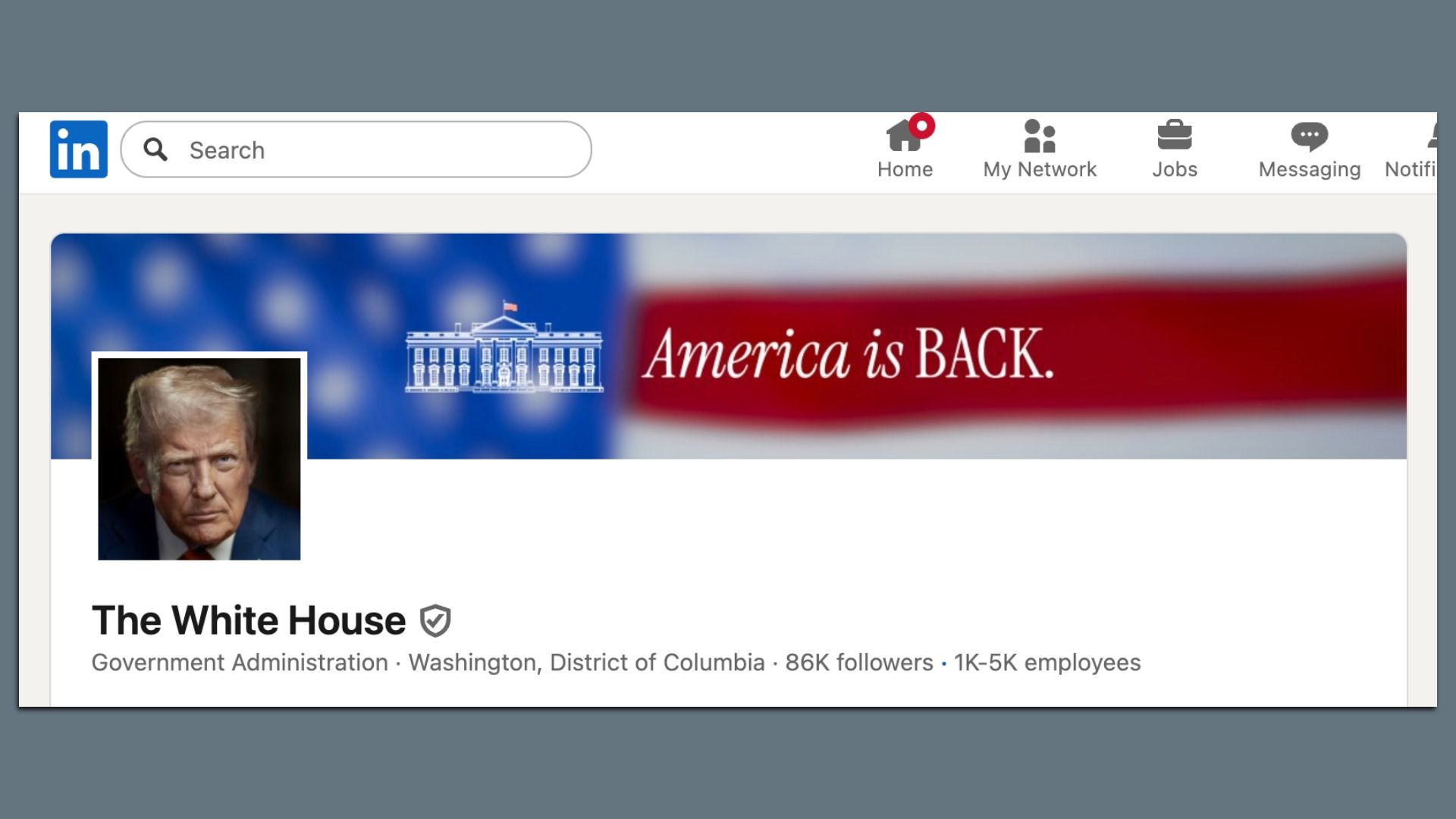
The official White House "company" page on LinkedIn received a brand refresh this week, replacing the traditional White House logo with a photo of President Trump.
Why it matters: It's another example of the Trump administration's social media trolling tactics, and it's resulted in his image showing up on former President Obama's LinkedIn page.
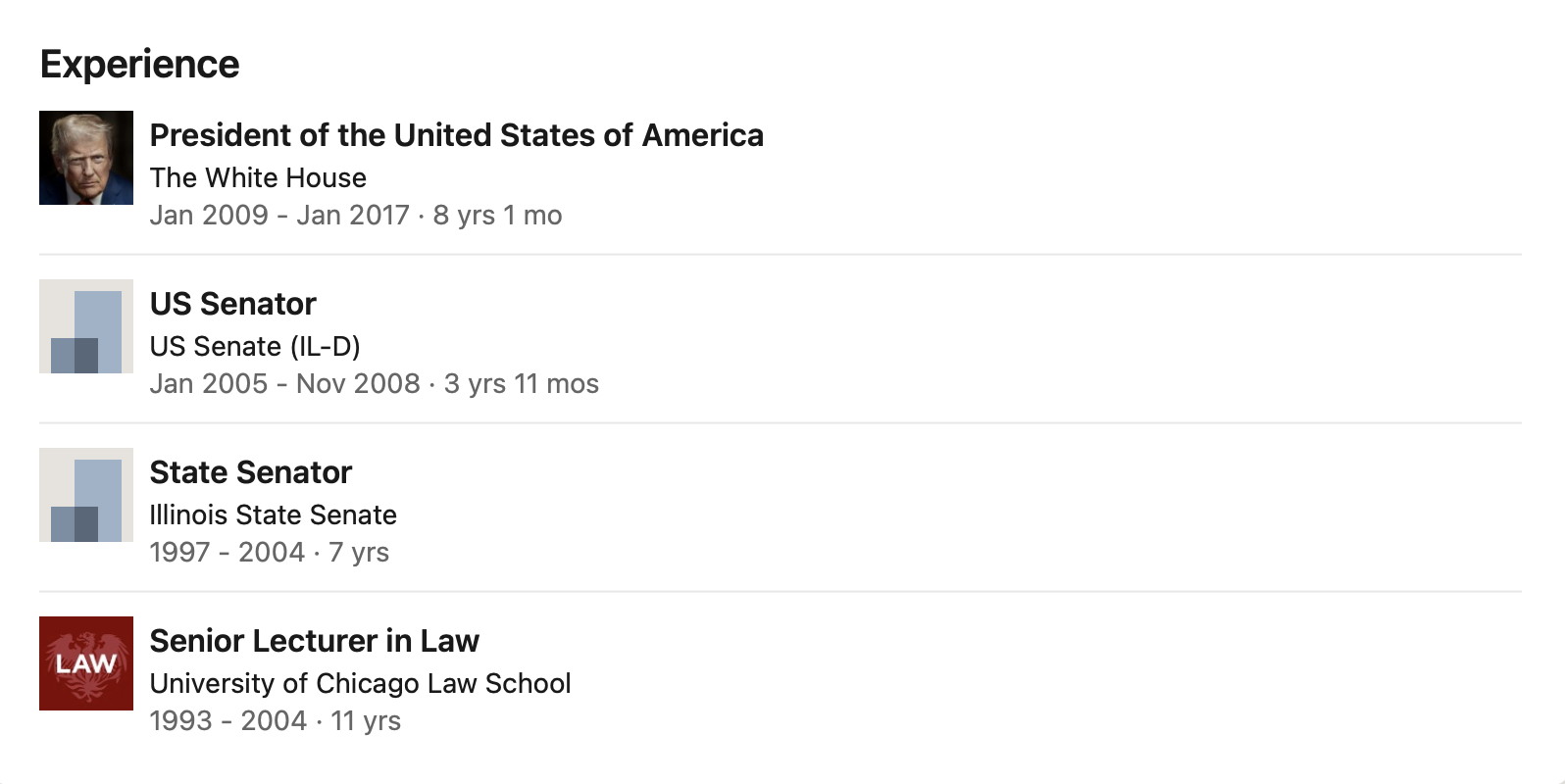
Between the lines: By changing the page, it now gives the appearance that those who have listed their previous work experience at the White House have served for Trump — even if they worked in previous administrations, as in Obama's case.
- It also gets people talking.
The intrigue: Several former White House officials told Axios that they quickly changed their affiliation from White House to the Executive Office of the President (EOP), which still has the official seal and logo.
- Step-by-step instructions explaining how to remove Trump's picture or change the company affiliation to EOP were shared across White House alumni group texts, one source told Axios.
- "If they spent half the time they spend trolling on lowering costs for Americans, they'd be onto something," a former senior Biden official told Axios.
- Chris Lu, former U.S. ambassador to the UN for Management and Reform, wrote on LinkedIn: "The White House has replaced the government seal with Trump's face in its LinkedIn profile. If you worked at the White House under a Democratic president or even another Republican president — and don't want Trump's face in your LinkedIn bio — just use Executive Office of the President instead."
What they're saying: White House communications director Steven Cheung confirmed on X that the move was meant to troll former administration officials.
- A White House spokesperson did not immediately respond to Axios' request for comment on whether the EOP page would be changed too.
- A spokesperson for LinkedIn said the move does not violate any of the platform's policies.
The big picture: This minor shift is another example of Trump binding his personal brand with the brand of the government office.
- Plus, this micro-marketing move shows that the Trump team understands how LinkedIn works, said Adam Rosenberg, a communications and political consultant.
- The small change not only trolls political opponents but also boosts the page's SEO on LinkedIn, he added.
- "People act like this team has no comms playbook and they actually do. They're incredibly digitally savvy to think of this first," Rosenberg said. "It's also clearly meant to bait Democrats into using the 'he thinks he's a King' argument in media."
3. 📚 Reading list
🧠 How Weber Shandwick CEO Jim O'Leary uses AI to scale himself. (Fast Company, Modern CEO)
💰IPO market's moment of truth: Five companies launched IPO roadshows on Tuesday — Figure, Klarna, Gemini, Legence and Black Rock Coffee. (Axios)
⚖️ Google won't be forced to sell its Chrome browser but must share data with rivals, per a federal judge's ruling. The nondivestiture decision was caused, in part, by the rise of generative AI giants. (Axios)
🥤 Elliott Investment Management takes $4 billion stake in PepsiCo and plans major activist campaign. (The Wall Street Journal)
❌ CEOs behaving badly: Nestlé CEO out after inappropriate workplace relationship (The Wall Street Journal). Piotr Szczerek, CEO of Polish company Drogbruk, came under fire after taking a signed hat from a child at the U.S. Open, but he ultimately apologized and returned the hat. (Yahoo, Fortune)
📚Trump's Harvard funding freeze struck down by federal judge. (Axios)
🤖 AI recruiters have better track records than human recruiters, per a recent University of Chicago study. (Bloomberg)
🎧 SiriusXM's talent-first strategy is helping it win the podcasting wars. (The New York Times)
4. Pfizer plays to Trump's Nobel Peace Prize desires

Pfizer CEO Albert Bourla defended the safety and efficacy of its COVID-19 vaccine and suggested Trump deserves the Nobel Peace Prize for his role in its development.
- 🧠 Why it matters for communicators: It's a communications choice that plays to Trump's ego.
Catch up quick: Trump on Monday demanded on Truth Social that "Drug Companies justify the success of their various Covid Drugs" after having praised the shots as a "miracle" during his first term.
- His Health and Human Services Department, led by vaccine skeptic Secretary Robert F. Kennedy Jr., is limiting access to COVID vaccines.
- Kennedy is also pulling $500 million in funding to develop new mRNA vaccines — the platform technology that was used to speedily deliver COVID vaccines.
Driving the news: Bourla yesterday called Trump's Operation Warp Speed — the 2020 American effort to develop COVID vaccines — "a profound public health achievement."
- "Such an accomplishment would typically be worthy of the Nobel Peace Prize, given its significant impact," Bourla said in a statement.
- He also provided a link to "numerous published studies and updates" that validate the Pfizer vaccine's "safety and effectiveness."
Between the lines: Pfizer has a lot to lose if access to its COVID vaccine is permanently limited.
- The shot pulled in $5.35 billion in revenue for Pfizer in 2024, making it the pharmaceutical company's fifth-best-selling treatment.
The intrigue: For years, Trump has wanted to win the Nobel Peace Prize, Axios' Alex Isenstadt reported in March.
- "I deserve it," Trump said of the Nobel in February, "but they would never give it to me."
- A White House spokesperson had no immediate comment yesterday.
5. Rise of the MAHA "mom-fluencers"
The MAHA movement's not-so-secret weapon is a network of moms on social media, who use activism around wellness causes to amplify Robert F. Kennedy Jr.'s calls to clean up America's food supply.
Why it matters: "Bro-casters" like Joe Rogan may help drive the political narrative, but Kennedy has turned to these "mom-fluencers" to further his agenda, which includes narratives that aren't scientifically sound.
Case in point: Influencers such as Vani Hari, better known as the "Food Babe," can be found on social media platforms and podcast circuits.
- Hari, a New York Times bestselling author with 2.3 million Instagram followers, got dozens of protesters to travel to WK Kellogg Co. headquarters in Battle Creek, Michigan, last year to protest food dyes in the company's cereals and deliver petitions.
- "I've gathered hundreds of thousands of signatures on petitions," Hari told Axios. "I have a huge following. So that helps and people trust when I take on an industry or a topic."
Other mom-fluencers include:
- Nutritionist Courtney Swan, who has more than 580,000 Instagram followers.
- Moms Across America founder Zen Honeycutt, host of the "Unstoppable with Zen Honeycutt" podcast.
- Ana-Maria Temple, a holistic pediatrician with 366,000 Instagram followers.
Zoom in: Several influencers told Axios the movement is built around small group text chains, newsletters and social media posts that amplify shared concerns.
- They also pointed to the mobilizing power of groups like the Weston A. Price Foundation, a nonprofit that aims to restore nutrient-dense foods to the American diet and has chapters around the country.
Reality check: While the moms discuss the value of eating whole foods, getting exercise and quality sleep, and parental choice, they've often veered into misinformation, experts said.
- Influencers often embrace the fallacy that natural is good and chemicals are bad when casting suspicion on the food and drug industries, said Katrine Wallace, an epidemiologist at the University of Illinois Chicago who debunks questionable health claims.
- "Those videos go way more viral than mine, because if somebody says 'Here's the secret the government doesn't want you to know,' that's going to be compelling," Wallace said.
6. 👀 1 thing to watch


News about tariffs is attracting eyeballs once again after a short summer slump, according to Memo data shared with Axios.
By the numbers: Since April, tariff coverage has drawn over 119 million in total readership, peaking in May with 35.2 million readers.
- Interest rebounded in August, as the tariffs began to go into effect.
What to watch: On Friday, a federal appellate court ruled that most of Trump's tariffs were illegal. The administration is expected to appeal the decision.
- If the ruling stands, corporations could demand billions in back pay, Axios' Madison Mills reports.
The bottom line: The tariff news cycle continues, and business leaders will be expected to answer to it.
✅ Thanks for reading. Want more communicators content? Become an Axios Communicators Pro member
Sign up for Axios Communicators