Axios Communicators

April 30, 2026

🩵 Hi there! In this special edition of the newsletter, I share some of what I learned while covering this beat.
- 🗓️ Next week, comms legend Sally Susman will helm this newsletter.
- You'll also hear from experts like Microsoft's Frank Shaw and Yahoo's Sona Iliffe-Moon in the weeks to come.
🍸 Join Axios Live and IBM in partnership with Web Summit in Vancouver, Canada, on Monday, May 11, at 9pm PT for a night of connection and cocktails with innovators across the global tech landscape. RSVP here.
This edition of Axios Communicators, edited by Christine Wang and copy edited by Kathie Bozanich, is 2,381 words, 9 minutes.
1 big thing: From scribes to strategists

When this newsletter launched in 2022, OpenAI was a little-known research lab, Bob Chapek was the CEO of Disney, X was just a letter in the alphabet and Bud Light was just a beer.
Why it matters: Looking back, we see how dramatically the landscape has changed and how quickly the communications function has had to evolve.
In my time covering this beat, here are the biggest unlocks I've seen:
- Communications is recognized as a core business function, not a support role.
- The most effective comms leaders are adding to their roles as scribes, messaging experts and media bookers. They are now operators, risk managers and strategic advisors sitting at the center of the business.
- And if you think your job is strictly public relations, then you're going to get left behind — or replaced by a bot.
State of play: Today's comms leaders aren't just shaping narratives. They're helping organizations navigate technological disruption, cultural change and political polarization.
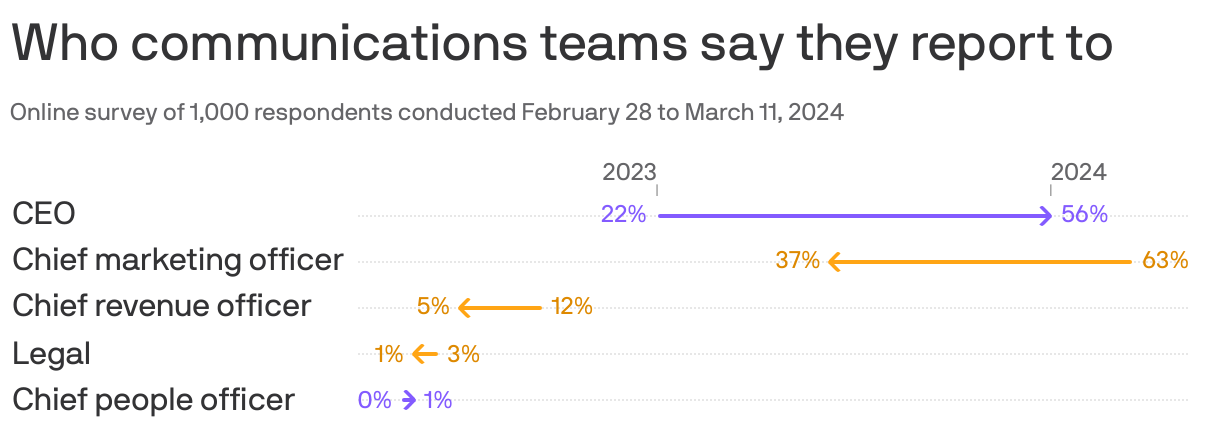
- More comms and corporate affairs leaders are reporting directly to the CEO and holding positions on senior leadership teams.
Zoom in: A recent Memo report found that 56% are under the CEO's supervision — an increase of 34 percentage points from the prior year.
- And even with notable volatility in the CEO ranks, turnover among chief communications officers has stabilized, according to a separate report from Patino Associates and CASA, showing that CCOs are seen as the steady hand.
The big picture: Because of the cultural complexities, economic volatility and political reality, communications teams now advise on issues ranging from geopolitics to trade and AI integration.
- The increase in responsibility has led to the rise in the CCO+ title.
- The Observatory on Corporate Reputation examined Fortune 1000 companies and found CCO+ roles have increased by roughly 88% since 2019, outnumbering traditional CCO roles for the first time.
What to watch: With artificial intelligence disrupting how consumers discover brands and boycotts spreading at the speed of a post, communications teams have become the brand gatekeepers.
2. The AI shift is a comms challenge first

Since this newsletter launched, AI has reshaped the work, infrastructure and risk calculus of corporate America.
Why it matters: Communications teams are tasked with explaining, implementing and responding to the technology.
State of play: Adoption is accelerating, but unevenly, according to several industry reports.
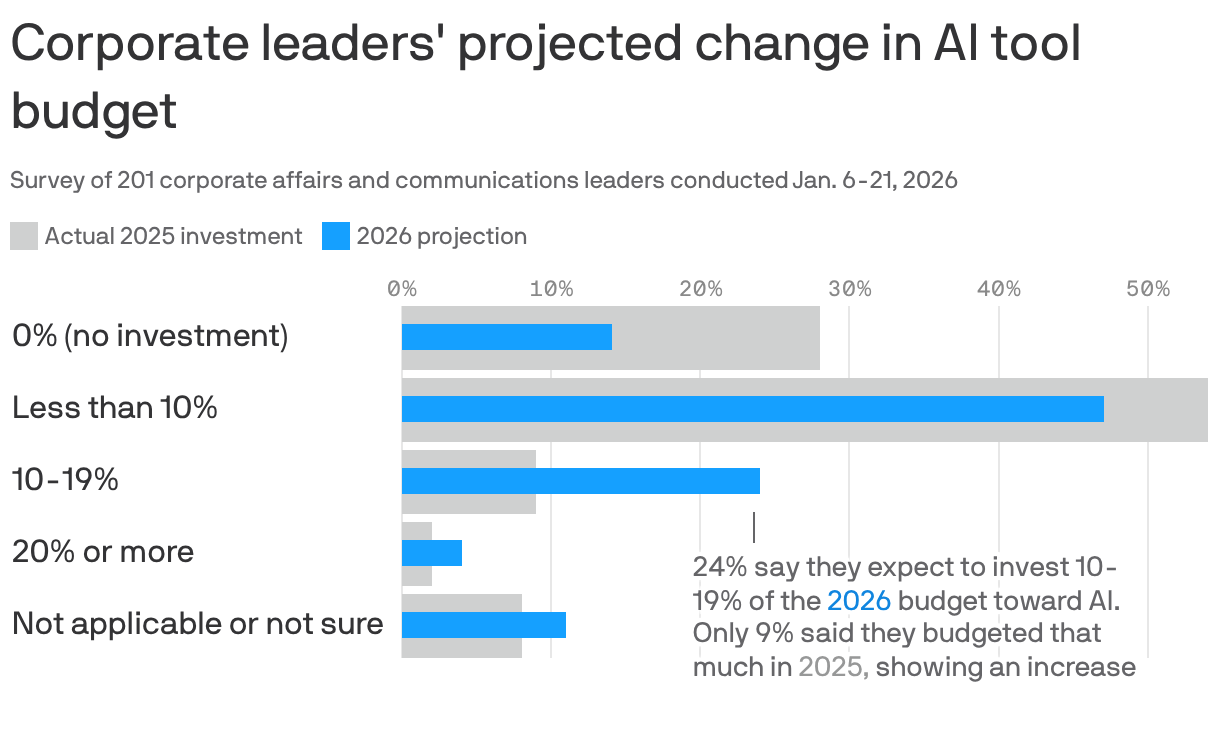
- Roughly 1 in 4 corporate affairs and communications leaders say they will dedicate more than 10% of their budgets to AI tools, but a majority (88%) aren't fully prepared to lead the AI transformation in their function, according to a recent study by Boston Consulting Group.
Zoom out: More than 80% of comms and corporate affairs work can be augmented or automated by AI, according to BCG, and PR agencies may bear the brunt of this.
- In three to five years, AI integration across all of corporate affairs could create productivity gains of 34% to 47% and cost reductions of 20% to 28%.
- The study found roughly 9% of corporate affairs work can be totally AI-led, while 83% requires AI-human collaboration, assistance or supervision.
By the numbers: Agentic AI creates the greatest potential cost savings among the operational, planning and analytical tasks of corporate affairs (28%-39%), followed by external and media communications (22%-31%), and ESG and community comms (21%-30%).
- The functions with fewer opportunities for cost savings include strategic and executive communications (12%-16%), public affairs (16%-22%) and internal comms (18%-24%).
Friction point: AI has also presented a major messaging challenge for the AI labs and companies that now consider themselves AI-enabled.
- Communicators are responsible for defining AI narratives across audiences — and it's not landing consistently.
- Consumers want reassurance and utility, policymakers demand transparency and guardrails, and investors are focused on growth and competitive advantage.
- Meanwhile, the workforce is anxious over the fear of becoming obsolete — or "FOBO."
The intrigue: Industry leaders are advancing contradictory messages about what AI is and what it means.
- OpenAI CEO Sam Altman has been blunt about the rapid pace of progress and the benefits AI could bring if society "gets it right."
- Anthropic CEO Dario Amodei has adopted the most safety-focused stance among major AI leaders, but some critics argue that Anthropic's rhetoric mirrors fearmongering.
- Google CEO Sundar Pichai, in a recent "60 Minutes" appearance, framed AI as a manageable evolution.
The bottom line: Communications teams are not just tasked with explaining AI, but using it while safeguarding trust in an increasingly synthetic information landscape.
What to watch: AI introduces new reputational threats — from hoaxes and hallucinations to loss of message control — while governance lags.
- Only a minority of boards have formal AI expertise, leaving companies exposed.
3. The agency tale: scale, shrink or specialize
The traditional PR agency model is fracturing, and fast.
Why it matters: A wave of consolidation, AI disruption and boutique upstarts is reshaping how communications work gets done, and who gets hired to do it.
State of play: Large holding companies are streamlining their communications and public affairs portfolios to drive efficiency and scale.
- Omnicom's merger with IPG created the world's largest marketing services company and triggered sweeping consolidation across its PR portfolio.
- WPP, by merging BCW and Hill & Knowlton to create Burson, sought to build an integrated, modern mega-agency. But just two years later, it is reportedly exploring a sale of Burson as part of a broader restructuring.
The good news is that private equity has historically been an eager buyer.
- KKR's acquisition of a majority stake in FGS Global — valued at about $1.7 billion — cemented the model.
- The number of private equity deals in the space has more than doubled in the last five years, according to LSEG.
- PE money has flowed into strategic comms advisory firms Penta Group, Teneo, Narrative Strategies and Bully Pulpit International.
Meanwhile, challenger firms have proliferated as senior operators defect from mega-agencies to launch boutique firms that offer high-touch, specialized counsel without the overhead of global networks.
- Also notable is a rise in fractional work, collectives and independent consultants.
Zoom in: Agencies of all sizes are pouring investment into AI tools as they look to scale and meet client demands.
- It's a fundamental shift from the classic agency model —built on billable hours and scalable headcount — toward more of a hybrid of consulting, AI-powered and capital-backed growth.
What to watch: 37% of comms leaders are considering reducing agency spend by more than 5% over the next 12 months, according to a recent BCG report.
- Yes, but: Demand for strategic counsel has surged as companies face the volatile political, regulatory and reputational landscape — aligning agency expectations more closely with advisory services than traditional PR.
4. All roads lead to Washington


Companies are one X or Truth Social post away from an online onslaught, market movement or political firestorm.
Why it matters: Business leaders across every industry are looking to get in front of the Trump administration.
- Yes, but: Engaging with Trump 2.0 is unlike engaging with previous administrations and execs are rethinking access, risk and public affairs frameworks for navigating its policies and penchant for dealmaking.
Catch up quick: Trump has called for the resignation of tech executives, inserted himself in media mergers, pressured companies over business strategies, demanded a cut of sales from certain companies and even moved to derail a corporate rebrand.
- Meanwhile, the White House has established a loyalty rating for companies based on how they communicate with the administration's policy proposals.
Between the lines: This time two years ago, many corporate affairs teams would've been caught flat-footed.
- Now, teams are moving faster, stomachs have gotten stronger and playbooks have been drafted for the possible moment a company or brand lands in President Trump's crosshairs.
By the numbers: A recent Axios-Gravity Research Communications Report of comms chiefs found that engagement hasn't slowed; it's just taken a different shape.
- 4 in 10 are conducting meetings with key administration officials, and 1 in 5 have been back-channeling at the CEO level.
- A plurality of those surveyed say they are taking a selective approach, interacting only on issues directly relevant to the business.
- 17% say they are taking a more limited approach, hoping that minimal contact will reduce reputational or political risk.
- Only 6% report active collaboration.
What to watch: Economic empowerment is a rising issue across all key stakeholders. The administration has also struggled with its economic narrative.
- The push and pull between corporations and the White House around who is at fault for rising prices will likely continue throughout 2026.
What's next: Big U.S. brands are scrambling to figure out how best to activate around the 250th anniversary of America's founding, as what should've been an easy, brand-safe opportunity has turned into a political tightrope walk.
5. New media reality

Every business is a content business now, from corporate-led podcasts, event series, digital live shows and viral CEO hamburger videos.
Why it matters: Breaking through requires navigating a fragmented mix of owned, earned and creator-driven channels, all filtered through algorithms that shape what audiences see and trust.
🔘 I visualize this as three concentric circles, all of which are needed to reach audiences:
- Go direct in its truest form: Communicating directly through using owned channels like a blog or personal social media account to get a message out.
- The smallest circle is the easiest to control, but — unless you're Trump or Elon Musk — is less likely to reach mass audiences.
- Go directly to friendlies: Engage with low-risk content creators, podcast hosts, industry leaders, independent reporters or thought leaders.
- The middle-circle strategy allows brands and executives to reach new but strategically aligned audiences with a reasonably controlled message.
- Yes, but: The lines are blurry here. Some of these engagements are pay-to-play, while others might require cross-promotion or audience sharing.
- Go to mainstream publications: Traditional news is not dead. It remains an important third-party validator for investors, policymakers and talent.
- The largest circle carries a higher risk — since you can't control the story — but can also offer a higher reward by allowing brands, companies or executives to get in front of a mass audience to show momentum and build credibility.
Between the lines: All of these platforms are being sourced and cited by large language models.
- Muck Rack input more than 1 million realistic user prompts into ChatGPT, Gemini and Claude, and analyzed the citations. It found that 37% of inquiries cite external blogs or content (not owned by the company or product targeted in the query) and 27% cite news stories produced by journalistic entities.
- A separate analysis by Penta Group found that 60% of cited material comes from corporate-owned or business-produced sources, and about 25% comes from traditional media, with the rest split across user-generated and third-party platforms.
What's next: Regardless of the tactic, clipping is king.
- It's an answer to the war for attention, and it's a great way to infiltrate algorithms or engage employees and other internal audiences with non-text-based communications.
6. 💭 What we heard
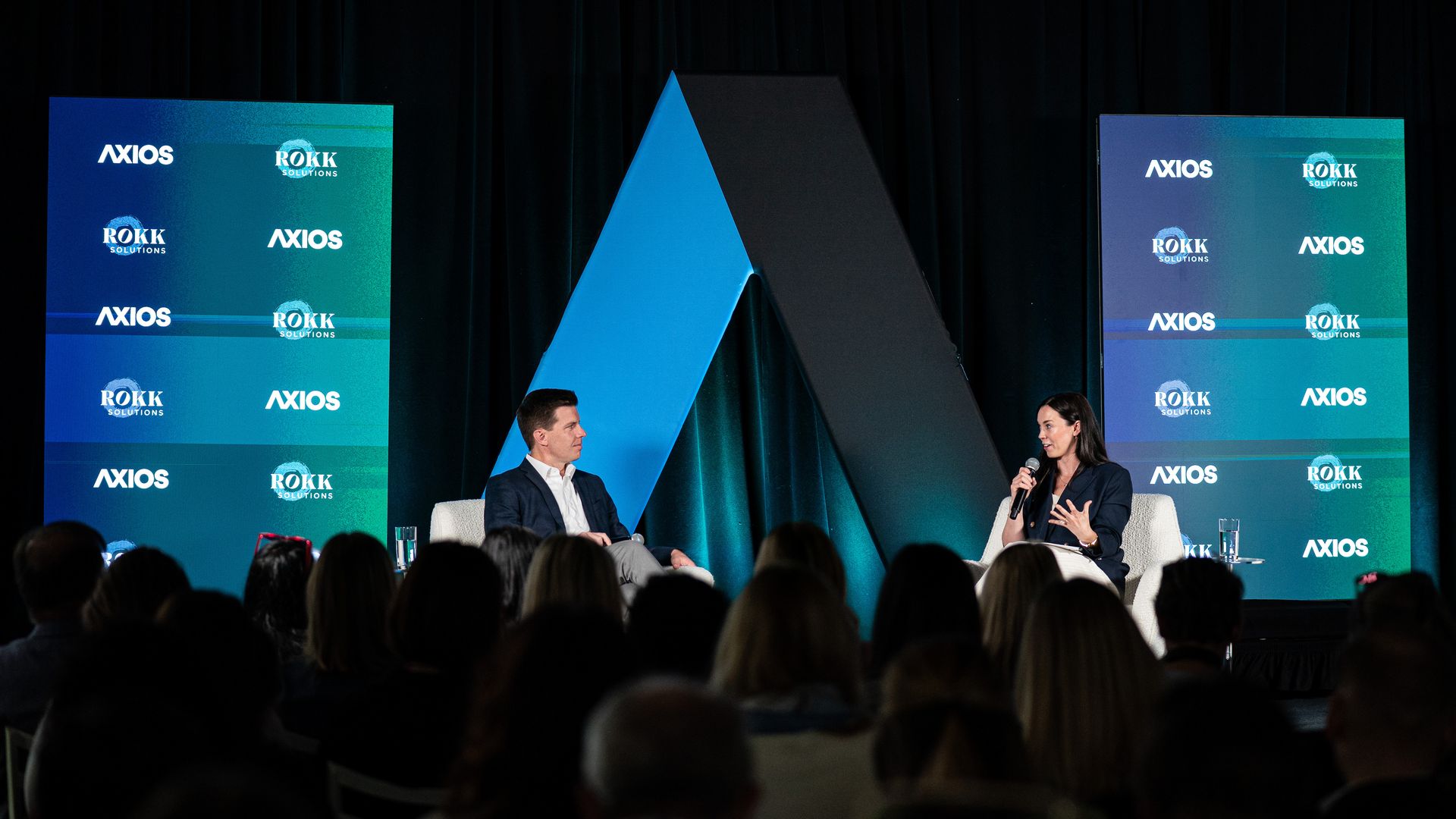
These findings were validated at Axios' invite-only gathering last week, which focused on the intersection of media, AI and policy.
Here's what we heard ...
📣 Reddit chief communications officer Adam Collins maintained that Reddit is the "most human place on the internet," which is one of the reasons it's such an appealing source for LLMs.
- "These, these platforms want to train on authentic conversations between human beings," he said. "That's how they get tone of voice. It's also how they get the actual information itself and keep it timely and fresh."
- But there's no way to game the system — brands that want to influence LLM outputs need to build their presence on Reddit authentically.
- "Our job is ultimately about people," Collins said. "Our job is to influence people, to drive understanding, perception and action. And if the technology becomes the purpose, if it becomes the end goal, it gets in the way of what we're actually trying to do."
👯 MS NOW president Rebecca Kutler also focused on how people "are really craving real-life connection" in the age of AI.
- "I'm looking around this standing-room-only room. That's why all of you came today," she said in an onstage conversation with Axios' Sara Fischer.
- "That's what we hope to build. ... What we're aiming to do is build a really rich community."
😳 The defining quality of successful Washington operators? It's "paranoia," according to Taylor Budowich, a former deputy White House chief of staff for President Trump who's president of The Sovereign Advisors.
- "They're paranoid that somebody else is working harder than they are. Probably because it's true … [and it] drives them to succeed."
Go deeper ... watch the conversations.
7. 🙏🏻 A final thank you
Building this newsletter — and working alongside the whip-smart and equally kind team at Axios — has been a career highlight that will be hard to top.
- To be honest, I didn't fully know what I was getting into when I took this job. But I saw a clear need for business-minded, rigorous coverage of this function and jumped at the chance to try.
- Since then, Axios Communicators has expanded beyond a weekly newsletter to include a thriving events operation and active community for communication leaders called Mixing Board, powered by Axios.
Communications doesn't always get the credit it deserves (PR needs better PR, after all). But over the past four years, I've had a front-row seat to the evolution.
- I've watched comms leaders become core strategic operators inside their organizations.
- And in a moment defined by AI disruption, a fractured information landscape and a heightened political environment, your work has only become more essential.
The bottom line: This is a critical business function — and it's in your very capable hands.
🩵 Thank you for welcoming me into your inboxes each week and trusting me with your stories. It's truly been an honor.
— Eleanor
🙏🏻 Thanks for reading! Axios Communicators will hit inboxes every Thursday.
Sign up for Axios Communicators