Axios Communicators

April 23, 2026

Welcome back!
- π¨ Big changes coming to Axios Communicators. More on that below β¦
- π But first, to my C-suite readers: Request to join Axios CEO Jim VandeHei's free new Axios C-Suite weekly newsletter.
This edition of Axios Communicators, edited by Christine Wang and copy edited by Kathie Bozanich, is 1,950 words, 7.5 minutes.
1 big thing: Chatty CEOs see higher returns

The first edition of this newsletter was titled, "Why every CEO needs to be a communicator," and if you're still not convinced four years later, chew on thisβ¦
- Fortune 500 companies with CEOs who communicate consistently and effectively average two to three times the returns of their peers, according to a recent analysis from Golin.
- A separate study by Cardinal40 found that high-quality CEO thought leadership can drive an average of $367 million in shareholder value in a single week.
Why it matters: Communications is delivering measurable financial impact at a time when it feels like most CEOs have gone radio silent.
Between the lines: Much of this silence stems from politicization and the reputational risks of wading in.
- As Jamie Dimon recently said on "The Axios Show," "CEOs aren't used to commenting on every single policy that comes out there. ... You can't comment on every little thing. And particularly when they make statements that you know they're going to modify later."
Reality check: Dodging policy discussions is nearly impossible given the impact tariffs, foreign affairs and regulation have had on U.S. businesses. How CEOs engage in Washington can now have direct implications for their reputations.
- According to Golin's analysis, CEOs perceived as aligning too closely with the Trump administration for business gain often saw net negative sentiment.
- Those who performed best took a narrower approach by engaging policymakers, attending White House meetings and advancing business priorities β while sticking to business-first language and avoiding ideological positioning.
- Of note, CEOs who took the position of walking back their company's DEI and sustainability commitments (68%) also saw a slip in sentiment scores.
What to watch: Artificial intelligence is shaping up to be the next messaging fault line.
- While 86% of Fortune 250 CEOs regularly reference AI, only half are viewed as credible on the topic.
- Those who connect AI to products, customer outcomes or workforce re-skilling have sentiment scores that are nearly four times higher than their peers.
- As the report notes, the gap is no longer between CEOs who talk about AI and those who don't β it's between those who can prove what they're doing and those who can't.
The big picture: In an effort to control the narrative, many CEOs are pulling back from traditional media and investing in owned channels by "going direct."
- Earned media impressions dropped by nearly 3 trillion year over year, and CEO participation in global forums and trade associations has also declined, per Golin's analysis.
- CEOs are showing up in commercials, launching podcasts and posting on Reddit.
The bottom line: CEOs aren't necessarily communicating less. They're just communicating differently.
Case in point ... ππ»
2. Silicon Valley is building its own news-industrial complex

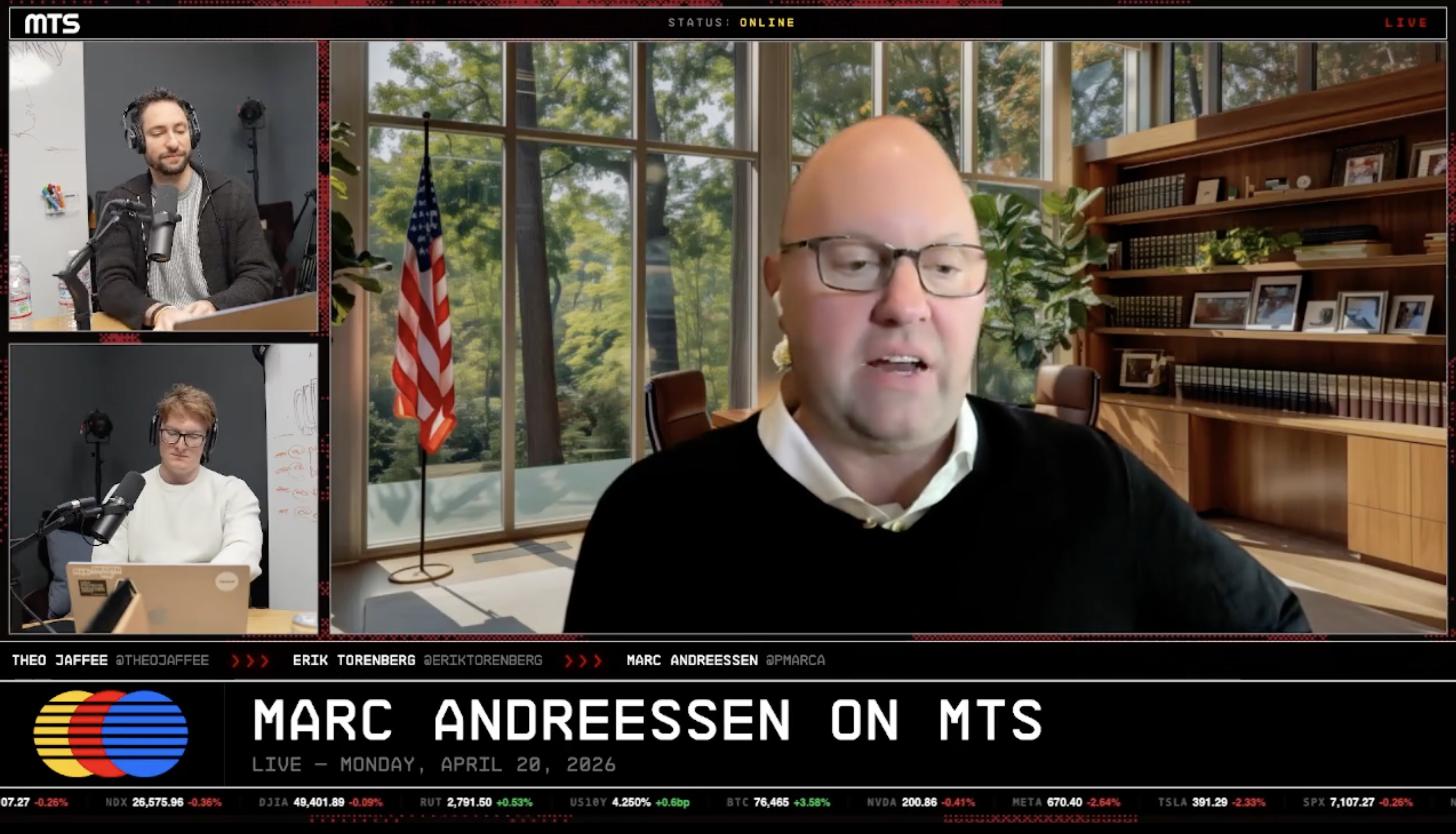
Silicon Valley's most powerful venture firm helped launch a 24/7 livestream on X on Monday, joining a wave of tech money piling into the news cycle as the internet's hottest new asset class.
Why it matters: "Monitoring the situation" β the theme of Polymarket's pop-up D.C. bar and the name of the new show ("MTS") funded by Andreessen Horowitz β has become one of the most viral and lucrative memes in tech.
- The phenomenon sprouted from Elon Musk's X, a platform dominated by independent creators, amateur intel analysts and prediction markets that treat real-time news as a spectator sport.
Zoom in: Backed by a roster of angel investors, "MTS" is being pitched as Silicon Valley's answer to cable news β a 24/7 livestream of elite X users reacting to real-time headlines, like Apple CEO Tim Cook's surprise exit.
- A16z cofounder Marc Andreessen framed "MTS" as a tool for "sense-making" in an era he calls "incredibly complex and erratic."
- Skeptics were quick to mock the format as a well-funded livestream of venture partners switching tabs among X, prediction markets and Wikipedia.
The big picture: As legacy media sheds jobs, audiences and relevance, an emboldened and deep-pocketed tech ecosystem is racing to replace it.
- Kalshi and Polymarket command valuations in the tens of billions, fueled by bettors trading record volume on everything from the Iran war to the best new AI model.
- OpenAI reportedly paid in the low-hundreds of millions this month for "TBPN," a buzzy livestreamed tech talk show reporting to Sam Altman's top political operative, Chris Lehane.
The intrigue: A new Peter Thiel-backed startup called Objection.AI aims to go even further, letting users pay to challenge news stories and have them judged by a mix of human investigators and AI.
3. AI use surges among policymakers


AI is no longer just a research tool in Washington, D.C. β it's starting to shape how policymakers form opinions, according to Penta Group data shared exclusively with Axios.
Why it matters: Policymakers are the latest to lean on AI for guidance, signaling its growing role in shaping decisions across markets, consumer behavior and now public policy.
By the numbers: Penta surveyed 2,060 U.S. federal policymakers and senior staff across Congress, the administration and federal agencies, and found that 27% say AI informs their perspective on a topic β up from 17% in 2025 β putting AI on par with traditional sources like experts and web searches.
- Six in 10 policymakers say they use AI at least once a day and are most likely to turn to it for background research on policies and issues (42%) and writing and editing statements, memos and reports (40%).
- Meanwhile, roughly 3 in 10 say they use AI to help gather background information.
The intrigue: Republican policymakers are about 1.2 times more likely than Democratic policymakers to use AI daily β 69% compared to 57%.
- Republicans are also more likely to find AI helpful in shaping their perspectives (30% vs. 23% for Democrats).
- Meanwhile, Democrats are more than twice as likely to avoid AI entirely. 13% say they don't use it in their daily work, compared with 5% of Republicans.
What to watch: The partisan gap could start to shape how lawmakers understand β and regulate β the technology, with implications for policies on governance and competition.
Go deeper ... Subscribe to Axios AI+ Government

4. AI labs don't seem to care that consumers hate them
Get on the AI train or get left behind. That messaging from frontier labs about the world changing nature of AI suggests they're not focused on addressing consumer backlash to the technology.
Why it matters: They may regret that approach when they go public and have to work overtime to turn AI haters into customers.
What they're saying: "Tech people have never been great communicators," Paul Argenti, corporate reputation expert and Dartmouth College professor, tells Axios.
- "The first company that actually understands the power of corporate communication and shaping messaging for their product is going to win," he added, recalling Google's early ads showing a father messaging his daughter.
- He says Google and Microsoft have a leg up over frontier labs because they have "more savvy" communications strategies.
State of play: Consumers are increasingly skeptical about AI, but that doesn't seem to be changing the messaging from AI CEOs.
- Half of Americans are more concerned than excited about the use of AI, according to Pew, and Gen Z's excitement about the technology sits at 22%, according to Gallup.
- Anthropic's Dario Amodei recently reiterated his concern about AI causing a "serious employment crisis" right after his company unveiled a model so powerful they only gave access to a few select partners.
- OpenAI CEO Sam Altman called this "fear-based marketing," adding that the doomerism hasn't helped.
5. Exclusive: New PR collective forms

Three boutique firms β Six Eastern, Daly and Care of Chan β have united to launch the agency collective Plenty & Co.
Why it matters: Collectives like Plenty & Co. are betting the future isn't a single agency but a curated ecosystem of specialists that can plug in as needed.
State of play: Clients are increasingly seeking strategic, bespoke advisory services over expensive, big-box PR β especially as in-house comms teams turn to AI to handle more of the work traditionally outsourced to agencies.
- According to a recent BCG report, 37% of comms leaders are considering reducing agency spend by more than 5% over the next year.
Zoom in: Plenty & Co. comprises Six Eastern, founded by Emilie Gerber and focusing on B2B and technical PR; consumer PR and brand shop Daly, founded by Alex Daly; and experiential events firm Care of Chan, founded by Sue Chan.
- The founding firms generate eight figures in revenue, employ nearly 50 and represent clients like Yahoo!, Substack, A24, J Crew and You.com.
- Plenty & Co. plans to bring in agencies with expertise in social, content and video.
What they're saying: "I think the reason why our model works better than working with a larger agency is that larger agencies, because they have a lot of pressure to scale and have so much overhead, is that they really lack depth across disciplines. They end up being jacks of all trades," Chan told Axios.
- "We're not like a top-down model, and instead operate like a flatter model. With [Plenty & Co.], you are going to get access to our advisory group of true experts."
What to watch: The quiet breakup of the traditional agency model.
- As AI chips away at executional work and clients scrutinize retainers, more brands are likely to move away from single, full-service agencies toward flexible networks of specialists.
- That shift could accelerate pressure on large holding companies grappling with consolidation, margin compression and talent retention.
The bottom line: The agency of the future may look less like a monolith and more like a lean network of experts.
6. π An update from Eleanor
Now, a personal update.
- I'm leaving Axios and stepping away from my role as the author of this newsletter at the end of the month.
- I've accepted an in-house role and can't wait to read Axios Communicators from the other side.
ππ» It has been an honor covering this beat and writing for all of you.
- From day one, this audience has been thoughtful, generous and deeply engaged. Your emails, tips, pushback and perspective have made this newsletter better in every way.
- You didn't just read it β you helped shape it.
What's next: We're on the hunt for the next author of Axios Communicators.
- If you're interested, you can email Axios publisher Nicholas Johnston. He's the guy who hired me all those years ago.
π§ In the meantime, you'll hear from some of the most knowledgeable and forward-thinking people in this space through guest-authored editions of the newsletter.
- These are people who have taught me something new or shaped the way I think about communications, strategy and leadership. People like:
- Sally Susman, former chief corporate affairs officer at Pfizer
- Microsoft chief communications officer Frank Shaw
- Deisha Barnett, UPS president of global communications and brand
- Steve Dowling, former head of communications at Apple and first comms hire at OpenAI.
- Yahoo chief communications officer Sona Iliffe-Moon
- M13 partner Christine Choi
- And Upland Workshop founder Adam Mendelsohn, among others.
As for me, I'll continue to play a part in upcoming Axios events like AI+ in NYC, Axios House in Cannes and MB (LIVE) in Chicago.
- βοΈ And I'll be in your inbox next week with my final edition of the newsletter.
Thank you for reading and for being part of this community.
π©΅ Eleanor
P.S. If you're in D.C., please stop by our event tomorrow and say hello (not goodbye!).
- We'll be interviewing former White House deputy chief of staff Taylor Budowich, Reddit CCO Adam Collins and MS Now president Rebecca Kutler. Details here.
ππ» Thank you for being a loyal Axios Communicators reader over the years.
- For more content, join Mixing Board, powered by Axios.
Sign up for Axios Communicators