Axios AI+ Government

April 17, 2026


It's Friday! We're back with our weekly rundown of what's happening at the intersection of AI and government.
Today's newsletter is 1,590 words, a 6-minute read.
1 big thing: The best and worst states for AI data centers

Data center construction is booming nationwide, but the AI buildout is separating the friendliest states from the most resistant, with Texas and Maine on opposite ends.
Why it matters: Americans are bracing for what trillions of dollars in AI infrastructure investment will mean for them.
Here's how two key states are encouraging — and slowing — the buildout.
It's no wonder that Texas, with its low electricity prices and abundance of land, is drawing a wave of data center investment.
- Texas has 212 operating data centers as of 2024 and 651 have been announced, according to data firm Aterio. Another 157 are under construction, beating Virginia.
- The state also offers one of the most generous tax incentives in the nation, worth more than $1 billion annually.
- Some state legislators are rethinking whether that tax break is appropriate, but Rep. Beth Van Duyne (R-Texas) said at a recent Axios event in Dallas that the incentives keep projects and jobs in the U.S. instead of abroad, noting companies already pay significant taxes.
Yes, but: While Texas may be optimal for industry, residents are concerned over water demands in a state experiencing drought and electricity demands that could lead to higher bills.
- Jobs and economic development — the main benefits politicians and companies point to — could be short-lived unless local governments secure longer-term gains for local communities.
- "Texas is at a different point because we do have leadership that has been looking at this for over 11 years. The idea of data centers is not something that just happened," Van Duyne said.
Maine is moving in the opposite direction.
- The nation's first statewide moratorium on new data center construction is headed to Gov. Janet Mills' desk. It's unclear whether she'll sign it, allow it to pass without her signature or veto it.
- The temporary ban would give a state council 18 months to evaluate projections of electric load growth, come up with strategies to protect ratepayers, and review how current financial tools and state programs can be applied to data centers.
"This is good for business, for the environment and for those who have concerns about AI writ large," state Rep. Melanie Sachs told Maria, pushing back against industry claims that this bill would signal to companies that Maine is closed for business.
- "The point for me was to make sure that we had that regulatory certainty for any developer and not shift halfway through," added Sachs, the bill's sponsor.
- "I think one-size-fits-all policies in which an entire state is shut off is extraordinarily misguided, because for every community that may not want a data center, you could have a community that says this really fits our needs," Dan Diorio, vice president of state policy for the Data Center Coalition, told Ashley.
The big picture: While Maine is the closest to making a moratorium reality, it's among at least 11 other states considering pauses.
- At the federal level, Sen. Bernie Sanders (I-Vt.) and Rep. Alexandria Ocasio-Cortez (D-N.Y.) have introduced legislation to pause all new data center construction nationwide.
Texas is far from being an outlier in embracing AI investments.
- Virginia remains the country's most established ecosystem of data centers with a long-running tax exemption.
- But it's one of several states considering repealing tax breaks, and political pressure for a moratorium is mounting in Virginia, too.
- Still, new deals are flowing in.
The bottom line: No state is fully for or against AI data centers. Communities across the country are attempting to strike a balance between economic opportunity and people's rising concerns over water use, energy demand and costs.
2. AI influence network takes shape

AI super PACs are stockpiling cash ahead of the midterms and laying the groundwork for competitive races, according to new Federal Election Commission filings.
Why it matters: AI players flush with cash are now a significant force in campaign finance, building a deep network to raise and deploy money as the technology becomes a key election issue.
Leading the Future — a pro-AI industry super PAC backed by tech execs and investors pushing rapid AI development and lighter regulation — announced it and its affiliated groups have raised more than $140 million to date.
- In the first quarter, LTF alone raised $25 million, all from venture capital firm a16z and its co-founders Marc Andreessen and Ben Horowitz.
- LTF reported roughly $51 million cash on hand in its latest filing.
Zoom in: LTF routed $13 million to affiliated groups and super PACs in Q1:
- $5 million each to American Mission PAC and Think Big PAC.
- $3 million to American Mission Florida, a state-level political committee.
Friction point: Candidates on both sides of the aisle are feeling the heat from both well-funded AI groups and voters who are increasingly concerned about AI risks.
- "Americans are worried about rising costs, harms to children, threats to jobs, the spread of deepfakes, and the concentration of power in a handful of technology companies," advocacy organizations wrote on Wednesday to a group of Democrats, urging them to reject support from Leading the Future.
The other side: LTF leaders Zac Moffatt and Josh Vlasto are framing their positions on AI — rapid development and light regulation — as crucial in the race against China and for economic security.
- "We will continue to evaluate and support candidates based on their commitment to advancing a national regulatory framework on AI that creates American jobs and protects the safety of users, families, and communities," they said in a statement.
- The group has had success in various primaries so far, and said it plans to expand to more races in the coming months.
Public First Action — a bipartisan 501(c)(4) nonprofit that advocates for AI safety and transparency — has more than $50 million cash on hand, according to former Rep. Brad Carson (D-Okla.), one of its leaders.
- Anthropic is the group's sole disclosed donor, having given $20 million to the nonprofit earlier this year. Public First Action is not required to publicly report its donors under federal election law.
Public First Action is tied to three super PACs.
3. Trump officials negotiating access to Mythos


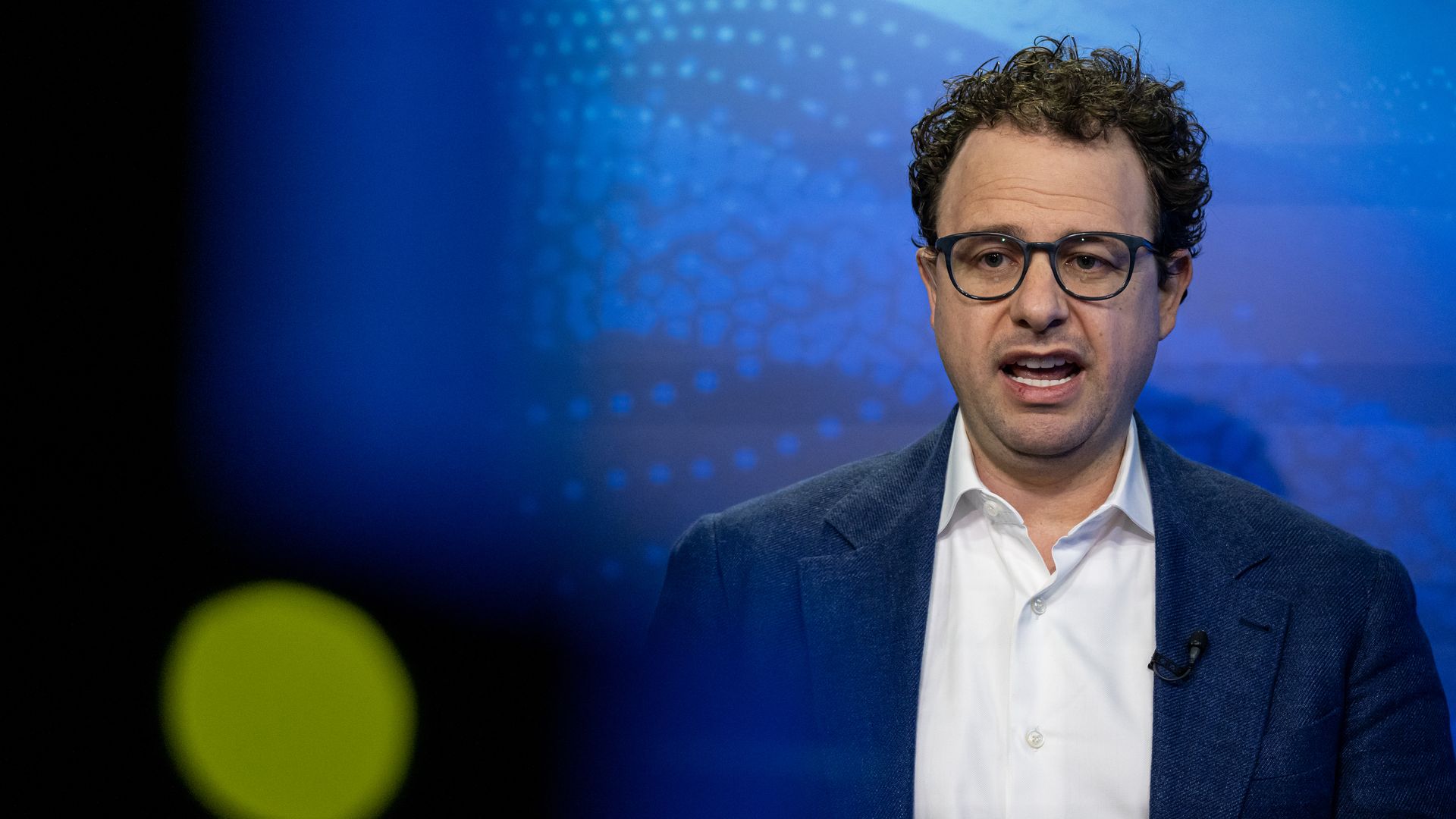
The White House and Anthropic are in active discussions about deploying the AI firm's powerful new model, Mythos Preview, within the federal government despite ongoing efforts to blacklist the company as a supply chain risk, sources familiar with the discussions tell Axios.
Why it matters: Anthropic is in a bitter feud with the Pentagon, but even U.S. officials who dislike the company concede that it's building tools that could aid U.S. national security — or harm it, if they fall into the wrong hands.
- Plus, Anthropic CEO Dario Amodei is scheduled to walk into the West Wing today for a meeting with White House chief of staff Susie Wiles.
Driving the news: Anthropic is only rolling out Mythos to a select group of companies and organizations, rather than the general public, so they can assess its frightening cyber capabilities and harden their defenses.
- Some government agencies want to join that club, and the White House and Anthropic are discussing the terms under which that might be possible.
- In response to queries from agencies as to whether they are able to use Mythos, the Office of Management and Budget sent out an email, first reported by Bloomberg, saying it was looking into the matter.
- Two sources told Axios there are ongoing discussions with Anthropic, and agencies may get access to Mythos in the coming weeks.
4. Faith leaders ask Congress to limit AI weapons

Faith leaders are calling on lawmakers to pass binding legal safeguards to ensure that humans, not machines, control AI-enabled weapons.
Why it matters: A cross-faith coalition is stepping into the debate over how AI will reshape warfare as Congress considers guardrails for military AI.
What they're saying: "Every great faith tradition teaches us that the taking of a life is a grave and solemn act," 20 religious leaders wrote in a letter shared first with Maria.
- "As a matter of conscience, we believe that such a decision must never be delegated to a machine."
The big picture: The Pentagon's use of AI sparked widespread concern after tensions with Anthropic over the company's red lines around autonomous weapons and mass surveillance.
- "Existing internal Defense Department policy requires that autonomous systems allow commanders to exercise 'appropriate levels of human judgment,' but this guidance is both ill-defined and can be changed at any time by the Secretary of Defense, without congressional approval," the faith leaders wrote.
- The letter was sent to the chairs and ranking members of the Senate and House Armed Services Committees.
What we're watching: Congress is gearing up to debate the annual defense policy bill, a potential vehicle for AI guardrails and guidance.
5. The Output: London moves, jobs and more

Here's our guide to catch you up on the AI policy news you may have missed this week:
🇬🇧 London AI calling: Anthropic is ramping up its London footprint with plans for a new office space for 800 staffers, while OpenAI announced it's setting up a new permanent London hub despite setbacks to its Stargate project, per CNBC.
🌏 Asia policy tracker: Digital in Asia has a new policy tracker to help keep tabs on Asia's AI governance landscape.
💼 Job risk findings: Our Axios colleague Courtenay Brown reported on a new study by OpenAI that found workers whose jobs are most vulnerable to automation — data-entry keyers, bookkeepers and more — are already using AI for three times as many of their relevant tasks as workers in less-exposed jobs.
Thanks to Mackenzie Weinger and David Nather for editing and Matt Piper for copy editing.