What Davos' CEO interviews signal about the future of media


Add Axios as your preferred source to
see more of our stories on Google.
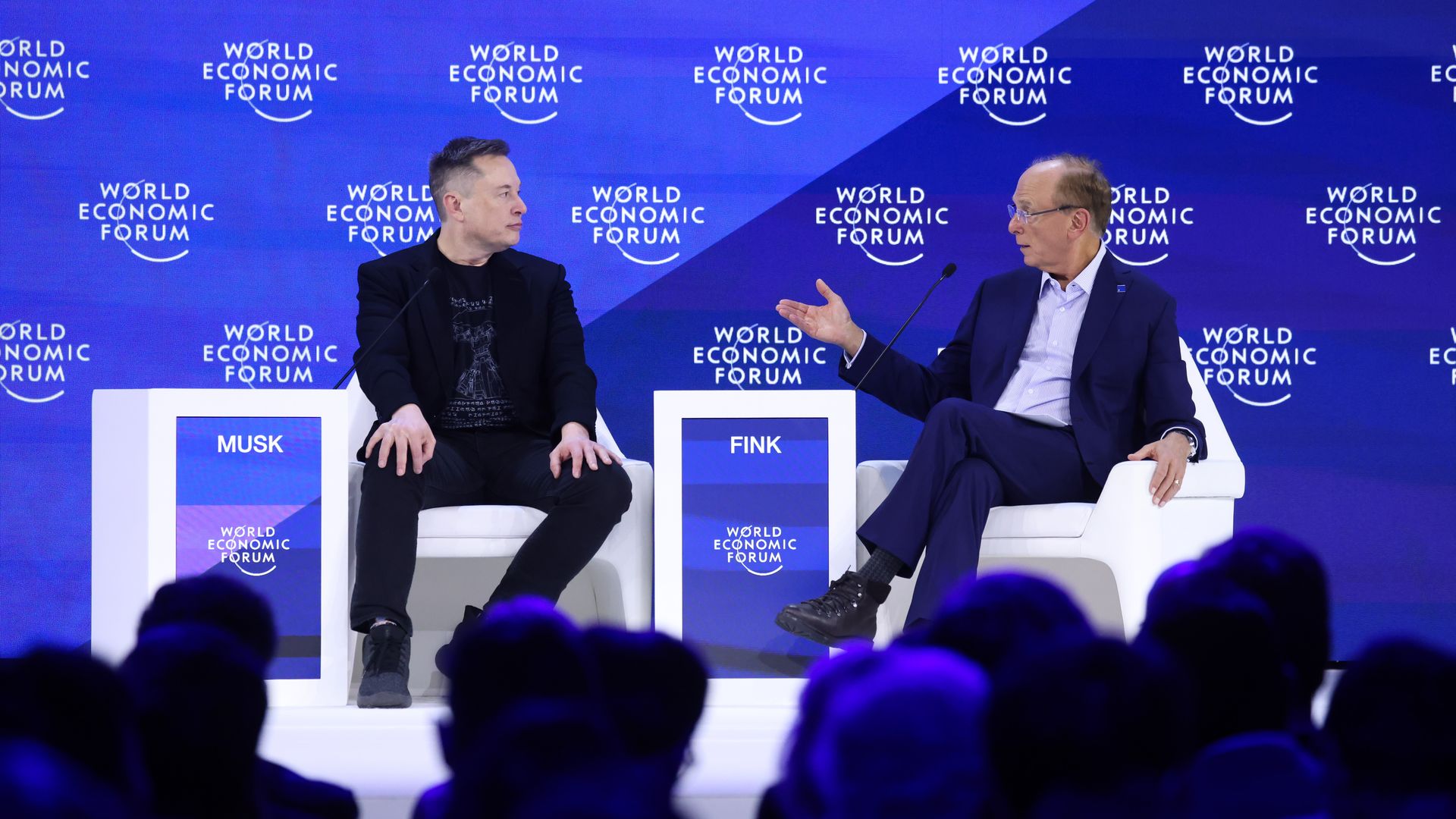
Tesla CEO Elon Musk speaking with BlackRock CEO Larry Fink at the World Economic Forum. Photo: Krisztian Bocsi/Bloomberg via Getty Images
Larry Fink, CEO of BlackRock, moderated two of the biggest interviews at Davos this year, with Nvidia CEO Jensen Huang and Tesla CEO Elon Musk.
Why it matters: It's part of a growing trend: Add an interview with a CEO or even a new media podcast to your appearance list.
Driving the news: Fink began his Musk interview explaining the positive stock performance of Tesla, encouraging pension funds in the room to invest in the company.
- That came after he asked the audience to cheer for Musk a second time because there "was not a large applause" when they first walked on stage.
- This follows Fink's interview with Huang in which he also mentioned the returns of Nvidia since it went public.
- While mentioning a stock's performance is typical in a traditional interview led by a journalist, telling an audience to invest in a specific company would not be acceptable.
Zoom out: This is part of a growing trend of opportunities for celebrities, podcast hosts and executives to conduct interviews instead of journalists.
- Influencers and comedians are increasingly tapped to conduct red carpet interviews.
- David Rubenstein, billionaire founder of the Carlyle Group, has a long-form interview show on Bloomberg Television.
- Meanwhile, Stripe co-founder John Collison hosts a podcast called "Cheeky Pint" in which he interviews CEOs and founders in a bar setting over a beer and executives from OpenAI rotate hosting its long-form podcast.
Between the lines: These platforms allow CEOs or founders to reach targeted audiences with conversations that a traditional news media outlet might not entertain.
- "If I'm a CEO, I can just go directly online and just post whatever I want to say. I don't need to go and announce it to the rest of the world via CNN," Masha Angelova, senior editorial producer at the U.S. Chamber of Commerce and previously a booker for networks like CNN and Bloomberg, told Axios.
- Angelova has noticed executives now seem to prefer a longer conversation with a peer over a short TV interview.
Zoom in: They also prefer talking to subject matter experts.
- "We're pure enthusiasts for the stuff that we talk about," TBPN co-host Jordi Hays said at a recent Axios event. "And so being insider-y just means that it's the conversations that we enjoy having."
- "People might say we don't try to do gotchas around politics, and we've, like very much, avoided political content. ... We will push people on their margins," he added, saying that conversation is more interesting to him and the show's audience.
Yes, but: Executives are still doing plenty of traditional media interviews with traditional journalists.
- A tech executive told Axios they spent about 60% of their time in Davos on media and external appearances.
What they're saying: "Starting a podcast is a lot of work, and it's not realistic for most companies," says Emilie Gerber, founder of the public relations firm Six Eastern.
- "Producing a good show, landing strong interviews, and building an audience is hard. Brands shouldn't over-optimize on going direct —appearing on existing podcasts and engaging with traditional media still delivers meaningful reach and credibility, with far less effort."
What to watch: It's not enough to just do the interview. There must be an intentional distribution strategy as well — video clips that can be posted across X, TikTok, LinkedIn and Instagram Reels.
- As Axios previously reported, social media platforms are expanding to TV due to the fact that people are spending more time watching short-form videos from their couches.
The bottom line: While more executives are turning to different formats for interviews (or doing the interviewing themselves), there's still an appetite for the kind of interview and coverage legitimacy that news outlets can provide.
More on Axios:
