Axios Communicators

August 22, 2024

👋🏻 Hi there!
- 📬 I'm looking for story ideas as we head into the final weeks of summer. Send your ideas, feedback, tips, etc. my way: [email protected]
Today's newsletter is 1,652 words, a 6-minute read.
1 big thing: Bracing for DEI backlash
Corporate executives and boards are ramping up communication efforts to prepare for attacks from activists linking business performance to DEI policies.
Why it matters: For some public companies, it is not a matter of if these politically motivated attacks will come, but when.
Catch up quick: Harley-Davidson and John Deere have walked back their commitments to diversity, while Tractor Supply has pulled the plug on diversity and environmental efforts following a social media campaign led by conservative activist Robby Starbuck.
- As part of the anti-DEI campaign, the activists have scraped the social media accounts of executives and board members in search of comments about LGBTQ+ rights, sustainability and DEI.
State of play: To prepare for this new type of professional doxxing, boards are sharing more about their operational decisions and personal credentials with investors, employees and consumers.
What they're saying: Board members often seek to challenge management and provide robust oversight, says Townsend Belisle, founder and CEO of strategic communication and production company Haystack Needle. Ironically, though, they might be the ones facing challenges because of their online presence, or lack thereof.
- Belisle says the business of monitoring and enhancing the digital footprint of board members has doubled in the past year.
- "Controlling and managing digital reputation is crucial for executives as their public image can significantly impact their career and the organization they represent," he said. "If they don't control their own personal narrative, others will."
The big picture: Right-wing activists have now forced a reversal of policies for three major American brands, and this will likely emboldened them to target others.
- There has also been an uptick in activist investors challenging ESG and DEI-related policies.
Between the lines: Some companies are more susceptible to anti-DEI pressures than others, says Gravity Research president Luke Hartig.
- "Any B2C brand with a conservative-leaning consumer base should definitely be worried, while brands with a more progressive consumer base are generally safe because the base is not as receptive to the anti-DEI arguments," he added.
Yes, but: Going back on a commitment — or appearing wishy-washy — is likely to damage corporate reputation.
- "This can be the kiss of death because it alienates everyone," one crisis communications expert said.
By the numbers: The decisions by Tractor Supply, John Deere and Harley-Davidson to revoke DEI policies have garnered more attention than the attacks coming from its top critic.
- The policy reversals saw 77% more media mentions and roughly 40% more social media interactions than Starbuck's initial anti-DEI campaigns, according to Newswhip data shared with Axios.
Reality check: Research continues to show that companies with diverse workforces outperformed their less diverse competitors by an average of 29% per year.
- Plus a majority of employees (56%) believe that diversity in the workplace is a good thing, per a Pew Research study.
What to watch: In the same way companies have started to change how they tout ESG, they are also starting to change how they talk about DEI.
2. Exclusive: OpenAI names Hannah Wong as CCO

OpenAI is elevating its communication function by naming Hannah Wong as its first chief communications officer, the company told Axios first.
Why it matters: The AI company continues to roll out new technology at a rapid pace, amid heightened regulatory scrutiny and pushback from creatives, news publishers and Hollywood.
Context: Wong, who joined OpenAI in 2021 from Apple, will continue to report to CEO Sam Altman and will oversee media relations, internal communications, strategic messaging, events, brand design, social media, community and talent partnerships.
- The communications team — which had just eight members when ChatGPT launched — has been quietly expanding and now boasts more than 50 people across the U.S., Europe and Asia.
- "We prioritize finding 'T-shaped' people who are talented generalists but also have deep expertise in their specialized areas," Wong told Axios.
What they're saying: OpenAI's communication team is challenged with explaining these technological advancements in a way that all audiences can understand.
- "Regardless of who we're really trying to reach, we must use broad, simple language, knowing that this is going to impact everybody's lives in different ways," says Wong.
State of play: Because 92% of Fortune 500 companies are using OpenAI's tools and 100 million people actively use ChatGPT on a weekly basis, the company and its executives are often looked to as the de facto spokespeople for the entire AI industry, says Lindsey Held, head of public relations at OpenAI.
- "We are trying to do a lot more in terms of educating how to use these tools," she said.
- "It's less futuristic and scary if you understand the tangible value, and so we're constantly thinking about how we do that increasingly globally, as we learn together, just given that this [technology] is advancing by the week."
- A tangible way the OpenAI comms team uses ChatGPT is with prompts like: "poke holes in this argument," "tighten this sentence" or "critique this statement from the perspective of [audience]."
Of note: Anthropic is also strengthening its bench of communicators — specifically those focused on tech and product communications — to help better explain its AI tools.
What's next: OpenAI researchers have said they are closing in on AI that can perform human-level "reasoning."
- Wong and her team will have the job of explaining what that means.
3. PR burnout on the rise

Check on your communication friends and colleagues, because half of them have considered quitting their job due to burnout, according to a new report from Muck Rack.
- Why it matters: The demands of the job — like the project workload, "always on" mentality and tight deadlines — have caused 44% of PR professionals to quit this year.
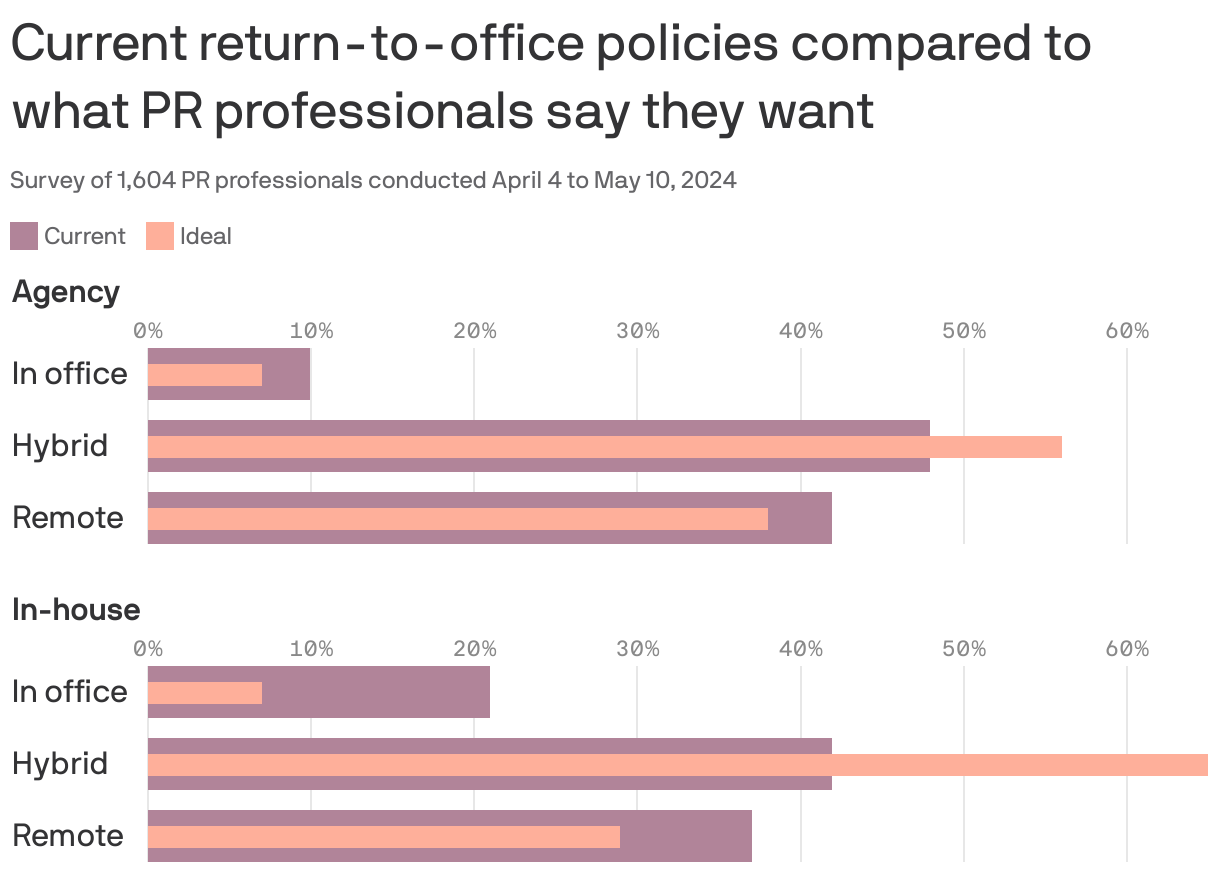
By the numbers: Muck Rack surveyed 1,604 PR professionals from April 4 to May 10, and found that burnout is consistent across both brands and agencies, and also across seniority levels.
- 75% of those who work in agencies report high stress and most commonly report stress levels at an 8 out of 10.
- Meanwhile, 71% of those who work in-house report high stress levels, with 6 being the most common rating.
Zoom in: Another factor in work-life-balance is the return-to-office battle that is still ensuing between employer and employee.
- According to the report, a majority of in-house and agency communicators want a hybrid work environment, but less than half report hybrid as the norm.
- Regardless of where their office is, roughly 8 in 10 are working outside regular business hours at least once a week.
What they're saying: "We know from our own experience that comms professionals are often expected to be available and responsive in ways that can really disrupt a sense of personal time and personal boundaries leading to a feeling of lost agency, a lack of care and a feeling of disempowerment," says Ethan McCarty, CEO of Integral.
4. Communicator spotlight: Cristal Downing of Merck

Cristal Downing is the chief communications and public affairs officer for the pharmaceutical company Merck.
- Why it matters: Her title doesn't fully encompass her role, she told Axios.
🔍 Zoom in: When I asked Downing to explain her job in the simplest terms — as if she was talking to my 5-year-old — she laid out five key responsibilities:
- Reputation protector: "I am responsible, along with my team, for protecting, defending and elevating the company's brand, its reputation and its profile."
- Culture shaper: "We are responsible for helping to shape and create a more favorable operating environment for the company."
- Truth teller: "We serve as the conscience of the company and that means that [we] bring to the table all of the expertise across corporate affairs, but within limits from an objective perspective. So we have the responsibility and the opportunity to be the truth tellers and ensuring that we are always aligned with our values, our principles and our moral compass."
- Mitigator: "There is an element of risk and we also are expected to help the company identify, mitigate or eliminate it where possible and certainly navigate it effectively and more successfully."
- Narrative builder: "We have the pleasure, the privilege, the responsibility to share news about this company ... and we do that through really powerful and profound storytelling."
🏗️ How it's structured: Downing reports to Rob Davis, chairman of the board and chief executive officer of Merck, and oversees a team of approximately 285 responsible for communications, public affairs and environmental, social and governance (ESG) efforts.
💡 Every CEO should know that communication is a strategic asset to the company.
- "We have a strategic framework and identified business objectives as a company, so my directive to the team is that anything and everything that we're doing must ladder up to them. If it does not, then you should not be doing it," says Downing.
5. 💡 Comms tip to-go
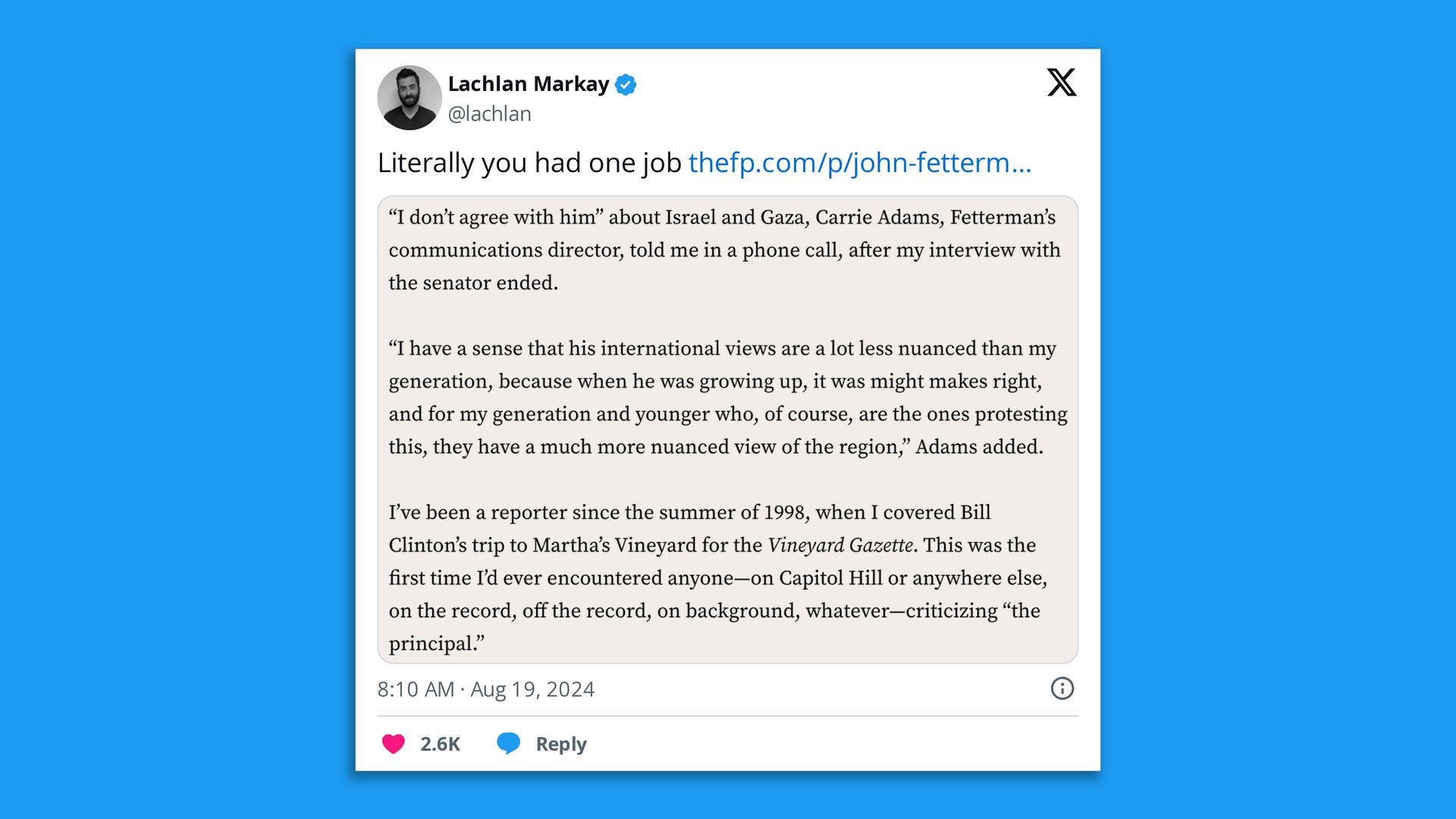
Given all the online chatter around Sen. John Fetterman's communications director going on the record to dismiss the Pennsylvania Democrat's foreign policies, I figured it was time to re-up this guide to media relations.
👀 Why it matters: I see PR pros — from interns to chief communication officers — get this wrong every day.
Context: In the U.S., all parameters should be agreed to ahead of time by both parties.
- On the record: Everything said can be shared, quoting the source by name, title and affiliation.
- On background: The information can be shared without naming the particular source, but affiliation, rank or position can be used — for example, "a spokesperson for the company said …"
- On deep background: The information can be shared, but how its attributed is often vague — such as "According to a source … " — and should be carefully discussed.
- Off the record: Information stays between the reporter and the subject. It cannot be used for publication.
- Embargo: A great tool for sharing complicated, data-heavy reports ahead of launch — but there must be a conversation first. Blasting embargoed materials is bad form.
- Exclusive: The story, news or opportunity is given to one, single outlet.
✅ Thanks for reading! And extra thanks to editors Nicholas Johnston and Kathie Bozanich.
Was this newsletter forwarded to you? Subscribe or become an Axios Communicators Pro member today.
Sign up for Axios Communicators