Axios China

January 24, 2024
Welcome back to Axios China. Today we're looking at the high-altitude balloons China sent near Taiwan this week, plus a weakening yuan, Hollywood films falling flat in China, and lots more.
- New here? You can subscribe to receive Axios China in your inbox every Wednesday.
Today's newsletter is 1,578 words, a 6-minute read.
1 big thing: China steps up Taiwan pressure campaign with more balloons

Illustration: Shoshana Gordon/Axios
China has sent a growing number of high-altitude balloons near Taiwan in recent days as it steps up pressure on the self-governing island after it held elections this month in defiance of China's claims of sovereignty.
Why it matters: It's part of a larger intimidation effort that Taiwan's Defense Ministry has called "cognitive warfare" — an attempt to weaken the resolve of Taiwan's residents and leaders and bring their behavior more in line with Beijing's will.
What's happening: China sent six high-altitude balloons near and over Taiwan earlier this week, the highest number reported in a day by Taiwan's Ministry of National Defense.
- The balloons come in addition to incursions by Chinese military planes and ships across the Taiwan Strait, which have occurred on a near-daily basis since then-House Speaker Nancy Pelosi visited Taiwan in 2022.
- China also sent a flurry of balloons over Taiwan just days before the country's presidential election on Jan. 13, when Taiwan elected current Vice President William Lai to be the next president. His victory gives the Beijing-skeptic Democratic Progressive Party (DPP) an unprecedented third straight term holding the presidency.
- Chinese officials had previously warned Taiwanese against voting for Lai.
Some view the timing of the balloons as an attempt to sway the minds of Taiwan's voters and to pressure Taiwan's government.
- "Balloons provide an additional way for China to challenge Taiwan's control of its air space," Bonny Lin, director of the China Power Project at the Center for Strategic and International Studies, told Axios.
- "Balloons also have more reach — China has also been able to send balloons directly over Taiwan without much response from Taiwan. In contrast, China has yet to send manned or unmanned military aircraft over the main island of Taiwan," Lin said.
- Taiwan's Ministry of National Defense has previously said its general policy has been to not shoot down the balloons. It has previously assessed some balloons as being primarily meteorological in use.
What they're saying: China has not commented on the balloons' function or purpose.
- "I'm not aware of the specifics you mentioned and it's not related to China's foreign affairs," Chinese Embassy spokesperson Liu Pengyu told Axios in an email when asked for more details about the balloons.
Between the lines: China is trying to walk a fine line between putting pressure on Taiwan and sparking a wave of public support for the DPP as it is still negotiating with two other political parties for control of the legislature, Raymond Kuo, director of the RAND Corporation's Taiwan Policy Initiative, told Axios.
- Because the balloons don't appear to carry munitions, they're a "relatively less escalatory way to put pressure while controlling the blowback," Kuo said.
Background: China's high-altitude surveillance balloons first drew major international scrutiny in February 2023, when a balloon passed over the continental U.S.
- The incident pushed U.S.-China relationship to its lowest point in decades. Secretary of State Antony Blinken canceled a planned trip to Beijing, and China refused to take a call from Defense Secretary Lloyd Austin after a U.S. fighter jet shot down the balloon once it reached open water.
- The U.S. said the balloon was "clearly for intelligence surveillance." The Chinese government has said the balloon was used for meteorological purposes only.
- Shortly after this incident, Taiwan and Japan revealed that Chinese balloons had also passed near their territory in recent years.
What to watch: "By flying balloons over Taiwan, Beijing leaves escalation space. In the future, they can increase by steps: first fly balloons, then drones, then fighter aircraft between 12 and 24 nautical miles from Taiwan's coast, then inside Taiwan's territorial airspace, and potentially next fly fighters over Taiwan," Bonnie Glaser, managing director of the German Marshall Fund's Indo-Pacific program, told Axios.
- "The Chinese likely want to ratchet up pressure gradually and leave options for future responses," Glaser said.
2. China is unable to invade Taiwan, most U.S. and Taiwanese experts say
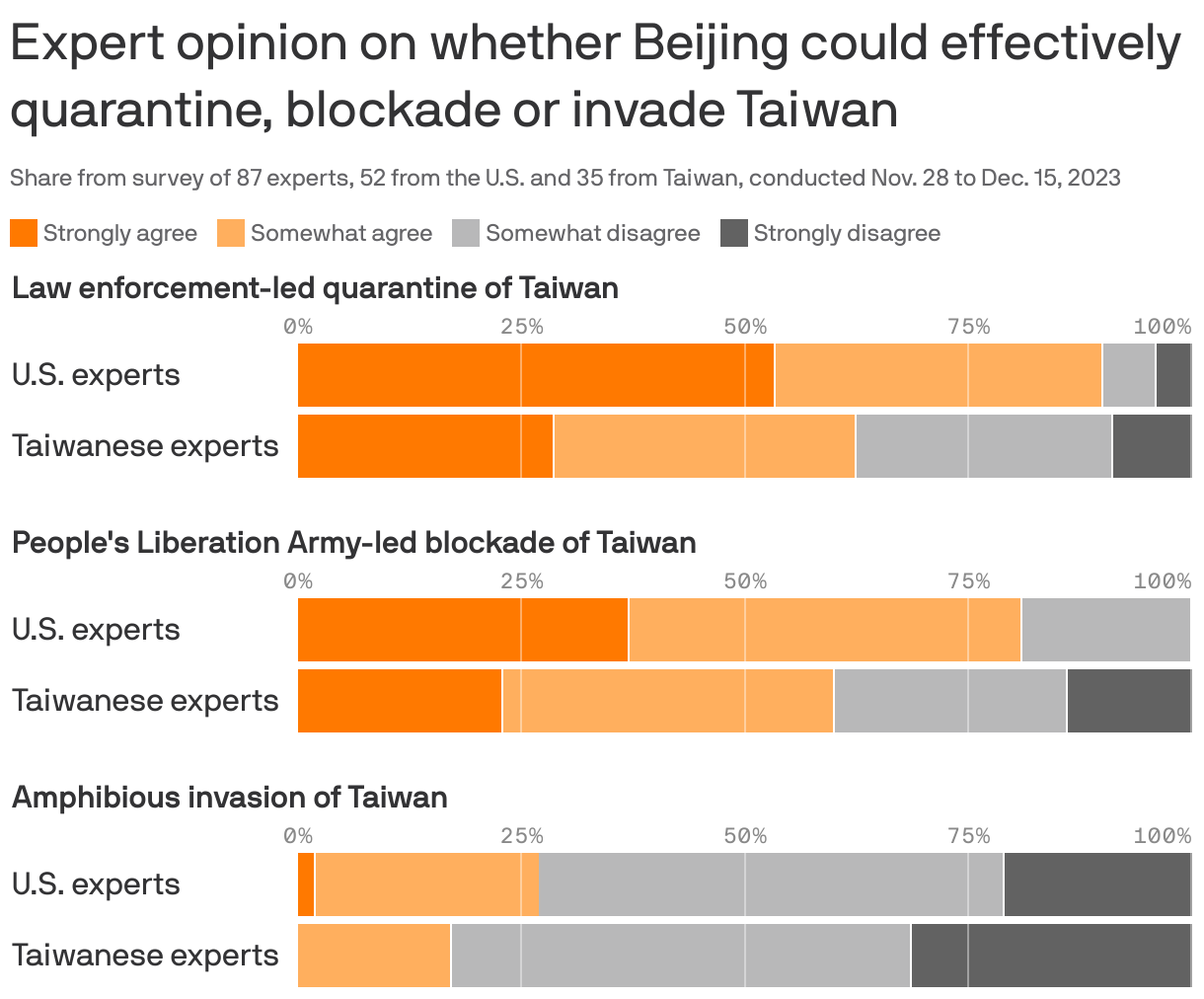
Most U.S. and Taiwanese experts polled in a new survey say China lacks the capabilities to effectively carry out an amphibious invasion of Taiwan but is well-positioned to execute a blockade.
Why it matters: China's growing aggression toward Taiwan has made the region a dangerous potential flashpoint and could trigger a military conflict between the U.S. and China.
Details: The survey, conducted by the Center for Strategic and International Studies' China Power Project and Taiwan's Institute for National Defense and Security Research, polled 52 U.S. experts and 35 Taiwanese experts.
- Just 26% of U.S. experts and 17% of Taiwanese experts agreed China has the military capability to effectively launch an amphibious invasion of Taiwan within the next five years.
- One reason for this assessment is that an "amphibious invasion would require a much larger commitment of military forces than a quarantine or blockade, and the operations involved would be significantly more complicated," according to the CSIS report.
Experts from both countries largely agreed China has the ability to carry out a quarantine or a blockade within the next five years.
- 90% of U.S. experts and 62% of Taiwan experts said China could enact a quarantine — a limited blockade targeting commercial rather than military activity that would be carried out not by China's military but by its coast guard or other law enforcement vessels.
- 80% of U.S. experts and 60% of Taiwan experts said China could execute a blockade, which would involve both commercial and military activity and be led directly by China's military.
Of note: Compared to the ratings of U.S. experts, Taiwanese experts overall had a lower threat perception toward China and they consistently rated China as having lower capabilities.
3. Catch up quick
1. Four UN experts have called for the release of jailed Hong Kong media tycoon Jimmy Lai, who is facing charges under the city's national security law due to his pro-democracy stance, The Guardian reports.
- The call came as China is facing a regular human rights review at the UN, which happens approximately once every four years.
- "We are seeking rulings from the UN special mechanisms that Mr. Lai's rights have been violated. China, as a UN member, should heed these calls and uphold its international human rights obligations which require that Mr. Lai be released," Jen Robinson, a lawyer for Lai, told Axios.
2. China's central bank cut reserve requirements for banks in a bid to bolster the country's struggling economy, CNBC reports.
3. The Department of Homeland Security executed a search warrant last week at the Ohio-based U.S. subsidiary of Qingdao Sunsong, a Chinese automobile parts manufacturer that a congressional committee has accused of trade fraud. Go deeper.
4. Currency weakness strikes China, but helps Japan


China's yuan and Japan's yen both slumped over the last year, with decidedly different outcomes for stock investors in the two Asian economic giants, Axios' Matt Phillips writes.
Why it matters: The divergent performance between Chinese and Japanese shares over the last year reflects the broader shifts in the global economy that have emerged post-COVID.
Driving the news: Japanese stocks hit a new 34-year high on Monday and are now less than 10% away from the boom-era high they touched in 1990.
- Meanwhile, shares in mainland China had another ugly day, with the Shanghai Composite index dropping 2.7%, the worst day since April 2022.
- The broad index of mainland shares is down roughly 20% over the last year.
Between the lines: One way to understand the difference between the two countries is by looking at the currencies. Both have fallen more than 10% against the dollar over the last two years.
Yes, but: In Japan, the decline of the yen has boosted corporate earnings and confidence in the country's traditionally important export business with the U.S.
- A weaker currency was also traditionally a boon for Chinese exporters too.
- But tensions with the U.S., where the Biden administration has kept Trump-era restrictions on some Chinese exports in place, means the impact of a weakening yuan won't do as much to help reinvigorate the struggling Chinese economy as it once might have.
The bottom line: If anything, the Chinese government has appeared concerned that the yuan's weakness might go too far, amid a surge of capital outflows from the country.
- On Monday, Chinese banks appeared to make organized moves to prop up the yuan.
5. What I'm reading
More belts, more roads: The Red Sea crisis proves China was ahead of the curve (Foreign Policy)
- "Geopolitical shocks from Red Sea maritime terrorism and the Russia-Ukraine war have driven up logistics costs and food prices," writes Parag Khanna, founder and CEO of Climate Alpha.
- "The solution to supply shocks is more supply chains. More belts, more roads. ... China is the one country that has known this — and acted on it — for years."
6. 🎬 1 movie thing: China losing interest in Hollywood films
Illustration: Sarah Grillo/Axios
Hollywood movies once dominated China's box office. But in 2023, none made the country's top 10 list, the New York Times reports.
- The shift away from U.S. blockbusters markedly increased in 2020, as U.S.-China relations took a nosedive amid the pandemic and growing strategic competition — and as China's domestic censorship and propaganda cranked up even higher.
- Some of the highest grossing films now are Chinese-made patriotic films depicting the heroism of China's military, often with the U.S. as a main adversary.
Flashback: It was once easy for U.S. film studios to make fortunes in China, as long as they were careful to avoid crossing any of the Chinese Communist Party's red lines.
- But now anyone who wants to make money in the Chinese box office "must study deeply to understand the Chinese market, Chinese audiences and Chinese pop culture," Shi Chuan, the Shanghai Film Association's vice chairman, told the Times.
A big thank you to Alison Snyder for edits, Sheryl Miller for copy edits, Matt Phillips for contributing, and the Axios visuals team.
Sign up for Axios China

Analysis and intel from Bethany Allen-Ebrahimian, authority on Beijing intrigue and intentions.

