Axios @Work

March 03, 2021
Welcome back to @Work. I'd love to hear from you via email at [email protected] or on Twitter @erica_pandey.
Today's newsletter is 1,497 words, or a 5½-minute read. First up...
1 big thing: The future of workplace benefits

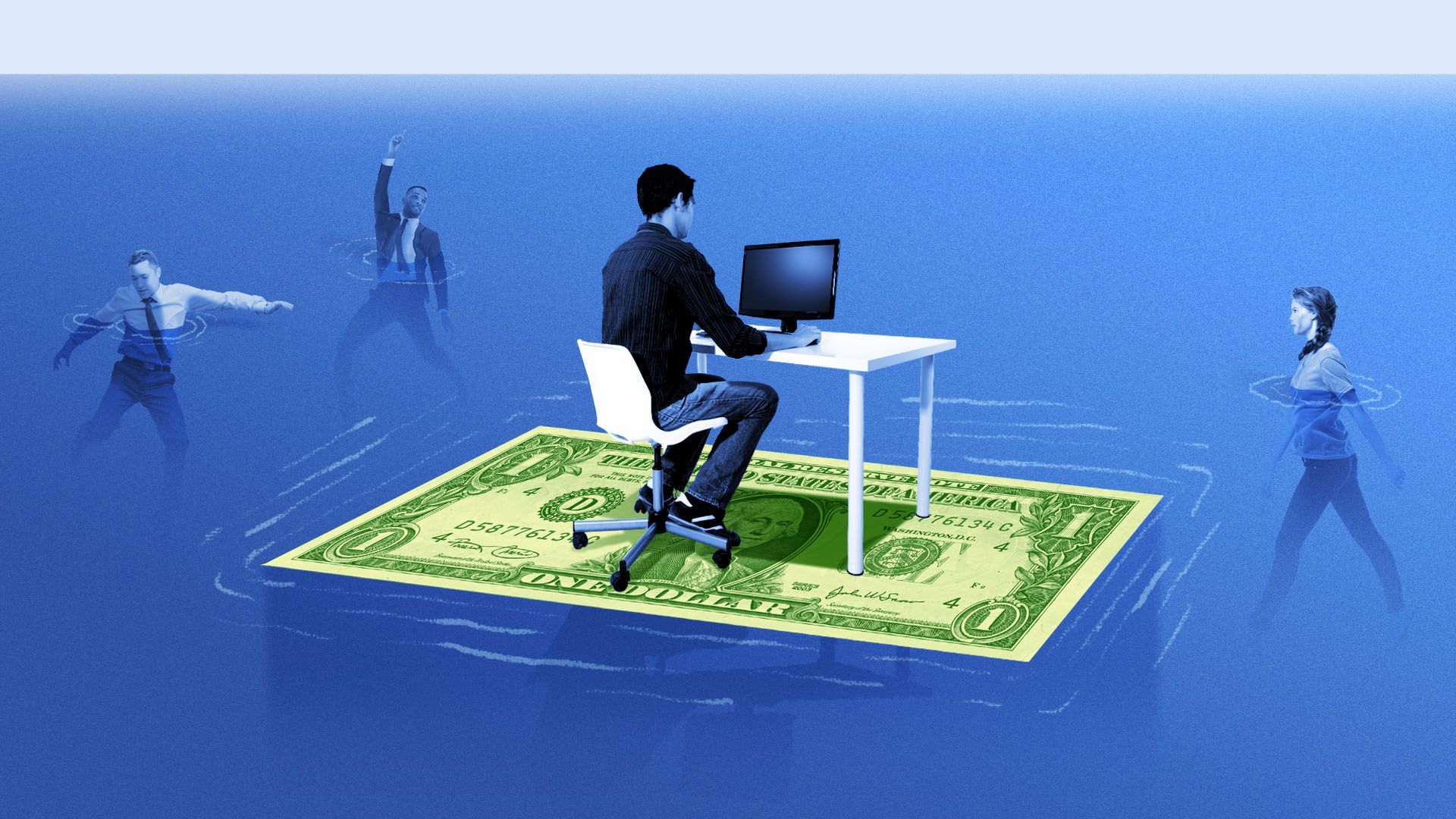
Illustration: Annelise Capossela/Axios
The pandemic exposed how workplaces across America are inhospitable to parents. But it could also spur companies to make changes.
The big picture: Well over a million parents have left their jobs due to child care responsibilities during the pandemic. Now, companies — large and small — are attempting to reimagine workplace benefits and add flexibility to help those parents come back.
What's happening: Kids are returning to school, but the damage has been done. Parents all over the country have dropped out of the labor force.
The crisis has been a wake-up call for employers.
- According to a new survey of human resources departments from Care.com, a whopping 98% of employers plan to expand their benefits.
- 66% are adding flexibility to help parents and other caretakers. And 63% are adding child care benefits.
Nick Mercadante, CEO of PursueCare, a Connecticut-based telehealth company, says the pandemic has emphasized how much caretakers juggle.
- "I didn’t realize it right away," he says. "I realized it because a couple employees were brave enough to reach out."
To help those employees, PursueCare bumped up its contribution to employees' flexible spending accounts in order to cover child care expenses.
- Mercadante has also let parents reduce work hours or adjust their schedules from the traditional Monday through Friday, 9-to-5 workday. And he has allowed them to take advantage of PursueCare's flexible paid time off policy to take days or even a month off to take care of kids or relatives during this stressful time.
- The goal was to do anything possible to make sure people didn't have to quit, he says.
- Much of corporate America shies away from offering so much flexibility — even saying working from home is "shirking" from home — but the pandemic has begun to tear down that thinking. "I feel like employers are afraid to let employees dictate how they work," says Mercadante. "But it's been fine. If anything, I’ve gotten more out of our folks."
And just as employers are offering flexibility, workers — especially women — are getting more comfortable with asking for it, according to a new report from AnnElizabeth Konkel, an economist at the jobs site Indeed.
- Konkel analyzed survey data from before and during the pandemic and found that women are now 10% more comfortable with asking for flexibility as it relates to work location and 4% more comfortable asking for adjustable schedules.
But, but, but: The parents who are able to even ask for this sort of flexibility work remotely in white-collar jobs or are in management roles, notes Konkel.
- It's typically the lower-income essential workers — who can't afford to miss paychecks — who aren't able to ask to work from a different place or at a different time.
- And while companies are figuring out ways to help their high-income employees, there is still no child care solution — from the public sector or the private sector — for America's most vulnerable caretakers.
Go deeper: The business case for child care benefits
2. Unpaid internships suck
Illustration: Sarah Grillo/Axios
We know unpaid internships keep scores of talented, cash-strapped students from gaining experience in industries like the arts and media, yet scores of internship opportunities continue to expect young people to work for free.
The big picture: Some 40% of internships at for-profit companies are unpaid. Many employers still see these summer jobs as a "rite of passage," but all they do is deepen class divides.
Driving the news: The prevalence of unpaid internships in media sparked an online debate yesterday after Jane Slater, a reporter for the NFL Network, tweeted in support of unpaid internships, saying, "There is a reason not everyone makes it in this business. I don’t have time for those of you who don’t understand grind."
- Her comment garnered responses from journalists around the country who shared their own experiences of having to get second or third jobs on the side in order to complete unpaid internships or having to forego meals because a summer gig wasn't paying.
The message was clear: Unpaid internships are only possible with a great deal of privilege. Students who can take these internships either have family money to pay rent and living expenses or come from wealthy universities that can provide hefty stipends.
- Those students are likely to be wealthy and white.
Why it matters: Unpaid internships are early exacerbators of inequality. When students can't find paid opportunities in the fields they want to work in, they choose different careers. As a result, the arts and media are overwhelmingly white.
The bottom line, per the New York Times' Astead Herndon: "[I]ve come to learn the ppl who think being broke for an unpaid internship was some fun or some necessary experience usually weren't broke. being broke is not fun. the people saying this were often playing poverty w/ in-the-wings family money — it was all heroes journey, no stakes."
3. Reddit's post-pandemic office
Reddit CEO Steve Huffman. Photo: "Axios on HBO"
The future of work at Reddit will be hybrid, CEO Steve Huffman told me in an interview for "Axios on HBO."
- "The only thing I know for sure is I am not going to be working in the office five days a week, and I'm not going to be working from home five days a week," Huffman said.
The big picture: Reddit has been surveying its employees, and "over a majority" say they want the flexibility to work from both home and the office, Huffman said.
- Some even say they want to be remote full-time and move out of San Francisco — a decision that's easier to make at Reddit than some other companies because Reddit has said it won't reduce employee pay based on local cost of living.
- That means you could live in the middle of the country and still make a Bay Area salary.
Between the lines: Reddit was in the process of moving offices when the shelter-in-place orders started last year.
- "Now we are reimagining this office as more of a collaborative space. So think a coffee shop, where people can come as individuals or as teams. They can work here as much or little as they like," said Huffman.
Stream the full interview, in which Huffman discusses GameStop and pornography on Reddit, on HBO.
4. Why Zoom fatigue hits so hard
Illustration: Annelise Capossela/Axios
"Nonverbal overload" may be the driving force behind Zoom fatigue.
- That's the energy expended from sitting in one spot and making prolonged eye contact, Stanford's Jeremy N. Bailenson writes in a new paper.
The big picture: Zoom exploded from 10 million users in December 2019 to 300 million during the pandemic.
- You can make those video calls better.
During in-person meetings, people are taking notes or glancing down or taking a second to gaze out the window. And they're not getting that close to one another.
- Extended face-to-face interaction is usually something we reserve for close friends and family, but Zoom makes us do that with everyone, every day, notes Bailenson.
On top of that, having back-to-back Zoom calls is like looking in a mirror all day, Bailenson writes. People are spending time and energy critiquing their appearances.
The bottom line: Don't rule out good old phone calls.
5. Worthy of your time


The pandemic-era e-commerce explosion (Axios)
- As e-commerce sales spiked during the pandemic, backroom warehouse labor rose to meet the demand. With more Americans employed in the warehouse sector, the quality of those jobs — and the effect automation will have on them — will be increasingly important.
Amazon's union drive gains high-profile support (New York Times)
- Speaking of e-commerce, the Alabama Amazon warehouse workers' union effort has caught the attention of NFL players, actors and Sen. Bernie Sanders. And this week, President Biden tweeted "one of the most forceful statements in support of unionizing by an American president in recent memory," the Times' Michael Corkery and Karen Weise write.
- The formation of a union at this Alabama warehouse would set the stage for Amazon unions all over the country.
Upended commute patterns should change transit plans (City Monitor)
- Our transit systems and travel projections for the busiest times on the roads were already outdated and the changes of the pandemic have made them even more obsolete. For example, the classic 9-to-5 workday is dying, and that should affect how we structure our public transportation, experts say.
Pennsylvania's unemployment system is failing parents (Philly Inquirer)
- Pennsylvania parents are being wrongfully denied unemployment insurance after leaving their jobs for child care during the pandemic, the Inquirer's Ellie Silverman reports. The issue has potentially impacted thousands in the state.
6. 1 not-so-fun thing: CEO house calls
Companies have been trying all kinds of different strategies to spice up Zoom meetings and bring the fun of office parties and retreats online.
- We've seen online mixology classes, magic shows, karaoke hours and more.
- The latest gimmick is home visits from CEOs, the Wall Street Journal's Chip Cutter writes.
Bryan Campbell, a software engineer in Austin, Texas, got a rude awakening one afternoon when he was on a company zoom and watched his CEO walking up to a house that looked a lot like his own.
- Sure enough, his CEO had arrived in person to deliver a trophy and a $1,000 check for winning an employee award.
- Campbell told Cutter he had to sprint to ditch his pajamas for real pants before opening the door.
The whole thing is incredibly thoughtful, but the pandemic-era workplace gimmicks might be going too far. Would you want your CEO to show up to your house unannounced?
Thanks for reading!
Sign up for Axios @Work

Explore the economic & social shifts upending the workplace by business reporter, Erica Pandey. Weekly - Tuesday