Axios AM

February 20, 2023
🇺🇸 Happy Presidents' Day! Smart Brevity™ count: 1,592 words ... 6 mins. Edited by Donica Phifer.
1 big thing: The debate over sentient machines
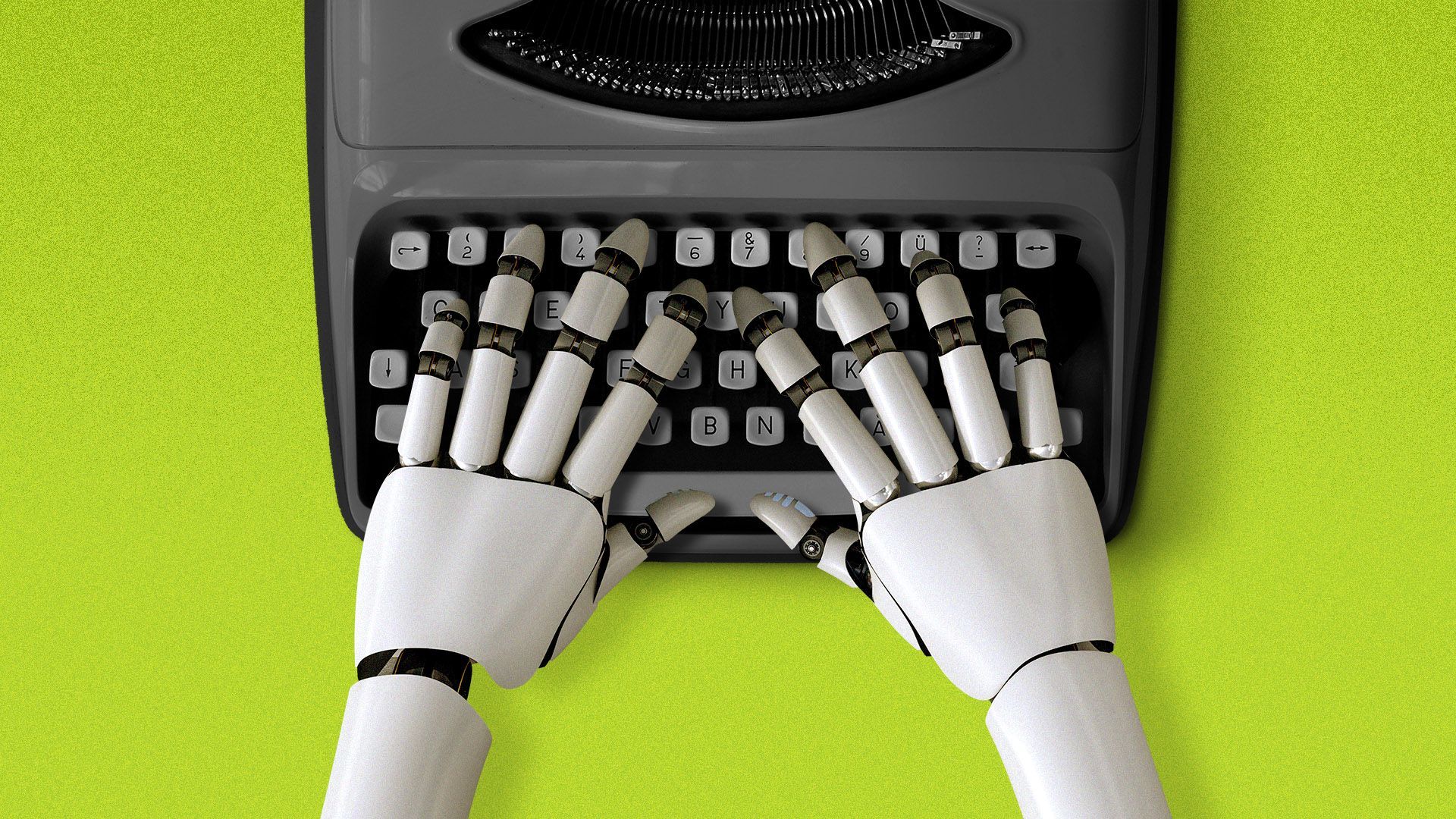
Illustration: Allie Carl/Axios
We've hit the science-fiction moment in the debate over generative AI, where people are warning of the human-like conversational skills of ChatGPT.
- Why it matters: ChatGPT, which ate the internet so it can spit out answers to human questions, isn't sentient — it's not self-aware. But even the early, imperfect, restrained version of the tech shows how easy human-like conversations and ideas are to replicate — and abuse.
The backstory: Jim VandeHei and I have spent the past week reading everything we can get our hands on about the tech, and talking to experts who understand it best.
đź’ˇ Our biggest takeaway: This is the most important tech breakthrough since at least the iPhone — and perhaps the internet itself.Â
- The ability of machines to devour billions of words written on the internet — then predict what we want to know, say and even think — is uncanny, thrilling and scary.
- You've read about tech columnists prompting creepy, human-like conversations with Sydney, the code name of Microsoft's new chat version of Bing.
đź” Zoom out: Right now we're getting only a small glimpse of the technology's full power. Google, for instance, has been hesitant to unveil and unleash its full generative AI because of its awesome and potentially dangerous capabilities.
- Even Microsoft and OpenAI are only giving some people limited access to a not fully formed version of its ChatGPT.
What's out there: An app called Replika bills itself as the "World's best AI friend - Need a friend? Create one now." A 24/7 friend for just $5.83/month! (The app is now trying to rein in erotic roleplay).
- A host of paid AI image generators — including Midjourney, and DALL·E 2 (which, like ChatGPT, is from OpenAI) — are now available.
- Many more services are on the way.
đź§ How it works: AI isn't sentient, but it sure seems like it. Here's why:
- The tools have devoured lots and lots of what sentient beings have written — and therefore can mimic human emotions, Axios' chief tech correspondent Ina Fried explains.
- Generative AI essentially scans previous writing on the internet to predict the most likely next words — infinitely.
The best article I've seen on the mechanics of ChatGPT is by Stephen Wolfram, who has studied neural nets for 43 years.
- The gist is that it's just adding one word at a time: "ChatGPT is always fundamentally trying to do is to produce a 'reasonable continuation' of whatever text it’s got so far, where by 'reasonable' we mean 'what one might expect someone to write after seeing what people have written on billions of webpages, etc.'" (Go deeper.)
What we're watching: The longer the Bing sessions went on, the more open the door became for creepy responses.
- Beginning last Friday, Microsoft said, "the chat experience will be capped at 50 chat turns [a user question + Bing reply] per day and 5 chat turns per session."
The bottom line: Computer science experts are much more concerned with how ChatGPT and its brethren will spread misinformation and perpetuate bias than with the AI being sentient or even superhuman.
- Bing isn't really happy or mad or in love. But it knows really well what humans sound like when we are.
Go deeper: "ChatGPT's edge: We want to believe," by Scott Rosenberg.
- All this week, our "AI revolution" series will explore the legal, ethical and practical ramifications of the new chatbots. Sign up here for Axios Login.
2. Big Tech's future is up to a court that doesn't understand it
Illustration: Brendan Lynch/Axios
The firestorm over Big Tech and content moderation is coming to a head at the Supreme Court — but some experts fear it's a job the court simply isn’t equipped to do well, Axios' Sam Baker and Ashley Gold report.
- Why it matters: The court historically hasn't been great at grappling with new technology. As it dives into the political battle over social-media algorithms, there's a real fear that the justices could end up creating more controversies than they solve.
The court is set to hear arguments this week in two cases involving Section 230, the federal law that says tech platforms aren’t liable for what their users choose to post.
- Both lawsuits — one against Google, and one against Twitter — argue that while tech companies may not be liable for the content of users’ posts, they should be liable for what their algorithms promote or suggest.
🖼️ The big picture: The Supreme Court is a slow-moving institution that tries to solve problems mainly by searching for one broad principle that can last forever. That's hard to square with complex, evolving technology.
đź‘‚ What we're hearing: The implications of these decisions may not be fully apparent for years, even to the engineers who work on the products.
- Even if Google and Twitter win, there’s a realistic scenario in which "the court still says problematic things ... that end up weaponizing the legal system against court moderation," Berin Szóka, president of the libertarian-leaning think tank TechFreedom, said during a roundtable with reporters last week.
Rulings are expected by this summer.
3. 🏛️ Scoop: Speaker gives Tucker access to 41,000 hours of 1/6 tape

House Speaker Kevin McCarthy has given Fox News' Tucker Carlson exclusive access to 41,000 hours of Capitol surveillance footage from the Jan. 6 riot, McCarthy sources tell me.
- Carlson TV producers were on Capitol Hill last week to begin digging through the trove, which includes multiple camera angles from all over Capitol grounds. Excerpts will begin airing in the coming weeks.
Why it matters: Carlson has repeatedly questioned official accounts of 1/6, downplaying the insurrection as "vandalism."
- Now his shows — "Tucker Carlson Tonight" on Fox News, and "Tucker Carlson Today" and "Tucker Carlson Originals" on the streaming service Fox Nation — have a massive trove of raw material.
Carlson told me: "[T]here was never any legitimate reason for this footage to remain secret."
- "If there was ever a question that's in the public's interest to know, it's what actually happened on January 6. By definition, this video will reveal it. It's impossible for me to understand why any honest person would be bothered by that."
🥊 Reality check: The Jan. 6 committee played numerous excerpts of the footage at last year's captivating hearings. (See the committee's archive.)
🔎 Between the lines: The process with Carlson started in early February, according to a communication between the show and a McCarthy representative that I was shown.
- The archive was previously reported to be 14,000 hours. I'm told it's now much more.
Flashback: McCarthy told reporters in Statuary Hall last month that he thinks "the American public should actually see all [that] happened instead of a report that's written [on] a political basis." (Video, beginning 10:50)
- Carlson last year called the attack an "outbreak of mob violence, a forgettably minor outbreak by recent standards."
4. 🇺🇦 Biden's secret visit to Kyiv

President Biden today made a surprise visit to Kyiv — his first visit to Ukraine since Russia's invasion nearly a year ago.
- The visit, four days before the war's one-year anniversary, is a major sign of U.S. support for Ukraine, Axios' Laurin-Whitney Gottbrath and Barak Ravid report.
Biden said: "One year later, Kyiv stands. And Ukraine stands. Democracy stands."
- Keep reading ... More photos.
5. đź§ł New data: Inflation means shorter trips
Illustration: AĂŻda Amer/Axios
Consumers are still traveling, despite high inflation, but they're seeking out cheaper trips, Axel Hefer, CEO of lodging search platform Trivago, tells Axios' Hope King.
- Instead of booking trips to Spain, global tourists are favoring cheaper destinations like Portugal, Morocco, and Turkey, Hefer noted.
Cost-conscious global travelers are trading down on lodging too — opting for well-rated two- and three-star hotels that offer a four-star experience.
- Trivago data also shows trips got shorter throughout last year.
6. Meta tests paid service

Meta, the parent of Facebook and Instagram, will begin testing a monthly subscription service that allows users to verify their accounts.
- The move is aimed at "increasing authenticity and security across our services," Meta CEO Mark Zuckerberg wrote in a Facebook post.
Why it matters: Meta Verified is the latest effort by Meta to experiment with a new business strategy as its advertising growth slows, Axios media trends expert Sara Fischer and Ivana Saric report.
Called Meta Verified, the subscription service will be rolled out this week in Australia and New Zealand, with other countries to follow.
- Meta Verified will be priced at $11.99 a month for web users and $14.99 a month on iOS.
7. 🇹🇷 Blinken in quake zone

Secretary of State Tony Blinken (right) and Turkish Foreign Minister Mevlut Cavusoglu tour the earthquake zone yesterday.
- The death toll in Turkey and Syria is nearing 45,000.
Blinken said: "We have nearly $80 million in donations from the private sector in the United States, [from] individuals. When I visited the Turkish Embassy in Washington, I almost couldn’t get in the front door because boxes were piled high."
8. 🤖 1 fun thing: Presidents à la Pixar

Dan Szymborski of Dayton, a baseball writer for FanGraphs, tweeted this Presidents' Day weekend "fun project: using AI, every US president as a Pixar character."
- Dan, who kindly gave me permission to share the image with AM readers, tells how he did it:
"I went through each president one by one, with about 40-50 runs per president, using Midjourney V4. When the AI still wasn't getting the right idea, I blended official photos/paintings into the mix, which usually got it to the end.
"Then I picked the ones that had some combination of being most recognizable and of the right art style without looking *too* crazy."
📬 Thanks for sharing your weekend with us. Please invite your friends to join.
Sign up for Axios AM

Catch up with the most important news of the day