Axios AM

October 09, 2026

πΆοΈ Happy Friday! Smart Brevityβ’ count: 1,666 words ... 6Β½ mins. Thanks to Erica Pandey for orchestrating. Edited by Bill Kole.
ποΈ Breaking: The Nobel Peace Prize was awarded today to former UN human rights chief Navanethem "Navi" Pillay, 85, a judge on the International Court of Justice, for promoting peace and international law. She was born in South Africa. Get the latest.
1 big thing: AI labs war-game "the day after"
Top executives at Anthropic, OpenAI and other AI companies are privately gaming out scenarios for "the day after" β a public and political revolt after a catastrophic AI event, Axios' Maria Curi reports.
- Why it matters: These officials anticipate a large-scale event, most likely a cyberattack, that shuts down access to financial services, internet connectivity, or even power and water.
π The risk: While scenario planning is common within many companies and national security settings β the Pentagon has been running war games for decades β the difference is that many top AI researchers and executives believe a major incident is inevitable.
- "OpenAI conducts preparedness exercises where teams discuss and work through a range of potential scenarios," a company spokesperson said. "These scenarios are not treated as inevitable, but are meant to help us prepare for a variety of circumstances."
- Anthropic declined to comment.
Zoom in: The blame game will start whether a rogue-agent swarm breaks containment from an internal testing environment or a bad actor finds unexpected ways to use available models.
- A recent campaign targeting South Korean financial organizations β including reported breaches at two banks β shows the damage a single person can do.
- A hacker from China allegedly used AI tools from China-developed models, including DeepSeek, to steal data from tens of thousands of bank customers. The attacker used Claude Code to ask for help finding places to sell the stolen data, according to cybersecurity firm CrowdStrike.
ποΈ Top AI planners assume Democrats, ascendant after the midterms, will move fast to shut down AI but will face significant challenges.
- An aging Congress, out of touch with the AI revolution, could find itself out of its depth.
- The global economy is now heavily intertwined with an AI infrastructure buildout. Slowing it down could hit an already fragile economy hard.
- Too many open-weight models exist that can already be freely downloaded and used to cause harm, a problem most cybersecurity pros see as solvable only by using AI to fight rogue AI.
Between the lines: Planning involves red-teaming for worst-case scenarios and racing to educate members of Congress.
- Company executives know regulation has no chance of passing right now, but still want to shape the legislation and policies U.S. leaders will turn to after a first catastrophic event.
- Some of the most heavy-handed Democratic proposals include banning superintelligence or pausing advanced AI development.
- Others have bipartisan support and even some industry buy-in, including a required kill switch on advanced AI. But experts have questioned the viability of trying to turn off all AI systems.
π¨ What we're watching: Many AI industry insiders told Axios they believe a major event will occur in the next six to 12 months.
- In a real crisis, Washington can set partisan differences aside. One Democratic aide pointed to cooperation during COVID and the 2008 financial crisis.
2. π³οΈ Fight night: Dems pile on Trump

President Trump wants midterms, 25 days from now, to be about him. Democrats couldn't agree more: In a trio of fiery Senate debates last night, the Democrats all glued their GOP opponents to Trump, his war and tariffs.
- Attacks in all three featured personal insults:
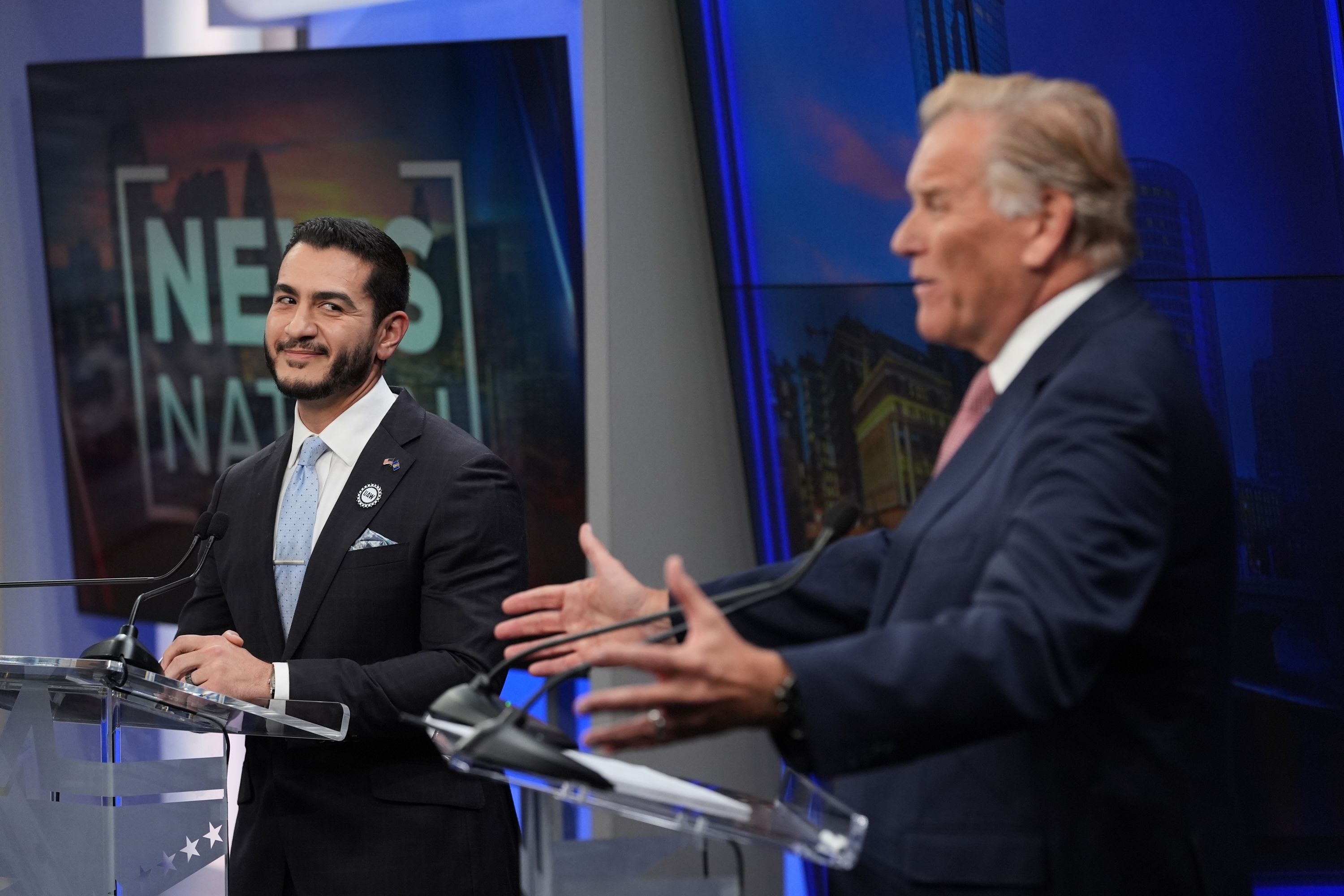
π In Michigan, former Rep. Mike Rogers (R-Mich.) and Democrat Abdul El-Sayed repeatedly traded personal attacks, talked over each other and even continued arguing during a commercial break. (AP)
- One of the most heated moments was during an exchange about Flock cameras: Rogers said they were useful for catching suspected terrorists, adding, "Why would that bother you? Well, if you have someone in your family that might be on the, on the watch list β¦"
- "El-Sayed, who is of Egyptian descent and would become the country's first Muslim senator if elected β and who has faced racist and Islamophobic attacks on the campaign trail β seemed to suggest in his response that Mr. Rogers was accusing him of being tied to terrorism," The New York Times notes. "Go ahead and say it," El-Sayed said. "You've been tiptoeing around it the whole time."
π In Georgia, Sen. Jon Ossoff (D-Ga.) and Rep. Mike Collins (R-Ga.) faced off in "an hour-long brawl dressed up as a debate," The Atlanta Journal-Constitution reports.
- Ossoff accused Collins of having a "childlike devotion" to President Trump and ties to white nationalists and neo-Nazis, saying, "You've hired half the Third Reich."
- Collins called Ossoff an out-of-touch "radical."
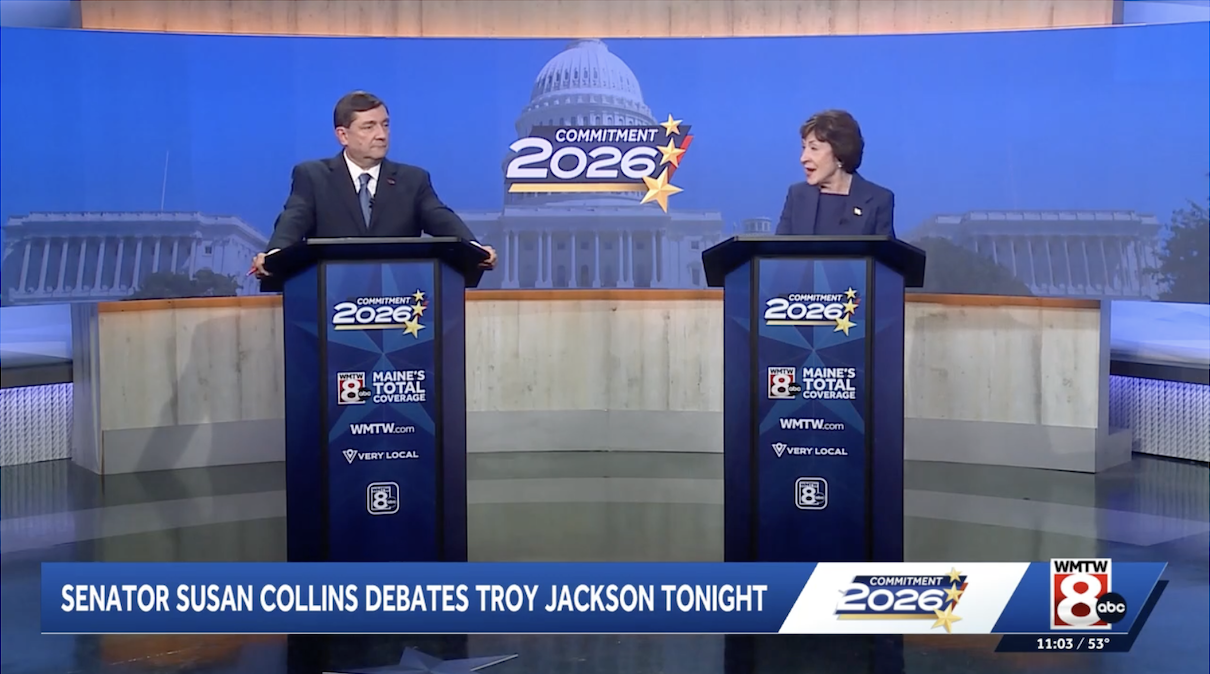
π¦ In Maine, Democrat Troy Jackson tried to tie Sen. Susan Collins (R-Maine) to Trump, while Collins tried to distance herself, as they sparred over the Iran war, energy costs and abortion rights.
3. ποΈ Dems weigh another Trump impeachment
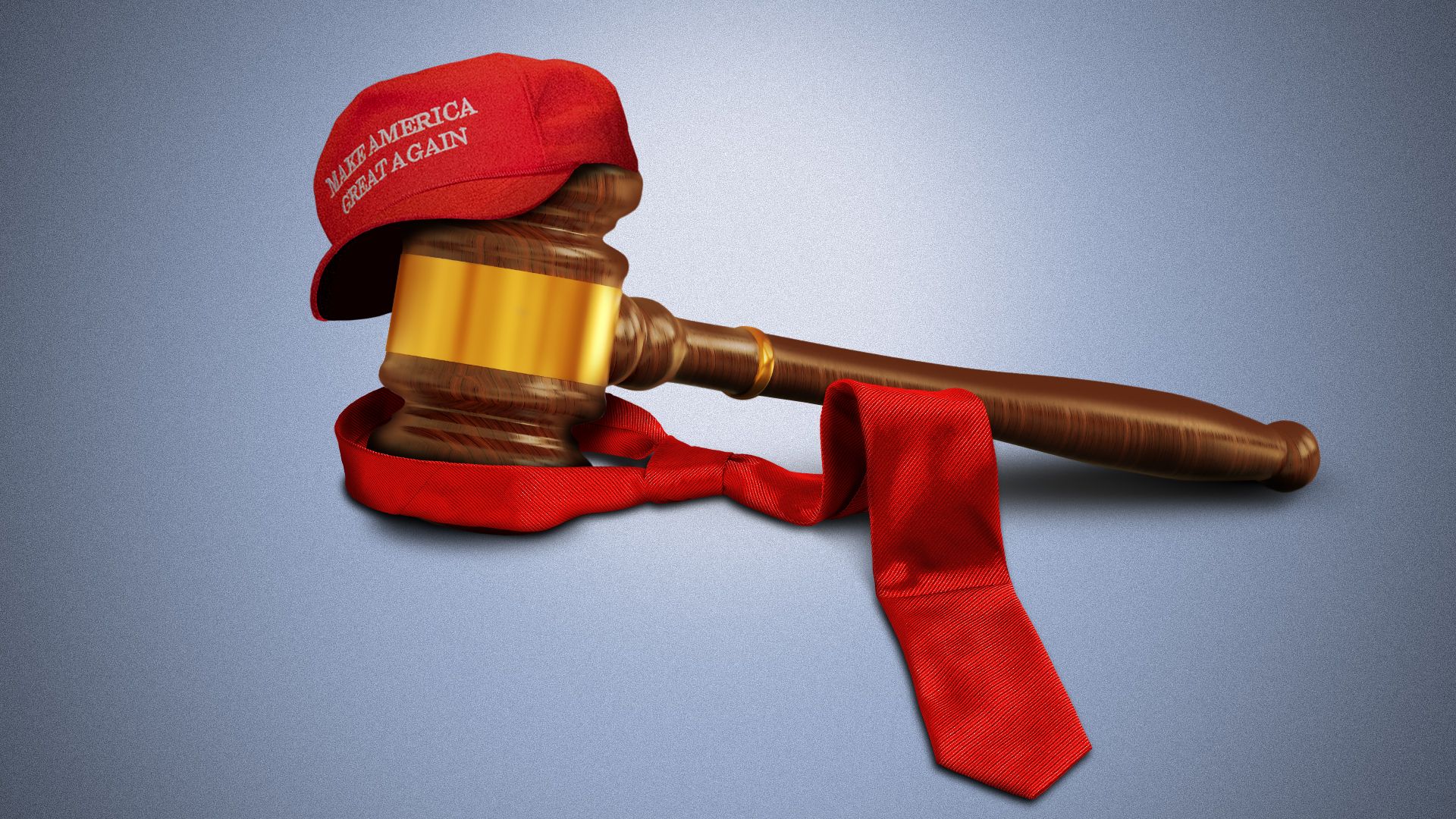
Democrats believe President Trump has committed impeachable offenses. But they're divided over whether they should try to impeach him if they win control of the House, Axios' Marc Caputo and Alex Thompson report.
- Why it matters: If Democrats win the House, as expected, their 2027 decision on whether to try to impeach Trump could have major consequences for the 2028 presidential race.
Rep. Jamie Raskin (D-Md.), who led the second Trump impeachment, following the Jan. 6 Capitol riot, said of impeachment: "[I]t is not a fetish with us ... On the other hand, it's definitely not a taboo."
- Raskin β who's in line to lead the House Judiciary Committee, which would be at the heart of any impeachment β said impeachable offenses could include going to war without congressional consent, imposing tariffs outside presidential authority and engaging in "unprecedented scales of corruption."
π Friction point: Many top Democrats note that Trump survived a record two impeachments in his first term β and that he'd be unlikely to be removed from office. That would require a two-thirds, bipartisan vote in a Senate that's likely to be closely divided.
- But Democrats' more progressive wing is already talking about an impeachment drive. Rep. Alexandria Ocasio-Cortez (D-N.Y.) told The Floridian in March: "If you are asking me if I support impeachment, I do. I think that it's on very objective grounds of following the law or not."
π What we're watching: Trump, who denies wrongdoing, is already preparing for his third impeachment. He told reporters Wednesday that he was "never even worried" about his first two impeachments.
- "I can do whatever I want, if I want," Trump said, calling the impeachments and subsequent criminal cases against him "very illegal things."
Deep down, Trump might welcome an impeachment, one adviser said, "because he's in his element in chaos and when he's being persecuted."
4. π¦Ύ Chart du jour: Data center dominance
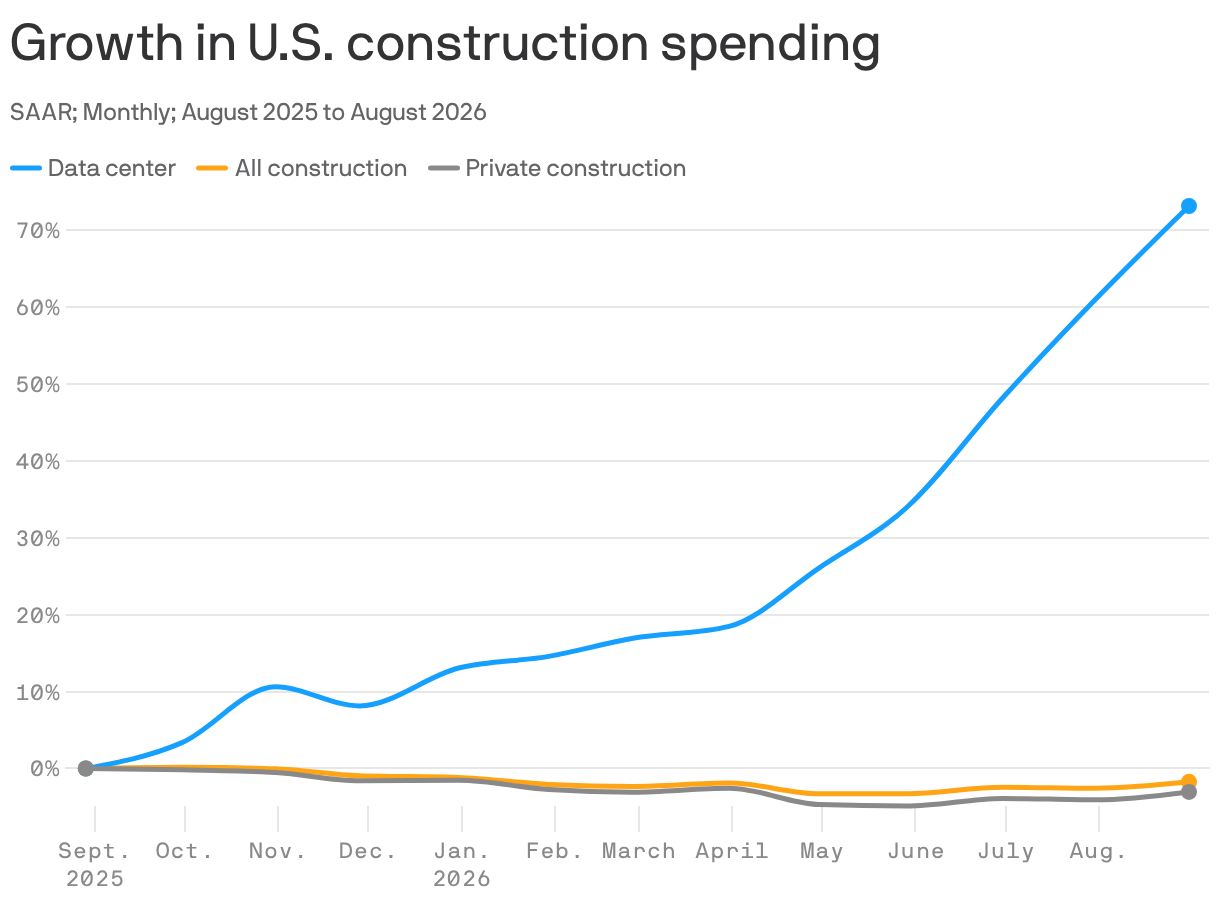
More and more, there's the AI economy β and everything else, Axios markets correspondent Matt Phillips writes.
- Why it matters: The growing chasm between the breakneck growth of the AI world and the slower pace of the economy where most Americans work and live has huge implications, especially for the markets.
The most recent numbers on U.S. construction spending through August β shown above β paint the picture remarkably clearly.
5. πΌ Immigration split-screen

The Trump administration said yesterday that it was suspending Microsoft from a key program used to sponsor employees for green cards.
- Later in the day, the administration honored the tech giant's CEO with a medal for innovation.
Why it matters: The split-screen highlights the tension between the administration's championing of Big Tech and its immigration policies, which constrain an industry that has long relied on hiring foreign-born workers, Axios' Emily Peck writes.
- Tech leaders have said that restrictions on hiring hamper the country's ability to compete β especially at a moment when the U.S. is in a race with China on AI.
Vice President Vance addressed the apparent contradiction at a press conference yesterday: "Our message to Microsoft is not that we want to harm your company; it's that we want your company to thrive, but we want it to thrive by employing and empowering your fellow Americans."
- Microsoft said 80% of the applications it submitted in the last fiscal year were to extend or change the status of existing employees β not to hire new people.
Read on ... Brittany Gibson contributed reporting.
6. π° The $167 voter
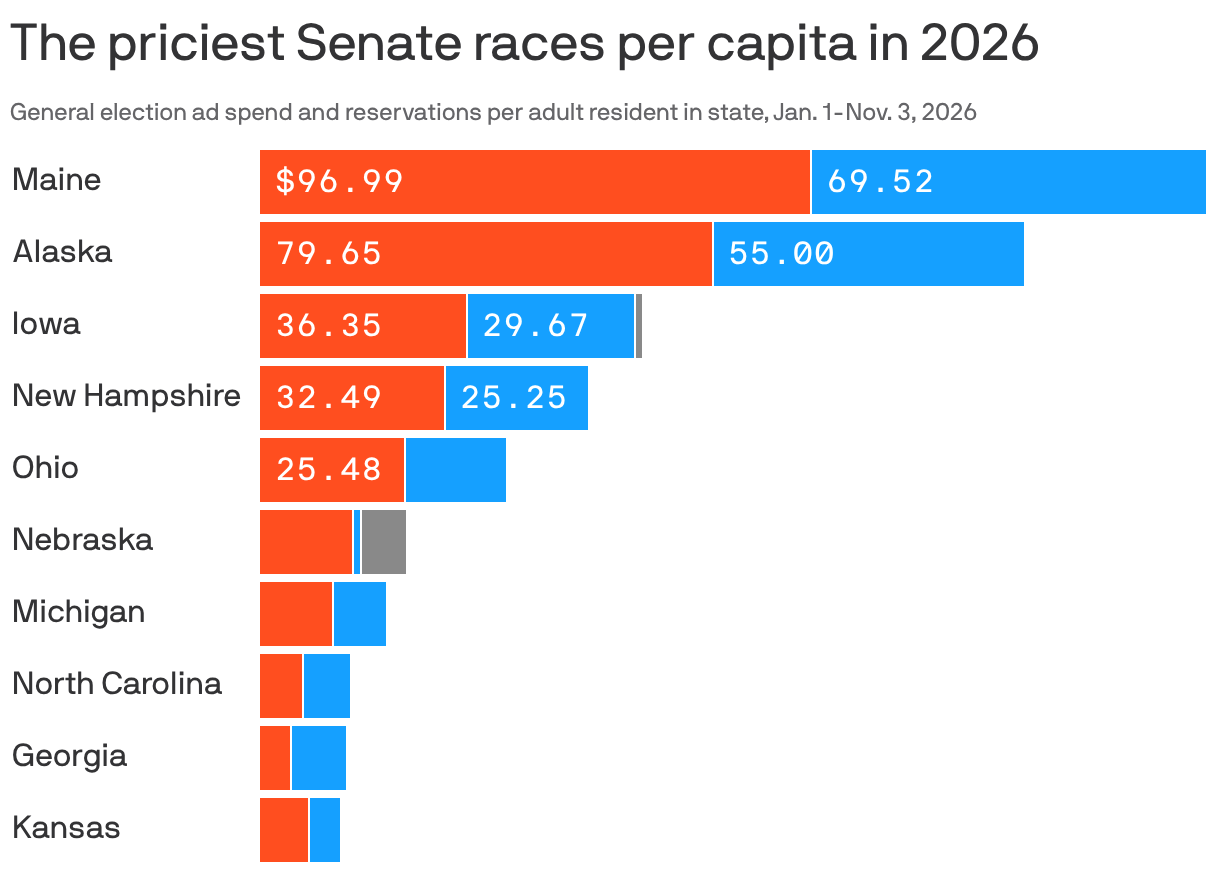
Every voting-age Mainer could get a $167 voucher for home heating oil with what Democrats and Republicans are spending on ads in the Senate race, according to an analysis of AdImpact data by Axios' Stef W. Kight and Hans Nichols.
- Why it matters: Every senator gets one vote, but Senate seats aren't created equal β and they don't cost the same.
π£ Zoom in: Like two years ago, the less-populated states have a dramatically higher dollar-per-voter ratio in 2026.
- Maine is in first place, followed by Alaska, which is scheduled to be hit with $76 million in ads β enough to suck up most of the state's inventory.
Ohio is in fifth place on the dollar-per-voter metric, but it's on track to host the most expensive Senate race in the country β for the second cycle in a row.
7. π Your state's craving

Reese's rules Halloween candy nationally β but some states have their own favorites, Axios' Sami Sparber writes from new DoorDash data.
- Sweet Smiles, a Dollar General brand that sells an assortment of sweets, stands out in seven Southern states.
- Laffy Taffy claims five states across the Midwest.
8. π 1 for the road: American Ironman

An Ohio native hopes to win one of the world's most grueling sporting events this weekend β before returning to Columbus to finish becoming a doctor.
- Matthew Marquardt wants to be the first American man since 2002 to win the Ironman World Championship, being held tomorrow in Kona, Hawai'i.
π©Ί Zoom in: The 28-year-old isn't just a professional Ironman athlete, Axios Columbus' Andrew King writes.
- He's also a Princeton graduate, third-year medical student and cancer researcher at Ohio State who's planning his postdoctoral residency.
- He rides with the initials of cancer patients he knows written on his bike.
Share this story ... Get Axios Columbus ... Find your Axios Local city.
π¬ Thanks for reading! Please invite your friends to join AM.
Sign up for Axios AM