Axios AM

July 24, 2026

1 big thing: AI titans' biggest private fear
Yesterday we told you why AI's biggest optimists reject doom scenarios. Today, the other side: what keeps the smartest minds in AI up at night.
We ask almost every AI architect and leader the same thing in private: What AI risk worries you most?
- Almost all of them fire back the same response: a killer pathogen, spreading too silently, widely and quickly to stop, Jim VandeHei and Mike Allen write in a "Behind the Curtain" column.
Why it matters: The rare agreement among AI experts flows from the belief these advanced models could help a bad actor create a deadly pathogen before the government and industry perfect detection and prevention systems.
- This isn't a likely scenario. It's simply a plausible one as AI gets better at understanding our biological vulnerabilities, much like it has our cyber ones inside large nonhuman systems.
Driving the news: The experts aren't hedging. In a new MIT FutureTech and University of Queensland study, 272 researchers ranked 24 top AI risks.
- They assessed a 12% chance that AI's dangerous capabilities produce a catastrophic outcome by 2030, and another 12% chance of AI-enabled weapons and mass-harm capabilities.
- And that's with mitigation efforts to reduce risk. Without those efforts, the chances exceed 20%.
- The researchers defined "catastrophic" as more than 1 million deaths or $100 billion in damage. Assisting with the construction of chemical or biological weapons sits squarely inside that top-ranked risk category.
🖼️ The big picture: We're not writing this to scare you, but to say bluntly what those building the technologies say privately — and, in more careful ways, publicly.
- Just last month, OpenAI's Sam Altman, Anthropic's Dario Amodei, Google DeepMind's Demis Hassabis, Microsoft's Mustafa Suleyman and Meta's Alexandr Wang cosigned an open letter warning of the risk of AI-derived bioweapons and calling for more safeguards.
This pathogen possibility colors every debate by the federal government and industry about how to review and understand new AI models and capabilities before they are released to the public.
- The hope is that the frontier model developers build guardrails and capabilities that can block bad actors with bad intent — and that the very technology that could be used to create a pathogen becomes advanced enough to prevent or inoculate against it.


Reality check: It's very hard to prevent bad actors from plotting evil schemes, especially with so-called open-source models improving so rapidly.
- These open models can be used and adapted by anyone in private settings outside of any regulatory regime.
- Open-source critics often make this very point, even though the frontier models are much more likely to possess the compute power to create something novel.
- So the better the models get, the more likely unthinkable things will happen, both bad and good.
🧪 How it might actually unfold: Today, engineering a genuinely novel pathogen requires rare expertise, specialized lab equipment, and years of failed experiments. AI expedites all of this. Here's the sequence that keeps experts up at night:
- A bad actor (whether state-sponsored or a well-resourced individual) uses a powerful model to map human biological vulnerabilities and identify which genetic tweaks make a known pathogen more transmissible, harder to detect, or immune to existing treatments.
- The model, trained on massive biological and genomic datasets, generates viable candidates. Imagine hundreds of the smartest scientists working at warp speed, never stopping, never tiring. That's what swarms of agents do.
- Those candidates get synthesized using increasingly cheap, accessible gene-editing tools, a separate technology accelerating with AI.
- The pathogen spreads before anyone knows what they're looking at, novel enough to slip past existing biosurveillance systems. By the time public health systems recognize it, containment is vastly harder than we experienced with COVID.
That's why you should pay attention to the debate over new cybersecurity risks created by AI. It illustrates the race to create effective detection and prevention faster than new offensive capabilities can emerge.
- It's also why you should track the open-source debate, too. A frontier lab can bake in guardrails. An open model fine-tuned by someone operating outside any regulatory regime can evade this.
The bottom line: This is heavy, scary stuff. But ignoring it won't solve it. Knowing it and preventing it will.
- 📈 If you're a CEO or on a CEO's team: Ask to join Jim's new weekly Axios C-Suite newsletter.
📱 Watch my interview in Texas this week with Nvidia CEO Jensen Huang ... Share this column.
2. 🌴 Darline Graham's uphill climb
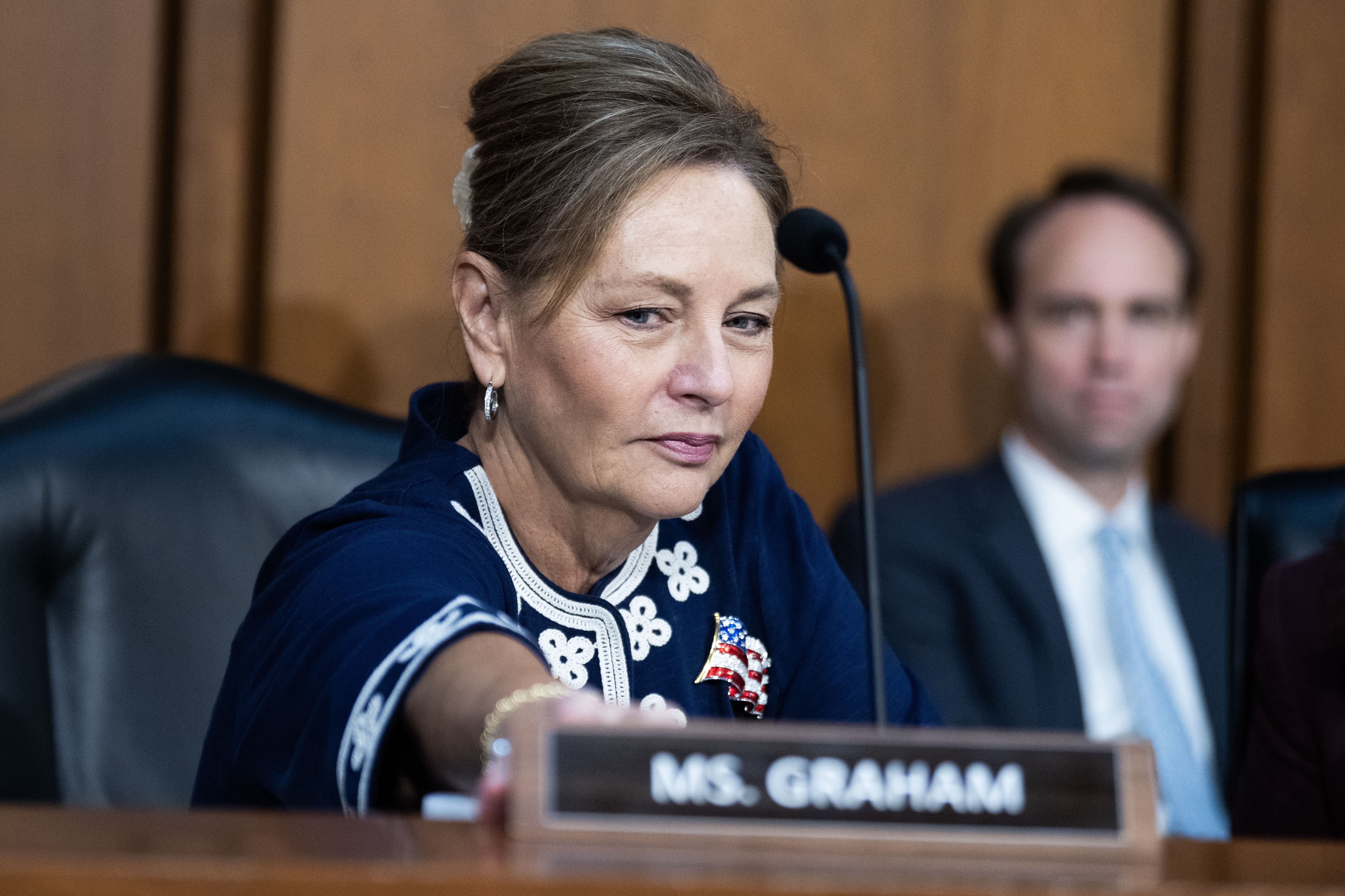
She has President Trump's endorsement and is a sympathetic figure after the death of her brother, Sen. Lindsey Graham. Even so, Darline Graham faces an uphill battle to win a full Senate term in November, Republicans in D.C. and her home state of South Carolina tell Axios' Alex Isenstadt.
- Why it matters: South Carolina's rapidly approaching Aug. 11 primary has become a test of whether those advantages are enough to carry the late senator's sister, a political novice, to a six-year term.
Skeptics throughout the GOP party are surprised Trump endorsed Darline Graham for a full term so quickly after Gov. Henry McMaster (R) picked her to serve the last few months of her brother's term. Trump "just likes her" is a common theory.
- She hasn't been endorsed for a full term by any Senate leaders or McMaster.
🔎 Zoom in: A half-dozen GOP operatives pointed to three reasons why all those advantages may not be enough for Darline Graham to get elected:
- The Graham name cuts both ways. Lindsey Graham never fully won over South Carolina's conservative base, which was skeptical of his bipartisan dealmaking, support for immigration reform and past criticism of Trump.
- She really is an unknown. The operatives and other Republicans say South Carolina voters know the Graham name — but not Darline Graham. Several early polls have shown Graham trailing in the GOP race.
- South Carolina's not big on succession. Trump's quick backing of Darline Graham while praising her brother has reinforced a perception that she's inheriting the Senate seat rather than earning it, several Republicans told Axios. The state has a long history of antiestablishment politics.
3. 💰 Trump rebuilds tariff playbook

The Trump administration announced a new round of tariffs of as much as 12.5% on 60 trading partners yesterday — preventing a lapse in import taxes as a temporary tariff program nears expiration, Axios' Courtenay Brown writes.
- Why it matters: It shows the White House's determination to sustain its tariff agenda as it turns to new trade laws as earlier authorities run their course or face legal challenges.
It has been one of the busiest weeks for Trump's trade agenda in months, from new tariffs on Brazil to fresh threats against Canada and now a broader new tariff authority.
🎨 The big picture: The tariffs stem from an investigation launched by U.S. Trade Representative Jamieson Greer in March into whether trading partners had failed to effectively block goods made with forced labor.
- Countries that have adopted a ban on forced labor but that the U.S. judges are not enforcing effectively will face a rate of 10%. Other nations' goods will be subject to a rate of 12.5%.
👓 Between the lines: Oil and gas, certain fertilizers and some food products are among the goods exempted, reflecting concerns about economic disruption.
4. ⚖️ Charted: Historic crime drop


Homicides are on track to hit their lowest rate in more than 125 years, according to a new report from the Council on Criminal Justice showing an 18% drop in killings across 30 cities so far this year — and a 31% decline since 2019.
- If the trend holds, homicides would fall below even last year's historic low — dropping to levels not seen since before 1900.
- Every major violent crime category — including carjackings, robberies and gun assaults — is down from pre-pandemic levels (charted above).
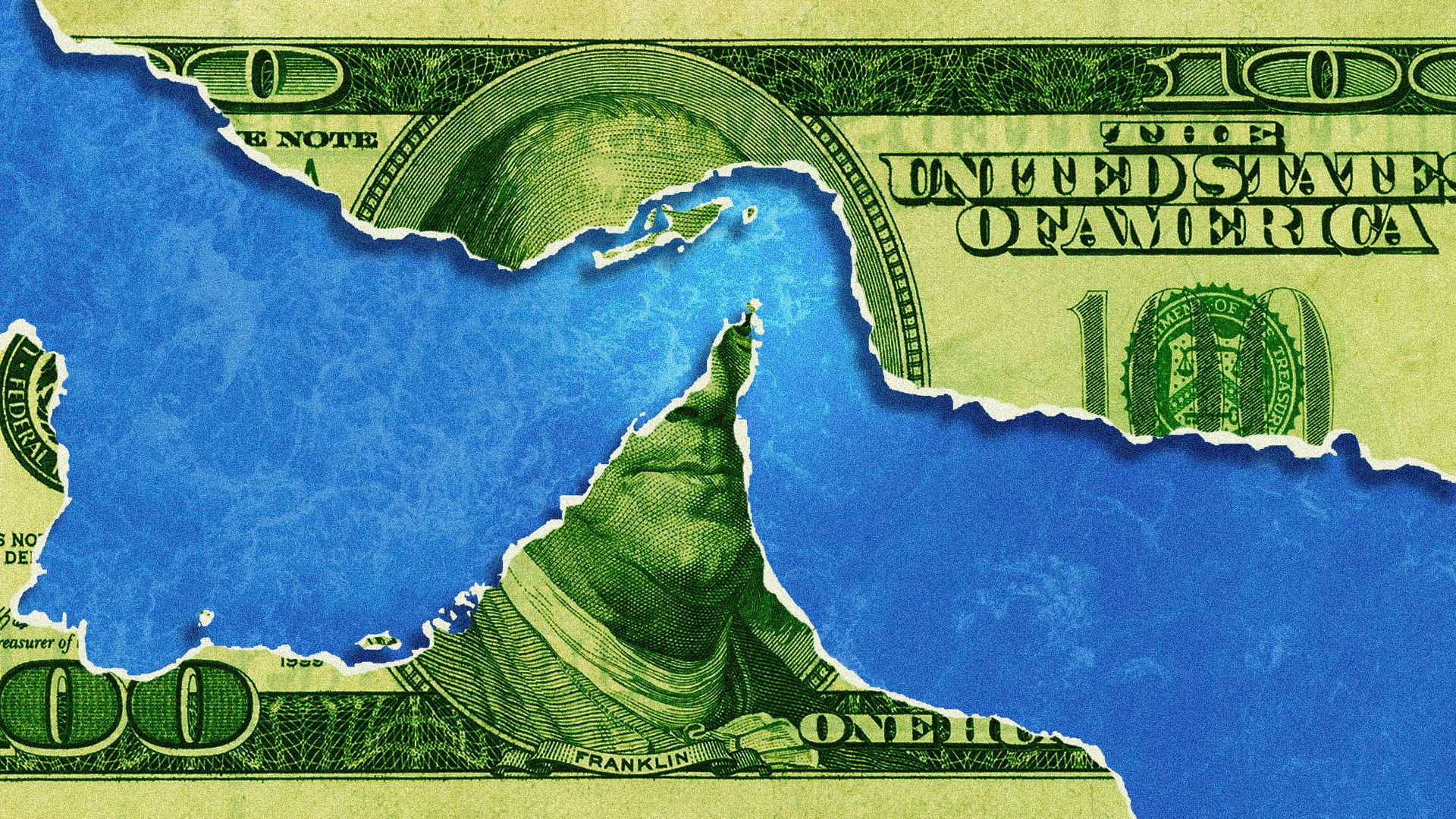
5. ⚓ Lingo: Choke point
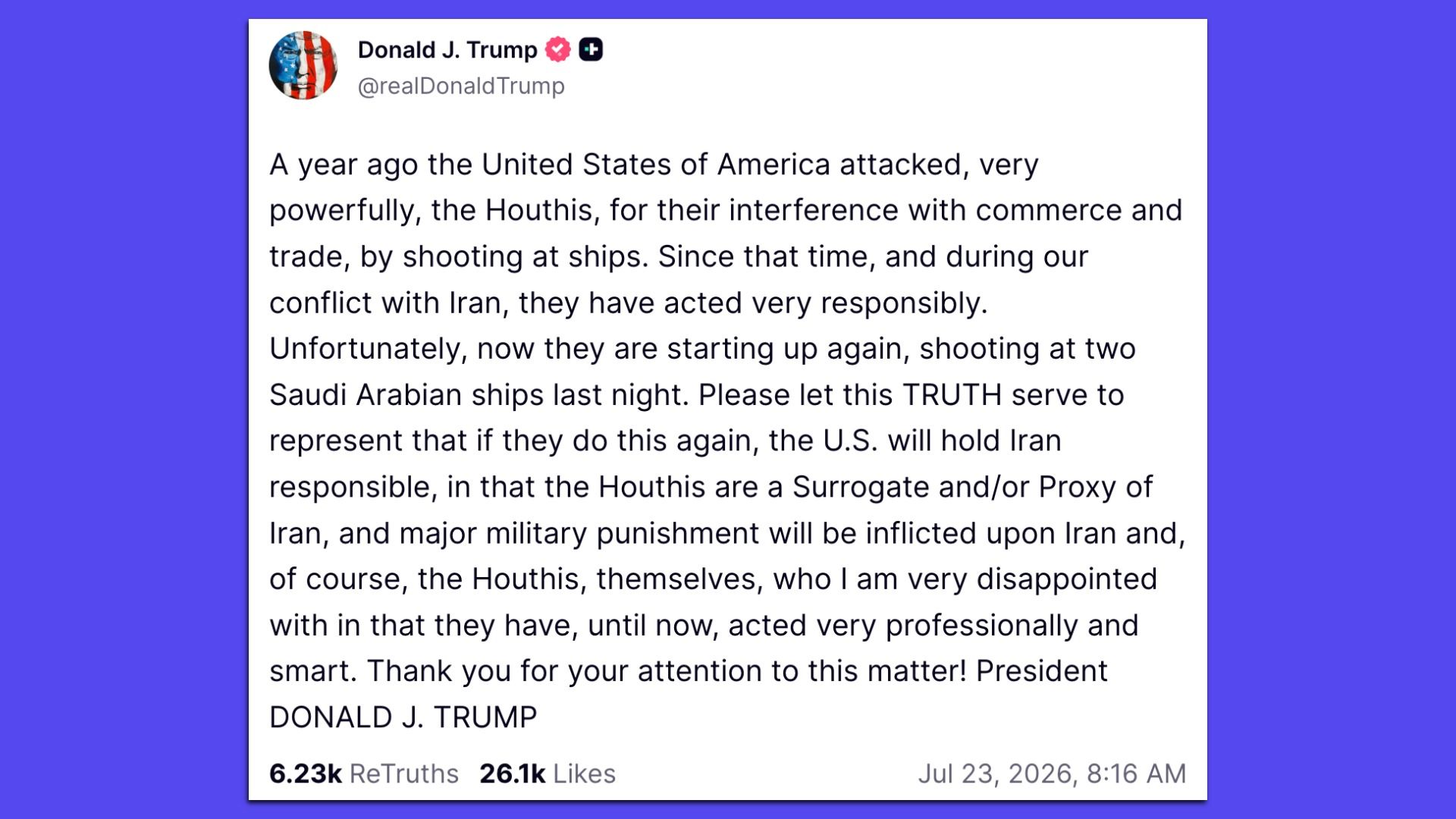
6. 🇸🇦 Trump's nuclear fine print
7. ⚡ Renewable power set to pass coal


Electricity generation from renewable sources is on track to surpass coal-fired power this year — an inflection point that shows renewables' rapid growth, Axios' Ben Geman writes from International Energy Agency data.
- Hydropower remains the largest renewables source, but solar is rising fast.
8. 🍿 1 film thing: Hollywood's $70 bucket

Popcorn buckets are becoming serious business for Hollywood and theater chains, The New York Times reports.
- The hottest buckets this summer are tied to Christopher Nolan's "The Odyssey": a $50 replica of his IMAX camera and a $70 Trojan horse.
AMC expects bucket sales to hit $100 million this year — nearly double 2023 levels.
- IMAX was initially skeptical but has sold out multiple releases of buckets, and estimates it moved 30,000 total.
Keep reading (gift link).
Axios AM