Axios AM

March 30, 2023

1 big thing — 🌵👢🐊 New data: Sun Belt boom

Texas was home to six of the top 10 largest-growing counties in 2022, according to Census Bureau data out this morning.
- The largest gainer was Maricopa County, Ariz. (Phoenix).
- The other three entries on the top 10 growth counties list (numerically, as opposed to percentage growth) were in Florida — Polk, Lee and Hillsborough counties.
Why it matters: America's shift in money, people and power to the Sun Belt — propelled by COVID — is continuing even as the pandemic eases.
📈 After the Phoenix area, the second-biggest gainer was Harris County, Texas — home of Houston.
- Collin County, Texas, a northern suburb of Dallas, ranked third in numeric population rise between July 2021 and July 2022.
📉 The two largest counties in numeric decline were L.A. County and Cook County, Ill., where the county seat is Chicago.
- But those also remain the most populous U.S. counties, followed by Harris County, Texas (Houston).
Two megatrends, from a Wall Street Journal analysis of the data:
- "Big cities lost fewer residents last year as more immigrants moved in." (This was evident in Manhattan, Seattle, Dallas and two South Florida counties, Miami-Dade and Broward.)
- "The suburbs of big cities and small and medium-size metropolitan areas continued to claim most of the country’s growth."
🏙️ Fun fact: Manhattan, which had a population decline of 98,505 in 2021, rebounded by 17,472 in the year ending July 2021.
- See a U.S. map: Percentage change in county population, '21 to '22 ... More data.
2. Chinatowns resist gentrification
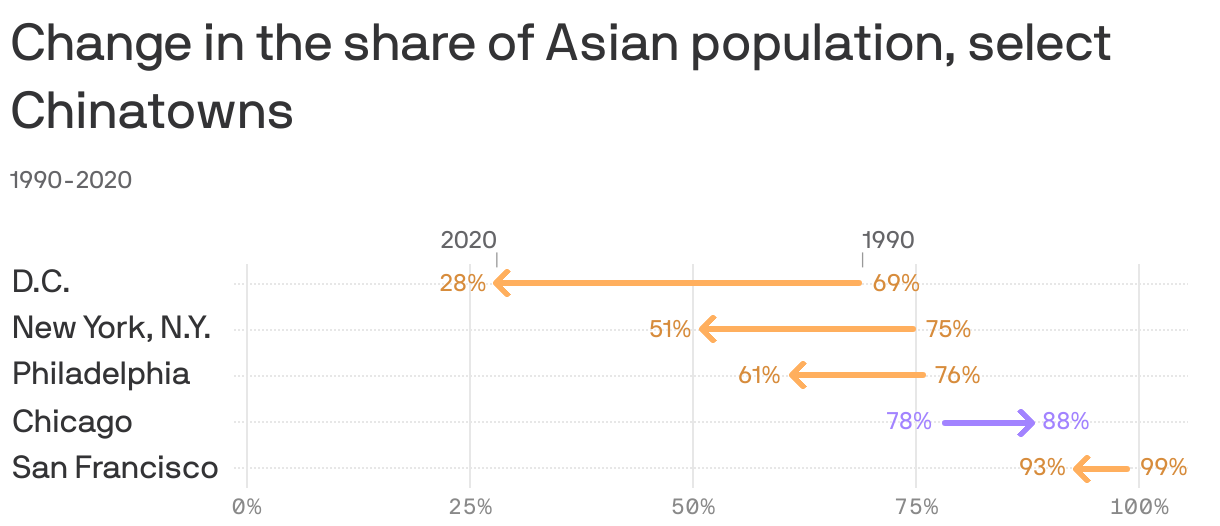 Open embedded content from datawrapper.dwcdn.net
New development is threatening some of America's oldest and largest Chinatowns, Axios' Shawna Chen, Megan Rose Dickey and Keldy Ortiz report.
- Why it matters: Chinatowns have been ethnic and cultural markers since Chinese immigrants first arrived in the U.S. But many are shrinking — or completely disappearing — amid urban development and gentrification.
Some locals fear the Philadelphia 76ers' proposal to erect a new arena on the southern border of the city’s Chinatown could drive out existing businesses — much like D.C.'s basketball arena did.
- San Francisco's pricey real-estate market is pushing out droves of long-time residents, and that's seen as a threat to the nation's oldest Chinatown.
- Residents in Manhattan's Two Bridges neighborhood have sued to try to stop a new development there.
3. Chinese surge at Mexican border


Thousands of Chinese migrants and asylum seekers have arrived at the U.S.-Mexico border in recent months, and many more are heading north after passing through the treacherous Darién Gap jungle between Colombia and Panama, Axios' Han Chen and Stef Kight report.
- Why it matters: It's another example of people from well beyond the Americas seeking refuge in the U.S. through the southwest border — and reflects the backlash to President Xi Jinping's harsh domestic policies.
🧮 By the numbers: During the first two months of this year, nearly 2,200 Chinese nationals have crossed into Panama through the thick jungle of the Darién Gap, according to migration data from Panama's government.
- That's more than the 2,000 Chinese migrants who made the trip in all of 2022 — which itself was a huge jump from the 77 counted in 2021.
Context: There has long been Chinese migration at the southern border, going back to the 1980s.
- But the numbers have ticked up in recent months because of a variety of factors, including the reopening of China's borders.
Chinese nationals are granted asylum at a relatively high rate in the U.S. — 58%, according to recent government data. That's compared to an average of 10% for asylum seekers from the Northern Triangle, which includes Guatemala, Honduras and El Salvador.
4. 🔮 Inside the Axios What's Next Summit

The latest innovation from rapper-producer Timbaland could make you rethink what's real.
- Timbaland told Axios' Hope King at our second annual What's Next Summit that he's considering incorporating a fictitious AI influencer known as Lil Miquela into his next musical endeavor.
What's happening: TikTok, with its attention-grabbing algorithm, has revolutionized how people discover new tunes, Timbaland said.
- 🎵 Timbaland's favorite artists now: Brent Faiyaz, Steve Lacy and Young Miko.

YouTube is finding its way from your phone into your living room, the company's "largest and fastest growing screen," CEO Neal Mohan told Axios Media Trends expert Sara Fischer at the summit.
- Mohan said he's excited about the company's first big push into sports. YouTube TV will become home to the NFL's Sunday Ticket package.
5. 🦾 AI's great "pause" debate

Illustration: Shoshana Gordon/Axios
6. Head of Nashville school ran toward trouble

Katherine Koonce, 60 — head of The Covenant School in Nashville, who was killed in Monday's shooting — was a rare female leader within a male-led religious culture.
- "If there was any trouble in that school, she would run to it, not from it," her friend Jackie Bailey told AP.
Koonce (photo top right) was one of six people killed in the shooting at the Christian elementary school, including three 9-year-olds — Evelyn Dieckhaus (photo above), Hallie Scruggs and William Kinney.
- Also killed were Michael Hill, 61, a custodian, and Cynthia Peak, 61, a substitute teacher (photos above).
Hill's family said in a statement: "We ... are so grateful that Michael was beloved by the faculty and students who filled him with joy for 14 years. He was a father of seven children ... and 14 grandchildren. He liked to cook and spend time with family."
- Nashville songwriter Natalie Hemby posted on Instagram that Peak, the substitute teacher, "taught me how to swim. Keep my head above water… which is what we're all trying to do right now."
Go deeper: Children lost in shooting were "feisty," a "shining light."
7. 📚 First look: Woodward-Bernstein cameo in Tapper's new novel
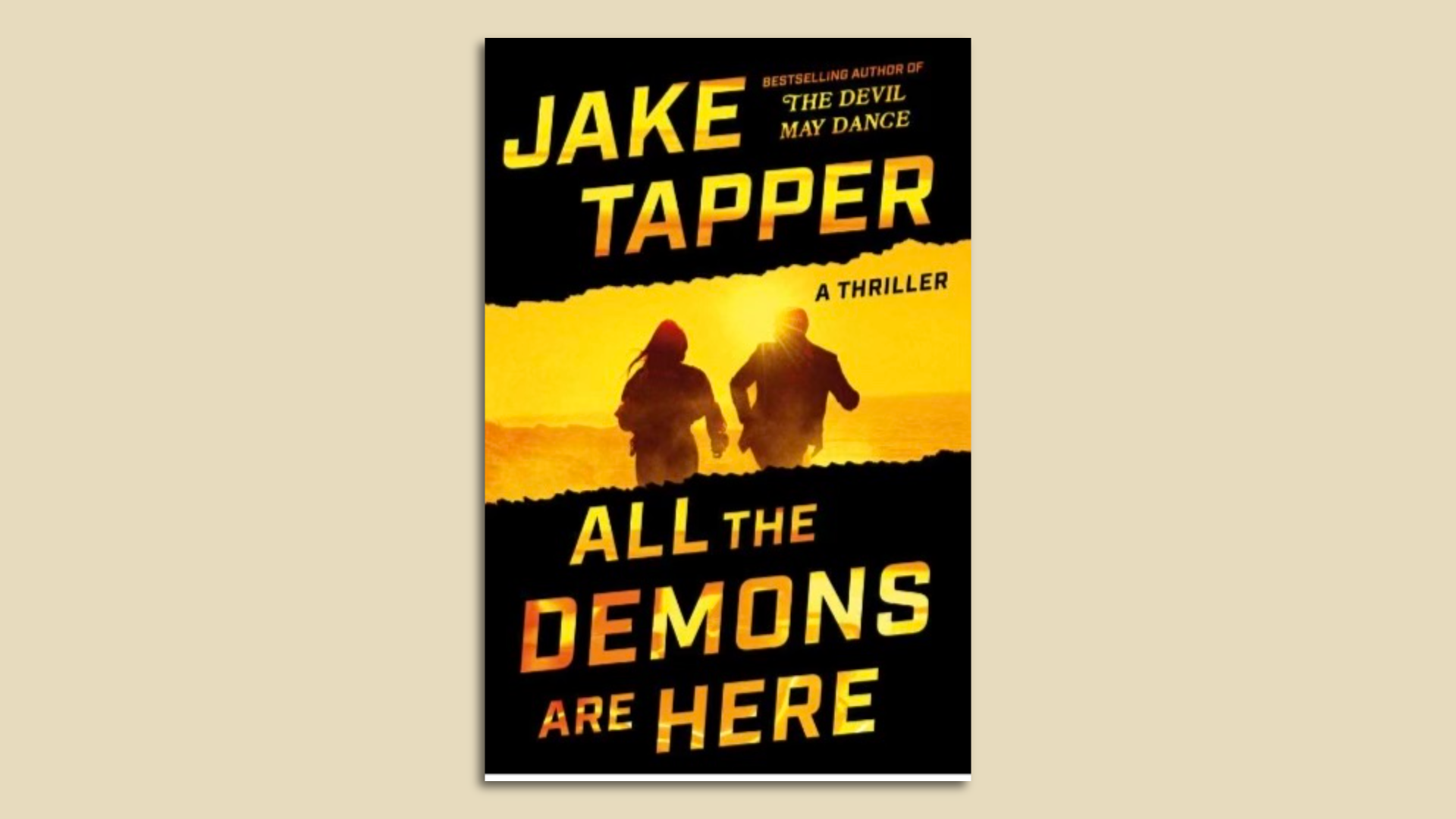
Cover: Little, Brown
8. ⚾ Play ball! A season of change

Illustration: Brendan Lynch/Axios
Axios AM

Catch up with the most important news of the day