Axios AM

July 09, 2026

๐ Happy Thursday! Smart Brevityโข count: 1,996 words ... 7ยฝ mins. Thanks to Noah Bressner for orchestrating. Edited by Bill Kole.
โฝ Kick-starting the day: The World Cup quarterfinals get underway this afternoon with a 4 p.m. ET showdown between France and Morocco. Get the latest.
๐จ Please join me Wednesday, July 15, at 8 a.m. at Axios House DC for News Shapers interviews with U.S. Trade Representative Jamieson Greer, Bank of America CEO Brian Moynihan, Rep. Madeleine Dean (D-Pa.), Sen. Bill Hagerty (R-Tenn.), Washington Commanders President Mark Clouse & more. RSVP here.
1 big thing: 3 big AI trends collide
Three AI trends are accelerating and colliding, forcing government, business and investors to rethink strategies in real time, Jim VandeHei and Mike Allen write in a "Behind the Curtain" column.
- AI is getting bigger and better, both here and in China.
- The U.S. government is scrambling to keep pace by creating a regulatory framework, perhaps with international reach.
- Both America and China are considering blocking access to their best AI, in recognition of the rising stakes.
Why it matters: The explosive rise of truly autonomous agents is forcing Washington and Beijing away from light-touch oversight, transforming the global AI race from a commercial sprint into a national-security standoff.
Here's our latest intel on each trend, based on conversations with top AI execs and administration sources, and our team's stress-testing of advanced AI models:
1. Models muscle up: Increases in the capability of the big AI models (led by OpenAI's ChatGPT, Anthropic's Claude and Google's Gemini) tend to get covered incrementally by the media. But we've just lived through a transformational few months.
- Anthropic's Fable and Mythos models โ restricted in June for nearly three weeks over security concerns โ have set a new standard for the mind-boggling power of frontier AI. Engineers can hand these models entire multimillion-line codebases and walk away for days, trusting agents to rebuild outdated systems, fix their own bugs and test their own work with shockingly little oversight.
- After a "voluntary" delay due to government consultations, OpenAI came roaring back with Sol โ a model early testers describe as a quantum leap in agentic power. Developers have been left slack-jawed by its ability to summon swarms of sub-agents that collaborate, hunt for security flaws and rewrite software at speeds that make previous models feel like dial-up.
- Elon Musk's SpaceXAI, fresh off its record-breaking IPO and $60 billion acquisition of Cursor, clawed its way back into the AI race yesterday with the release of Grok 4.5 โ a model triple the size of its predecessor. Musk says another model nearly twice as large is coming next month, doubling down on a bet that raw scale, not just smarter training, still wins.
- Meanwhile, China is dominating the open-source race. GLM-5.2, built by Chinese startup Z.ai, is free to download and now performs in the same tier as America's priciest models. Z.ai founder Jie Tang predicted China will achieve a "Fable-class" model before Q1 of 2027.
2. Administration activating: President Trump initially took a laissez-faire approach to AI as a way of keeping America's lead over China. But we've learned that top officials are vigorously debating a much more systemic and prescriptive approach, including protocols for the AI labs to follow before releasing their most powerful models.
- "The possibilities are wide open," said an outside adviser deeply involved in the conversations.
- Trump is reluctant to regulate, as is clear from his approach across much of the Executive Branch. But the power of Claude Mythos 5 and Fable 5 has roused many officials to favor a more robust, less ad hoc approach.
- Restrictions on those models showed the administration's hand: If national security becomes an issue, complying with the government becomes mandatory, as evidenced by Commerce Secretary Howard Lutnick's letters to Anthropic. A U.S. official told us: "The export controls were effective [in] ensuring Anthropic worked with the administration."
- Mythos, we were told again and again, was a wake-up call that more guardrails are needed. We've learned Trump officials are considering a new governing body for vetting AI, with the possibility of including other nations.
3. U.S., China contemplate controls: Chinese authorities have met with top tech firms over the past month to discuss restricting overseas access to the country's most advanced AI models, Reuters reported this week.
- When we started asking around about the report, we were surprised to hear the U.S. is kicking around ways to restrict Chinese access to U.S. models, perhaps through export controls. These conversations are very preliminary, with little agreement about what measures could actually work.
- This isn't just about American competitiveness โ national security is at stake. "AI is already deeply integrated into both countries' intelligence and military, which will change the geopolitical competition and the nature of warfare," said an insider who talks with competing factions of the administration.
The bottom line: We've entered the Big Phase โ big government considering new rules, big AI in a neck-and-neck race for frontier supremacy, and the big global showdown of China vs. USA.
- Share this column ... Zachary Basu and Andrew Kay contributed.
2. ๐ณ๏ธ Convention will replace Platner
Forty minutes before Graham Platner halted his Senate campaign last night with a defiant, emotional video, the Maine Democratic Party announced that the state committee had voted to hold a nominating convention at a date TBD "if there is a vacancy to fill."
- Why it matters: Progressives warn that an insider-driven process could dampen enthusiasm, while some moderates fear the convention will empower activists on the left, Axios' Holly Otterbein writes.
Twenty-nine days after officially becoming the nominee, Platner announced on social media: "We are suspending campaign operations."
- Platner, 41, indicated that he intends to withdraw from the race โ but said the process to replace him "needs to be driven not from back rooms, but by the will of the people."
The big picture: Platner's departure โ following a sexual assault allegation that he denies โ leaves Democrats in chaos.
- The formidable Sen. Susan Collins (R) is seeking a sixth term, making Maine one of the most critical midterm races as Dems try to flip the Senate.
Democrats have until July 27 โ 18 days from now โ to replace Platner with another candidate on the ballot. The process could yield a stronger candidate, but risks alienating Platner's former supporters.
- Several announced and potential candidates have started jockeying to become the new nominee.
๐ฑ In the video, Platner lashed out at what he called "a corporate media system and the political establishment" that he insisted "got to act as judge, jury and executioner."
- "I just want to make it clear: This is all false," he said of the allegations against him. "This was the last week to try to get me off of the ballot, and that's why this is occurring."
The bottom line: Platner's downfall is a massive blow to progressives who hoped he would demonstrate that left-wing candidates can flip key GOP-held seats ahead of the 2028 presidential election.
3. ๐ข๏ธ Trump shifts to battle for Hormuz
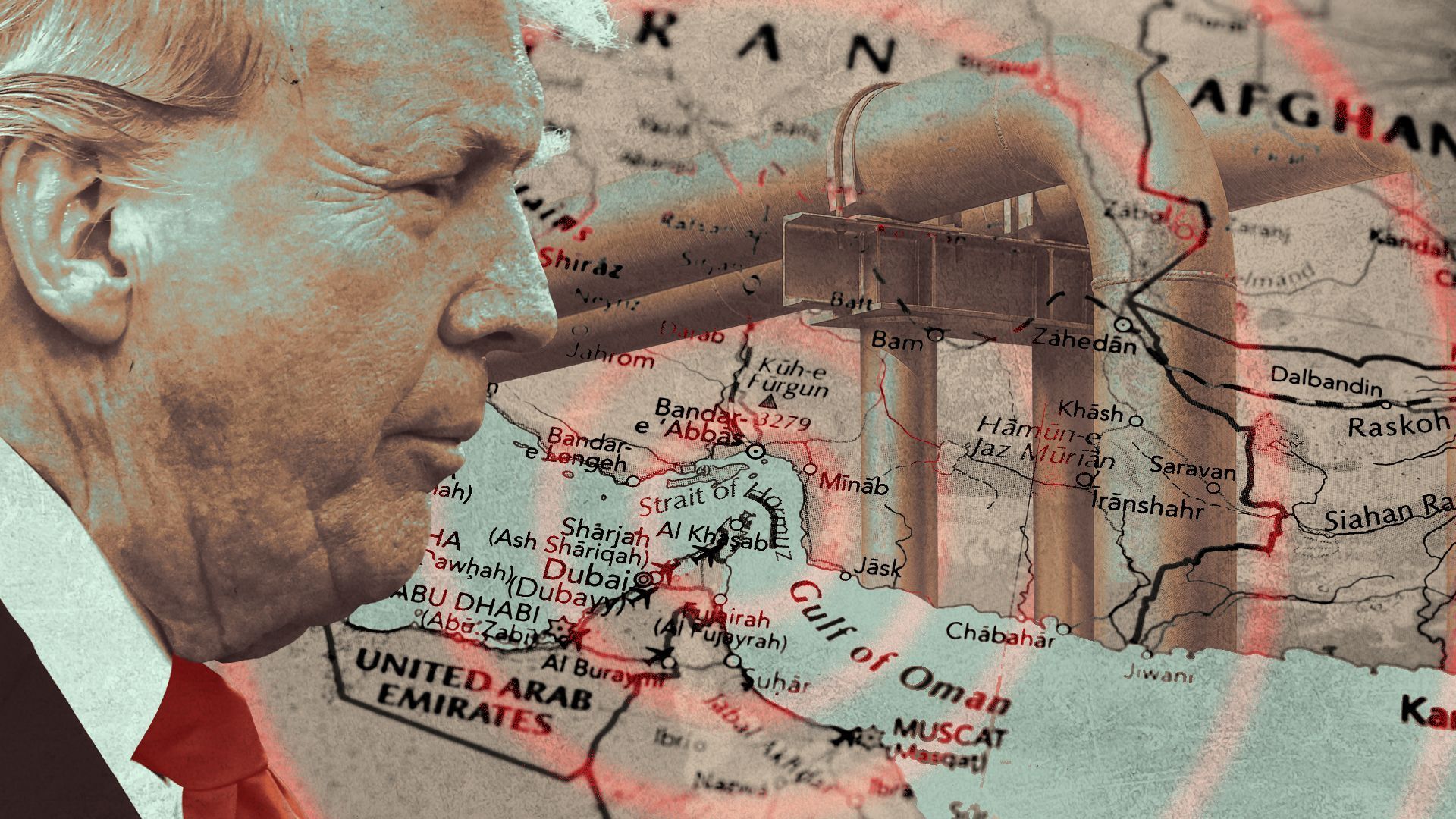
The White House is preparing for what could become a multiday or even multiweek exchange of fire with Iran over the Strait of Hormuz, Axios' Barak Ravid reports.
- Why it matters: A war that began with the goal of degrading Iran's missile capabilities and destroying what remained of its nuclear program has evolved into an open-ended fight over the world's most important energy chokepoint.
A U.S. official said the current escalation could last a day or two, a week or a month, depending on whether Iran continues attacking commercial ships in the strait.
- "We're going to slap them a bit so they understand we're not f*cking around," the U.S. official said.
4. ๐ข Trump's red scare
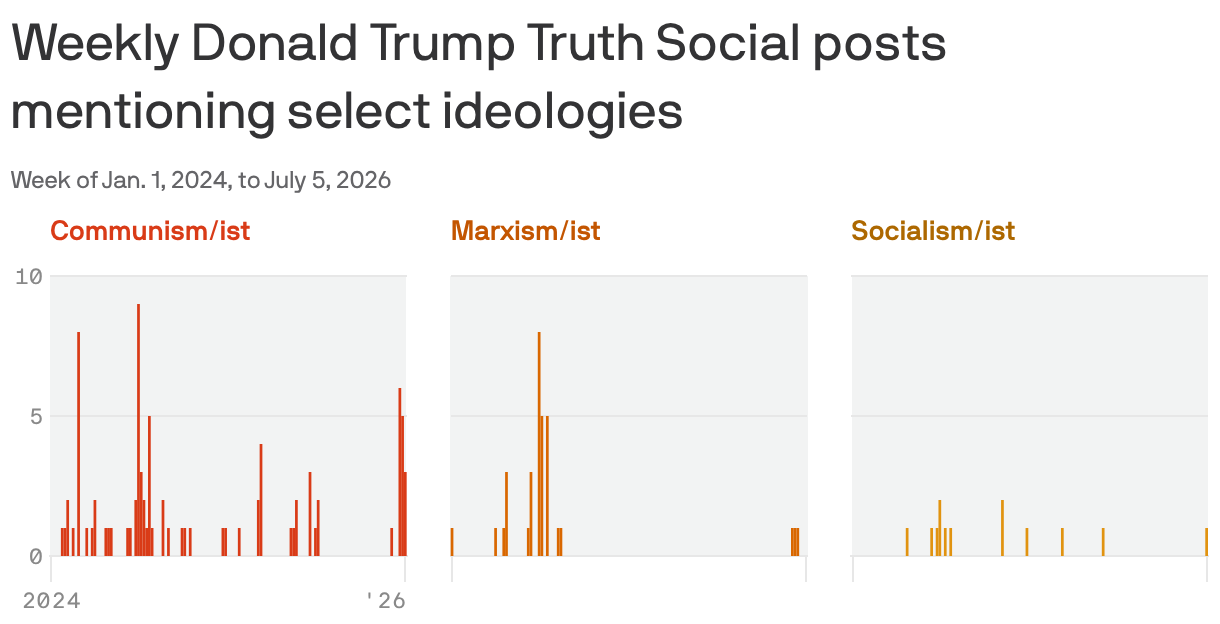
Open embedded content from datawrapper.dwcdn.netPresident Trump invoked "communism" 81 times over the past two weeks โ a sharp uptick after a trio of left-wing Democrats won primaries in New York.
- Focus groups run by his team showed the message fires up Trump's base. But it's less effective with independents and younger voters who have no memory of the Cold War. โReuters
5. ๐ฃ๏ธ OpenAI bets on voice
OpenAI is rolling out a new generation of voice models for ChatGPT, aiming to make conversations with its AI sound more natural while routing these queries to its best models, Axios' Madison Mills writes.
- Why it matters: The company sees this as a step toward a future where voice is the primary way people interact with AI.
OpenAI says its smartest voice models yet, GPT-Live-1 and GPT-Live-1 mini, make conversations feel more human by allowing users to interrupt naturally and pause speech without the model cutting them off.
๐ The intrigue: Given the company's push into hardware, the focus on voice could hint at a future device built primarily around voice interaction.
6. ๐จ Scoop: GOP megadonor backs Rubio

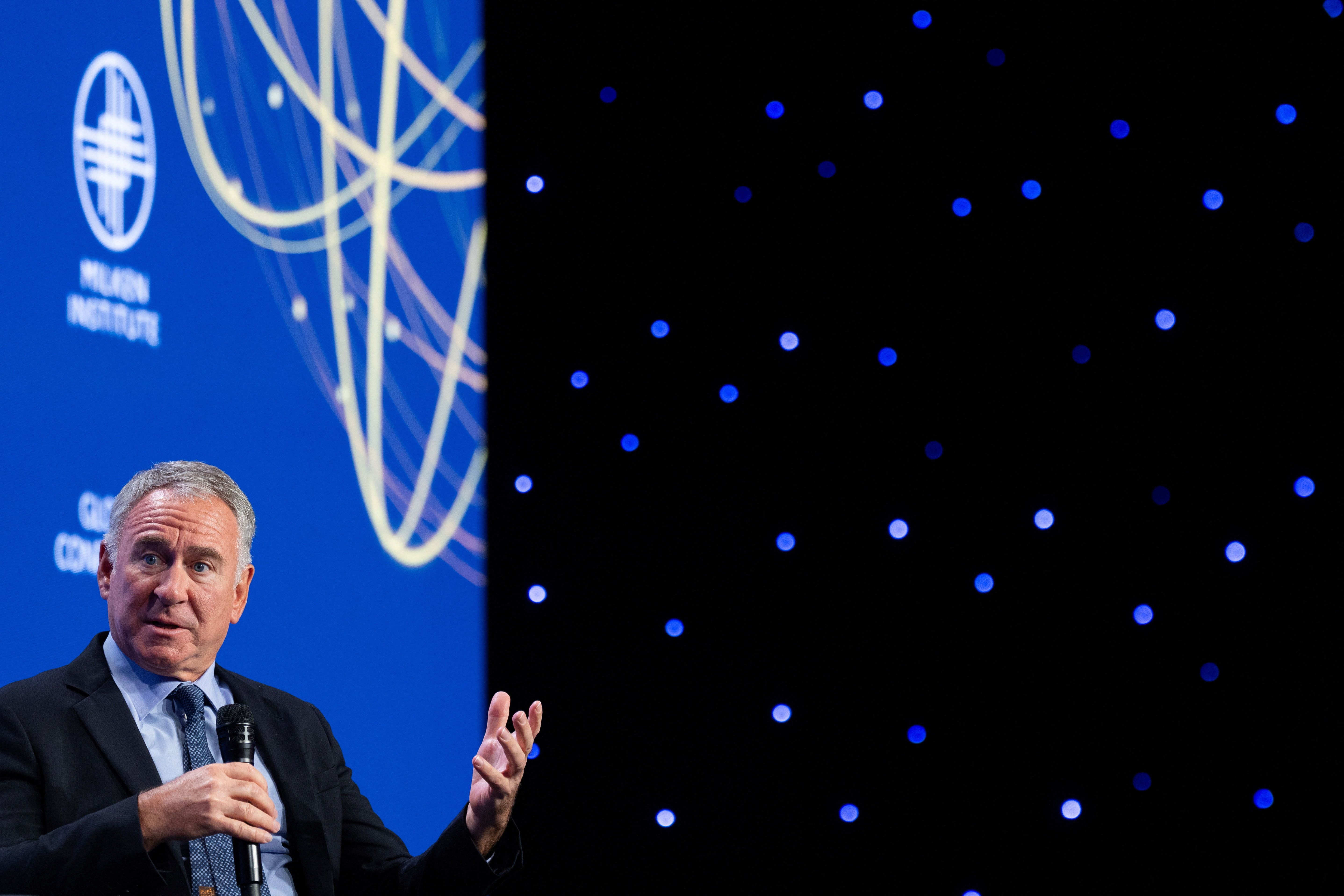
Republican megadonor Ken Griffin said yesterday at the media conference in Sun Valley, Idaho, that he'd support Secretary of State Marco Rubio over Vice President JD Vance in a 2028 GOP presidential primary, Axios' Alex Isenstadt has learned.
- Why it matters: Griffin is one of the most prolific donors in the Republican Party โ he gave more than $100 million in 2024 โ and would be a huge asset to Rubio if the secretary of state were to run for president.
Griffin's comments reflected the emerging split in the GOP between establishment-minded figures like Griffin, who want Rubio to run, and anti-establishment types who prefer Vance โ in part because of the VP's reluctance to involve the U.S. in foreign conflicts.
๐ Behind the scenes: Griffin was interviewed by Andrew Ross Sorkin at the exclusive Allen & Company conference. Sorkin asked Griffin whether he'd support Rubio or Vance in a 2028 GOP primary matchup.
- Griffin noted that he'd historically backed Rubio โ he donated to him during his unsuccessful 2016 presidential run โ and would be predisposed to backing him again.
Griffin was the nation's fifth-biggest donor in the 2024 cycle.
Rubio has made it clear he has no plans to run.
7. ๐ฐ Charted: America's tax divide


America's state governments have split into two camps: those that tax what you earn, and those that tax what you spend, Axios' Russell Contreras writes.
- Why it matters: States built on income taxes ask more of high earners. States built on consumption taxes ask more of everyday spenders.
๐งฎ By the numbers: In 2025, 27 states โ many in the Sun Belt โ relied most on sales and gross receipts taxes, while 21 states, heavily located on the coasts, relied most on income taxes, per an Axios analysis of new Census data.
- Most sales-dependent: Texas (86.6%), South Dakota (83.1%), Florida (80.3%), Tennessee (79.4%), Washington (74.6%), Nevada (73.9%).
- Most income-dependent: Oregon (71%), New York (67%), Massachusetts (66.8%), California (61.1%), Connecticut (59.5%).
Between the lines: The divide isn't perfectly partisan. Blue Washington is sales-tax-reliant, while purple New Hampshire relies most heavily on corporate income tax (32.9%).
8. ๐ 1 for the road: EV road trip hope
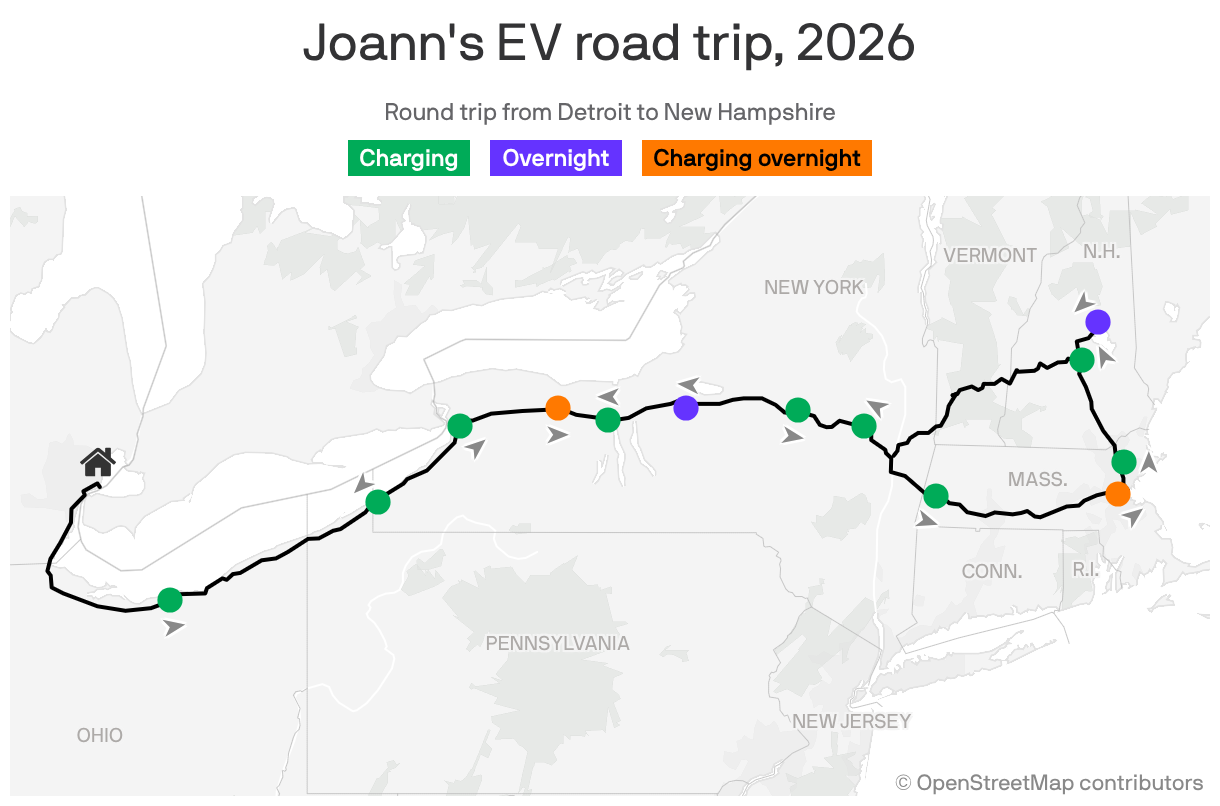
Open embedded content from datawrapper.dwcdn.netEvery so often, Axios Future of Mobility author Joann Muller puts an electric vehicle to the test on a long road trip. Here's how it went this time:
My 1,900-mile road trip last week in an EV proved it's easily doable, but the charging experience is still not as seamless and convenient as pumping gas.
- Why it matters: Driving an EV is delightful. Charging an EV is what gives people anxiety. Until that problem is solved, EV sales in the U.S. will remain lackluster.
My husband and I drove from Michigan to New Hampshire and back in a Toyota bZ on loan from the automaker's media test fleet.
- I wanted to see for myself how the world's largest automaker had upped its EV game after disappointing customers in 2022 with its first model, the bZ4X. (It's way better, with a bigger battery and longer driving range.)
- The bZ is one of four new Toyota EVs hitting the market this year.
๐ฃ๏ธ The big picture: This was our fourth long road trip in an EV, and they keep getting easier.
- There are many more fast chargers available now than during my first Michigan-to-Florida trek in 2023, and reliability has improved.
- And getting access to Tesla's Supercharger network has been a game-changer for non-Tesla owners.
Go deeper: Joann's road trip journal.
๐ฌ Thanks for reading! Please invite your friends to join AM.
Sign up for Axios AM