Axios AM

March 29, 2023
Hello, Wednesday! Smart Brevity™ count: 1,495 words ... 5½ minutes. Edited by Noah Bressner.
🔮 Tune in today: Axios' all-day What's Next Summit begins at 8:10 a.m. ET! Check out our agenda, and livestream the interviews here.
🔎 1 big thing — Axios investigates: Fake bomb threats harass China critics
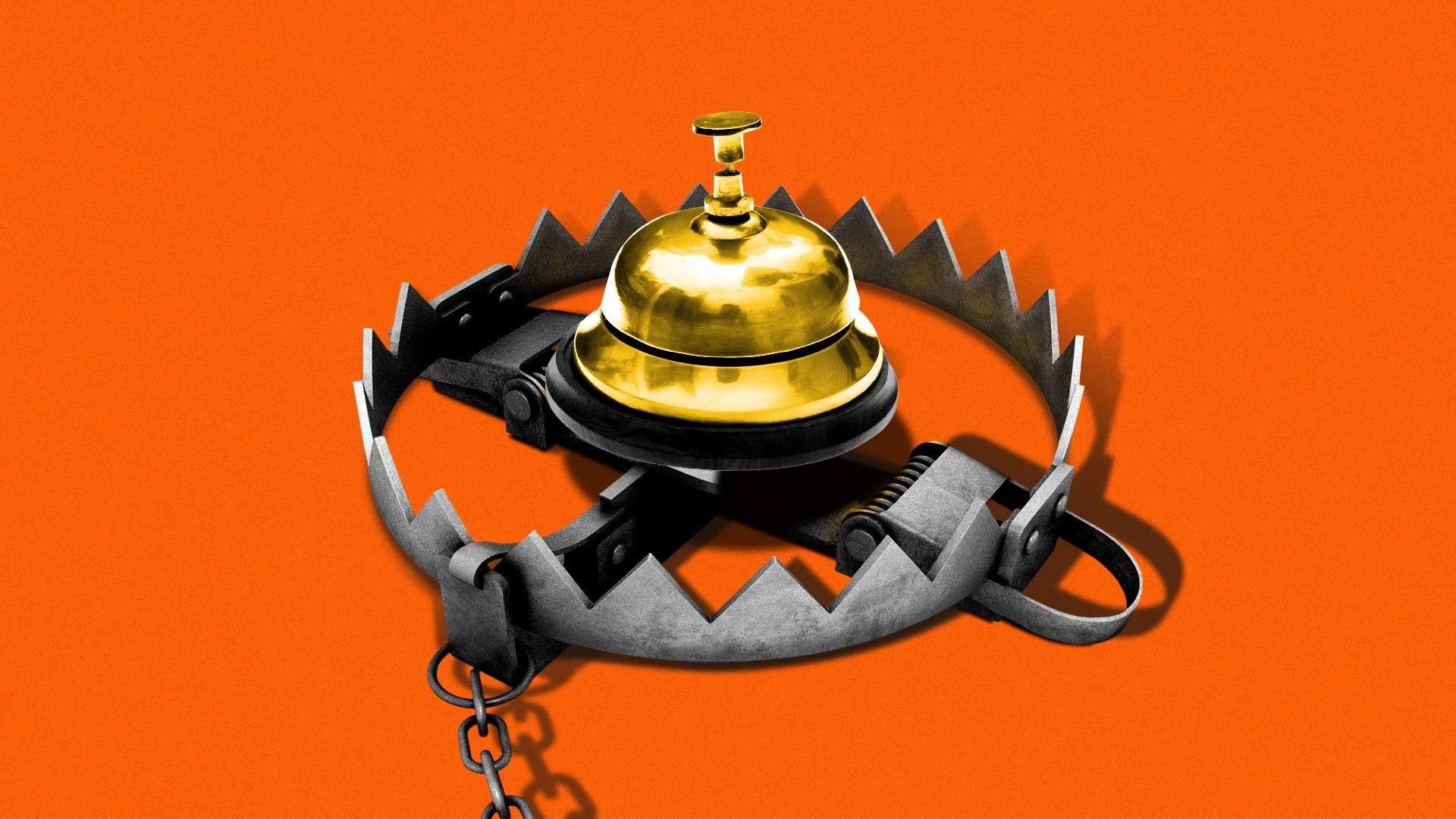
Illustration: Sarah Grillo/Axios
More than a dozen false bomb threats to luxury hotels and embassies across Europe, the U.S. and the Middle East appear to be part of a harassment campaign targeting three Chinese people living abroad who have criticized China's government, Axios' Bethany Allen-Ebrahimian and Alison Snyder report.
- The campaign is targeting a journalist and two activists. They believe the harassment is backed by the Chinese government.
Why it matters: Beijing for decades has used surveillance and intimidation to silence dissidents abroad. But analysts warn that efforts to target critics beyond China's borders are becoming more brazen.
When it comes to repressing critics abroad, "China operates pretty freely in democratic states," Yana Gorokhovskaia, an expert on transnational repression at Freedom House, told Axios.
- China's Ministry of Foreign Affairs didn't respond to a request for comment. The Chinese embassy in Washington said it isn't aware of the incidents in the U.S. and does "not have any information to offer."
🔎 What's happening: Beginning last October, anonymous perpetrators booked and paid for dozens of expensive rooms at luxury hotels in at least six countries — the Netherlands, Belgium, Germany, Turkey, Hong Kong and Macau in China, and the U.S.
- They used the personal information of Germany-based Radio Free Asia reporter Su Yutong and two activists, Wang Jingyu in the Netherlands and Bob Fu in the U.S., without their knowledge.
The perpetrators called in at least 14 fake bomb threats to some of those hotels, falsely identifying themselves as these people. That resulted in police investigations — and even the brief detention of one of the activists, according to Axios interviews with Su, Wang, and Fu, and statements provided to Axios by police and hotel staff.
- Two more false bomb threats were made in Wang's name against the Chinese embassies in the Netherlands and Norway, according to Wang and a Dutch police report viewed by Axios. The Chinese embassy in Norway confirmed to Axios that someone using Wang’s name made a bomb threat, and added in a statement that "after verification, we believe this is a hoax by certain people which does not consist of a valid threat."
- Dutch police in the Hague said the false reports most likely were made from IP addresses in China and Hong Kong, according to a Dutch news report.
- Law enforcement agencies in the U.S., Germany, the Netherlands, Macau and Hong Kong are investigating the threats.
The backstory: Su, Wang and Fu have publicly criticized Beijing's policies and actions, drawing the ire of the Chinese Communist Party.
- Su was put under house arrest in 2010 for distributing a banned book about former Chinese Premier Li Peng, who oversaw the 1989 Tiananmen Square massacre.
- Fu, a pastor, has lived in the U.S. for more than 25 years and runs ChinaAid, a nonprofit that assists Christians, Muslims and other people of faith persecuted in China.
In February, Fu received calls from the JW Marriott Essex House hotel in Manhattan and a hotel in Houston about the bomb threats they received in his name, he told Axios. Fu reported the incidents to the FBI.
- Su's name was used to book a room, then call in a false bomb threat at a luxury hotel in Istanbul, a manager at the hotel confirmed to Axios. The hotel staff understood it was a false bomb threat after speaking with Su directly, the manager said.
Wang, Su and Fu each told Axios they believe this is a Chinese state-sponsored campaign of transnational repression targeting Wang for his previous remarks and his current activism, Su for her coverage of Wang, and Fu for helping Wang.
- Su said perpetrators have booked dozens of taxis and ordered thousands of dollars in food delivered to her home through Uber Eats over the past several weeks, selecting "cash on delivery" as the method of payment.
The bottom line: "We left China in the hope of freedom from fear in the democratic countries," Su told Axios.
2. 📷 1,000 words

Girls embrace in front of a makeshift memorial for victims, near the Covenant School building at Covenant Presbyterian Church in Nashville.
3. 💻 New remote-work normal
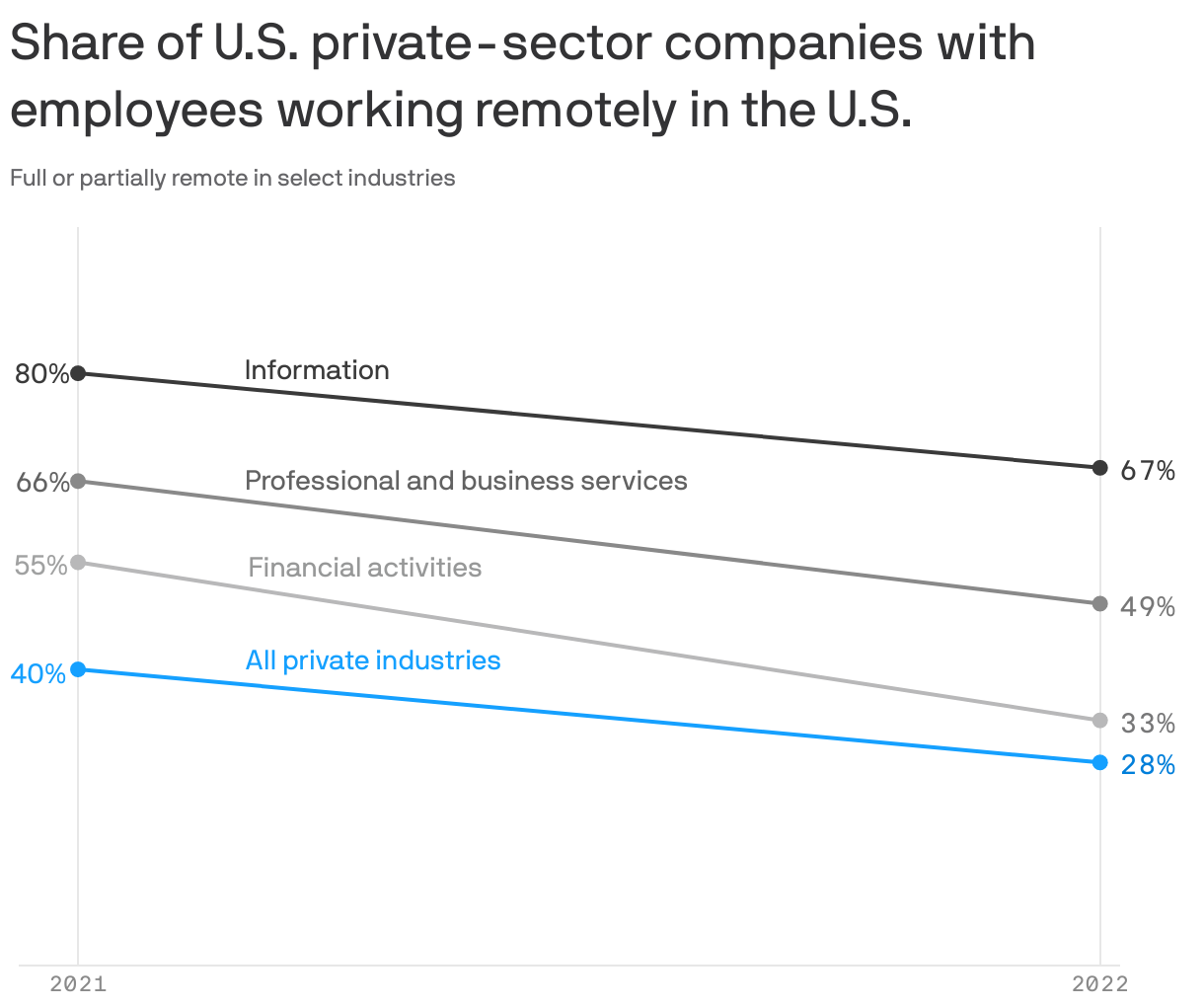
Millions fewer Americans worked remotely last year, Axios' Emily Peck writes from a new survey from the Bureau of Labor Statistics.
- Why it matters: The work world is returning to a new normal, with some working from home — more than pre-COVID — but less than at the height of the Zoom-and-sweatpants moment.
🧮 By the numbers: The share of establishments with employees rarely or never working remotely rose to 72.5% last year, up from 60.1% in 2021.
- White-collar sectors still have a large share of employees working from home. In the information sector (including tech and media companies), 67% of firms had people working from home sometimes or always last year.
🥊 Reality check: Before the pandemic, only about 5% of workers were remote, according to data from Nicholas Bloom, a Stanford economics professor who has tracked the trend for years.
4. 🚜 What's Next: Self-driving revolution goes off-road

Illustration: Shoshana Gordon/Axios
A shortage of truck drivers and skilled machine operators is inspiring the development of autonomous vehicles for use in construction, farming, heavy industry and even freight rail, Joann Muller reports in an Axios What's Next takeover on AI and automation.
- What's happening: Caterpillar deployed its first (truly massive) autonomous mining trucks in 2013, and now has nearly 600 in operation. It wants to bring autonomy to smaller vehicles, including bulldozers.
In agriculture, Deere & Company has introduced autonomous tractors to help growers cope with a shortage of workers.
- Startups such as SafeAI and Teleo are retrofitting older construction machines with autonomous or remote-operated technology.
🚂 What's next: Shipping containers that can move themselves on railroad tracks.
5. 🚗 How self-driving cars "see"

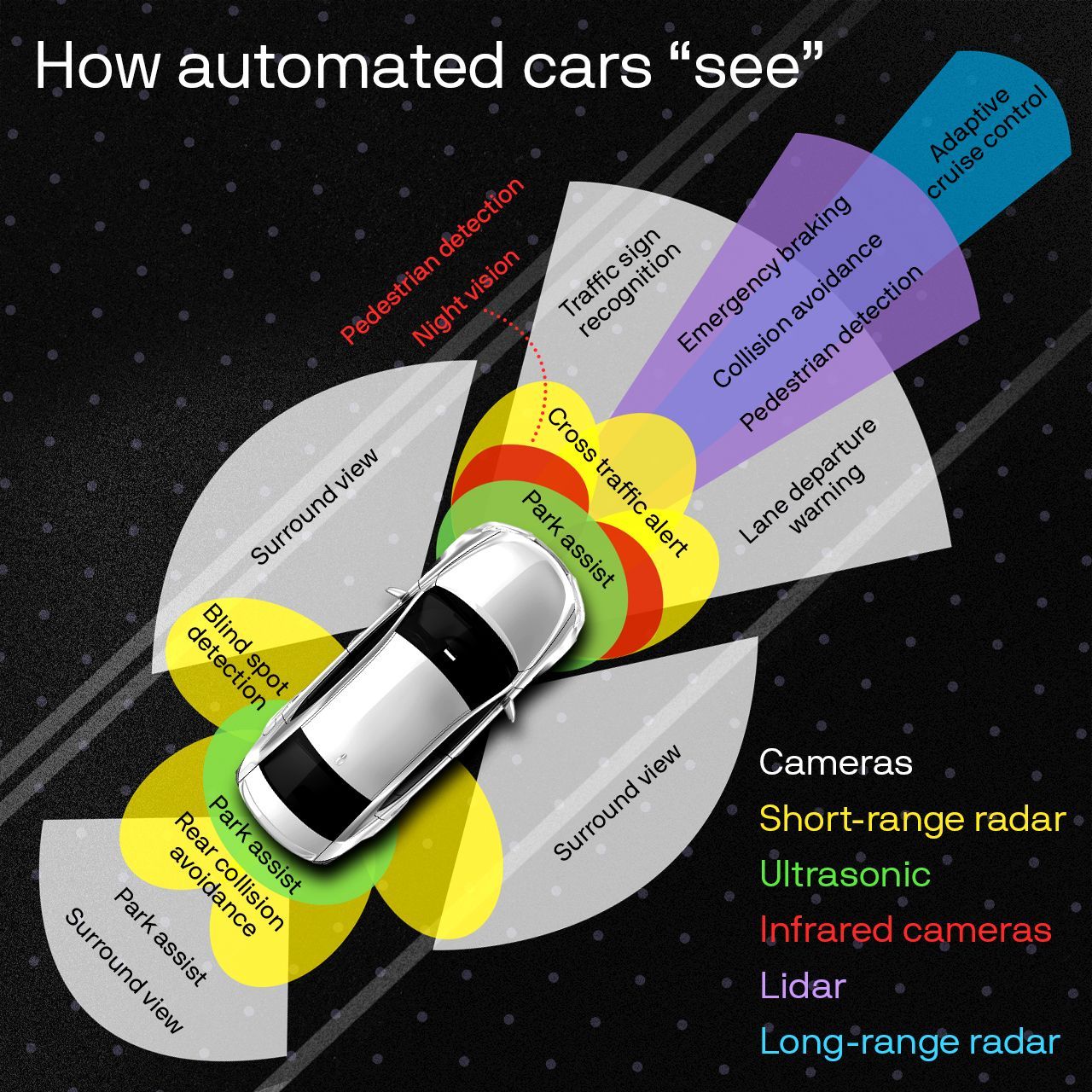
It takes a variety of overlapping sensors working together for self-driving cars to accurately perceive the world around them, Axios' auto expert Joann Mueller writes.
- Multiple cameras with different ranges and purposes help cars get a 360-degree view of their environment.
But regular cameras can't calculate distance, and aren't great in rain and fog:
- Infrared cameras can help with night vision.
- Radar supplements camera views.
- Lidar, using signals that bounce back from high-speed lasers, paints a detailed 3D picture of a car's environment.
- Ultrasonic sensors transmit high-frequency sound waves to detect objects within close range.
6. 🎤 Axios interview: Biden's World Bank pick

Photo illustration: Aïda Amer/Axios. Photo: Hollie Adams/Bloomberg via Getty Images
Ajay Banga, President Biden’s nominee to lead the World Bank, told Axios' Hans Nichols he wants the bank to focus on poverty alleviation and climate change — and warns that the world needs a massive investment from the private sector to adequately address both challenges.
- Why it matters: The bank is under pressure from rich countries, and the Biden administration, to do more to fight climate change. But less-developed countries worry the bank will do so at the expense of its focus on health, education and poverty reduction.
"I think it's a fallacious argument that says, either-or," Banga, the former CEO of Mastercard, told us.
- "For climate change, it's trillions of dollars a year. For inequality and poverty alleviation and development, it’s trillions a year," he said. "You just have to get the private sector to be a constructive part of the solution.”
Banga, 63, who was born in India and became a U.S. citizen in 2007, is leaving nothing to chance.
- He's wrapping up an arduous three-week, four-continent listening tour, having logged 39,546 miles and met with a total of 37 different governments, according to a Treasury official.
- He's now isolating in New Delhi after testing positive for COVID.
7. 🇺🇦 Traveling with Zelensky

ON A TRAIN FROM SUMY TO KYIV, Ukraine (AP) — Ukrainian President Volodymyr Zelensky warned that unless his nation wins a drawn-out battle in a key eastern city, Russia could begin building international support for a deal that could require Ukraine to make unacceptable compromises.
- He also invited China's leader, long aligned with Russia, to visit.
If Bakhmut falls to Russian forces, Vladimir Putin would "sell this victory to the West, to his society, to China, to Iran," Zelensky told AP executive editor Julie Pace.
- "If he will feel some blood — smell that we are weak — he will push, push, push," Zelensky said in English, which he used for virtually all of the interview.
The leader spoke to the AP aboard a train shuttling him across Ukraine. AP is the first news organization to travel extensively with Zelensky since the war began just over a year ago.
8. ⚾ 1 for the road: Ballpark prices


No peanuts here. A breakdown of the typical cost to see a live Major League Baseball last year puts the national average at $256.
- That includes four adult tickets, parking, drinks and hot dogs.
All 30 teams play tomorrow on Opening Day.
📬 Thanks for starting your week with us. Please invite your friends to join.
Sign up for Axios AM

Catch up with the most important news of the day