Axios AI+

October 16, 2023

Ina here, still pumped after attending an amazing, acrobatic P!nk concert on Saturday and then getting a last-minute ticket to go again on Sunday.
Today's AI+ is 1,234 words, a 4.5-minute read.
1 big thing: Toyota pursues a different path toward autonomy
Ina Fried/Axios
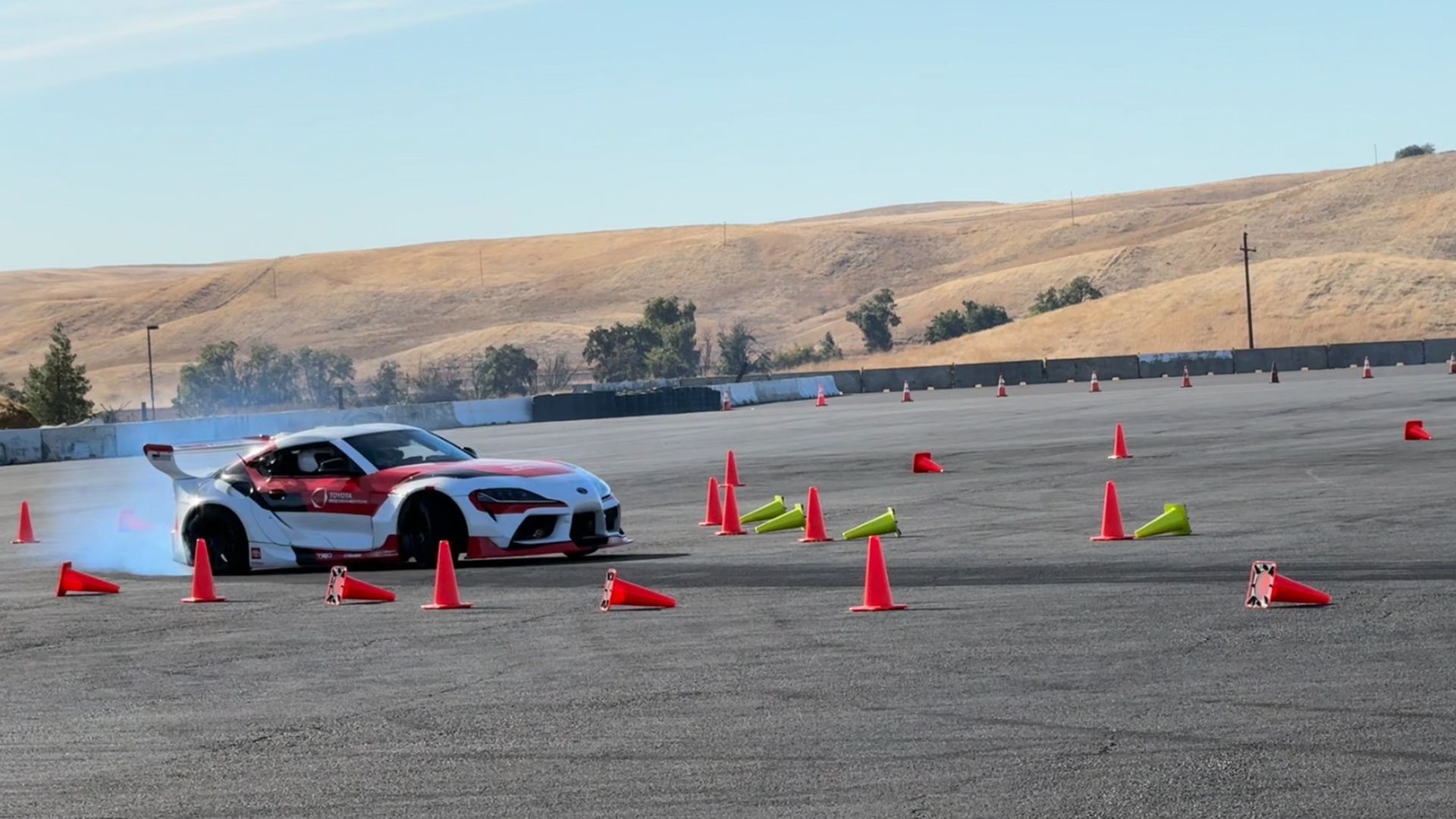
As Cruise, Waymo and others test self-driving cars on the streets of San Francisco, Toyota is testing other approaches to autonomy at a racetrack 150 miles northeast.
Why it matters: Today's self-driving vehicles navigate big-city streets at slow speeds, but it could take decades before those cars can handle much higher speeds or we can add autonomous capabilities to privately owned cars.
What they're saying: "Scaling [full self-driving] technology to be available to everyone everywhere all the time is actually really, really hard," said Avinash Balachandran, senior director of the Human Interactive Driving division at Toyota's Los Altos, California-based Toyota Research Institute (TRI).
The big picture: Toyota's approach relies on human drivers to handle some — or even most — of the tasks, with the autonomous part kicking in only when it detects intervention is needed.
- By contrast, a self-driving car needs to be able to handle everything all the time. Toyota says its approach can save lives far sooner than waiting for self-driving cars to be ubiquitous.
- Doing so also preserves the fun of driving — and Toyota is even exploring whether the computers can teach people to be better drivers, says TRI head Gill Pratt.
- Toyota's approach relies on most of the same sensors and machine learning that fuels self-driving cars.
Between the lines: The key is shifting the goal from replacing drivers to saving lives, Pratt says.
- Pratt tells Axios it's more practical and expedient to augment the skills of the human driver "rather than saying we're just going to remove the driver, throw away all their skills and try to replace them."
- Another advantage for carmakers pursuing mixed human-computer modes is they don't have to take on liability the way they do with fully self-driving vehicles.
- In most cases, the driver and insurance remain liable even when cars have safety features like advanced cruise control or emergency automatic braking.
Yes, but: Mixing humans and computers isn't always easy.
- "There is an art to it," Pratt says. "You have to be very careful when you're giving a human being the part of the task, for instance."
Zoom in: Last Thursday, I had a chance to ride in several of Toyota's test vehicles at Thunderhill Raceway Park in Willows, California.
- In a heavily modified Toyota Supra, I experienced tight turns (known as drifting).
- In a nearly stock Lexus LC 500 outfitted with self-driving capabilities, I went up to 90 miles per hour and witnessed the vehicle's ability to spot and avoid a stalled car.
- Finally, I got behind the wheel in another test vehicle where I learned to drift and experienced what it's like when you're at the wheel while sharing control with a computer.
My thought bubble: The experience highlighted that while autonomous vehicles face challenges, computers are much better suited to many driving tasks. And they can do things a human can't, such as applying only the front or rear brake or applying the brake differently to the right and left sides of the pedal.
What's next: Different companies will pursue both approaches. Most traditional carmakers will focus more heavily on mixing in autonomous capabilities, while upstarts will prioritize the mix of financial and safety benefits that could come with removing human drivers entirely.
- One shift to watch for is that driver actions, such as pressing a pedal or turning the steering wheel, may serve less as a way to directly manipulate the car and more as an indication of a driver's intent to the computer.
Watch Ina's test drive video.
Go deeper: Dividing work between humans and AI
2. Exclusive: Details on Schumer's next AI forum

Illustration: Eniola Odetunde/Axios; Photo: Mark Wilson/Getty Images
Senate Majority Leader Chuck Schumer's next forum on artificial intelligence will take place Oct. 24 and focus on innovation, his office shared exclusively with Axios Pro's Ashley Gold.
Driving the news: The invite list for Schumer's second AI forum in the Capitol features AI companies like SeedAI and Cohere and VCs Andreessen Horowitz and Kleiner Perkins, along with academics and labor leaders.
- Schumer's first forum featured CEOs of the biggest tech and AI companies including Mark Zuckerberg, Bill Gates, Sundar Pichai and Elon Musk.
- The series is meant to educate lawmakers and form the basis for legislation regulating AI.
Details: Among the invitees are Marc Andreessen, Steve Case, John Doerr, Stripe CEO Patrick Collison, former White House advisor Alondra Nelson, and Max Tegmark, president of the Future of Life Institute.
A version of this story was published first on Axios Pro. Unlock more news like this by talking to our sales team.
3. Burned-out parents turn to ChatGPT for relief

Illustration: Natalie Peeples/Axios
ChatGPT's latest job is to be mom and dad's brilliant sidekick. Parents of kids of all ages are using the chatbot to help raise their children, Axios' Megan Morrone and Erica Pandey report.
Why it matters: The tool has the potential to ease the burden on burned-out, over-scheduled parents. But it's no replacement for a human's judgment — especially regarding what's best for their kids.
What's happening: ChatGPT excels at brainstorming and researching — both functions that can be uniquely useful to parents, says Celia Quillian, a product marketer in Atlanta who runs a TikTok account advising followers on creative ways to use the robot.
- The chatbot could plan an 8-year-old's mermaid-themed birthday party in seconds, offering drink ideas like mermaid fruit punch — blue Gatorade with floating gummy fish — and snack ideas like seashell cookies.
- It can conjure up a chore chart for a group of young siblings, tailoring the tasks so they're appropriate for each age. For example, a 7-year-old might start with picking up toys, while their 13-year-old sibling vacuums the living room.
- It can even answer age-old questions that kids ask exasperated parents. Think, "Why is the sky blue?" The chatbot will feed you an answer fit for a 4-year-old.
Zoom in: Some parents are using the chatbot to navigate even bigger milestones in their children's lives.
- Parents have used it to script "the talk" with young teens or draft a toast for their child's wedding.
What they're saying: Keith Foxx, principal at Foxxstem engineering services, regularly uses ChatGPT to connect to his third and youngest daughter, who's currently in 10th grade.
- Foxx says his daughter struggled through COVID and now he connects with her by sending her inspirational texts or poems.
- "I'll say, 'Give me a 16-line poem for a 15-year-old, from her dad. She needs motivation to go to school,'" Foxx tells Axios.
- Because he's able to get very specific in his prompts, the texts are personal. And if the result doesn't sound like him, Foxx gets even more specific.
- "I may have a follow-up that says, '"This is good, but, you know, can you do it for an African-American dad?'"
4. Training data
- AI detectors are incorrectly identifying some real images from the Israel-Hamas war as fake, creating what some experts are calling a "second level" of misinformation. (404 Media)
- The ability to use images within ChatGPT may enable new ways of evading the AI technology's safeguards. (Simon Willison's Weblog)
- The National Labor Relations Board issued a complaint Friday against X (formerly known as Twitter), alleging the company illegally fired a worker over a tweet that challenged its return-to-office mandate. (Axios)
- The U.S. continues to crack down on American chipmakers who thwart restrictions to export semiconductor and chipmaking gear to China. (Reuters)
- Kashmir Hill offers an in-depth look at how AI is making it difficult for parents to control their children's images online. (New York Times)

Thanks to Megan Morrone and Scott Rosenberg for editing and Nicole Ortiz for copy editing this newsletter.
Sign up for Axios AI+

Scoops on the AI revolution and transformative tech, from Ina Fried, Madison Mills, Ashley Gold and Maria Curi.